



















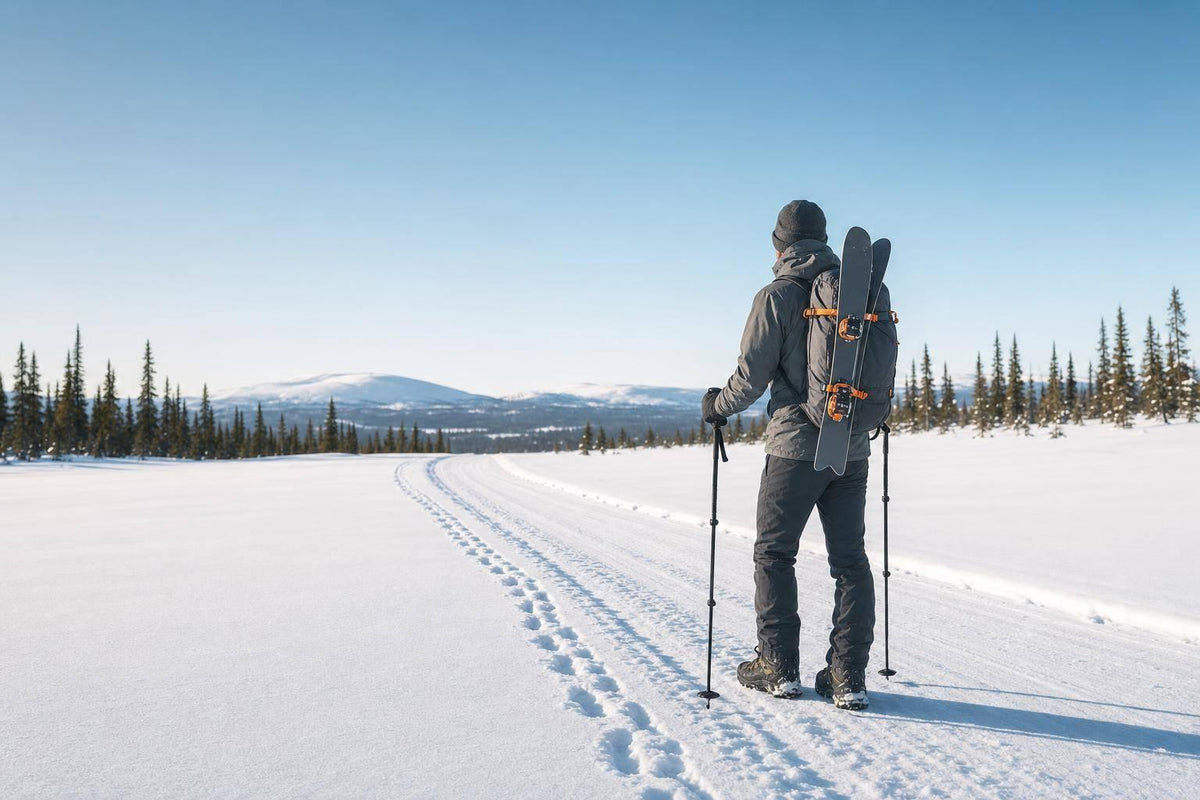
Yes - if your winter approach is short, packed, and mellow, I’d say WALKSKI is worth a look. If you’re doing about 1 to 3 miles on firm snow, it can feel easier than snowshoes and far less fussy than a full touring setup that can cost around $2,200. At $595+, it fills a pretty clear gap.
Here’s my plain-English take:
- Buy WALKSKI if you want glide on packed roads and rolling trails
- Skip it if you deal with deep, loose snow all the time
- Go with touring skis if your flat approach is long or your days get steep
- Stick with snowshoes if the snow is soft, chopped up, or unpredictable
What stood out to me most is the trade-off. WALKSKI is shorter at 100 cm, works with regular winter boots, and weighs 6.9 lb per pair. That makes it easy to throw in the car or strap to a pack. But that short length also means less glide, so on long flat sections, you’ll work more than you would on full-length skis.
Snowfeet WALKSKI | Backcountry Skiing in Georgia
Quick Comparison
| Option | Best For | Main Upside | Main Downside | Price Range |
|---|---|---|---|---|
| WALKSKI | Short packed approaches | Simple setup, some glide, regular boots | Short glide on long flats | From $595 |
| Touring skis | Long flats, bigger days, steeper terrain | Best glide and control | More gear, more cost | About $2,200 all-in |
| Snowshoes | Soft, deep, rough snow | Solid traction, simple use | Slow and tiring on packed snow | Varies |
So, if you want the short answer: WALKSKI makes sense for casual backcountry access, not big ski missions. It’s a middle-ground tool. And for the right person, that middle ground is the whole point :)
Where WALKSKI Performs Well on Flat and Low-Angle Terrain
Packed snow, access roads, and rolling terrain
For the short, mostly flat approaches covered above, WALKSKI does best on firm snow.
On packed snow, it gives you enough glide to beat plain old walking. That makes it a good match for packed access roads, approach trails, and rolling terrain, without the bulk of full touring skis. At 100 cm, it’s also easier to manage on forested or uneven trails than longer touring skis.
The removable climbing skins help when a flat approach gets slick or turns into a short, low-angle climb. That’s where WALKSKI starts to make a lot of sense: you can keep moving fast without dragging along a full touring setup.
Portability and easy setup with regular winter boots
The biggest day-to-day win is the setup. The patented universal binding works with standard winter boots, so you don’t need dedicated touring boots. It fits U.S. boot sizes 6 to 14.5 and weighs 6.9 lb per pair, which makes it easy to carry or toss in the car.
The binding has four modes:
- Walk
- Climb level 1
- Climb level 2
- Ski
That means you can switch between walking, climbing, and skiing as the terrain changes. Walk Mode frees the heel, so your stride feels more natural on flats and rolling ground. And that’s the whole appeal here. You get a low-friction setup that feels simple, not fussy, which is a big draw for occasional backcountry users.
Short skis suit casual users who want simple, low-effort winter travel
That ease of use is a big reason WALKSKI fits casual users, families, and winter hikers who want some ski efficiency without going all-in on a touring rig. Users with recreational Nordic experience have said WALKSKI is easy to turn and control.
For this kind of use, simplicity matters more than top-end touring performance. The next thing to look at is how much glide you give up with a shorter ski.
sbb-itb-17ade95
The Real Trade-Offs: Where WALKSKI Falls Short
Less glide on long, sustained flat sections
WALKSKI feels great on short access routes. That’s where the short length shines. But once the route stretches out, the downside shows up too.
At 100 cm, WALKSKI gives up glide. And glide matters more than most people think. With shorter skis, each push carries you a shorter distance. On a quick approach, that’s no big deal. On 2–3+ miles of flat road or track, it adds up fast. Longer touring skis glide farther and help you burn less energy over time.
Standard backcountry touring skis are usually 160–180 cm long. That extra length gives you more ski in contact with the snow, steadier tracking, and more carry between strides. So if your normal approach goes past the 2-mile mark on flat ground, full-length XC or touring skis are the better tool.
More condition-dependent in soft or loose snow
Snow conditions can make or break short skis. On firm, settled snow, WALKSKI makes a lot of sense. In loose, deep, or poorly packed snow, it can turn into work.
The short platform sinks more. That means less glide and more effort. In deeper snow without a firm base, each step starts to feel like you’re lifting your foot out of a hole instead of sliding ahead. At that point, the movement feels a lot more like snowshoeing than skiing.
Breakable crust is rough too. Short skis can catch and dive in ways that feel random, and that gets old in a hurry. If your home zone often gets fresh storm snow or heavy, wet spring snow, WALKSKI works best only when the surface has set up and firmed up. In those softer conditions, the edge it has over longer, wider backcountry skis gets a lot smaller.
Not the right fit for steep or long touring goals
WALKSKI is built for short approaches and mellow terrain. Once the route gets steeper or longer, the job changes.
It’s not made for alpine touring days with 1,500–3,000+ vertical feet of climbing, sidehilling, or tricky terrain changes. That’s where full touring gear starts to earn its keep.
Full touring setups, with dedicated AT boots and longer skins, give you:
- Better edge hold
- More steady traction on steep traverses
- More ankle support on technical terrain
Regular winter boots are a big plus on easy ground because they’re simple and comfortable. But on steep traverses and technical climbs, they become a limit. In that kind of terrain, a full touring setup is the more capable pick.
WALKSKI vs. Touring Skis vs. Snowshoes
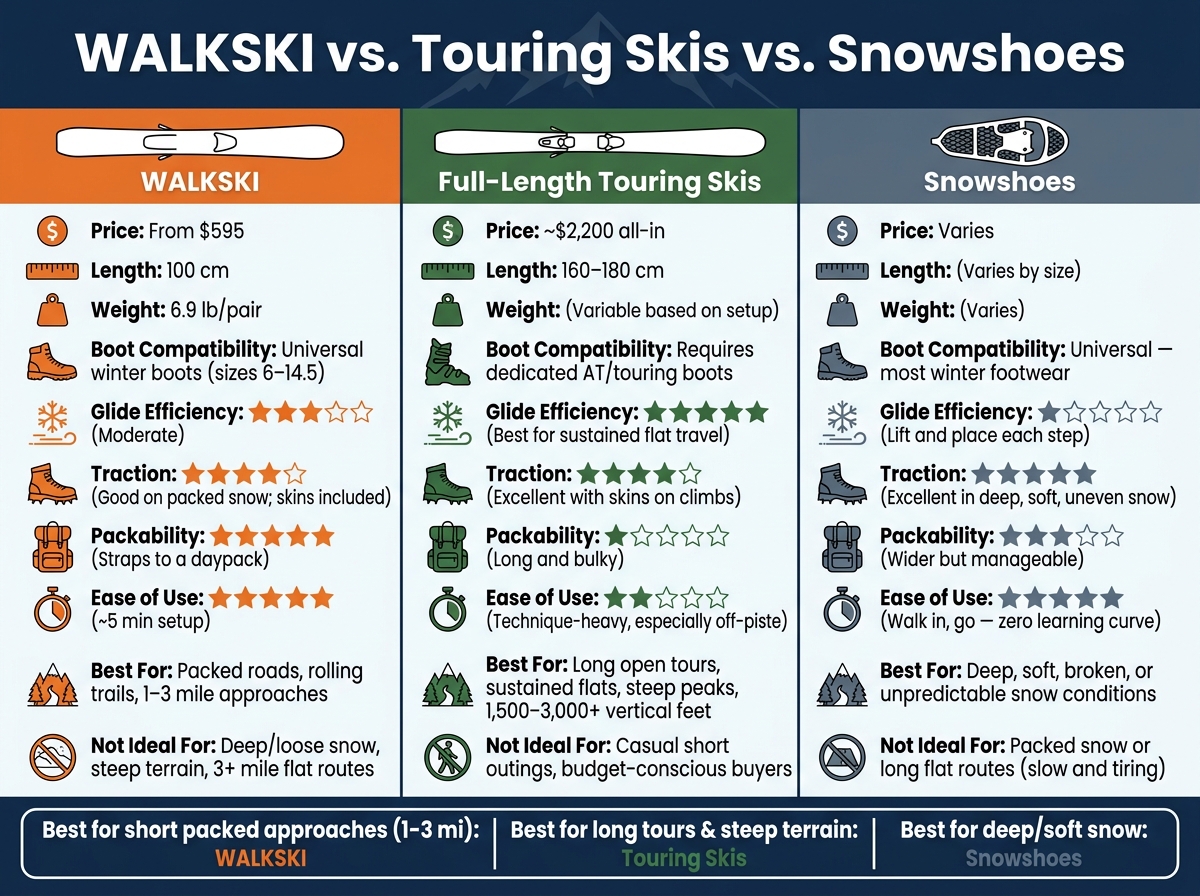
WALKSKI vs. Touring Skis vs. Snowshoes: Which Winter Approach Tool Wins?
Comparison table for flat approach terrain
For short, flat approaches, the day-to-day differences matter more than the label.
| Feature | Snowfeet* WALKSKI | Full-Length Touring Skis | Snowshoes |
|---|---|---|---|
| Glide Efficiency | Moderate - better than snowshoes, but less than long skis | High - best for sustained flat travel | Very low - lift and place each step |
| Walking Comfort | High - free-heel Walk mode feels natural on flats | Moderate to high - efficient sliding stride, but more technical | Moderate - wider stance, more leg lift |
| Traction | Good on packed or mixed snow; skins help when it gets slick | Good with skins on climbs | Excellent in deep, soft, or uneven snow |
| Packability | High - easy to strap to a pack | Low - long and bulky to carry | Moderate - wider, but still manageable |
| Boot Compatibility | Universal - winter, snowboard, or ski boots | Specific - requires touring or tech boots | Universal - most winter footwear |
| Ease of Use | Very low barrier - about 5 minutes | High - technique-heavy, especially off-piste | None - walk in, go |
| Best Terrain | Packed roads, rolling tracks, short backcountry entries | Long open tours, sustained flats, steep peaks | Deep, soft, or broken snow |
Why Snowfeet* is the better pick for most casual users
Here’s the simple version: your best pick depends on how far you're going, what the snow feels like, and how much gear you want to haul.
Touring skis are faster on long, flat stretches. Snowshoes do best in deep, chopped-up snow. But on short, packed approaches, WALKSKI hits the sweet spot.
For casual users, WALKSKI feels easy right away. You’re not dealing with a big learning curve, and the setup works with regular winter boots. That alone makes it a lot less of a hassle. It’s also much cheaper than buying a full touring setup.
So if your route starts with a packed access road or a rolling trail, WALKSKI is the more practical choice for most casual users. And that leads to the next part: who WALKSKI fits best.
Final Verdict: Is WALKSKI Worth It for Your Approach Style?
Who WALKSKI is best suited for
The choice comes down to one simple thing: how much glide you want on short, packed approaches.
WALKSKI makes the most sense for short, packed approaches where you want some glide without dragging along a full touring setup. It’s a nice match for people who want to skip dedicated touring boots and just use winter footwear they already own. That cuts out a real cost and hassle barrier.
If your usual outing is about 1 to 3 miles on packed snow, WALKSKI lines up well with that use case.
Use the checklist below to see if your routes match where WALKSKI shines.
Key points to review before buying
Before you buy, give these points an honest look:
- Terrain: Most of your travel is on packed roads, groomed tracks, or low-angle forest paths, not steep couloirs or deep, loose powder.
- Distance: Your approaches stay under 3 to 4 miles round trip. Past that, the shorter glide starts to stand out more when you compare it with full touring skis.
- Boot situation: You want to use boots you already own instead of buying specialized AT boots.
- Performance expectations: You’re fine giving up some glide efficiency for a setup that straps onto a daypack with little fuss.
- Budget: At a fraction of the cost of a full touring setup, WALKSKI keeps the price well below what a complete touring rig usually costs.
If you’re planning long hut-to-hut tours, steep descents on a regular basis, or full days in deep, mixed snow, WALKSKI isn’t the right tool. In that case, old-school touring skis or a splitboard will serve you better. But for short, packed, simple outings, yeah - WALKSKI is worth a look.
FAQs
How much do snow conditions affect WALKSKI performance?
Snow conditions matter, but WALKSKI works best on packed trails, groomed tracks, and forest roads. That’s its sweet spot.
It also does well in light, shallow powder - up to about 4 inches. The rockered tip and wide shape help it stay easy to handle without feeling bogged down.
In deep, soft, or loose snow, though, you’ll get less float than you would with longer touring skis. That’s just the trade-off. On icy or firm surfaces, trimming the climbing skins so 5 to 7 mm of metal edge stays exposed can help traction.
Can beginners use WALKSKI without ski experience?
Yes. Snowfeet WALKSKI* can work well for beginners, even if they’ve never skied before.
At 100 cm, it’s easier to turn and control than standard touring skis. That makes the learning curve feel shorter and a lot less scary. Most first-time users start to feel comfortable in anywhere from a few minutes to two hours.
Another nice part: the universal bindings work with winter boots or snowboard boots you may already have. So you can often get started without buying a whole new setup.
When do full-length touring skis make more sense?
Full-length touring skis make more sense for long tours, big vertical days, and steep alpine terrain where mistakes get expensive.
Snowfeet WALKSKI works well on short, mellow, or rolling approaches. But at 100 cm, it gives up some float, stability, and glide in deep, unconsolidated powder. That’s where full-length skis pull ahead.
They’re also a better fit for:
- High-speed descents
- Big-mountain lines
- All-day backcountry missions











Lascia un commento
Questo sito è protetto da hCaptcha e applica le Norme sulla privacy e i Termini di servizio di hCaptcha.