



















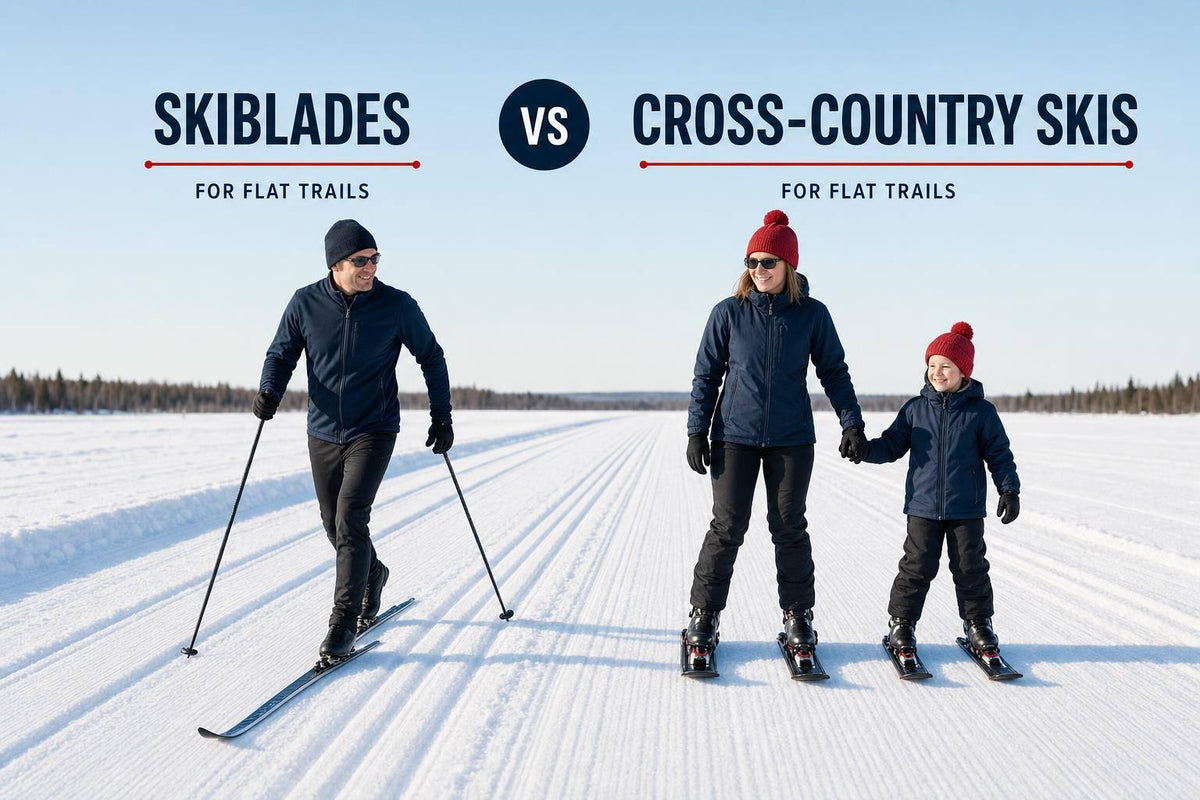
If you ride flat trails, full-length cross-country skis win for glide, but skiblades win for ease, storage, and low-speed fun. That’s the short answer.
If I had to boil it down:
- Pick full-length XC skis if you want to cover more miles with less effort
- Pick 65 cm skiblades if you want the easiest setup for short laps, family outings, and tight spaces
- Pick 99 cm skiblades if you want a middle option with more glide and easy control
- Pick the 90 cm NORDIC if you want a compact XC-style workout without hauling long skis around
On flat terrain, the main tradeoff is simple: glide vs control. Full-length XC skis glide farther. Short skis and skiblades are easier to turn, stop, carry, and stash in a small closet. And for a lot of riders, that’s the thing that decides what actually gets used.
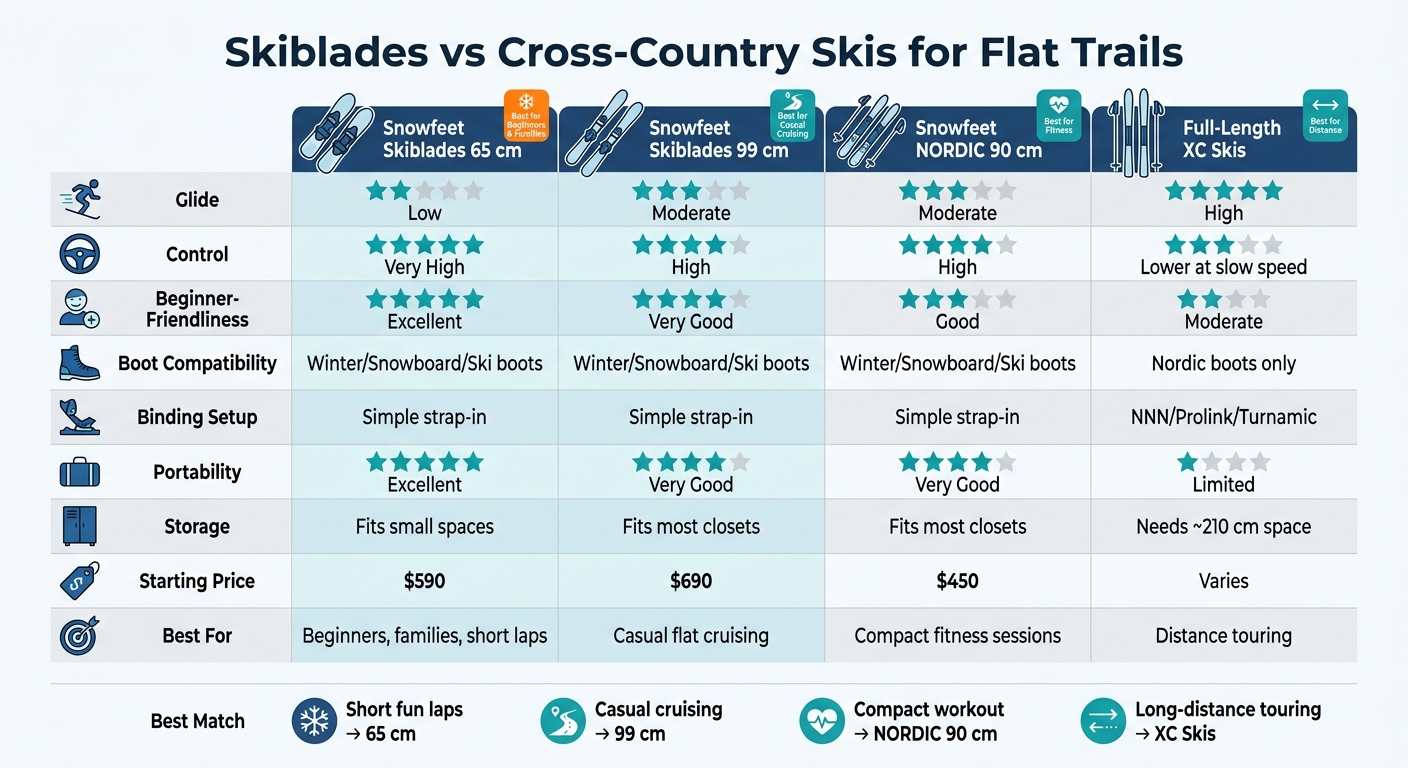
Skiblades vs Cross-Country Skis: Flat Trail Comparison Guide
Is Cross-Country Skiing Possible with Mini Ski Skates? | Snowfeet*
Quick Comparison
| Option | Best For | Glide | Control | Boot Setup | Portability | Starting Price |
|---|---|---|---|---|---|---|
| Snowfeet* Skiblades 65 cm | Short fun laps, beginners, families | Low | Very high | Winter shoes, snowboard boots, or ski boots | Very high | $590 |
| Snowfeet* Skiblades 99 cm | Casual cruising on flat trails | Medium | High | Winter shoes, snowboard boots, or ski boots | High | $690 |
| Snowfeet* NORDIC 90 cm | Compact fitness laps | Medium | High | Winter shoes, snowboard boots, or ski boots | High | $450 |
| Full-length XC skis | Distance touring and training | High | Lower at slow speed | Nordic boots only | Low | Varies |
A few numbers stand out right away:
- 65 cm vs full-length skis is a huge gap in size
- Full-length XC skis are often 15 to 30 cm longer than your height
- XC ski bags can run around 210 cm, which is, uh, a lot of ski to deal with in a small car or apartment
So, if your goal is distance, go XC.
If your goal is easy, fun flat-trail use, skiblades make more sense.
That’s the whole story in plain English :)
For a quick visual, these videos can help:
How Each Option Feels on Flat Ground
Glide and forward movement
On flat trails, XC skis have the edge for glide. Snowfeet* skiblades have the edge for easy control.
Full-length classic XC skis move best on groomed flats and reward that steady shuffle-and-glide rhythm. If you like covering ground and keeping a smooth pace, they feel right at home.
Snowfeet* Skiblades give up some glide, but they’re easier to balance on and steer. That trade-off matters more than people think. The 65 cm model is the most compact. The 99 cm version adds more stability. And the 90 cm NORDIC sits in the middle, somewhere between the 65 cm and full-length XC skis.
That glide edge can fade a bit when the trail gets crowded, slow, or more playful.
Turning, stopping, and low-speed control
Short skiblades are better at low-speed control. The 65 cm Snowfeet* Skiblades let you turn almost on the spot, which is fun and, honestly, pretty forgiving. The 99 cm tracks better but still stays nimble. XC skis take more work at low speed, and stopping usually means a gradual coast or a snowplow.
Flat-trail performance comparison table
| Snowfeet* 65 cm | Snowfeet* 99 cm | Snowfeet* NORDIC 90 cm | Full-length XC skis | |
|---|---|---|---|---|
| Glide efficiency | Low | Moderate | Moderate | High |
| Turning ease | Very easy | Easy | Easy | Requires technique |
| Stopping ease | Easy | Easy | Moderate | Takes practice |
| Beginner-friendliness | Excellent | Very good | Good | Moderate |
| Best use on flat trails | Short, playful outings | Casual cruising | Easy flat-trail sessions | Longer groomed trail sessions |
Glide matters, sure. But in practice, boot fit and portability often decide what you’ll grab and use most. That’s where the choice gets more personal. :)
sbb-itb-17ade95
Boots, Portability, and Day-to-Day Convenience
After glide and control, the next thing people care about is simple: which setup is easier to live with? If trail performance is close, convenience often breaks the tie.
Boot compatibility and setup ease
Full-length XC skis need Nordic boots plus a matching binding system, usually NNN, Prolink, or Turnamic. That means you’re not just buying skis. You’re also buying into a boot-and-binding setup that has to match.
Snowfeet* skiblades and the NORDIC 90 cm are much simpler on this front. They work with winter shoes, snowboard boots, or ski boots, so most riders can skip buying a separate pair of Nordic boots.
That also makes setup easier day to day. Snowfeet* products are built to feel approachable: strap in and go. XC skis take more fiddling. You need the right boot sole standard, the right binding match, and a clean click-in. It’s not hard once you know the system, but it does add friction. And yeah, that matters when you just want to squeeze in a quick loop before lunch or after work.
For casual outings, less setup usually means one thing: more time on snow.
Portability for cars, travel, and small storage spaces
Length is the big issue here. Full-length cross-country ski bags are often around 210 cm, which gives you a pretty clear picture of how much room standard XC gear takes. In a small apartment, a packed car, or a tight gear closet, that can be a pain.
Snowfeet* Skiblades at 65 cm and 99 cm, plus the NORDIC 90 cm, are much easier to deal with. They fit in the back of almost any car, slide under a bed, or tuck into a closet corner. That makes them handy for quick local laps, family trips, and those grab-and-go days when you don’t want your gear to feel like furniture.
Shorter gear also tends to make flying easier because it packs smaller and is easier to protect. You still need to pack smart, of course, but it’s a lot less awkward than hauling full-length XC skis through an airport.
For short flat-trail sessions, that convenience gap often ends up making the choice.
Setup and convenience comparison table
| Snowfeet 65 cm* | Snowfeet 99 cm* | Snowfeet NORDIC 90 cm* | Full-length XC skis | |
|---|---|---|---|---|
| Boot compatibility | Winter shoes, snowboard boots, or ski boots | Winter shoes, snowboard boots, or ski boots | Winter shoes, snowboard boots, or ski boots | Nordic boots only |
| Binding complexity | Simple strap-in | Simple strap-in | Simple strap-in | NNN/Prolink/Turnamic system |
| Portability | Excellent | Very good | Very good | Limited |
| Storage ease | Fits in small spaces | Fits in most closets | Fits in most closets | Needs long storage space |
| Travel friendliness | Easy to pack and fly with | Easy to pack and fly with | Easy to pack and fly with | Requires more packing and baggage planning |
Which Option Fits Your Situation
At this point, glide, control, boots, and portability are already sorted out. So now it comes down to one thing: how you ride. If the earlier section helped trim the options, this part makes the match a lot easier.
Best for short sessions and family outings
For short, crowded, low-speed flat-trail sessions, the Snowfeet* Skiblades 65 cm are the most practical pick. They’re a nice fit for quick laps, casual fun, and spots where space is tight.
Families get a big plus here too. These work with ski boots or snowboard boots many people already own, which makes family outings a lot easier to pull off. Less gear drama, more snow time :)
Best for casual cruising and mixed flat terrain
For longer loops on groomed trails or packed snow paths, the Snowfeet* Skiblades 99 cm give you the best balance of easy handling and better distance efficiency on flat terrain. If you want one option that sits right in the middle, this is the strongest pick for casual flat-trail cruising.
The Snowfeet* NORDIC 90 cm fits riders who want a flatter-trail workout, not just another short ski option. It also comes in a winter-shoe binding version, which keeps setup simple for fitness laps.
Rider type and model match table
Here’s the fastest way to match each model to a rider type.
| Rider Type | Typical Scenario | Best Match | Why It Fits |
|---|---|---|---|
| Beginner adult | Local park loop, first time on snow | Skiblades 65 cm | Easy to control on short, low-speed flat routes |
| Family with kids | Backyard or school field fun | Skiblades 65 cm | Works with boots the family already owns |
| Casual cruiser | Groomed flat trail, longer loop | Skiblades 99 cm | Best balance of glide and easy handling for flat cruising |
| Fitness-focused rider | Cardio workout on flat groomed trail | NORDIC 90 cm | Skate-style motion built for a flat-trail workout |
| Traveler / urban rider | Flying or commuting to a winter destination | Skiblades 65 cm | Most compact size for cars, bags, and tight storage |
That leaves one final question: which setup works best overall for flat trails?
Final Verdict: Which Works Better for Flat Trails?
Short answer: full-length cross-country skis still come out on top for distance touring and higher-mileage training on groomed flats. They’re made for smooth, efficient mileage.
But for casual trail days, pure glide isn’t the whole story. Ease of use matters. A lot. For most casual flat-trail riders in the U.S. - beginners, families, and people sticking to short rec trails - that’s where _Snowfeet Skiblades 65 cm and 99 cm come out ahead._* They’re simple to set up, easy to carry, and way less of a hassle.
If you want something in between, the NORDIC 90 cm is the compact fitness option. The Snowfeet NORDIC Cross-country 90 cm* fits riders who want more of that XC-style stride without dealing with a long, bulky ski.
| Your Goal | Best Pick |
|---|---|
| Short family sessions | Skiblades 65 cm |
| Casual flat cruising | Skiblades 99 cm |
| Compact fitness sessions | NORDIC Cross-country 90 cm |
| Distance touring | Full-length cross-country skis |
The bottom line: if you’re a casual rider, skiblades are the easier, more fun pick for flat terrain. If you’re more focused on fitness and often log miles on groomed trails, full-length XC skis still make sense. And if you want a nice in-between option, the NORDIC 90 cm gets you close in a much smaller package.
FAQs
Can skiblades work on groomed XC trails?
Yes. Snowfeet NORDIC skis are made for groomed cross-country tracks and snowmobile-packed snow.
At 90 cm, they feel much easier to handle than standard cross-country skis, which usually run 170–210 cm long. That shorter size makes them more nimble and less awkward for beginners. In plain English: they’re easier to turn, easier to control, and a lot less intimidating when you’re just getting started.
Full-length skis still have an edge when you want better glide over long distances. But for casual trail loops, park paths, and light touring, Snowfeet NORDIC skis are often the more beginner-friendly pick.
Which option is easier for complete beginners?
For complete beginners, Snowfeet NORDIC skis are a lot easier to use than long cross-country skis. The short 90 cm length makes a big difference. You’re less likely to cross the tips, and turning or moving through tight spots feels much more natural.
They also work with regular winter boots, which is a nice bonus. That means new skiers can focus on simple weight shifts instead of trying to learn the classic kick-and-glide motion right away. Long cross-country skis do glide better on long routes, sure, but Snowfeet NORDIC gives beginners a faster, more confidence-boosting start.
Are skiblades good enough for fitness workouts?
Yes. Skiblades like the Snowfeet NORDIC 90 cm can work well for casual fitness workouts. But they’re not the same as full-length cross-country skis.
They’re a good fit for short 20- to 60-minute laps on flat, groomed paths, parks, or golf courses. Think easy cardio, a bit of fresh air, and some winter fun rolled into one :)
If your goal is long-distance training, racing, or high-speed skiing, full-length cross-country skis are still the better pick.











Hagyj egy hozzászólást
Ezt a webhelyet a hCaptcha rendszer védi, és a hCaptcha adatvédelmi szabályzata, valamint szolgáltatási feltételei vonatkoznak rá.