



















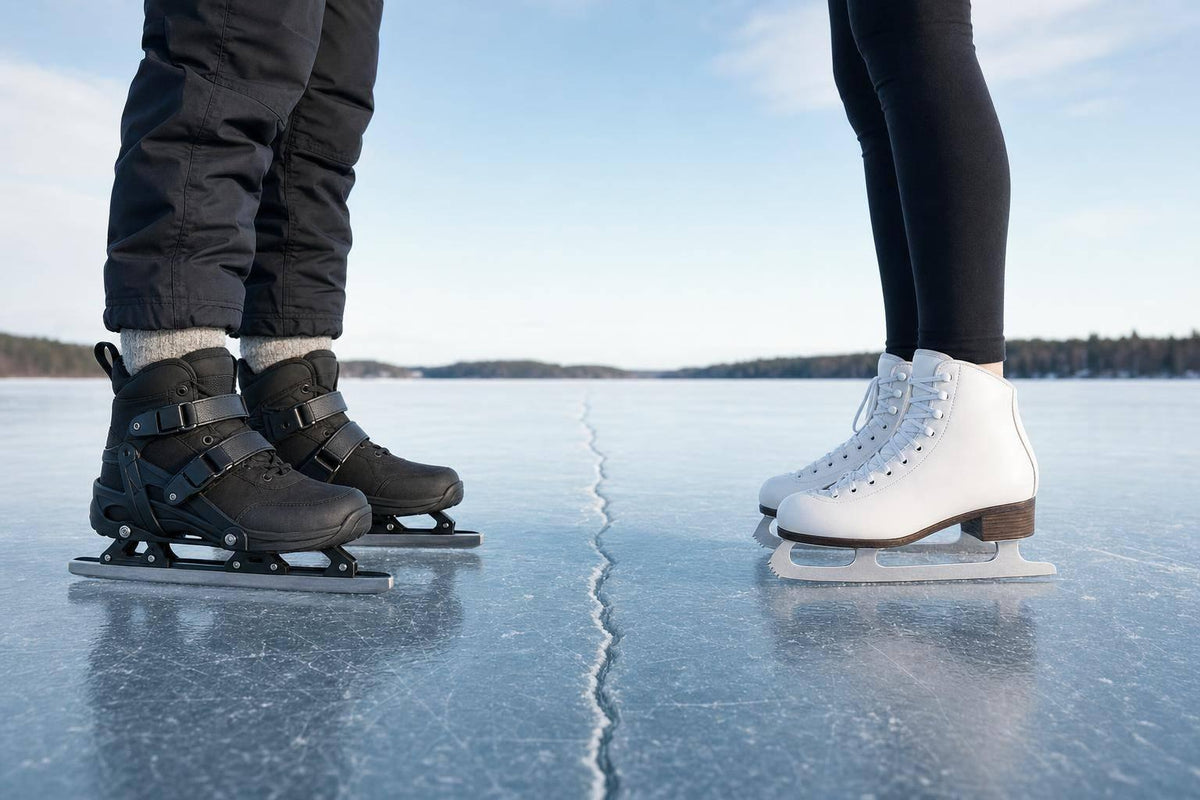
If I just want an easy day on a frozen lake, I’d pick Icefeet over figure skates. They feel steadier on rough ice, work with my winter boots, and cost $199. Figure skates still win for edge control, spins, and clean turns on smooth ice.
Here’s the short version:
- Icefeet fit best for beginners, families, travel, and casual lake days
- Figure skates fit best for skaters who want single-blade control and already know good technique
- On rough lake ice, double blades feel more stable
- On smooth ice, figure skates turn with more precision
- For safety, I still wouldn’t skate on ice under 4 inches thick, and 4–6 inches is the safer range for one person
So if you care most about stability, easy learning, simple stopping, warmth, and easy packing, Icefeet make more sense for most people. If you care most about artistic skating and sharp edge work, figure skates still have their spot.
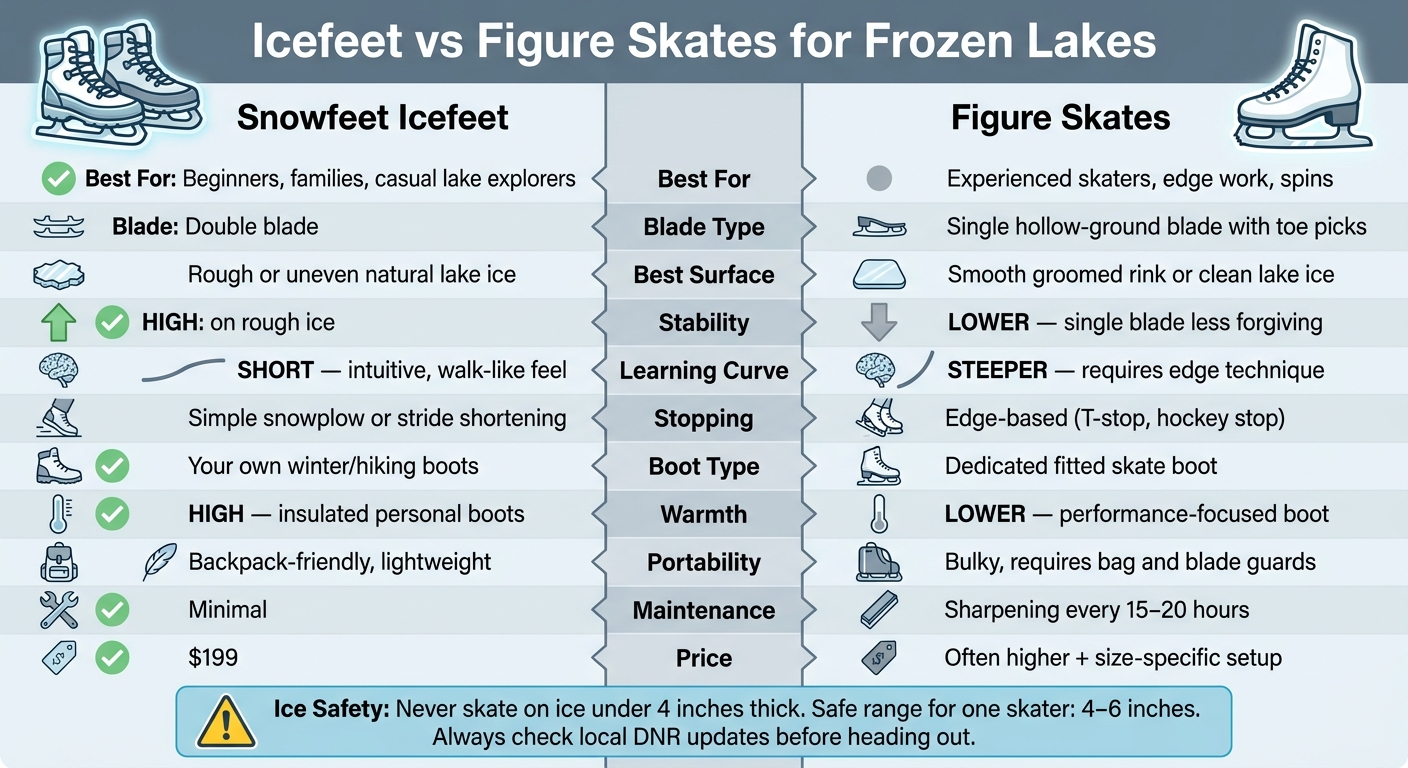
Icefeet vs Figure Skates: Which Is Best for Frozen Lakes?
Finally… Ice Skates Anyone Can Use!
Quick Comparison
| Criteria | Icefeet | Figure Skates |
|---|---|---|
| Best for | Beginners, families, casual lake skating | Skilled skaters, edge work, spins |
| Blade setup | Double blade | Single blade with toe picks |
| Feel on rough ice | More steady | More likely to catch |
| Learning curve | Easier | Harder |
| Stopping | Simple, beginner-friendly | Needs more technique |
| Boots | Uses winter or hiking boots | Built-in skate boots |
| Warmth | Better for cold lake days | Often colder |
| Portability | Fits in a backpack | Bulkier |
| Price | $199 | Often more, plus size-specific setup |
| Best surface | Uneven natural ice | Smooth rink or clean ice |
If I were helping a friend at the lake, I’d say this: pick Icefeet for fun and less hassle; pick figure skates for skating technique. :)
Core Difference: Snowfeet* Icefeet vs Figure Skates
On a frozen lake, it usually comes down to this: do you want easy, steady gliding, or the sharper feel of figure skates? The design of each option changes how it behaves on natural ice.
How Snowfeet* Icefeet are built for casual lake skating
Snowfeet* Icefeet use a double-blade design that straps right onto your winter boots or hiking boots with adjustable bindings. That matters more than it might seem. Two blades give you a more planted feel than a single-blade skate, so balance tends to feel easier right away.
For beginners and casual riders, that means less messing around and more time actually skating. At $199, Icefeet are also a lower-cost, grab-and-go pick.
That setup is a big reason Icefeet feel steady and easier to handle on rougher, uneven lake ice.
How figure skates feel on natural ice
Figure skates use a single blade attached to a stiff, fitted boot. That setup is built for precise edge control, which is a huge part of figure skating.
The toe picks at the front of the blade are made for jumps and some spins, not basic stopping or laid-back skating. On natural ice, that can be a headache. Toe picks can catch on cracks and ripples, and outdoor skating guides warn that figure skates' toe picks and shorter blades are more likely to snag on uneven ice than other skate types.
If you already know how to use your edges, figure skates can feel sharp and exact. But for casual skating on a lake, they’re less forgiving.
| Feature | Snowfeet* Icefeet | Figure Skates |
|---|---|---|
| Blade | Double-blade | Single hollow-ground blade |
| Boot | Your own winter/hiking boots | Dedicated fitted skate boot |
| Toe picks | None | Yes - for jumps and spins |
| Price | $199 vs. higher, size-specific setups | |
| Best surface | Rough or uneven natural ice | Smooth groomed or rink ice |
That’s the split: stability and ease on one side, precision and edge control on the other.
sbb-itb-17ade95
Performance on Frozen Lakes: Stability, Learning, Stopping, and Turning
Why Icefeet feel easier on rough or bumpy lake ice
Once stability is settled, the next thing people notice is how each skate deals with bumps, turns, and stops.
Lake ice is rarely perfect. It’s often rough, uneven, or dusted with a light layer of snow. That’s where the double-blade setup helps. It gives you more standing stability and tends to handle bumps better. You’re not trying to balance on one thin blade the whole time, so the glide feels more natural and less twitchy.
That step-through motion also makes learning feel less awkward. For many first-timers, it feels closer to walking and gliding than full-on skating. And when it’s time to stop, the process is pretty simple: shorten your stride or use a light snowplow motion. No drama, no fancy move needed. For nervous beginners, that lower barrier can make a big difference.
Where figure skates still perform better
On smooth ice, figure skates still have the edge. They give skilled skaters sharper edge control, tighter turns, and that classic figure-skating feel that many people love.
But there’s a catch. Toe picks and thin blades can snag on cracks, ridges, or crusty patches. So while figure skates shine on clean ice, they tend to be less forgiving once the lake surface gets choppy.
| Performance Factor | Snowfeet* Icefeet | Figure Skates |
|---|---|---|
| Stability on rough ice | High - double-blade setup feels steadier | Lower - single blade is less forgiving |
| Learning curve | Short - intuitive, natural step-through feel | Steeper - depends more on edge technique |
| Stopping | Simple stride shortening or snowplow motion | Edge-based stops like T-stops and hockey stops |
| Turning | Broad, relaxed turns and pivots | Precise edge-carved turns and crossovers |
| Rough-ice handling | Forgiving on bumps, cracks, and light snow | More likely to catch on imperfections |
| First-time confidence | High - familiar and less intimidating | Lower - balancing on one narrow blade can feel daunting |
Which skate fits which rider
The better pick comes down to what you want out on the ice.
Icefeet usually work better for:
- Beginners
- Families
- Casual lake explorers
- People who want an easier first day on rough ice
Figure skates make more sense for skaters who already have solid technique and want clean edges, tighter turns, and better performance on smooth ice.
Next, comfort and portability can widen that gap even more.
Comfort, Boot Compatibility, and Portability for a Day on the Lake
Skating in your own winter boots with Snowfeet* Icefeet
Comfort matters on a long lake outing. After you know how they feel on the ice, the next thing is simple: what are they like to wear, and how much of a hassle are they to bring along?
Figure skates use stiff boots made for jumps and spins. That works well for competition. But for a laid-back day on the lake, that same stiffness can feel like overkill. They’re built around fit and performance, not warmth, and you’ll feel that pretty fast on a cold afternoon.
Snowfeet* Icefeet strap right onto the winter boots you already wear. That means familiar ankle support, more warmth, and no second pair of boots to break in just to skate.
Why portability matters for lake trips
Portability matters.
Figure skates come with extra stuff to manage. You need blade guards when you walk off the ice, a bag to carry them, and a full shoe swap at the shoreline. They also need regular sharpening.
Icefeet are small enough to throw in a backpack next to your lunch and thermos. Strap them onto your boots and head out.
| Feature | Snowfeet* Icefeet | Figure Skates |
|---|---|---|
| Boot compatibility | Works with most insulated winter boots | Dedicated integrated boot only |
| Warmth | High - uses your own insulated, waterproof boots | Lower - prioritizes fit and performance |
| Comfort | Familiar, flexible, less restrictive | Stiff and rigid; can be uncomfortable for beginners |
| Transport | Backpack-friendly, lightweight | Bulky; requires a dedicated bag and blade guards |
| Setup time | Quick - strap on at the shoreline | Slower - requires a full footwear change |
| Maintenance | Minimal | Regular sharpening every 15–20 hours of use |
On natural ice, that kind of simplicity goes a long way. The best setup is often the one you can carry with no fuss, put on fast, and use without freezing your toes off :)
Safety on Natural Ice and Final Recommendation
How each skate handles common lake hazards
On natural ice, ice conditions matter more than the skate. No gear can make thin ice safe. Skip ice under 4 inches. For one skater, 4–6 inches is the safer range. And clear ice and white ice are not the same thing. White, slushy, or snow-covered ice is weaker than clear ice, even when the thickness matches.
Start with local guidance every time. Check DNR updates, park signs, and any posted warnings before you head out. Those local calls beat any general rule of thumb. Every time.
Lake ice can be a bit of a mixed bag. One section looks smooth, then boom - rough freeze-thaw patches, shallow snow hiding cracks, pressure ridges, or little chunks of debris frozen into the surface. That’s where skate design starts to show its strengths and weak spots.
Figure skates use a long, narrow single blade. On rough lake ice, that blade can catch on cracks, freeze lines, and sharp debris edges. When that happens, the stop can feel sudden and awkward, which is tough for newer skaters to handle. Snowfeet* Icefeet use a shorter double blade, which tends to feel more forgiving when the surface isn’t clean and smooth.
Still, no skate changes the big rule: thin ice is thin ice. Scan the surface before you move, stay clear of inlets, outlets, and pressure ridges, and don’t skate alone.
Given those risks, the simpler setup is the better fit for most casual lake skaters.
Final verdict: which one should most people choose
For most casual lake riders, Snowfeet Icefeet* are the better pick. They’re easier to use, more stable on rough ice, and easy to toss in the car or pack. The price is $199, and you can use your own winter boots.
Figure skates still have their place. If you want classic single-blade technique, edge work, or formal skating practice, they make sense. But that’s a smaller lane. It also assumes you already have the skill and access to clean, well-checked ice.
For most people who just want a laid-back day on natural ice, Icefeet cut down a lot of the hassle that stops people from going in the first place.
| Snowfeet* Icefeet | Figure Skates | |
|---|---|---|
| Best for | Beginners, casual explorers, travelers | Experienced skaters focused on technique |
| Stability on rough lake ice | More forgiving | Demands cleaner, smoother ice |
| Learning curve | Low | Steeper |
| Ideal conditions | Natural lake ice, imperfect surfaces | Smooth, well-checked ice |
FAQs
Can Icefeet handle light snow on a frozen lake?
Yes. Icefeet and other Snowfeet double-blade options handle light snow on a frozen lake better than figure skates.
Figure skates can get fussy in even 1 to 2 inches of snow or on rough patches. Snowfeet products have a wider base and a double-blade setup, so they feel more stable and are less likely to catch an edge.
What boots work best with Snowfeet* Icefeet?
Snowfeet* Icefeet work with a wide range of winter boots. For the best ride, go with stiff, waterproof boots that have solid ankle support and a flat sole.
They fit most boots in U.S. sizes 4.5 to 14.5. Snowboard boots are often a smart step up since they add support and flex where it counts.
Skip soft or loose boots. They can make you feel wobbly and cut down on control.
Are figure skates better if I already skate at a rink?
If your main goal is figure skating, crossovers, or more advanced rink moves, old-school figure skates are still the better pick. They give you better precision, edge control, and support.
But if you want a casual, comfy, and beginner-friendly way to get on the ice, Snowfeet Icefeet* make more sense. You use them with your own winter boots, and the double-blade setup gives you more stability than single-blade figure skates.











Hagyj egy hozzászólást
Ezt a webhelyet a hCaptcha rendszer védi, és a hCaptcha adatvédelmi szabályzata, valamint szolgáltatási feltételei vonatkoznak rá.