



















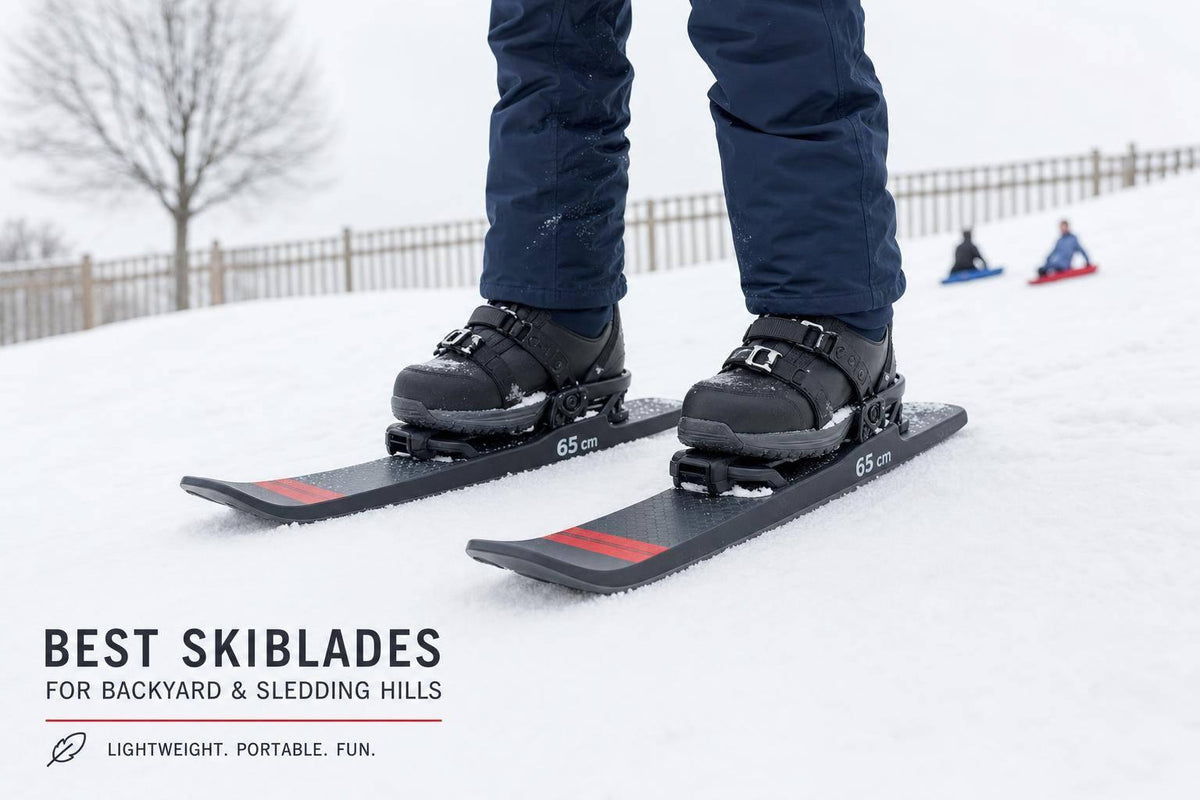
If you’re riding a short backyard hill, shorter skiblades usually make more sense than skis. I’d keep it simple: 44 cm for the smallest, tightest hills, 50 cm if you want easy boot setup, and 65 cm if you want the best mix of control and balance.
Here’s the short version:
- Best overall: Snowfeet* Skiblades 65 cm
- Best for tiny hills and easy carry: Snowfeet* Skiskates 44 cm
- Best if you want to use winter boots or snowboard boots: Snowfeet PRO 50 cm
- Best for longer neighborhood runs: Snowfeet* Skiblades 99 cm
- Best only if you already ride ski boots and want a short-ski feel: 90–99 cm snowblades
Why? Because on a small hill, you need gear that’s easy to turn, easy to stop, and easy to carry back uphill. A 44 cm to 65 cm setup does that better than full skis that often run 150–200+ cm. And weight matters too: some Snowfeet models come in around 2–5 lb per pair, while full skis can weigh 6.6–11 lb each. That’s a big gap when you’re hiking up the same hill for the 12th time :) .
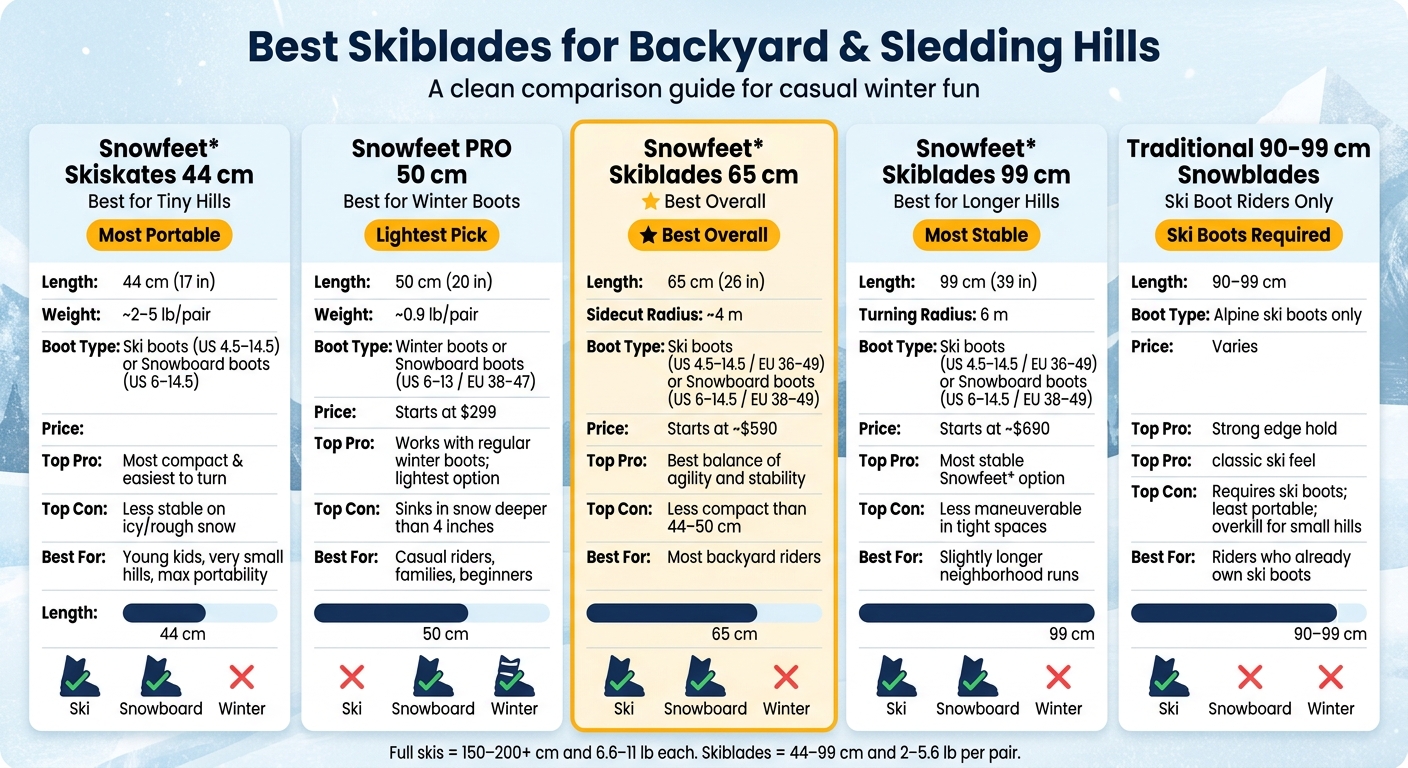
Best Skiblades for Backyard Hills: Side-by-Side Comparison
Snowboarder tries Snowfeet* | Which Snowfeet* Short Ski is the Best? | Snowblades 44, 65, 99 Review
Quick Comparison
| Product | Best For | Boot Type | Main Tradeoff |
|---|---|---|---|
| Snowfeet* Skiskates 44 cm | Very small hills, kids, max portability | Ski boots or snowboard boots | Less steady on icy or rough snow |
| Snowfeet PRO 50 cm | Casual riders, shared family use, winter boots | Winter boots or snowboard boots | Not great in snow deeper than 4 in |
| Snowfeet* Skiblades 65 cm | Most backyard riders | Ski boots or snowboard boots | A bit less compact than 44–50 cm |
| Snowfeet* Skiblades 99 cm | Slightly longer local hills | Ski boots or snowboard boots | Needs more room to turn |
| 90–99 cm snowblades | Riders who already own ski boots | Ski boots | More bulk on small hills |
So, if you want my plain answer: go 65 cm for the best all-around pick, 44 cm for the smallest hills, and 50 cm if boot convenience is your top concern.
You can also watch short skiblade and skiskate ride clips on YouTube before you buy:
- YouTube search: Snowfeet skiskates
- YouTube search: Snowfeet skiblades 65 cm
- YouTube search: snowblades vs skiblades
1. Snowfeet* Skiskates 44 cm
At 44 cm - about 17 inches - the Snowfeet* Skiskates are the easiest pair in this lineup to turn and carry. They use a wood core, which helps keep them light, tough, and closer to the feel of a ski.
Maneuverability
Short hills are more fun when your gear turns fast, changes direction without a fight, and stops without a lot of drama. That’s where the 44 cm length shines. These skiskates are easy to turn, which makes them a strong pick for backyard slopes and neighborhood sledding hills.
Boot Compatibility
You’ve got two binding options here:
- The ski-boot binding version fits US sizes 4.5–14.5
- The snowboard-boot version fits US sizes 6–14.5
That broad size range makes the pair easy to share between riders, which is handy if this set is going to bounce around the family or friend group.
Low-Speed Control
These are easy to learn on packed, mellow hills. That makes them a nice match for casual sessions where you want to clip in and have fun without a long learning curve.
There is one catch. On icy snow or loose-packed snow, they can be harder to control. So they work best on compacted sledding hills, not steep pitches that get sketchy fast. A helmet and wrist guards are a smart call, especially for kids.
If you want a bit more length and a feel that leans more toward skiing, the 50 cm PRO is the next step up.
Portability
This is one of the big selling points. The 44 cm Skiskates are easier to carry than 90–99 cm snowblades, so they make a lot of sense for quick carry-in, carry-out use when convenience matters just as much as how they ride.
If you like the idea of this setup but want more stability, the 50 cm PRO and 65 cm Skiblades move in that direction.
2. Snowfeet PRO 50 cm
If the 44 cm Skiskates feel a bit jumpy, the 50 cm Snowfeet PRO hits a nice middle point. At 50 cm - about 20 inches - it gives you a bit more balance without losing that short-ski vibe. You get more support than the 44 cm model, but it still feels small, light, and easy to throw around.
Maneuverability
The PRO turns fast, but it feels more settled underfoot than the 44 cm version. That’s a big deal on small hills, where short, fast moves matter more than long carving turns. On a backyard slope, you’re not chasing huge arcs. You’re making quick corrections, dodging little bumps, and staying in control. That makes the PRO a better pick for riders who want a touch more balance than the 44 cm Skiskates.
Boot Compatibility
The adjustable bindings fit US sizes 6–13 (EU 38–47) and work with regular winter boots or snowboard boots. So, setup stays easy. That’s handy for:
- Families who share gear
- Beginners who don’t want extra hassle
- Casual buyers who want one pair and done
Low-Speed Control
On packed snow, the PRO feels steady at low speed and is easier to stop than longer skis. That’s a nice match for short runs, where control matters more than top-end speed.
There is a catch, though. Once snow gets deeper than about 4 inches, the small surface area starts to sink more, so powder isn’t its strong suit.
Portability
At about 0.9 lb per pair, the PRO is light enough to toss in a backpack and go. For short-hill riders, that low weight often matters more than downhill speed. In plain English: it’s easy to carry, easy to store, and easy to bring along when the hill is more “backyard bump” than “full ski resort.” :)
It starts at $299.
For riders who want an even more ski-like feel with more balance, the 65 cm Skiblades push farther in that direction.
3. Snowfeet* Skiblades 65 cm
If the 50 cm PRO feels a bit too loose, the 65 cm Snowfeet* Skiblades give you more stability without crossing into full-ski territory. At 65 cm - about 26 inches - they’re the longest short option in this group. That extra length helps on a backyard hill, where a little more support can go a long way. They start at about $590.
Maneuverability
With a sidecut of about 4 meters, these still turn fast and feel quick edge to edge. But the longer platform makes them feel more settled than the 44 cm or 50 cm models. On a short neighborhood hill, that means you can link turns with more confidence and get a bit more of that carving feel. Less chaos, more control - in a good way.
Boot Compatibility
You can get them with either ski bindings or snowboard bindings, which is handy if you already own boots and don’t want to buy another setup.
- Ski boot bindings: about US 4.5–14.5 (EU 36–49)
- Snowboard boot bindings: about US 6–14.5 (EU 38–49)
That’s a pretty big fit range, so one pair can work for most teens and adults in the same household.
Low-Speed Control
On packed snow, the extra length gives you more edge contact and a steadier feel at slow speeds than the 44 cm or 50 cm options. That matters on short runs, where you’re not bombing downhill and need the gear to behave. In deep, soft snow, though, they’re not in their happy place. The blade can sink and start to feel heavy. Packed or lightly groomed snow is the sweet spot here, where control stays strong for short-run riding.
Portability
At 65 cm, they’re still easy to carry by hand or strap to a bag for the walk from the car to the hill. And since they work with a broad range of boot sizes, they’re easy to share too.
If you want more stability and longer turns than this, the 99 cm Skiblades are the next move.
sbb-itb-17ade95
4. Snowfeet* Skiblades 99 cm
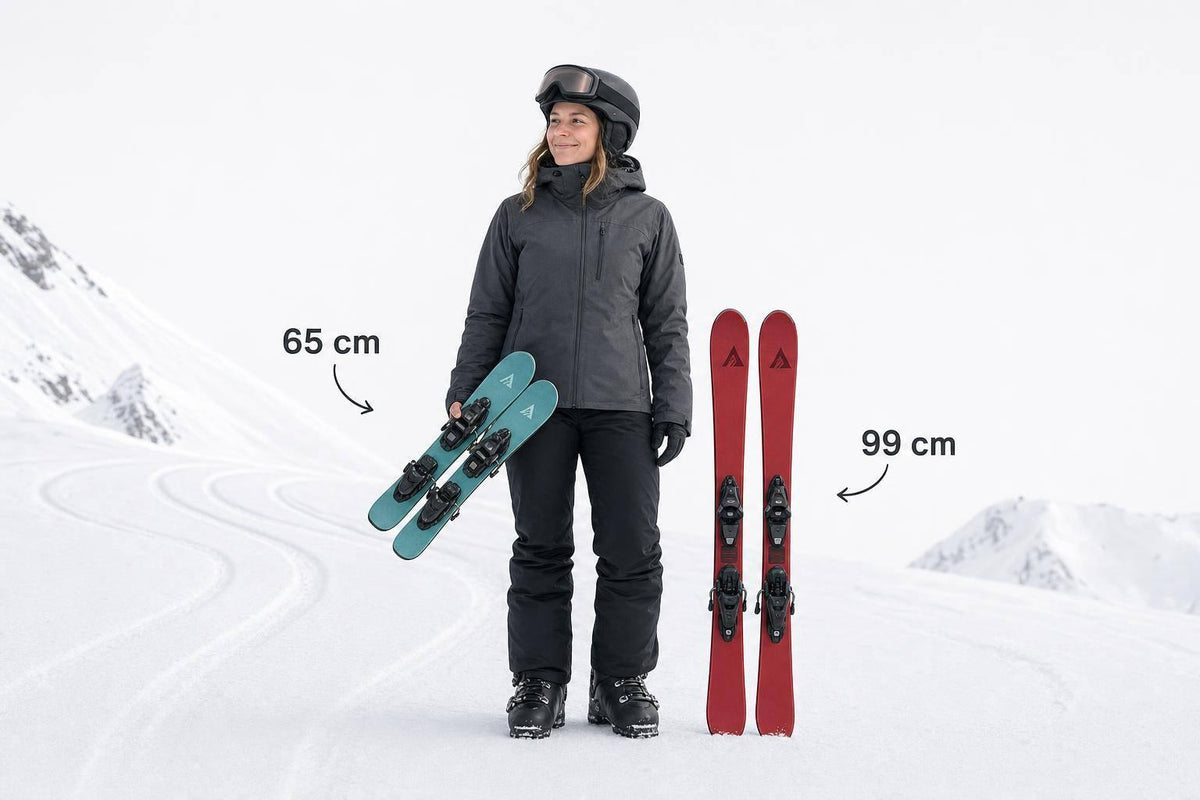
At 99 cm (39 inches), these are the longest Snowfeet* skiblades in this lineup. They feel the closest to regular skis, but without the bulk. Price starts at about $690.
Maneuverability
The 99 cm Skiblades have a 6-meter turning radius. So, they don’t snap through turns as fast as the shorter Snowfeet* models.
That said, they’re still much easier to steer than full-length skis. You get enough quickness for short runs, with a calmer feel that works well for beginners and casual riders.
Boot Compatibility
Snowfeet* sells the 99 cm version with either ski boot bindings or snowboard boot bindings.
- The ski-boot version fits EU 36–49 / US 4.5–14.5
- The snowboard-boot version fits EU 38–49 / US 6–14.5
Low-Speed Control
On mellow backyard hills, the longer platform gives you the most stability of any Snowfeet* model in this lineup. That’s the big edge over the 65 cm and shorter options.
More length means more stability, but they still stay easy to handle on small hills. It’s a nice middle ground if you want a steadier ride without jumping all the way to full skis.
Portability
At about 4.9–5.6 lb per pair, they’re still easy to carry and simple to stash in a trunk, back seat, or mudroom. In plain English: they sit right between Snowfeet*’s short, playful models and standard snowblades.
If you’re trying to compare that ride feel with short skis, the next section looks at where standard 90–99 cm snowblades fit.
5. Traditional 90–99 cm Snowblades
If you want a more classic ski feel and you already own ski boots, this is the closest non-Snowfeet* choice. Traditional 90–99 cm snowblades feel more like short skis. But on backyard slopes, that extra length often brings more hassle than help. They make more sense on bigger runs than on a small hill behind the house.
Maneuverability
Compared with 44 cm or 65 cm skiblades, 90–99 cm snowblades take more space to turn and feel less snappy. On a neighborhood sledding hill, the quick, instant-turn feel of the shorter Snowfeet* options is usually a better match.
Boot Compatibility
Most of these use alpine ski boot bindings, so they work best for riders who already have ski boots. That also makes them less handy than Snowfeet* if you want to ride in casual winter shoes or snowboard boots.
Low-Speed Control
On gentle slopes, the longer platform can feel more stable for riders who want that ski-like feel underfoot. But on small hills, shorter skiblades are easier to stop, adjust, and point back on line when things get a little wonky.
Portability
They’re still easy enough to carry, but they take up more space than 44–65 cm Snowfeet* models and feel less grab-and-go. For backyard hills, that extra length makes them the least handy pick in this lineup.
That tradeoff matters most when you match gear to how you ride. The next section breaks down which length fits kids, beginners, and casual riders best.
Pros and Cons by Use Case
Use this chart to line up hill size, boot type, and skill level with the right length. The best pick comes down to three things: the size of the hill, the boots you plan to wear, and how much stability you want under you.
| Product | Pros (Backyard & Sledding Hills) | Cons (Backyard & Sledding Hills) |
|---|---|---|
| Snowfeet* Skiskates 44 cm | Best for young kids on very small hills; works with regular winter or snowboard boots; quick to pivot on tight, short runs | Less stable on bumpy or icy terrain; short edge gives less control on hard snow |
| Snowfeet PRO 50 cm | Works with snowboard boots; easy to stop on short runs; better for frequent backyard use | Less stable than 65–99 cm options; sinks in snow deeper than 4 inches |
| Snowfeet* Skiblades 65 cm | Best balance of agility and stability for backyard hills; good for learning parallel turns and stopping; works with snowboard boots | Less grab-and-go than 44–50 cm options; not ideal for very cramped yards |
| Snowfeet* Skiblades 99 cm | Most stable Snowfeet* option on slightly longer neighborhood hills; easier to carry than resort gear; allows controlled carving at moderate speeds | Less maneuverable in tight spaces; more technique required than shorter models |
| Traditional 90–99 cm snowblades | Strong edge hold; stable at moderate speeds for experienced riders | Require ski boots; least portable option; overkill for short backyard hills |
The tradeoff is pretty simple. Shorter Snowfeet* models lean toward control, easy handling, and grab-and-go use. Longer blades lean toward stability, especially when the hill gets a bit longer or the speed starts to build.
Final Verdict
After looking at control, portability, and boot fit, the ranking is pretty simple:
For most backyard riders, the Snowfeet* Skiblades 65 cm is the best all-around choice. It hits the sweet spot between stability, control, and easy transport better than the shorter or longer models.
If you want the shortest, easiest setup to throw on and ride, go with the Snowfeet* Skiskates 44 cm. Pick this one only if ultra-fast turns and the most compact size matter most.
Don’t own ski boots? Then the Snowfeet PRO 50 cm makes the most sense. It’s the top pick if you want Snowfeet* gear that works with regular winter boots or snowboard boots.
As for the 99 cm Skiblades and old-school snowblades, skip them for small backyard hills. They make more sense on longer runs.
FAQs
How do I choose between 44 cm, 50 cm, and 65 cm?
Choose your skibike length based on skill level, terrain, and whether you want more agility or more stability.
Here’s the simple breakdown:
- 44 cm: the most nimble and playful option. It feels closer to skating and is easy to carry, but it gives you less stability.
- 50 cm: the middle ground for most casual adult riders. It stays compact, feels easy to handle, and works well with regular winter boots.
- 65 cm: the most forgiving and stable size. It’s a good pick for beginners, families, and kids.
Are skiblades safe for beginners on small hills?
Yes - on small hills, skiblades can be a good pick for beginners. 65 cm models are often the sweet spot because the short length makes turning and stopping feel easier, and a lot less scary than full-length skis.
That said, the very shortest skiblades can feel a bit twitchy. If that happens, 50 cm or 65 cm options tend to feel more steady and forgiving. They also make stopping on packed or groomed snow feel easier and more predictable.
A few basics still matter:
- Wear a helmet
- Stay away from hazards
- Stick to packed or groomed snow when you're learning
So, if you're starting out on a small hill, short skiblades can make the whole thing feel simpler and less intimidating :)
Which Snowfeet* model works best with regular winter boots?
For casual backyard laps and neighborhood sledding hills, the Snowfeet PRO 50 cm is the best pick if you want to wear regular winter boots. Its universal bindings fit most waterproof winter boots, so you can skip the stiff ski boots and just get out there.
If you want something smaller, the 38 cm model also works with regular winter boots. It’s a nice compact option and easy to toss in the car.
The 44 cm Skiskates and 65 cm Skiblades give you more performance, but there’s a catch: they need ski or snowboard boots.











Hagyj egy hozzászólást
Ezt a webhelyet a hCaptcha rendszer védi, és a hCaptcha adatvédelmi szabályzata, valamint szolgáltatási feltételei vonatkoznak rá.