



















If you want the short answer: I’d pick the 99 cm skiblades for most ski trips, the 44 cm skiskates for max portability, and the 120 cm short skis if ride feel matters more than bag space.
Flying with skis gets annoying fast. Full-length skis at 160–170 cm often need a ski bag, take up half the rental car, and can mean extra airline fees. Short skis cut that hassle way down.
Here’s the simple breakdown:
- 44 cm Skiskates: smallest option, backpack-friendly, best for one-bag travel
- 65 cm Skiblades: easy to pack, light, good for short resort trips
- 99 cm Skiblades: best balance of pack size and on-snow feel
- 120 cm Short Skis: closest to a standard ski feel, but less compact
- 160–170 cm full-length skis: best for speed and powder, worst for travel
- 90–100 cm competitor snowblades: decent middle ground, but less boot choice
What matters most on a trip?
- Pack size
- Weight
- Boot setup
- How they feel on groomers, moguls, and rough snow
One thing I’d keep in mind: boots can take up as much room as the skis. That’s why models that work with snowboard boots can make travel a lot less annoying :)
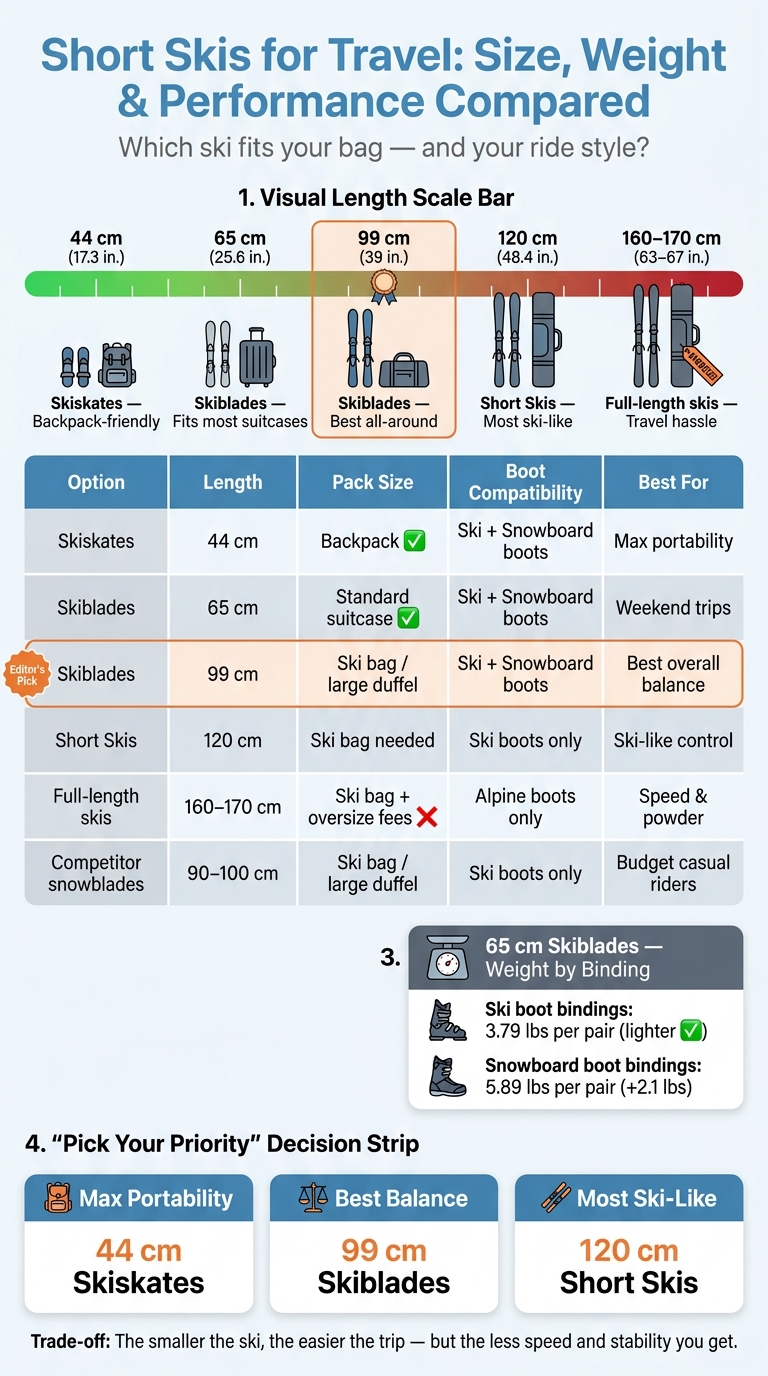
Short Skis for Travel: Size, Weight & Performance Compared
Snowboarder tries Snowfeet* | Which Snowfeet* Short Ski is the Best? | Snowblades 44, 65, 99 Review
Quick Comparison
| Option | Length | Best For | Main Trade-Off |
|---|---|---|---|
| Snowfeet* Skiskates | 44 cm | Backpack travel, carry-on style packing | Least stable at speed |
| Snowfeet* Skiblades | 65 cm | Weekend trips, casual resort laps | Less calm on steep or icy runs |
| Snowfeet* Skiblades | 99 cm | Most travelers, best overall balance | Still bigger than ultra-short options |
| Snowfeet* Short Skis | 120 cm | Riders who want more ski-like control | Harder to pack than shorter models |
| Full-length skis | 160–170 cm | Fast skiing, powder days | Bulky, heavy, travel hassle |
| Competitor snowblades | 90–100 cm | Short-ski riders with ski boots | Less boot freedom, more packing bulk |
A few numbers tell the story fast:
- 44 cm = 17.3 in.
- 65 cm = 25.6 in.
- 99 cm = 39 in.
- 120 cm = 48.4 in.
- Full-length skis = 63–67 in.
And if weight is your thing, the 65 cm skiblades come in at about 3.79 lb per pair with ski bindings and 5.89 lb per pair with snowboard bindings. That’s a pretty big gap for flyers watching bag weight.
So, if I were packing for a flight tomorrow, I’d keep it simple:
- pick 44 cm for the smallest setup
- pick 99 cm for the best all-around trip ski
- pick 120 cm if you want more control and don’t mind checking a longer bag
If you want a quick visual on short skis and snowblades, these may help:
So, this guide is all about one question: how much travel ease are you willing to trade for more speed and stability?
1. Snowfeet* Skiskates 44 cm
At 44 cm, the Skiskates are the smallest option in this comparison. They fit in a backpack and stay well under most carry-on size limits. That’s a big deal if you’re trying to dodge the whole long-ski travel headache.
They’re built like actual skis, not like a toy or novelty add-on. That said, some users say they feel heavier than their size would make you expect. Fair point. But that extra weight makes sense for skis that need to handle repeat travel, getting packed, moved around, and used on trip after trip, not just tossed in a bag once.
Boot fit matters too. These work with ski boots and snowboard boots. If walking comfort is high on your list, the snowboard-boot version is the easier pick.
On snow, they lean hard toward maneuverability over top speed or high-speed control. The feel is closer to skating than standard skiing. They’re slower and less stable at speed than the 99 cm or 120 cm models, so they make the most sense for travelers who want the smallest ski setup they can get. One verified user summed it up like this:
"These are not as fast as regular skis. If you like to bomb runs as fast as possible, you'll want longer skis. For everything else, these are absolutely incredible." - Mike E, Verified User
They’re rated 5.0/5 from 123 reviews and start at $460. If you want a bit more stability without giving up much packability, the next step up is the 65 cm Skiblade.
2. Snowfeet* Skiblades 65 cm
Pack Size and Travel Weight
The 65 cm Skiblades hit a nice middle ground. They give you more stability than the 44 cm Skiskates, but they’re still easy to travel with.
At 65 cm (25.6 in.), they fit in most standard suitcases or duffel bags. That makes them much easier to pack, carry, and stash away than full-length skis. If you’re flying out for a weekend trip, that matters a lot.
Weight depends on the binding setup. The ski-boot version weighs 3.79 lbs per pair, while the snowboard-boot version comes in at 5.89 lbs per pair because the bindings are heavier.
Boot Compatibility
You’ve got two binding choices here:
- Ski boots (US sizes 4.5–14.5)
- Snowboard boots (US sizes 6–14.5)
Both options adjust without tools, which is a nice touch.
If you want the lightest setup, go with ski boots. If you care more about comfort when walking between the lodge and the lift, snowboard boots make more sense. They do add some bulk, sure, but they’re easier on your feet. It’s kind of the classic travel trade: lighter bag or comfier walk.
Resort Performance
Here’s the part most travelers care about: are they still fun on a short resort day? Yep.
These are made for groomed slopes, terrain parks, and moguls. They have a 4 m turn radius and a deep sidecut, so they feel quick edge to edge and easy to carve. That short-turn feel is a big part of the fun.
There is a catch, and it’s worth saying straight. They feel less planted at higher speeds, and they’re not built for deep powder. But for casual resort laps, weekend trips, and playful days on packed snow, that trade-off is easy to live with.
They’re rated 5.0/5 from 77 reviews and start at $590. If you want more speed and a steadier ride, the 99 cm Skiblade is the next step up.
3. Snowfeet* Skiblades 99 cm
Pack Size and Travel Weight
At 99 cm (39 in.), these skiblades take up a lot less space than full-length skis. That makes them easier to bring on flights, toss in a compact car, or stash for a road trip. Compared with the 65 cm version, this size still travels well but gives you more confidence once you're on snow.
As Brad Tolin put it:
"Also a big plus - they're lightweight and much easier to carry around than full-size skis."
Boot Compatibility
The 99 cm model comes in both ski-boot and snowboard-boot versions. That’s a nice setup. Snowboard boots are easier to walk in, which your feet will thank you for in the parking lot. Ski boots give you firmer carving control. So you can pick the feel you want without losing the easy-to-travel appeal.
Resort Performance
On snow, the 99 cm model feels closer to a ski than the 65 cm version. It’s built for groomed slopes and moguls. That makes it a strong pick for travelers who want something small enough to pack, but still closer to an all-mountain feel.
The deep parabolic sidecut helps carving feel smooth and natural. The twin-tip design also lets you ride switch if you want to change things up. It has a 5.0/5 rating from 50 reviews and starts at about $690. If you want more planted control at speed, step up to the 120 cm model.
4. Snowfeet* Short Skis 120 cm
Pack Size and Travel Weight
If 99 cm feels a bit too tiny, 120 cm is the next move for travelers who want more of that classic ski feel. At 120 cm (48.4 in.), these are the longest skis in the Snowfeet* lineup, but they’re still far easier to travel with than standard 160–170 cm skis.
That extra length matters. It gives you more stability on snow without turning packing into a whole airport headache. Put simply, this is the most ski-like Snowfeet* model that still fits the whole easy-to-travel idea.
Boot Compatibility
The 120 cm model is ski-boot only. It uses Pro Ski Boot Bindings for Mondo Point 26–36.1. So, yes, you give up snowboard-boot use here.
But that trade-off has a clear upside: the setup feels more precise and closer to a regular ski.
Resort Performance
On snow, this model leans much closer to a standard ski than the shorter Snowfeet* options. The camber plus tip-and-tail rocker gives it a planted feel at higher speeds, while the narrow 7.8 cm waist helps it stay quick from edge to edge. The twin tips also let you ride switch.
"Please note that these are not as fast as regular skis. If you like to bomb runs as fast as possible, you'll want longer skis. For everything else, these are absolutely incredible."
It handles groomed runs, moguls, and ungroomed terrain better than the shorter Snowfeet* models. That’s the big draw. You get something that starts to feel close to a standard ski, while still being much less of a pain to travel with.
Price: $950
Next up: how this middle-ground setup stacks up against full-length all-mountain skis.
sbb-itb-17ade95
5. Full-Length All-Mountain Skis (160–170 cm)
Pack Size and Travel Weight
Full-length skis are a pain to travel with. At 160–170 cm (about 63–67 in.), they don’t fit in a standard suitcase. You need a ski bag, and that can mean oversize airline fees.
That matters at every step of the trip. Flying gets more annoying. Rental cars need more space. Hotel storage turns into one more thing to deal with. For travelers, the difference is plain: you need a ski bag, not a standard suitcase.
Boot Compatibility
Traditional all-mountain skis usually lock you into alpine boots and standard alpine bindings. Snowfeet stay more flexible, which gives you more room to choose what works for your setup.
Resort Performance
If your goal is top speed, a 160–170 cm all-mountain ski has one big edge: stability. Shorter skis just can’t match it when you’re charging hard.
But there’s a trade-off. These skis can feel clunky on:
- moguls
- narrow trails
- crowded slopes
That’s exactly where shorter Snowfeet* models are easier to control and a lot less fussy. So, yeah, speed is the main reason people put up with the travel hassle. And that in-between zone is where competitor snowblades try to make their case.
6. Competitor Snowblades and Short Skis (90–100 cm)
Elan, Salomon, and SnowJam all make skis in this range. Common picks include the Elan Freeline 99 cm, Salomon Snowblade 99 cm, and SnowJam 540 Titan 90 cm. These are the short-ski options people often stack up against Snowfeet*.
For travel, the main issue isn’t whether they ride well. They do. The bigger issue is how much room they take up and whether you’re stuck with ski boots. That’s where things get a lot less fun, fast.
Pack Size and Travel Weight
At 90–100 cm - about 35–39 inches - these skis are far easier to travel with than full-length all-mountain skis. No debate there. But they still take up more space than Snowfeet* 65 cm or 44 cm models.
In plain terms, most people won’t toss these into a normal suitcase and call it a day. They’ll usually go in a checked bag, ski bag, or a big duffel. So, yes, they’re shorter. But they’re not exactly small.
Boot Compatibility
Most competing models use standard alpine boots and bindings. The SnowJam 540 Titan fits ski boot sizes US 4–11.5, but that also means you’re locked into ski boots.
That matters more than it may seem at first. Boot choice affects:
- how easy your gear is to pack
- how much stuff you need to carry
- how comfortable you are when you’re not on snow
And let’s be honest - walking around in ski boots is nobody’s idea of a smooth airport day :) If you want one setup for riding and easier travel, boot limits can become a pain.
Resort Performance
On snow, these skis do a nice job on groomers and packed conditions. They can carve well, and they have that quick, playful feel many riders like.
Salomon marketed the Snowblade line to intermediate and advanced riders. So these aren’t beginner-only toys. They’re built more for skiers who already know how to control a short, lively ski.
If you want that same general length but more freedom with boots, Snowfeet* 99 cm Skiblades give you the option to use ski boots or snowboard boots.
These short skis can be a blast. But for travelers, the trade-off still comes back to three simple things: size, weight, and boot choice.
How Each Criterion Affects Your Travel Decision
Now it’s time to stack these options side by side on four travel factors: pack size, weight, boot compatibility, and resort feel.
Pack size is usually the first thing people look at. And yeah, that makes sense. If your gear is a pain to carry, the trip gets annoying fast. The Snowfeet* Skiskates at 44 cm (about 17 inches) fit in a backpack, which makes them the easiest pick for air or car travel.
Travel weight starts to matter the second you deal with airline bags. Shorter skis weigh less as a rule, and the binding setup changes the total too. On the 65 cm Skiblades, snowboard bindings add about 2 lbs per pair compared with ski bindings. That’s a pretty big deal if you’re trying to keep your bag as light as possible.
Boot compatibility changes more than people think. It affects packing, walking, and how your feet feel after a long day. The Snowfeet* 44 cm, 65 cm, and 99 cm models come with either ski boot or snowboard boot bindings. That gives Snowfeet an edge for travel, and it’s a lot easier to walk around in than setups that lock you into ski boots only.
Resort performance is where the trade-off gets plain and simple. Full-length skis still do better at speed and in powder. Short skis do better on groomers, moguls, and in terrain parks. Different tool, different job.
Here’s the fast breakdown:
| Criterion | Best Option | Key Trade-off | Best For |
|---|---|---|---|
| Pack Size | Skiskates 44 cm | Less stability at speed | Carry-on travelers, backpackers |
| Travel Weight | 65 cm Skiblades (ski bindings) | Less comfortable to walk in than snowboard boots | Weight-conscious flyers with ski boots |
| Boot Comfort | 99 cm Skiblades (snowboard bindings) | Heavier than the ski-binding version | Casual riders, all-day comfort |
| Resort Performance | 120 cm Short Skis | Less compact than the shorter models | Riders who want a longer short ski for resort use |
| All-Mountain | 160–170 cm full-length skis | Heavy, bulky, expensive to fly | Advanced skiers, powder hunters |
Next, it helps to look at the trade-offs head-on in the pros-and-cons section.
Pros and Cons of Each Option
When travel comes first, every option gives you a different mix of packability, control, and ride feel. Some are dead simple to toss in a bag. Others ski more like the gear you already know, but take more work to haul around.
Here’s the side-by-side view:
| Item | Biggest Pros | Main Cons | Best For |
|---|---|---|---|
| Skiskates 44 cm | Smallest and easiest to fly with; fits in a backpack; works with ski boots or snowboard boots | Least stable at speed; poor in powder; steepest learning curve of the group | Minimalist flyers, budget travelers, and one-bag trips |
| Skiblades 65 cm | Short enough for most checked suitcases; more edge control than Skiskates | Limited on steep or icy terrain; not built for deep powder or high-speed runs | Weekend trips, families, and casual resort riders |
| Skiblades 99 cm | Easier to pack than full-length skis; more stable feel and a more traditional ski experience | Usually still needs a ski bag; gives up some stability at high speeds | Resort riders and travelers who want a real ski feel without hauling long skis |
| Short Skis 120 cm | More stable than shorter models; standard release bindings; better all-around resort performance | Needs a ski bag; heavier and bulkier than the shorter Snowfeet* options | Travelers who want near-traditional performance and don't mind checking a ski bag |
| Full-length skis (160–170 cm) | Best stability at speed; handles powder and variable terrain well | Bulky and heavy; usually requires a ski bag and can mean extra airline fees | Advanced skiers on destination vacations who prioritize performance over convenience |
| Competitor snowblades (90–100 cm) | Compact and lighter than full-length skis | Less boot flexibility and packability than Snowfeet* options | Budget-conscious casual riders who already own ski boots |
The pattern is pretty clear. The smaller the gear, the easier the trip. But you also give up some speed, float, and calm on rough snow.
So, it comes down to one thing: how much portability are you willing to give up for more speed and stability?
The next section turns these trade-offs into a final pick for travel-first skiers.
Conclusion: Which Short Ski Is Best for Travel?
If you want the easiest option to toss in a backpack, the 44 cm Skiskates win on portability.
For most riders, though, the 99 cm Skiblades hit the sweet spot. They’re easy to pack, but they still feel good on snow. The 65 cm option makes sense for short resort trips, while the 120 cm Short Skis are the better pick if you want a ride that feels closer to a standard ski.
There’s always a trade-off here. The more ski-like the ride feels, the more space the gear takes up. Full-length skis still come out on top for speed and powder, but they’re tougher to haul around and usually cost more to fly with.
So, it comes down to one simple thing: how much portability are you willing to trade for performance?
For most casual travelers, 99 cm Skiblades are the best all-around pick. Go with 44 cm if you want maximum portability. Pick 120 cm if you want the closest thing to a standard ski feel.
FAQs
Can I bring short skis as carry-on?
Yes, but it depends on the model.
Snowfeet 38 cm Mini and 44 cm Skiskates are your best carry-on bets. They usually fit in standard carry-on bags or large backpacks, which makes travel a lot easier.
The 50 cm PRO might fit too, but there’s a catch: the bindings can make packing a bit snug.
Anything over 50 cm - like the 65 cm, 99 cm, and 120 cm models - is usually too long for cabin storage. Those should be checked.
A couple of things can still throw a wrench in the plan:
- Airlines make the final call
- Full flights may lead to gate-checking, even if your gear would normally fit
So, if you want the safest carry-on option, stick with the 38 cm Mini or 44 cm Skiskates.
Which Snowfeet* size is best for beginners?
For beginners, the best Snowfeet* size is 65 cm Skiblades. They’re the easiest to learn on, and they hit that sweet spot between control and comfort on groomed runs at normal resort speeds.
If you want a bit more stability once your skills start to click, 99 cm is the next move. But for most new riders, 65 cm is the best place to start.
Do I need ski boots or snowboard boots?
No. You don’t need stiff alpine ski boots or snowboard boots made just for Snowfeet* short skis.
Snowfeet* Skiskates and Skiblades come with bindings that fit ski boots or snowboard boots within the supported size ranges. Some models even work with regular winter boots.
So, in many cases, you can use the same footwear for walking and riding. Nice and simple :)











Hagyj egy hozzászólást
Ezt a webhelyet a hCaptcha rendszer védi, és a hCaptcha adatvédelmi szabályzata, valamint szolgáltatási feltételei vonatkoznak rá.