





If you wear a men’s U.S. size 12 to 14 boot, the short answer is this: go with the 65 cm Skiblades if you want the safest middle ground, or the 99 cm class if you want the most stable ride. The 44 cm Skiskates fit big boots on paper, but the ride gets more twitchy as rider size and speed go up. The PRO 50 cm is the weak spot for big feet because its fit tops out at U.S. 13, and bulky boots can still be a problem.
I’d break it down like this:
- Best for most big-foot riders: Snowfeet* Skiblades 65 cm
- Best for tall or heavier riders: 99 cm short skis
- Best for max packability: Skiskates 44 cm
- Best only if you use winter boots: Snowfeet PRO 50 cm
Three things matter most here:
- Boot type: ski boots, snowboard boots, or winter boots
- Binding fit: the stated size range is only half the story
- Platform length: more length usually means more control
One number says a lot: the 44 cm model is less than half the length of the 99 cm class. That’s great for a backpack. It’s not as great when a tall rider wants a calmer feel on firm snow.
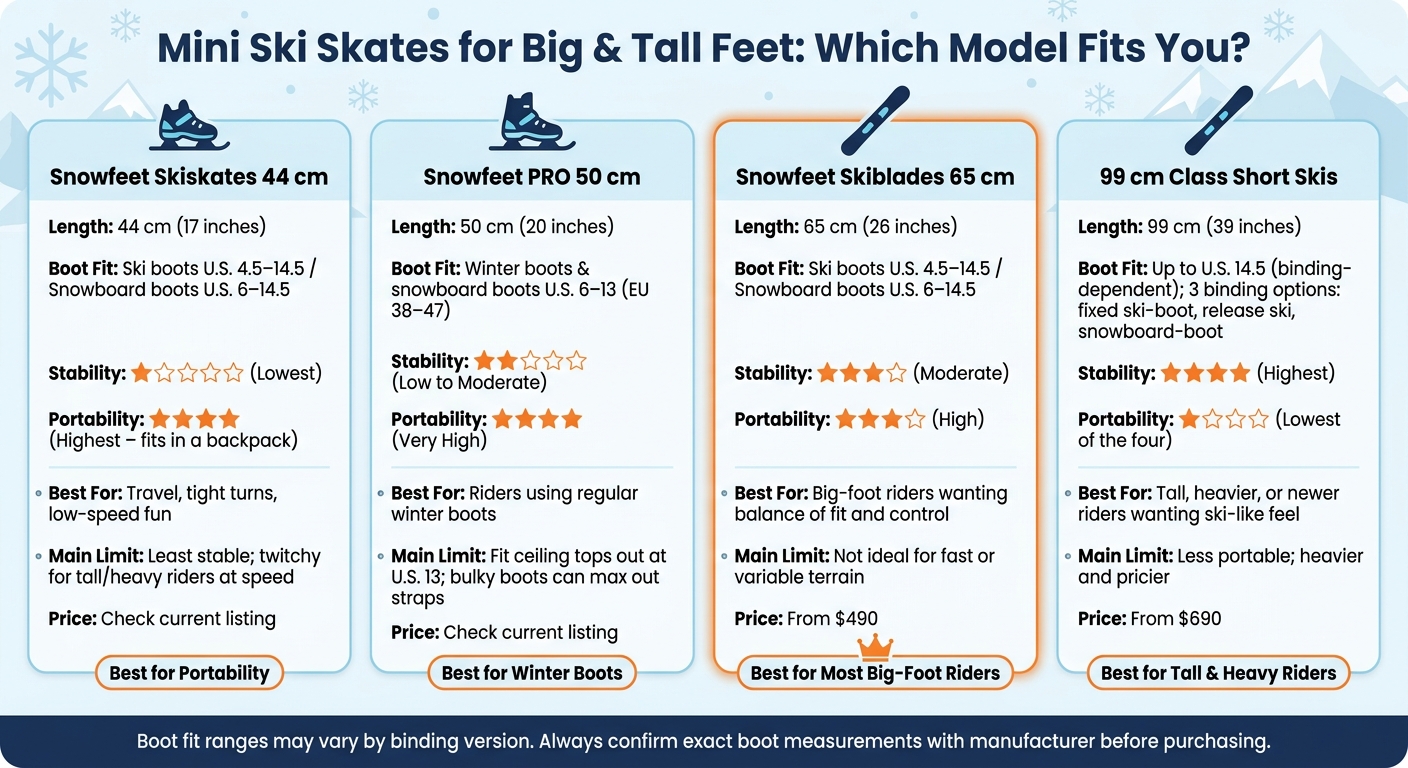
Mini Ski Skates for Big Feet: Side-by-Side Comparison Chart
Ski or Skate on Snow? With Snowfeet 65 CM, You Can Do Both.
Quick Comparison
| Model | Boot fit | Best for | Main limit |
|---|---|---|---|
| Snowfeet* Skiskates 44 cm | Ski boots U.S. 4.5–14.5; snowboard boots U.S. 6–14.5 | Travel, tight turns, low-speed fun | Least stable of the group |
| Snowfeet PRO 50 cm | Winter boots and snowboard boots U.S. 6–13 | Riders who need regular winter-boot use | Big boots can max out the straps |
| Snowfeet* Skiblades 65 cm | Ski boots U.S. 4.5–14.5; snowboard boots U.S. 6–14.5 | Best balance of fit and control | Still short for fast, rough conditions |
| 99 cm class | Up to U.S. 14.5 in matching versions | Tall riders, heavier riders, more ski-like feel | Less portable and costs more |
So, if I were helping a size 13 or 14 rider in the shop, I’d start with the 65 cm first. It’s the point where the setup starts to feel more planted and less like you’re standing on two icy bananas :) If stability matters more than pack size, I’d move straight to the 99 cm class.
1. Snowfeet* Skiskates 44 cm
At 17 inches long, the Snowfeet* Skiskates 44 cm are the smallest pick in this lineup. Tiny? Yes. But they’re not a toy. You can get them in a ski-boot version or a snowboard-boot version, so the right choice depends on what you ride in.
The ski-boot version fits U.S. sizes 4.5–14.5. The snowboard-boot version fits U.S. sizes 6–14.5. That’s a pretty wide fit range for such a short platform. It also means they can work for riders with bigger feet, including U.S. sizes 13 and 14. One thing to note: these are not made for regular winter shoes.
The bindings are adjustable and tool-free, which is nice when you want to get set up without messing around in the snow. But there’s an important catch: they use a fixed, non-release binding, not a standard ski release binding. That matters. Snowfeet* also doesn’t list a max rider weight or a release rating for this model, so if you’re a bigger rider and need those specs, it’s smart to check with the company before you buy.
For larger riders, the main issue isn’t foot fit. It’s how the 44 cm platform feels once you pick up speed. This is the most portable and nimble option here, but that short length gives up some stability compared with the 65 cm model and the roughly 99 cm short skis. So, if you want something easy to pack, easy to carry, and quick edge to edge, this one makes sense. If you want more stability, better speed control, or a bit more support underfoot, it’s worth stepping up to a longer model.
Price depends on the seller and the binding version, so check the current listing before you order. Next up: the Snowfeet PRO 50 cm, which adds a bit more length and support without getting bulky.
2. Snowfeet PRO 50 cm
If the 44 cm Skiskates feel a bit too short under your feet, the Snowfeet PRO 50 cm is the next move. At 20 inches long, it gives you an extra 6 cm over the 44 cm Skiskates. That may not sound like much, but on snow it can make a clear difference. Taller riders tend to get a steadier, more planted stance without hauling around much more gear.
The PRO works with winter boots and snowboard boots. The fit range is U.S. sizes 6–13 (EU 38–47). That said, boot bulk matters a lot here. Big winter boots or chunky snowboard boots can eat up the strap length fast. And for snowboard boots, the maker says U.S. 12–13 sizes may not always fit because of that extra bulk. If the strap is maxed out, control drops in a hurry. A loose fit on snow is like a loose truck on a skateboard - fun for about two seconds, then not so much.
There’s no published maximum rider weight for this model. So for taller or heavier riders, the main thing to watch is boot hold. If your boots stay locked in and you’re riding at smooth, low-to-moderate speeds, that’s the lane this model fits best.
The PRO works best on:
- Groomed trails
- Packed snow
- Moderate slopes
Skip it for powder or high-speed open runs. That’s the trade-off: more portable than Skiblades, but less calm at speed. If you want more support and better speed control, step up to the 65 cm Skiblades.
sbb-itb-17ade95
3. Snowfeet* Skiblades 65 cm
At 65 cm (26 inches), the Snowfeet* Skiblades give bigger riders a bit more support and a calmer feel underfoot. That extra length starts to matter when you want more control but still like the small, easy-to-carry format.
The shape - 11/9.5/11 cm with a 4 m radius - is built for quick turns and solid edge grip on hardpack. On groomed snow, that tends to feel more steady and easier to trust for taller or heavier riders.
You can get the Skiblades in both ski-boot and snowboard-boot versions. The fit range is broad enough for U.S. men’s size 13–14 riders:
- Ski boots: U.S. 4.5–14.5 (EU 36–49, mondo 22.5–32.5)
- Snowboard boots: U.S. 6–14.5 (EU 38–49)
For bigger boots, this is the first model in the lineup that starts to feel planted instead of twitchy. One heads-up, though: check both your boot type and your actual shell size before you buy. For ski boots, mondo point is the safest number to use.
These Skiblades work best on groomed resort snow, beginner areas, and parks. They’re made for controlled, playful riding. Not for bombing open runs. And not for deep powder.
Listed price: $490. That puts them in a nice middle spot before you jump to the 99 cm class, where you give up some portability for more stability.
4. Longer Short Skis and Snowblades (99 cm Class)
If the 65 cm Skiblades feel a bit too tiny, the 99 cm class gives you the calmest ride at speed in the Snowfeet* lineup. At 99 cm (39 inches), there’s more ski under your feet, and you can feel it. For taller or heavier riders, that extra length tends to feel steadier once you pick up speed.
Snowfeet* Skiblades 99 cm use an 11.5/8.5/11 cm shape (tip/waist/tail), a 6 m turning radius, and tip and tail heights of about 5 cm. Put simply, that longer edge gives you more support front to back than the shorter models. If you spend more time in soft snow, the Snowfeet* POWDER 99 cm goes wider at 15/12/15 cm, which adds more surface area for light powder. It still won’t float like a full-length powder ski, of course, but the POWDER version is the better call when the snow gets softer.
One of the big selling points here is the binding choice. The 99 cm comes in three setups: fixed ski-boot bindings (U.S. 4.5–14.5 / EU 36–49), release ski bindings (mondo 26–36.5), and snowboard-boot bindings (U.S. 6–14.5 / EU 38–49). That top end of U.S. size 14.5 is a nice plus if your boots run big. And if you already own snowboard boots, that version is simple and comfortable. Want more of a direct ski feel? Go with the fixed ski-boot binding. If you use compatible alpine ski boots and want release settings you can adjust, the release-binding option is worth a look, though it should be mounted or checked by a qualified ski tech.
That broad binding range is where Snowfeet* stands out most against ski-boot-only rivals. The Elan Freeline and FiveForty Hares both have solid 99 cm options, but both stick to ski-boot-only bindings. Snowfeet* gives you three ways to set things up, which is a big plus if you want to ride in snowboard boots. Pricing for the Snowfeet* Skiblades 99 cm starts at $690.
Compared with the 65 cm model, the 99 cm version gives up some packability for more stability and stronger edge control. That’s the trade. Less toss-it-in-a-backpack energy, more planted-on-snow feel.
| Factor | 65 cm Skiblades | 99 cm Skiblades |
|---|---|---|
| Stability at speed | Moderate | Noticeably better |
| Soft-snow flotation | Limited | Better, especially on the POWDER version |
| Portability | Very compact | Still compact, but longer |
| Tight turns and tricks | Strong | Good, but less playful |
| Boot size coverage | Up to U.S. 14.5 | Up to U.S. 14.5 |
| Starting price | From $490 | From $690 |
Pros, Cons, and Fit Trade-Offs by Model
Binding fit is only part of the story. Platform length and boot support have a big effect on how planted, or twitchy, the ride feels. That matters a lot if you have bigger boots or you're a taller rider.
Here’s the quick side-by-side view:
| Factor | Skiskates 44 cm | Snowfeet PRO 50 cm | Skiblades 65 cm | 99 cm Class |
|---|---|---|---|---|
| Fit ceiling | High | Moderate | High | Depends on binding; up to U.S. men's size 14.5 in compatible versions |
| Stability | Lowest | Low to moderate | Moderate | Highest |
| Portability | Highest - fits in a backpack | Very high | High | Lowest of the four |
| Control on firm snow | Demanding | Slightly easier than 44 cm | Noticeably more settled | Best edge grip and tracking |
| Comfort for taller riders | Tiring | Similar demands to 44 cm | Better fore-aft support; less twitchy | Most stable stance; smoothest tracking |
| Skip if… | You're tall or heavy and want high-speed stability or a conventional ski feel | Your boot is U.S. 14 or larger, or you need maximum stability | You ride fast, in deep snow, or on highly variable terrain regularly | Your top priority is the smallest, lightest travel setup |
Use the table as your fast filter. Then spend extra attention on the two middle models, because that’s where most fit calls get made.
The PRO 50 cm is the pick if pack size comes first. It’s easy to travel with, easy to stash, and just plain convenient. The catch? It has the tightest practical fit ceiling of the group. So if your boots run big, this is where things can get annoying in a hurry.
The 65 cm Skiblades hit the sweet spot for a lot of big-foot riders. You still get a compact setup, but the ride feels calmer and less nervous. Put simply: more support, less drama. If you want better stability without jumping to a much longer platform, this is usually the safer bet.
Next: match your boot type to the best model and pick the final setup.
Best Pick by Boot Type and Final Verdict
Use the table below to turn the fit and stability trade-offs into a final pick.
| Rider or boot type | Best pick | Why | Main trade-off |
|---|---|---|---|
| Ski boots, U.S. 4.5–14.5 | Skiskates 44 cm (portability) or Skiblades 65 cm (stability) | 44 cm is the most compact ski-boot option; 65 cm adds stability | 44 cm is less forgiving; 65 cm is bulkier |
| Snowboard boots, large adult feet | Skiblades 65 cm, in the snowboard-boot binding version | Longer platform gives a more confident stance for taller or heavier riders | Use the snowboard-boot binding version only |
| Regular winter boots, U.S. 6–13 | Snowfeet PRO 50 cm | Designed for standard winter footwear | Less stable than a 65 cm or 99 cm platform at speed |
| Experienced rider, maximum portability | Skiskates 44 cm | Shortest, lightest, quickest to turn | Demands more balance; least forgiving at speed |
| Tall, heavier, or newer rider | 99 cm-class short skis | Most fore-aft support and the most familiar ski-like feel | Less portable; typically heavier and pricier |
| Boot near the size limit | Verify before buying | If your boot is near the top of the range, confirm the binding version before buying | Contact Snowfeet with your exact boot measurements first |
Before you buy, confirm your exact boot size, binding version, and rider-weight limit.
Here’s the simple way to think about it: if portability matters most, go shorter. If control matters most, go longer.
Skiskates 44 cm are the go-to pick for portability. PRO 50 cm works with standard winter boots. Skiblades 65 cm hit the middle ground on fit and control. And 99 cm short skis are the stability-first option.
FAQs
How do I choose between 65 cm and 99 cm?
Choose 65 cm skiblades if you want more stability and support than the shorter options. They make sense for heavier or taller riders, faster laps on groomers, and cleaner carving with snowboard boots.
Choose 99 cm if you want the safest all-around pick for casual resort use. It gives you enough stability for moderate to higher speeds without feeling like too much ski.
If stability is your top concern, don’t go shorter than 65 cm.
Will my size 13 or 14 boots fit securely?
Yes - most Snowfeet models can fit size 13 or 14 boots just fine. The main thing is picking the right model.
The 44 cm Skiskates and 65 cm Skiblades fit snowboard boots up to US size 14.5, so they’re the safer bet for bigger boots.
The 50 cm PRO is rated for US sizes 6–13. So if you wear a size 13, it may work, but only if the straps close all the way and hold the boot snug. If the fit feels a bit tight, extra-long straps can help.
Are mini ski skates safe for heavier riders?
Mini ski skates can work for heavier riders, but the big thing is stability. And that comes down to ski length and snow conditions.
Ultra-short models, around 44–50 cm, can feel less stable or a bit twitchy once speed picks up. That’s fun for some riders, sure, but it can also feel like shopping carts with rocket boosters :)
For larger adults, sizes under about 90–95 cm aren’t a good main setup.
Here’s the simple breakdown:
- If you weigh over 170 lb, Snowfeet suggests the 50 cm PRO
- If you want the most stability and weight support, 99 cm or 120 cm are the better pick
- Those longer options work best on groomed runs
- Your boot binding needs to fit snug and be tightened the right way
That last point matters more than people think. Even a good ski can feel off if the binding is loose. A snug fit gives you better control and helps the skis feel more steady underfoot.













Hagyj egy hozzászólást
Ezt a webhelyet a hCaptcha rendszer védi, és a hCaptcha adatvédelmi szabályzata, valamint szolgáltatási feltételei vonatkoznak rá.