



















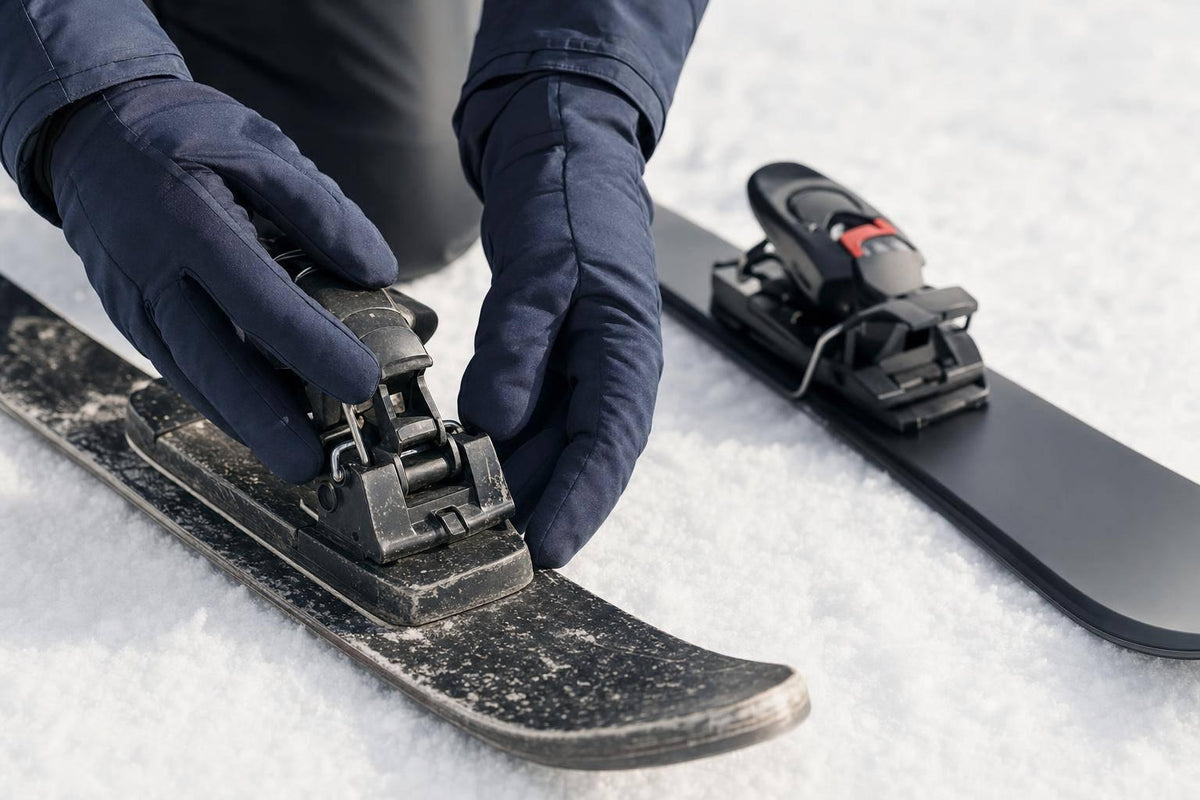
Yes - old snowblades can still be fine, but only if they pass 3 checks: structure, bindings, and boot fit. If the base or edges are damaged, the bindings are worn out, or the setup no longer matches how you ski, it’s time to move on.
Here’s the short answer:
- Keep them if they’re solid, the bindings still work as they should, and you ski mellow resort laps a few days a year.
- Upgrade if they have cracks, soft spots, delamination, loose binding screws, or old fixed bindings that don’t release.
- Be extra careful with age: bindings past 15–20 years old are often hard to service, and many older snowblades were built only for alpine ski boots.
- Modern short skis give you more boot options, less bulk, and a calmer ride for many skiers.
If I were checking a pair in my shop, I’d ask:
- Is the ski still sound?
- Do the bindings still hold and release right?
- Does this setup still fit how you ride now?
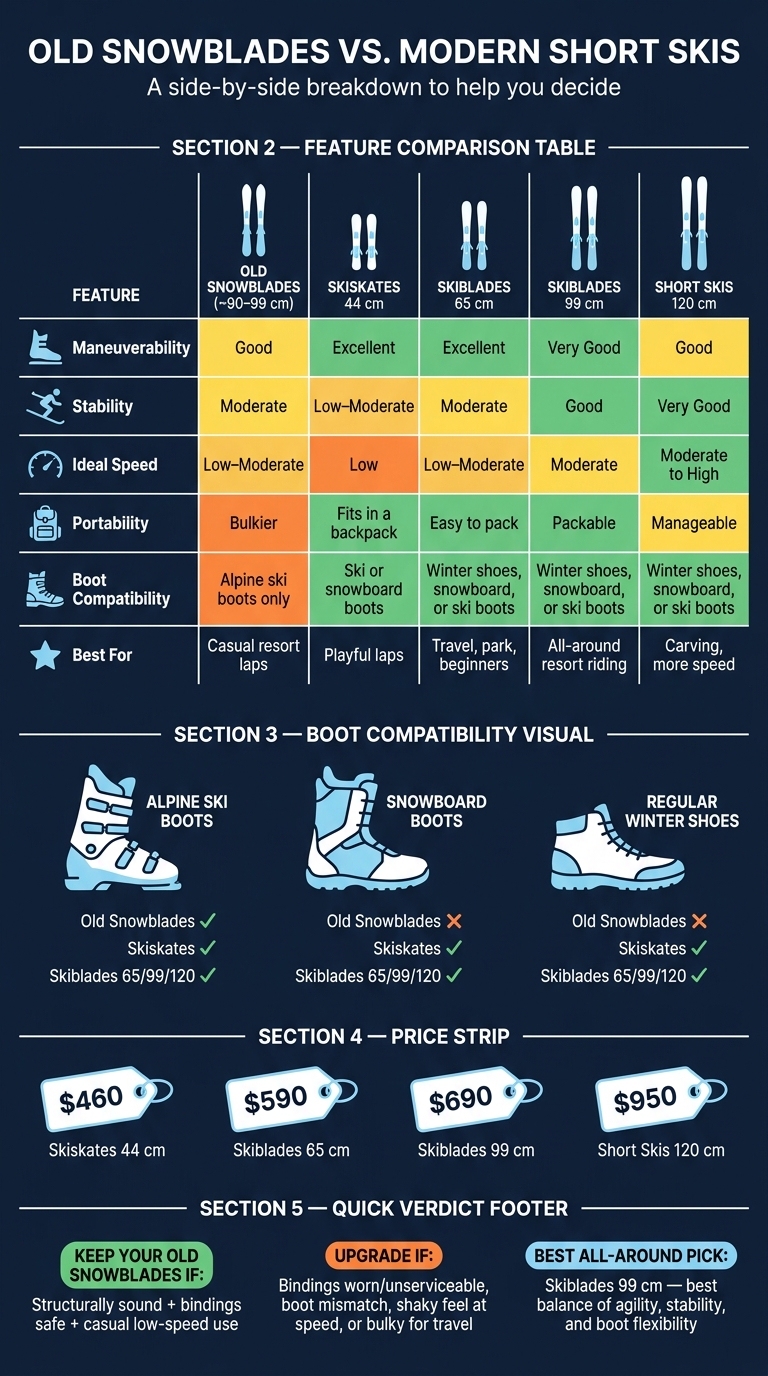
Old Snowblades vs. Modern Short Skis: Full Comparison Guide
Snowfeet* Snowblades | Skiboards | Skiblades | Short Skis - Complete Guide | All you need to know
Quick Comparison
| Option | Best case | Main risk | Best for |
|---|---|---|---|
| Old snowblades | Still in good shape, tight hardware, casual use | Old bindings, boot mismatch, shaky feel | Low-speed resort laps |
| Skiskates 44 cm | Tiny, easy to pack | Less stable at speed | Travel, playful laps |
| Skiblades 65 cm | Very easy to turn | Less calm when going fast | Beginners, short easy runs |
| Skiblades 99 cm | Best mix of control and stability | Less planted than 120 cm | Most resort riders |
| Short skis 120 cm | More stable and better edge hold | Bigger than other short options | Skiers who want more support |
A dry base or light rust isn’t the end of the world. But core shots, bent edges, bubbling topsheets, and weak binding mounts are hard stop signs. So, if your old pair is safe and still fun, keep skiing it. If not, don’t let nostalgia make the call :)
1. Check the Condition of Your Old Snowblades First
Start with a quick check: base, edges, topsheet, and binding mounts. Cosmetic wear is fine. Structural damage is a hard stop. If the shell looks sound, the next call comes down to bindings and boot fit.
Work from tip to tail on both blades in good light.
Base, edges, and topsheet: signs your pair still has life left
A gray, white, or chalky base usually means it’s dry and slow. That’s not great, but it’s often fixable with a tune and hot wax. What puts a base in the danger zone are core shots, deep gouges, warping, or base bubbles.
Edges tell a similar story. Light surface rust and small nicks are common, and most shops can clean those up. The big red flags are bent sections, cracks, missing chunks, or edges pulling away from the sidewall. Here’s a simple shop-floor test: press the bases together and slide them past each other. If you feel catching or hear clicking, you may have a bent or raised edge that needs a closer look.
On the topsheet, small chips near the tips and tails are normal wear. That part alone isn’t a deal-breaker. But if chips expose the core, or the topsheet bubbles, lifts, or peels, it’s time to stop and look closer. Press lightly around any sketchy spot. If it moves on its own or feels soft, the layers are no longer bonded. That’s bad news. Next up: the mounting area.
Core damage, delamination, and fatigue: signs it is time to retire them
Run your hand along each blade and press firmly underfoot. The flex should feel even. If you notice soft spots, a spongy feel, or crackling when you press down, that can point to core compression, moisture getting inside, or broken inner layers. A ski that feels flat and dead has likely hit the end of the road.
Delamination is one of the clearest signs that it’s time to retire them. Look for visible gaps, bubbling along the sidewall, or edges that shift when pressed. Once those layers separate, the blade can’t spread force the way it should in a turn. On firm snow, that bumps up the chance of sudden edge failure.
Then check the binding mounts. Screws that spin without tightening, cracks spreading from the screw holes, or soft material around the inserts all point to a weak mounting zone. If a binding can’t be torqued down the right way, it can detach under load. That pair is done.
| Area | Still usable | Time to retire |
|---|---|---|
| Base | Shallow scratches, dry but waxable, no core exposure | Core shots, deep gouges, warping, base bubbles |
| Edges | Light rust, minor nicks, small burrs | Bent, cracked, thinning, loose, or missing sections |
| Topsheet/sidewall | Cosmetic chips, small surface scratches | Bubbling, peeling, delamination, exposed core |
| Binding mounts | Screws snug and seated firmly | Cracked, stripped, or soft material around screws |
| Overall feel | Solid, flat, consistent flex | Soft spots, crackling, twist or warp, separation |
A solid pair can keep going. If the construction is damaged, though, don’t push your luck. Move straight to binding safety if the structure checks out.
2. Binding Safety and Boot Compatibility Matter More Than Age
Once the ski itself passes inspection, the binding is the big safety check. And honestly, it matters more than the age sticker.
A snowblade can look almost new and still be a bad buy if the binding doesn’t hold your boot well or won’t release when you crash. That’s why some older snowblades feel old even when the ski still looks clean.
Old fixed bindings vs. modern release options
Most older snowblades came with fixed, non-release bindings. That means the setup keeps you attached during a fall. And yeah, that’s the problem.
Modern alpine-style bindings are made to release under heavy twisting or forward-fall forces, which can help lower the risk of leg and knee injuries. A fixed binding doesn’t give you that backup.
Time also hits bindings harder than many people think. Straps crack. Buckles wear down. Plastic gets brittle. Metal parts can rust or corrode. Something that looks fine sitting in the garage may feel loose once you put real force into it on snow.
So, click your boot in and test it:
- Check for side-to-side play
- Watch for heel lift
- Listen for noise when the binding flexes
Any movement is a red flag. If the binding rattles, depends on worn straps or buckles, or needs a DIY fix to stay tight, skip it. No ski deal is worth that kind of gamble.
Which boots work best: ski boots, snowboard boots, or winter shoes
Boot fit is where a lot of older snowblades start to stumble.
Many old setups were built mostly for alpine ski boots with ISO 5355 soles. That’s fine if you already own ski boots. If you don’t, it’s a pain. Ski boots are stiff, bulky, and kind of miserable to walk in. Great for skiing. Not so great for everything before and after skiing.
This is where modern short-ski options like Snowfeet* Skiblades in 65 cm, 99 cm, and 120 cm, plus Snowfeet* Skiskates 44 cm, have a clear edge. They work with snowboard boots or regular winter shoes, depending on the model. That means no ski-boot rental, less gear to drag around, and a setup that’s much easier for casual days or last-minute trips.
For a traveler, a beginner, or someone who just wants to lap the bunny hill without hauling a full ski setup, that kind of boot freedom makes a big difference.
| Boot type | Old snowblades | Snowfeet* products |
|---|---|---|
| Alpine ski boots (ISO 5355) | Usually compatible | Compatible with select models |
| Snowboard boots | Rarely compatible | Compatible with Skiblades and Skiskates |
| Regular winter shoes | Not compatible | Compatible with Skiskates |
That’s the gap. If your old snowblades only work with ski boots you don’t own, the setup is already boxing you in. That’s where modern short skis like Snowfeet* start to make more sense.
Next, compare what you gain by moving to modern short skis.
sbb-itb-17ade95
3. Old Snowblades vs. Modern Short Skis: What You Gain by Upgrading
If your old snowblades passed inspection, the next thing to ask is simple: do they still match how you ride today? That’s where the gap starts to show.
The big changes come down to three things:
- Agility
- Boot fit
- Portability
And yeah, those three can change your whole day on the mountain.
Comparison table: old snowblades vs. Snowfeet* models
| Feature | Old Snowblades (~90–99 cm) | Skiskates 44 cm | Skiblades 65 cm | Skiblades 99 cm | Short Skis 120 cm |
|---|---|---|---|---|---|
| Maneuverability | Good | Excellent | Excellent | Very good | Good |
| Stability | Moderate | Low–moderate | Moderate | Good | Very good |
| Ideal speed | Low–moderate | Low | Low–moderate | Moderate | Moderate to high |
| Portability | Bulkier | Fits in a backpack | Easy to pack | Packable | Manageable |
| Boot compatibility | More limited | Ski or snowboard boots | Winter shoes, snowboard boots, or ski boots | Winter shoes, snowboard boots, or ski boots | Winter shoes, snowboard boots, or ski boots |
| Best for | Casual resort laps | Playful laps | Travel, park, beginners | All-around resort riding | Carving, more speed |
A lot of the ride feel comes down to length. Shorter gear turns faster. Longer gear feels calmer when you pick up speed. Pretty simple.
Snowfeet* Skiblades have a turning radius of around 4 meters, while regular all-mountain skis usually sit around 12–20+ meters. That’s a huge gap. On snow, it means Snowfeet* gear feels much faster to redirect. You think about turning, and it’s already halfway there :)
The Skiskates 44 cm are the smallest option in the lineup, and they feel like it. They’re hyper-agile, playful, and small enough to toss in a backpack. That makes them a fun pick for low-speed resort laps, skating-style movement, and side hits. What they’re not built for is sustained high-speed skiing or big-mountain terrain.
At the other end, the 120 cm Short Skis give you more stability and better carving than the smaller options. So if you want more performance but don’t want to drag yourself back to full-length skis, they make a lot of sense.
Where long skis still do better
Long traditional skis still have the edge in a few spots:
- High speed
- Deep powder
- Aggressive carved turns
For most casual resort riders, though, Snowfeet* is the easier setup and the one that fits more kinds of riding.
So the real question isn’t just whether your old pair still works. It’s whether keeping them is still the smart move for the way you ski now.
4. When to Keep Old Snowblades and When to Upgrade
If your pair passed inspection, the next step is simple: does it still match how you ski?
Keep them if your use is casual, low-speed, and occasional
Keep old snowblades only if they passed inspection and the bindings are still serviceable. If you ski a few days each season and stay on mellow green or blue runs, there’s no big need to replace them right away.
In that case, think of them as a backup setup or a fun laps option, not your main gear. That’s the sweet spot for older blades. Easy cruising, low speed, no drama.
Upgrade if you want better control, safer bindings, or easier travel
It’s time to upgrade when a shop won’t service or test the bindings. That’s the big one. And if your snowblades are more than 20 years old, they’re often past retirement age no matter how clean they look.
Bindings aren’t the only reason to move on, either. Upgrade if:
- your edges don’t hold on firm morning groomers
- your boots don’t fit the binding track the right way
- the setup feels shaky once you go past a relaxed cruising speed
- you travel to ski and the old blades feel bulky in the car or at the airport
That last point sneaks up on people. Old blades can turn packing into a game of Tetris nobody asked for.
Modern Snowfeet* gear fixes those three pain points: control, binding setup, and travel size. Pricing starts around $460 for Skiskates 44 cm, $590 for Skiblades 65 cm, $690 for Skiblades 99 cm, and $950 for 120 cm Short Skis.
Best Snowfeet* model by rider type
Once you know how you ride, the choice gets pretty easy.
| Rider Type | Best Model | Why |
|---|---|---|
| Beginners and playful riders | Skiblades 65 cm | Short, forgiving, easy to turn on green and blue runs |
| All-around resort skiers | Skiblades 99 cm | Best balance of agility and stability for a full day on mixed terrain |
| Stability-focused or transitioning from long skis | Short Skis 120 cm | More edge hold and a calmer feel at higher speeds |
| Frequent travelers and ultra-compact setups | Skiskates 44 cm | Fits in standard luggage, no oversized bag fees, easy to carry |
| Snowboard-boot or winter-shoe riders | Skiblades 65 cm or 99 cm in compatible setups | Certain Snowfeet* configurations work without rigid alpine ski boots |
For most casual riders, Skiblades 99 cm are the safest all-around pick.
If you’re still on the fence, the simple rule below settles it.
Conclusion: A Simple Rule for Deciding
After you check the condition and bindings, the call is pretty simple. Look at three things: structure, bindings, and how you ride.
If your old snowblades have no core damage or delamination, the bindings are safe, a shop is willing to service them, and you mostly take mellow laps on easy resort runs a few days each season, keep them. There’s no need to swap them out.
If a shop won’t service the bindings, the edges don’t hold, or the setup starts to feel shaky once you get past easy cruising speed, upgrade. Same goes if your boots no longer fit well or the setup feels too bulky for travel.
The short version
Keep your old snowblades if they're structurally sound, the bindings are safe and compatible with your boots, and your riding stays casual and low-speed. Upgrade if any part of that stops being true.
If you do upgrade, Snowfeet* is the cleaner pick for most casual riders. Snowfeet* Skiblades make the most sense for most people:
- Skiblades 99 cm for the best all-around balance
- Skiskates 44 cm for max portability
- 120 cm Short Skis for more stability
If it’s safe and still fun, keep it. If it’s holding you back, upgrade.
FAQs
Can a ski shop still service my old bindings?
Often, no. Many ski shops won’t service older snowblade bindings because parts can be hard to find, upkeep takes more work, and the safety systems may be out of date.
That can turn a cheap find into a headache. Instead of taking a safety risk or sinking time into repairs, moving to Snowfeet* is often the more practical pick.
Are old snowblades safe for beginners?
Not always.
A lot of older snowblades come with non-releasing bindings. That means they may not pop off in a fall, which can turn a wipeout into a much bigger problem. And yeah, that’s not something you want to gamble on.
Older models can also have:
- worn parts
- tired materials from years of use
- binding systems many U.S. ski shops won’t service
For beginners, modern Snowfeet* skiblades are often the safer pick. They’re more reliable, easier to use, and a lot less likely to give you headaches before you even get on the lift.
Which Snowfeet* length is best for me?
It comes down to how you ride and how much experience you have.
For most casual resort riders, the 99 cm Skiblades are the best all-around pick. They give you a nice mix of stability, carving, and agility. Think of them as the sweet spot - not too twitchy, not too long, just plain fun.
Go with the 44 cm Skiskates or 65 cm Skiblades if you want maximum playfulness, tricks, and easy transport. They’re small, light, and a blast if you like a more loose, skate-like feel.
If you want something closer to standard skis, the 120 cm Short Skis make more sense. They offer better stability at speed and stronger carving on steeper runs. The trade-off? They require ski boots.












Hagyj egy hozzászólást
Ezt a webhelyet a hCaptcha rendszer védi, és a hCaptcha adatvédelmi szabályzata, valamint szolgáltatási feltételei vonatkoznak rá.