




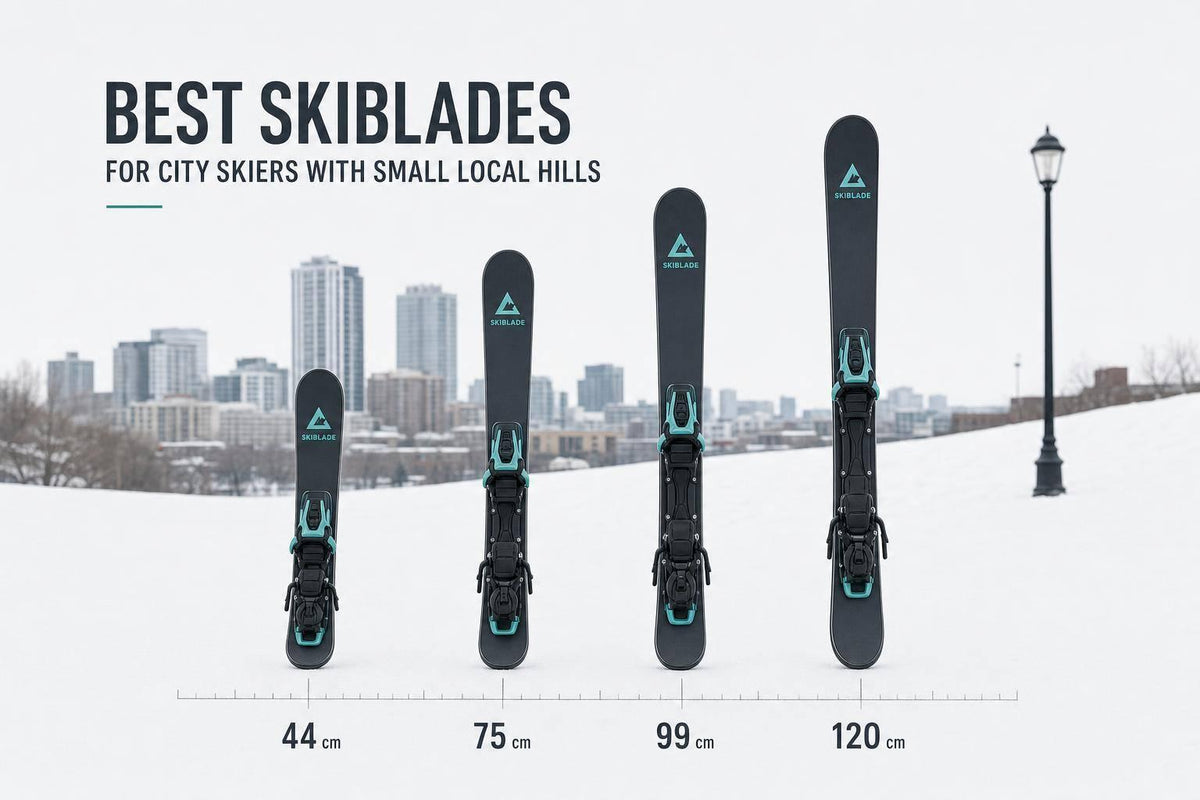
If I had to give one fast answer: the 65 cm Skiblades are the best fit for most city skiers on small local hills. They’re short enough for apartment life, bus or subway carry, and short after-work laps, but long enough to feel calmer than the 44 cm option. If you want max carry ease, go 44 cm. If you want more calm on snow, go 99 cm. If you want the closest feel to standard skis, go 120 cm.
Here’s the whole article in one quick sweep:
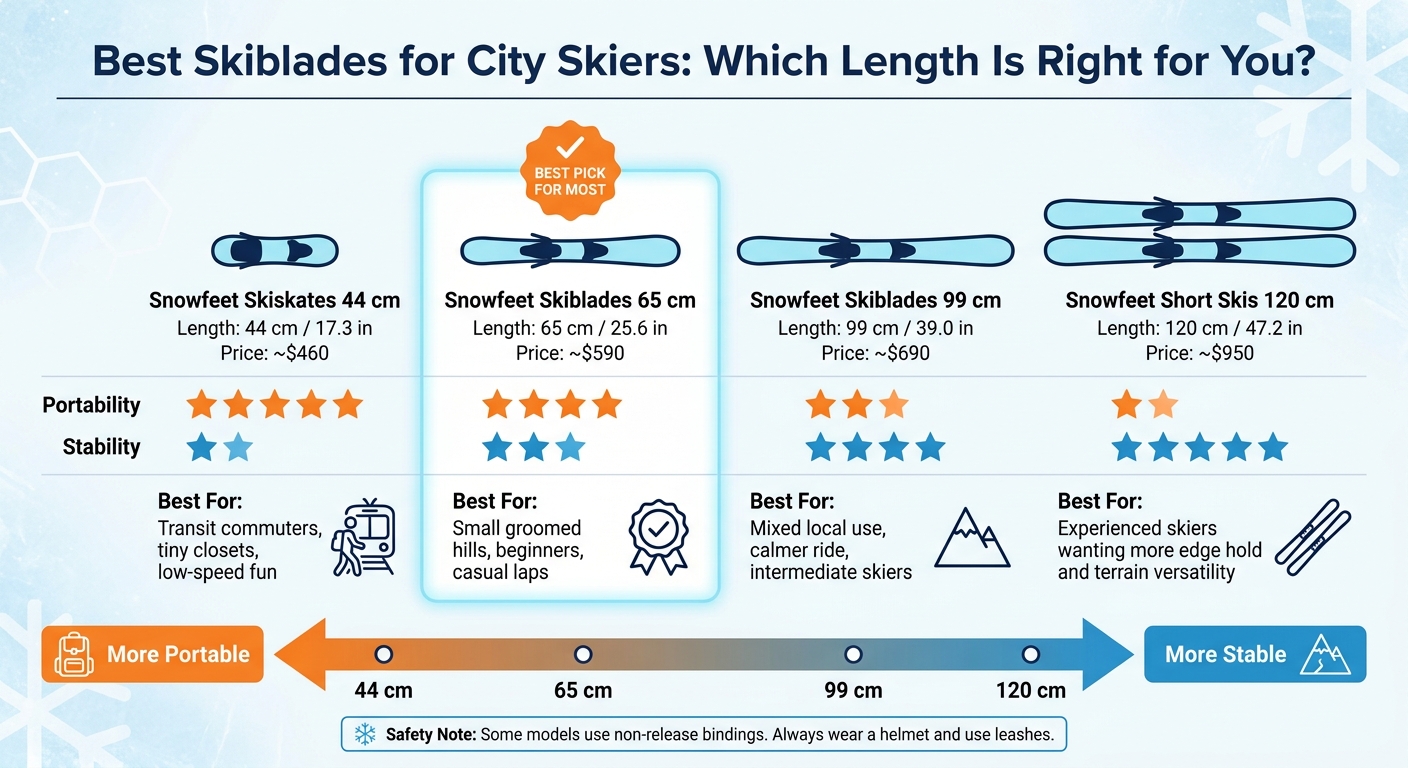
- 44 cm Skiskates: best for backpacks, tiny storage, and low-speed fun
- 65 cm Skiblades: best all-around pick for small groomed hills
- 99 cm Skiblades: best mix of agility and stability
- 120 cm Short Skis: best if you want more edge hold and a more standard ski feel
A few numbers make the tradeoff clear:
- 44 cm / 17.3 in
- 65 cm / 25.6 in
- 99 cm / 39.0 in
- 120 cm / 47.2 in
- Approx. prices: $460, $590, $690, and $950
So, what changes as length goes up?
- You get more stability
- You give up some carry ease
- You get a ride that feels less twitchy
- You need more storage space
Skiblades vs Short Skis: Size, Price & Performance Comparison for City Skiers
Snowboarder tries Snowfeet* | Which Snowfeet* Short Ski is the Best? | Snowblades 44, 65, 99 Review
Quick Comparison
| Model | Best For | Main Tradeoff | My Short Take |
|---|---|---|---|
| 44 cm Skiskates | Transit, tiny closets, playful laps | Least stable at speed | Pick these if carry size is your top issue |
| 65 cm Skiblades | Small local hills, beginners, casual laps | Not as steady as longer options | Best pick for most people |
| 99 cm Skiblades | Mixed local use, calmer ride | Takes more room than 44/65 cm | Best middle option |
| 120 cm Short Skis | More edge hold, more ski-like feel | Least compact of the four | Best if you want short skis that feel closer to normal skis |
One more thing: some setups use non-release bindings, so safety matters a lot. I’d keep it simple - wear a helmet, use leashes when required, and check binding type before you buy.
If you ski short groomed runs near the city, this comes down to one question: do you care more about carrying your gear, or how calm it feels on snow? That’s the whole game here :)
1. Snowfeet* Skiskates 44 cm
At 44 cm (17.3 inches), the Skiskates are Snowfeet's most portable model.
Portability and storage
This is where they shine. At 44 cm, they can fit in some backpacks, which makes subway rides, bus trips, apartment storage, and walking to the hill feel way more doable. No roof rack. No full ski bag. Just grab them and go.
That kind of day-to-day ease is hard to beat. Longer skis, even the 99 cm or 120 cm models, just don't slide into normal life as easily.
One small but important thing: protect the steel edges and base when you carry them around.
Stability and speed range
Short length gives you one clear tradeoff: less stability at speed, more agility in tight spaces.
So, these work best for:
- crowded short runs
- quick turns
- mellow laps
- park-style messing around
They are not built for fast carving. Think quick and playful, not full-send.
Best hill and terrain fit
They do best on gentle, groomed slopes and firm snow. Deep powder and steep runs are not their thing.
For a short after-work session on a local hill, though, they're tough to top on pure convenience. You can show up, click in, make a few fun laps, and head home without the whole big-ski routine.
Boot and binding practicality
The Skiskates come in two binding versions: ski-boot or snowboard-boot.
Ski-boot bindings fit about US 4.5–14.5 (EU 36–49, mondo 22.5–32.5). Snowboard-boot bindings fit about US 6–14.5 (EU 38–49).
The bindings adjust without tools, which is handy when you're moving from storage to transit to the hill. It's a small detail, but it makes life easier.
One thing you can't gloss over: these are non-release bindings. They do not work like standard releasable alpine ski bindings. So, yeah, safety matters a lot here.
Always:
- attach the safety leashes
- wear a helmet
- check that your boots are locked in before every run
If you like the same small footprint but want more stability, the 65 cm Skiblades are the next step.
2. Snowfeet* Skiblades 65 cm
At 65 cm, these Skiblades are a nice step up. They still work well in tight spaces, but they feel steadier and a bit more forgiving than the 44 cm Skiskates. If 44 cm feels a little too twitchy, but 99 cm or 120 cm sounds like too much ski, this is the middle ground that makes a lot of sense.
Portability and storage
Yes, they’re longer than the 44 cm Skiskates. But they’re still easy to carry, stash in a car, or store at home compared with full-size skis. For commuters or anyone who doesn’t want to lug around a long ski bag, that’s a pretty nice deal.
Stability and speed range
The 4 m turning radius - about 13 feet - keeps them quick from edge to edge, so short turns still feel easy. That extra length also settles things down at moderate speeds. In plain English: you get a calmer ride without losing the playful feel that makes short skis fun.
The shape helps the skis start turns with less effort, and they feel easier to guide where you want them to go. Compared with the 44 cm model, you get more edge hold and more stability, while still keeping that nimble feel for short laps and tight spots.
Best hill and terrain fit
These work best on small groomed hills, beginner zones, and mellow intermediate runs. Their short length makes them easy to handle in crowded areas, where quick turns and fast stops can save you from a yard sale in front of the lift line.
They’re not the best pick for:
- Deep powder
- Rough ungroomed snow
- Long, steep runs
If that’s the kind of terrain you like, the 99 cm or 120 cm models are the better call.
Boot and binding practicality
The 65 cm Skiblades come with either ski-boot bindings or snowboard-boot bindings. The listed fit is about U.S. men's sizes 4.5–14.5 for ski boots and U.S. sizes 6–14.5 for snowboard boots. Pick the binding that matches your boots, and double-check sizing before you buy.
One thing matters here: some setups use non-release bindings, so they do not release in a fall. That means you should wear a helmet and check the fit before every run.
If you want more stability for faster laps or rougher snow, the 99 cm Skiblades are the next step.
sbb-itb-17ade95
3. Snowfeet* Skiblades 99 cm
If the 65 cm model feels a bit too twitchy, the 99 cm version brings more calm without drifting into full-size ski territory.
At 99 cm (39 inches), this is the middle-ground option. It feels more stable than the 44 cm and 65 cm models, but it’s still short enough for fast laps at your local hill. That makes it a strong match for riders who want easy carry and storage, but also want a smoother ride on crowded after-work runs.
Portability and storage
These still travel well. They weigh 4.94 lb (2.24 kg) with ski bindings or 5.60 lb (2.54 kg) with snowboard bindings, so you can bring them on transit and stash them in a locker, trunk, or closet without much fuss.
Stability and speed range
The 6 m turning radius and 5 cm tip and tail rise help the 99 cm model feel steadier on groomed snow and at moderate speeds, while keeping that quick-turn feel. In plain English: you get calmer tracking and better edge hold than the shorter models, but you still keep the nimble ride that makes short skis so fun on packed local hills.
Best hill and terrain fit
These work best on:
- Groomed local hills
- Short intermediate runs
- Small terrain parks
This is the sweet spot where quick turns matter more than long, fast carves. Go with the POWDER version only if you want more float in softer snow.
Boot and binding practicality
Snowfeet offers a few binding setups: simple ski-boot bindings, pro release-style ski bindings, and snowboard-boot bindings. The simple ski-boot setup fits U.S. sizes 4.5–14.5, and the snowboard-boot setup fits U.S. sizes 6–14.5.
Want a more standard ski-style safety release? Pick the release-style ski binding.
If you’re after more ski-like calm at higher speeds, the 120 cm model is the next move.
4. Snowfeet* Short Skis 120 cm
If the 99 cm model sits in the sweet spot, the 120 cm version leans more toward a classic ski feel. It’s the longest option in this Snowfeet* group, and you’ll feel that on the hill. You get more calm at higher speeds without jumping all the way to full-length skis.
Portability and storage
The 120 cm isn’t as easy to haul around as the 99 cm model. Still, it’s a lot simpler to carry and stash than standard skis. If you ride after work, take transit, live in an apartment, or have a short walk from the station to the slope, the 99 cm is still the easier choice.
The 120 cm fits best when portability still matters, but it’s not the main thing driving your pick.
Stability and speed range
This model uses a camber-and-rocker shape, with about 5.5 cm of tip rise and 4.5 cm of tail rise. That setup gives you more edge hold than the shorter versions, while keeping turns easy and smooth.
On groomed runs, that means calmer tracking and more confidence at moderate speeds. In plain English: less twitch, more control.
Best hill and terrain fit
The 120 cm works well on groomed local hills and small terrain parks, mainly when you want to carve more and pivot less. It also does a better job in softer patches than the shorter models, which makes it a good match for after-work laps on mixed snow.
Boot and binding practicality
The 120 cm comes with a few binding choices:
- ski-boot bindings
- snowboard-boot bindings
- release-style ski bindings
For sizing, ski boots fit about US 4.5–14.5, and snowboard boots fit about US 6–14.5.
Next, compare how each length handles commuting, hill size, and riding style.
How Each Model Handles Commuting, Hill Size, and Riding Style
Now that each length is clear, this chart makes the choice a lot simpler.
Pick based on the thing that matters most day to day: carrying it, dealing with crowded slopes, or going faster.
| Scenario | Best Pick | Alternative | Why |
|---|---|---|---|
| Apartment storage and public-transit carry | 44 cm Skiskates (~17.3 in) | 65 cm Skiblades (~25.6 in) | Smallest footprint; 44 cm fits in a backpack |
| Short groomed runs and crowded local slopes | 65 cm Skiblades (~25.6 in) | 99 cm Skiblades (~39.0 in) | Best balance of quick turning and control |
| Terrain-park laps and playful skiing | 44 cm for low-speed play; 65 cm for regular laps | 99 cm Skiblades | Best for playful laps where stability still matters |
| Speed and edge hold on steeper or larger hills | 120 cm Short Skis (~47.2 in) | 99 cm Skiblades | Longer skis generally provide more snow contact and stability at speed |
Here’s the quick read:
- 44 cm if you want max portability
- 65 cm if you want the easiest city-slope balance
- 99 cm if you want a calmer ride
- 120 cm if you want the most ski-like stability
That’s the Snowfeet-only view. The next table puts that tradeoff next to full-length skis, which is where things get even more practical.
Compared with conventional long skis and fixed-length short-ski designs, city riders give up a bit of top-end stability in exchange for much easier transport and day-to-day use. For a lot of people, that’s a fair trade. If you’ve ever tried dragging full skis onto a bus or stuffing them into a small apartment corner, you already know why :)
| Factor | Snowfeet* Short Models | Conventional Long Skis |
|---|---|---|
| Storage and transit | 44 cm is the easiest to carry; 65–120 cm models are still substantially shorter than standard skis | Usually require a ski bag, roof rack, or larger vehicle |
| Tight turns on short runs | Less convenient for tight, urban laps | More directional and generally harder to steer in short turns |
| High-speed stability | More limited, especially at 44–65 cm | Stronger because longer skis usually provide more stability at speed |
| Edge hold | The 99 cm and 120 cm models are the strongest options within the lineup | Longer effective edge commonly supports stronger carving |
| Playful and park use | Convenient for quick laps, spins, and low-speed experimentation | Better for larger jumps and faster approaches |
| Deep snow and variable terrain | The 99 cm and 120 cm models handle mixed snow better than the shorter models | More surface area and flotation overall |
Snowfeet gives you more length choices, so it’s easier to match your commute and your hill without overthinking it.
Next, the pros and cons narrow that comparison to one final pick.
Pros, Cons, and Final Pick
This summary narrows the choice to the three things city skiers care about most: carry, control, and stability.
| Model | Pros | Cons | Best For |
|---|---|---|---|
| Snowfeet* Skiskates 44 cm (~17 in) | Smallest footprint; easiest to carry; best for quick, low-speed laps | Least stable at speed; limited in deeper snow; demands more balance | Ultra-portable commuters and park riders |
| Snowfeet* Skiblades 65 cm (~26 in) | Best balance for small groomed hills and first-time riders | Less stable than longer models; not ideal for variable or deep snow | Most beginners and casual city skiers |
| Snowfeet* Skiblades 99 cm (~39 in) | Best balance of agility and stability for city hills | Needs more storage space than shorter models; less nimble for tight tricks | City skiers who want one ski for local hills and occasional bigger days |
| Snowfeet* Short Skis 120 cm (~47 in) | Most stable; best when you want the closest feel to a standard ski | Least compact; less convenient on transit | Experienced skiers who want more terrain versatility |
If two models seem like a match, use price and portability as the tie-breakers. Approx. prices: 44 cm $460, 65 cm $590, 99 cm $690, 120 cm $950; check current Snowfeet pricing.
If you want the short version, here it is: the 65 cm Skiblades are the clearest overall pick for most U.S. city skiers. They’re short enough for lockers, subway rides, and small closets, but still give you enough control for short runs and day-to-day local use.
Here’s the simple split:
- Pick the 44 cm if carrying ease matters most.
- Pick the 65 cm if you want the best all-around fit for city skiing.
- Pick the 99 cm if you want a calmer ride and more range on mixed snow.
For cramped storage, public transit, and fast laps at the local hill, the 65 cm gives up the least and covers the most.
Wear a fitted helmet, use the right bindings, and check local rules before you ride.
FAQs
Are 65 cm skiblades good for complete beginners?
Yes. 65 cm skiblades are a great pick for complete beginners. They feel stable, forgiving, and a lot less intimidating than full-length skis.
Compared with 44 cm skiskates, the 65 cm length gives you more surface area under your feet. That means better balance and more control, which helps a ton when you're learning basic turns and stops.
You still get that nimble, playful feel too. So you’re not stuck wrestling with long skis while trying to figure things out :)
Which length is easiest to carry on public transit?
For public transit, the 44 cm Snowfeet Skiskates are the easiest to carry. They fit in a backpack, which makes life a lot simpler.
The 65 cm Skiblades are also easy to bring along and work well for backpack carry.
The 99 cm and 120 cm models are still easier to handle than regular skis. But they’re less compact, and in most cases, they won’t fit in a backpack.
Should I choose release or non-release bindings?
It depends on how you ride and which Snowfeet model you pick.
If you want more stability at higher speeds on blue or black runs, the 120 cm model is your best bet. It uses standard ski boot release bindings, which makes it a better match for that kind of riding.
For most beginners and casual skiers, the 65 cm and 99 cm models are the easier, more flexible option. They come with non-release bindings and tend to feel more user-friendly on the mountain.













Jätä kommentti
Tämä sivu on suojattu hCaptcha-tunnistuksella, ja hCaptchan tietosuojakäytäntöjä ja käyttöehtoja sovelletaan.