



















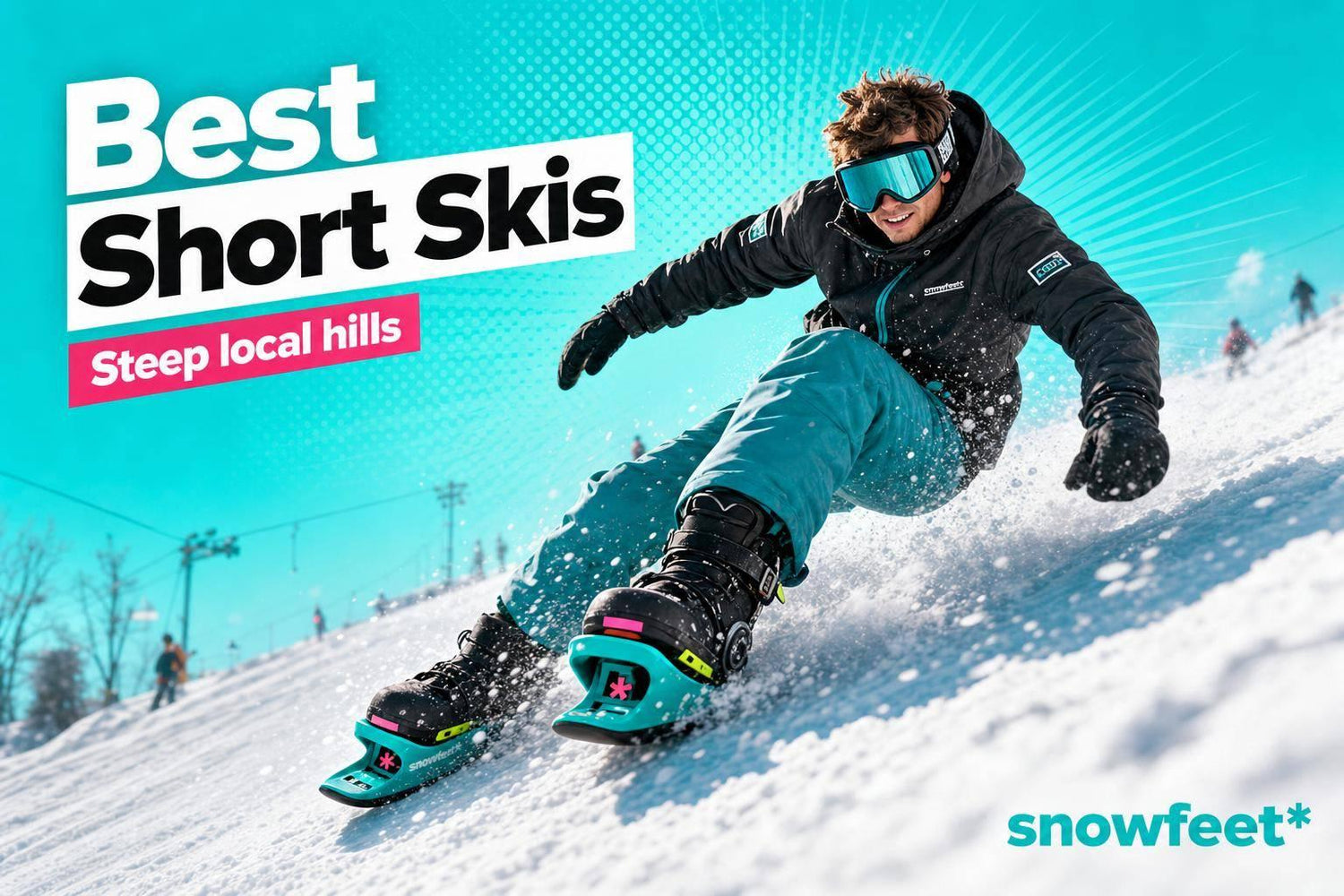
If you ski short, steep local runs, shorter skis usually make more sense than long skis. On hills like these, I’d keep it simple: 44 cm is the most nimble, 65 cm is the best middle pick, 99 cm gives the easiest control for most riders, and 120 cm feels the most stable.
Here’s the whole article in plain English:
- Skiskates 17 in (44 cm) - from $460: smallest, lightest, most twitchy
- Skiblades 26 in (65 cm) - from $590: fast turns with a bit more control
- Skiblades 39 in (99 cm) - from $690: best all-around choice for many people
- Short Skis 47 in (120 cm) - $950: most planted ride, but costs more and needs ski boots
If your local hill is steep, crowded, and over fast, you don’t need huge skis. You need gear that helps you turn fast, check speed, and deal with chopped-up snow without a wrestling match. That’s the main takeaway here.
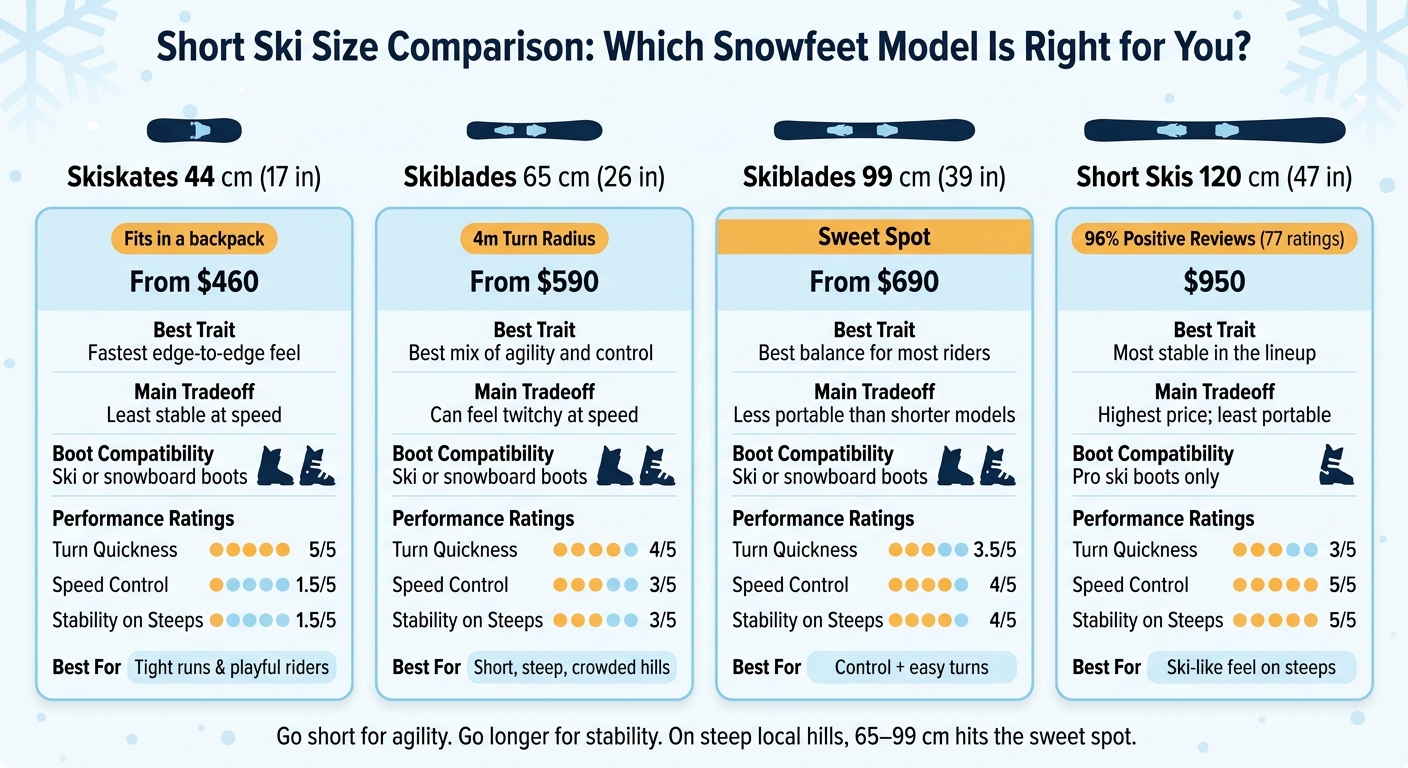
Short Ski Size Comparison: Which Snowfeet Model Is Right for You?
Snowboarder tries Snowfeet* | Which Snowfeet* Short Ski is the Best? | Snowblades 44, 65, 99 Review
Quick Comparison
| Model | Price | Best Trait | Main Tradeoff | Best For |
|---|---|---|---|---|
| 44 cm (17 in) | $460 | Fastest edge-to-edge feel | Least stable at pace | Tight runs and playful riders |
| 65 cm (26 in) | $590 | Strong mix of agility and control | Can still feel twitchy | Short, steep local hills |
| 99 cm (39 in) | $690 | Best balance for most riders | Less easy to pack than shorter pairs | Riders who want control and easy turns |
| 120 cm (47 in) | $950 | Most stable in the lineup | Highest price; less portable | Riders who want a more ski-like feel |
A few stats stand out:
- The 65 cm model has a 4 m turn radius
- The 120 cm model has 96% positive reviews across 77 ratings
- The 44 cm pair is small enough to fit in a backpack
So, if I had to sum it up in one line: go short for agility, go longer for stability. On steep local hills, that usually puts the 65 cm and 99 cm right in the sweet spot :)
If you want a quick visual before you buy, these video searches can help:
- Snowfeet Skiskates review on YouTube
- Snowfeet 65 cm Skiblades review on YouTube
- Snowfeet 99 cm Skiblades review on YouTube
- Snowfeet 120 cm Short Skis review on YouTube
Bottom line: if you want the most fun on steep home-mountain laps, don’t chase top speed - chase control.
1. Snowfeet* Skiskates 44 cm (17 in)
For the tightest, steepest local hills, start with the shortest option.
Starting at $460, the Skiskates are the shortest and most nimble Snowfeet* model. At just 17 inches long, they’re made for short, crowded, narrow runs where control matters more than top speed.
Agility and Speed Control
At 44 cm, they roll from edge to edge FAST. They feel more like skates than skis, which makes quick direction changes feel natural on steep, narrow terrain. The steel edges help a lot, and the easy snowplow-style stop keeps things under control on busy local hills.
Stability on Steeps
Once speeds climb or the snow gets rough, you’ll need to stay on your game. Think bent knees, staggered stance, and active balance. The 44 cm model works best when the run is short and controlled, not fast or choppy. If you want a calmer ride with more stability, the 99 cm or 120 cm models will likely fit better.
Boot Compatibility
You can pick ski-boot bindings for more edge control, or go with snowboard-boot bindings for a looser, more casual feel.
If you want a bit more stability but still want those quick turns, move up to the 65 cm Skiblades.
2. Snowfeet* Skiblades 65 cm (26 in)
The Snowfeet* Skiblades 65 cm step up nicely from the 44 cm Skiskates. You get a bit more platform, but they still feel quick and easy to throw around. Starting at $590, they give you more confidence on steep local hills without turning into a clunky ride. If the 44 cm model feels a bit too twitchy, this is the middle-ground pick that makes a lot of sense.
Turn Quickness
This model has a 4-meter turn radius and a deep sidecut, which helps edge-to-edge moves feel fast and smooth. On narrow runs, that shorter length still shines. It’s nimble, easy to steer, and a lot of fun in tight spaces.
Speed Control
The steel edges and heel brake help keep speed in check on steeper pitches. That gives the 65 cm version a more steady feel than the 44 cm model, while still keeping that playful, lively ride. In plain English: you get better control without losing the fun part.
Stability on Steeps
Compared with the 44 cm Skiskates, the 65 cm length is easier to balance on steeper slopes or uneven snow. It hits a nice sweet spot for riders who want agility but don’t want to give up too much stability. If you plan to ride faster or deal with rougher descents, the 99 cm model brings a calmer feel.
Boot Compatibility
The universal bindings work with both ski boots and snowboard boots, which keeps setup simple and flexible. The pair weighs 3.79 lbs with ski bindings, so they’re light enough to carry to the hill or toss in a backpack.
For riders who want more stability on faster or rougher local hills, the 99 cm model adds more platform.
3. Snowfeet* Skiblades 99 cm (39 in)
The Snowfeet* Skiblades 99 cm feel more like skis, but without the size and hassle of full-length skis. Starting at about $690, they sit right in the middle of the lineup. That makes them a smart pick for riders who want more control on steep local hills. On short, steep neighborhood runs, the 99 cm length gives you quick turns with a calmer, more planted feel than the shorter blades. It’s a nice step up if the 65 cm model feels a bit too twitchy, but you’re not ready to move to 120 cm.
Turn Quickness
Thanks to the deep parabolic sidecut and narrow waist, the 99 cm model feels fast edge to edge. It turns quickly, but it still behaves well at slower speeds. That’s a big deal on tight local runs where you don’t have much room to mess around.
Brad Tolin said it best:
"These ski blades are a blast to use. Super easy to control, quick to turn, and way more forgiving than traditional skis."
Speed Control
The shorter length helps a lot on steep local hills. It’s easier to turn, easier to shut down speed, and easier to stop when things get spicy. Compared with longer skis, that can feel like a big relief.
Stability on Steeps
The wood core construction and metal edges give the 99 cm model a steadier, more planted feel on rutted, uneven snow than the 44 cm or 65 cm versions. You notice it most when the hill gets choppy and beat up.
That said, there’s still a trade-off. Longer skis hold their line better once speed climbs. As Brad Tolin put it:
"Only trade-off is at higher speeds, where longer skis still feel more stable - but for overall fun and maneuverability, these are hard to beat."
That more planted ride also works nicely with the binding choices.
Boot Compatibility
The 99 cm Skiblades work with ski boots, pro ski boots, and snowboard boots, based on the binding model. So if you want more ski-like handling without swapping your whole boot setup, this is the easiest next move.
Mike E. shared this:
"I was nervous about the boots not being stiff enough for skis but it was not an issue at all. SUPER comfortable, easy to control, very agile, easy on the knees and ankles because they are so light."
If you want the most stability in this group, the 120 cm model is the next jump.
sbb-itb-17ade95
4. Snowfeet* Short Skis 120 cm (47 in)
If you want the calmest ride in the lineup, this is the step up to take. The Snowfeet* Short Skis 120 cm are the longest Snowfeet* model and cost $950.
They feel the closest to a regular ski, but they’re still shorter and easier to handle on steep local hills. The tradeoff is simple: you lose a bit of that super-fast, twitchy feel from the shorter models, but you get a more planted ride when the hill gets steep and chopped up.
Turn Quickness
With a 7.8 cm waist and deep sidecut, these skis still carve fast and steer with ease on steep local groomers. They’re not as snappy as the 65 cm or 44 cm models, but they hold a clean arc and feel solid when it matters.
Speed Control
The mix of metal edges and a graphite base gives you precise grip when you need to scrub speed on a steep pitch. They’re still easier to turn and stop than regular long skis, though they ask for a bit more intent from the rider than the shorter Snowfeet* models.
Stability on Steeps
This is the big selling point. The Camber + Tip and Tail Rocker shape gives the 120 cm a more planted feel on choppy or ungroomed snow than the 99 cm.
It’s the most stable ski in the Snowfeet* short ski lineup, with 96% positive reviews across 77 ratings. That lines up with what riders say on snow. One user, Tripp, put it like this:
"I would have never been able to explore all the areas on regular skis that I did on these."
Boot Compatibility
The 120 cm comes with Pro Ski Boot Bindings that work with standard ski boots in the 26–36.1 MP size range. So if you want a secure, familiar setup on steeper terrain, this one checks that box.
Next, we’ll break down how ski length affects speed control, stability, and portability on steep local hills.
How Length Affects Performance on Steep Local Hills
Shorter skis turn fast. Longer skis feel more planted. On a steep local hill, that tradeoff changes a lot: how fast you can link turns, how easy it is to scrub speed, and how calm you feel when the run gets short, steep, and a bit chopped up.
Here’s the simple takeaway from the four lengths:
| Model | Turn Quickness | Speed Control | Stability on Steeps | Boot Compatibility |
|---|---|---|---|---|
| Skiskates 44 cm (17 in) | Extreme - skate-like | Low | Low | Ski or snowboard boots |
| Skiblades 65 cm (26 in) | Very high | Moderate | Moderate | Ski or snowboard boots |
| Skiblades 99 cm (39 in) | High | High | High | Ski or snowboard boots |
| Short Skis 120 cm (47 in) | Moderate | Very high | Highest in the lineup | Pro ski boots |
The move from 44 cm to 65 cm is where things start to click for a lot of riders. You get much better edge control, but you still keep most of that quick, playful feel. The extra length helps the ski feel less twitchy, which is nice when the hill gets steep and your legs are already sending you a message :)
Step up to 99 cm, and you get more grip plus a bit more forgiveness when the snow gets rough or choppy. Then there’s the 120 cm model. It feels closest to a regular ski, but it’s still easier to handle on short, steep runs where you don’t want to wrestle a long setup all day.
Short Skis vs. Traditional Long Skis
Traditional long skis do have one clear edge: stability at high speed. They hold better on hard, icy steeps because more edge stays in contact with the snow. That gives you more grip when you’re skiing straight and fast.
But on short local hills, that matters less. You’re usually not bombing giant faces or making long, open turns. You’re making fast decisions, tightening turns, and keeping speed in check before the run ends 20 seconds later.
"Only trade-off is at higher speeds, where longer skis still feel more stable - but for overall fun and maneuverability, these are hard to beat." - Brad Tolin
That’s the tradeoff in plain English: long skis like speed, short skis like quick moves. On a steep local hill, quick moves often win.
Pros and Cons of Each Model
Each model has its own sweet spot on steep local hills. They all tackle the same job in different ways: speed control, balance, portability, and stability. So, this isn’t about “best” and “worst.” It’s about fit.
| Model | Biggest Advantages | Main Limitations | Best For |
|---|---|---|---|
| Skiskates 44 cm (17 in) | Most compact; fastest edge-to-edge; least forgiving at speed | Least stable at speed; demands constant front-back balance | Riders who want the fastest turns and don't mind a twitchier ride |
| Skiblades 65 cm (26 in) | Best balance of quick turns and everyday control on steep local hills | Twitchier at speed than 99 cm and 120 cm models | Tight, steep, crowded runs where agility matters most |
| Skiblades 99 cm (39 in) | Easiest for beginners to control; more planted than 65 cm, still easy to steer | Less portable than shorter models; less skate-like than the 44 cm model | Riders who want reliable control on steep local hills without sacrificing maneuverability |
| Short Skis 120 cm (47 in) | Most stable in the lineup; handles bumpy, chopped-up snow well | Highest price ($950); least portable; requires Pro Ski boot bindings | Riders who want the calmest, most ski-like ride on steep local hills |
Read the table as a set of tradeoffs, not a ranking. The right pick depends on how steep, short, and crowded your local hill feels.
The 44 cm Skiskates ask the most from your balance, especially front to back. In return, they give you max agility on steep, short runs. If you like fast, snappy turns and don’t mind a ride that feels a bit twitchy, these are a blast.
The 65 cm Skiblades sit in that nice middle lane. They give you ski-like turns with skate-like quickness. That makes them a strong pick when the hill is tight, steep, and packed, and you need your turns to happen NOW, not three seconds from now.
For most casual riders, the 99 cm Skiblades are the easiest all-around choice on steep local hills. They’re forgiving for beginners, but still planted enough when the snow gets rougher. If you want control without giving up easy steering, this is the safe bet.
The 120 cm Short Skis feel the calmest in the bunch. They handle bumpy, chopped-up snow well, but you give up some portability and quickness to get that smoother ride. They also cost the most at $950 and require Pro Ski boot bindings.
Which Model Should You Choose?
How steep and crowded is your local hill? That’s the big thing to look at. The tradeoffs above make it easier to match the right length to the kind of terrain you ride most.
If you're a beginner or casual rider, the 65 cm Skiblades are the easiest to handle on short, narrow runs. They’re quick to learn, easy to carry, and nimble on groomers. If you want a bit more stability but still like fast, snappy turns, step up to 99 cm.
If you're a confident rider and want quick turns plus better control in rough snow, go with the 99 cm Skiblades. Their deep parabolic sidecut stays responsive, and they handle choppy afternoon snow well. Want a smoother, calmer ride? Move up to 120 cm.
If you want the most ski-like option in the lineup, the 120 cm Short Skis give you the calmest ride on chopped-up steeps.
For long, fast descents or deep powder, long skis are still the better tool. But on steep, short local hills - where quick turns and easy speed control matter most - Snowfeet* short skis are the smarter fit for most riders.
FAQs
Which size is best for beginners?
For beginners, the Snowfeet Skiblades 65 cm are the best place to start. They’re the easiest to learn on, feel natural in turns, and give you a forgiving ride that helps build confidence on groomed resort runs.
If you want a bit more stability and a little more room to grow, the 99 cm Skiblades are also a popular pick. The 44 cm Skiskates are a blast and super easy to carry, but for most new riders, the 65 cm and 99 cm models give you better balance and control.
Can I use snowboard boots or ski boots?
Yes - most Snowfeet* short-ski models work with snowboard boots if they use adjustable strap-style bindings. That includes the 44 cm Skiskates plus the 65 cm and 99 cm Skiblades.
There’s one main exception: the 120 cm Skiblades. Those use traditional release ski bindings, so they need hard-shell ski boots.
Before you buy, check the binding type for the exact model you want. That one detail makes all the difference.
Are short skis good on icy or choppy hills?
Yes - with the right expectations and the right model.
Snowfeet short skis do best on groomed, packed snow. They’re easy to turn and easy to control, which makes them a good fit for icy or choppy hills at moderate speeds.
That said, there’s a catch. They’re less stable than longer skis, and they can lose edge grip on steep ice or when you start going faster. So if the snow is hardpack and you want a bit more confidence under your feet, go with the 99 cm Skiblades.
The shorter 44 cm Skiskates are more demanding. They need more balance, and on firm snow, you’ll feel that pretty fast.











Jätä kommentti
Tämä sivu on suojattu hCaptcha-tunnistuksella, ja hCaptchan tietosuojakäytäntöjä ja käyttöehtoja sovelletaan.