



















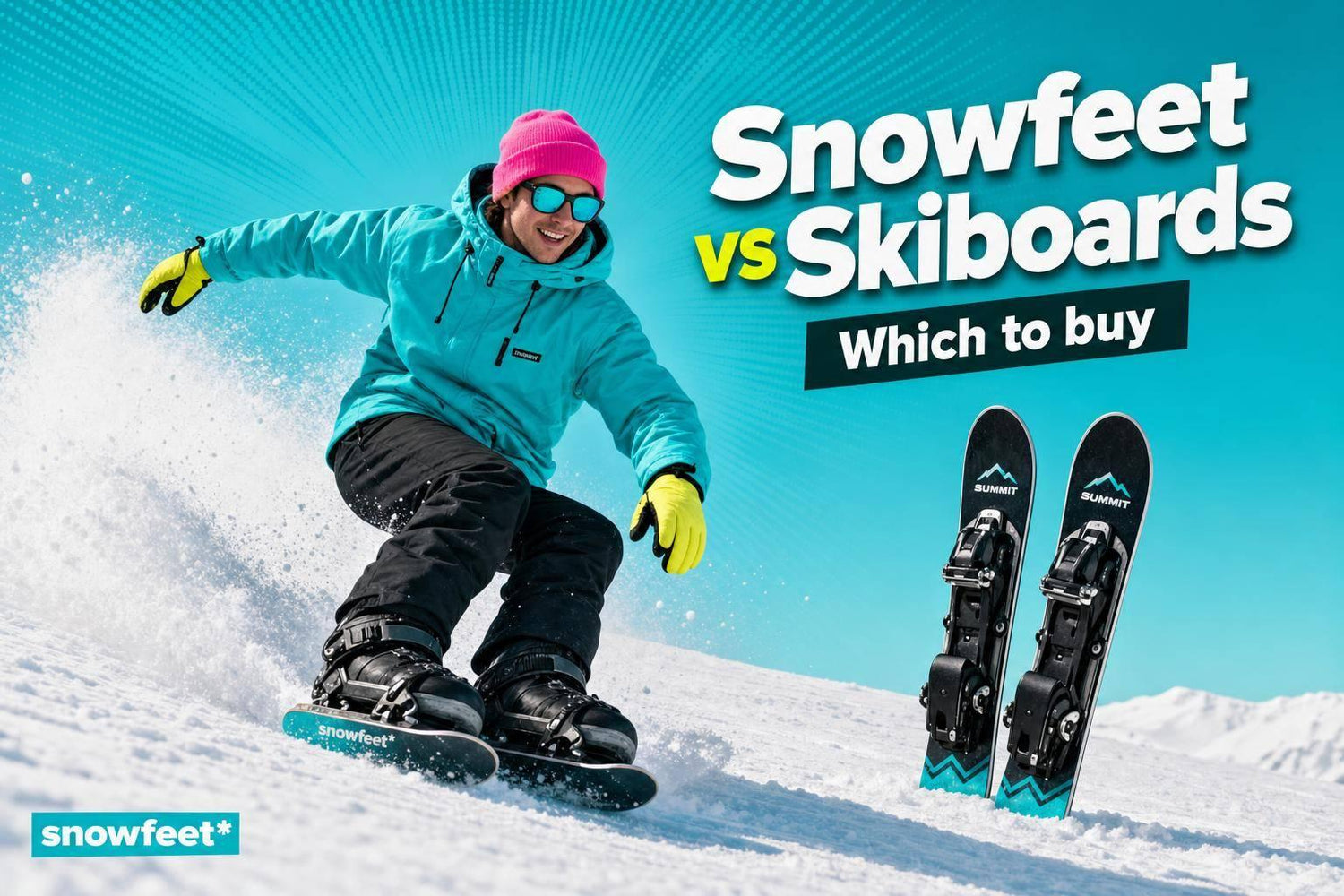
If you want the short answer: I’d pick Snowfeet* for most riders.
Why? It’s easier to learn on, easier to pack, and it works with more boot types. Summit makes more sense if you already ski, already own ski boots, and want more control on groomed runs at higher speed.
Here’s the whole thing in one glance:
-
Pick Snowfeet* if you want:
- a short learning curve
- lighter, smaller gear
- ski boot or snowboard boot use
- park laps, local hills, travel, or casual resort days
-
Pick Summit if you want:
- a more ski-like setup
- better hold at speed on groomers
- standard alpine bindings
- a short ski that feels closer to full-size skis
A few numbers help tell the story:
- Snowfeet* ranges from 44 cm to 120 cm
- Summit ranges from 79 cm to 110+ cm
- Snowfeet* starts around $460
- Summit skiboards often land around $300 to $700, but total cost can climb if you need boots and bindings too
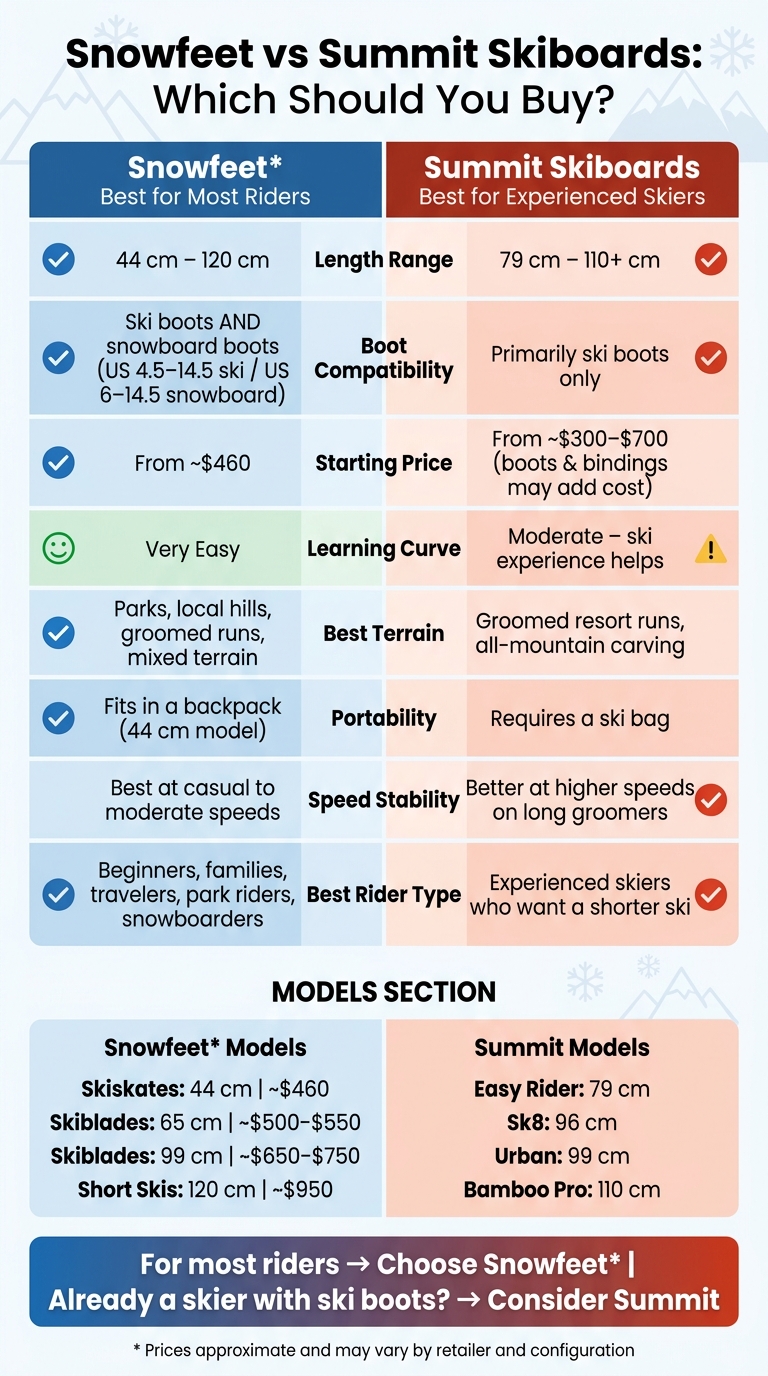
Snowfeet vs Summit Skiboards: Side-by-Side Comparison
Snowboarder tries Snowfeet* | Which Snowfeet* Short Ski is the Best? | Snowblades 44, 65, 99 Review
Quick Comparison
| Category | Snowfeet* | Summit Skiboards |
|---|---|---|
| Length range | 44–120 cm | 79–110+ cm |
| Boot options | Ski boots + snowboard boots | Mostly ski boots |
| Best for | Beginners, families, park riders, travelers | Skiers who like groomed carving |
| Learning feel | Simple, playful | More ski-focused |
| Travel ease | Small models can fit in a backpack | Usually needs a ski bag |
| Speed feel | Best for casual to moderate speed | Better on long, fast groomers |
| Price feel | More options by riding style | Can cost less up front, depending on setup |
So, if you’re choosing between the two, I’d keep it simple: Snowfeet* fits more people. Summit fits a smaller group. If your day on snow is about fun, easy setup, and less gear drama in the parking lot :) Snowfeet* is the safer bet.
Product overview: what Snowfeet* and Summit actually offer
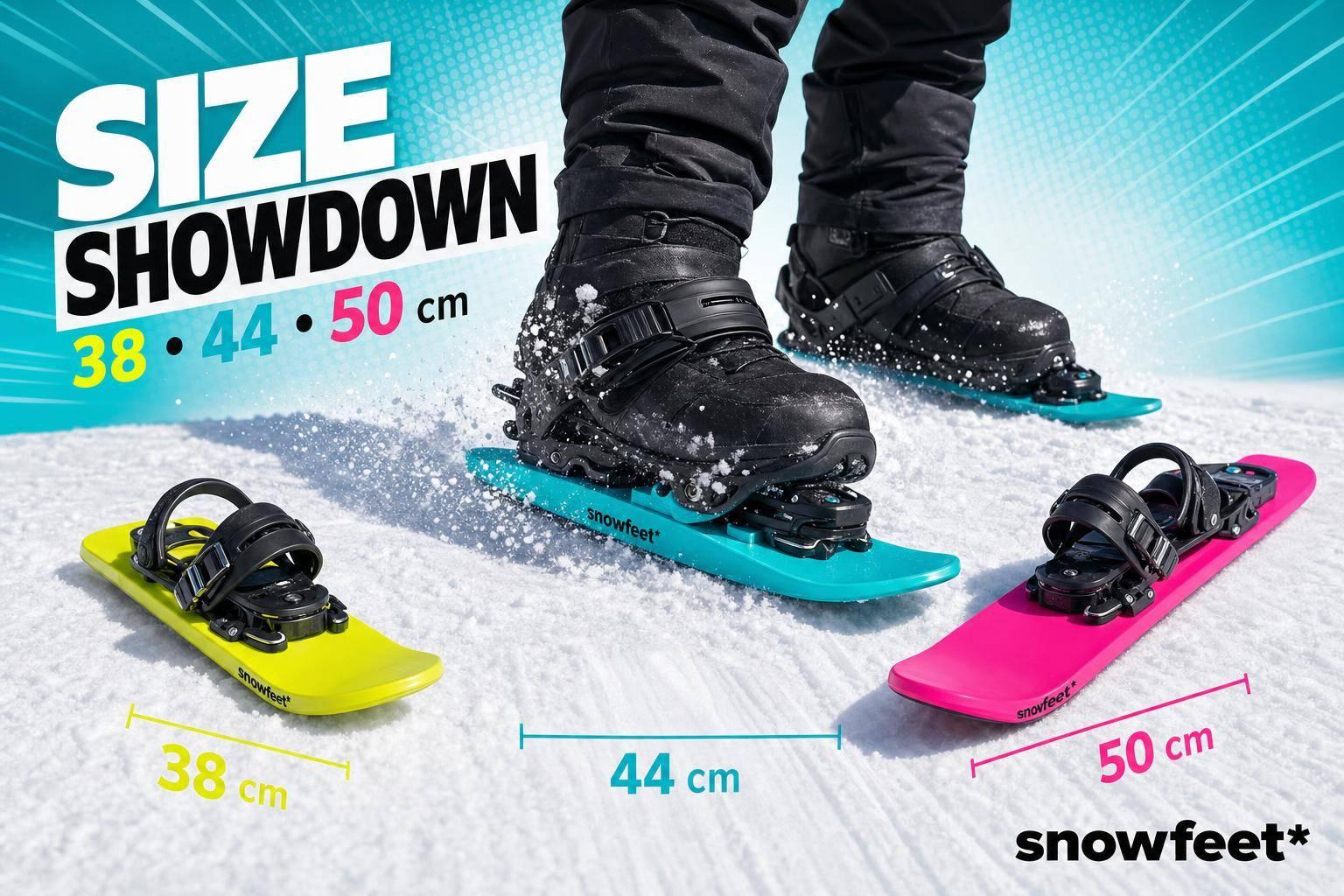
Snowfeet* lineup: 44 cm to 120 cm
Snowfeet* has four main models, and each one fits a different kind of rider.
The 44 cm Skiskates are the shortest and most playful option. They feel closer to snow skating than standard skiing. That makes them easy to turn and fun in parks, on sledding hills, and in tight spots. They come in versions for ski boots or snowboard boots.
The 65 cm Skiblades give you more edge contact and a bit more stability. So, they’re a nice next step if you want something that feels more like a ski but still stays quick and nimble.
Then there are the 99 cm Skiblades. These work well on groomed resort runs and stay comfortable at higher speeds, but they’re still much shorter than full-length skis.
At the top of the range, the 120 cm Short Skis lean the most toward resort riding. They’re a good fit for people who want stronger on-slope performance without going all the way to standard ski length.
One big part of Snowfeet*’s appeal is boot choice. The gear works with ski boots and snowboard boots, including ski boot sizes of about US 4.5–14.5 and snowboard boot sizes of about US 6–14.5. For a lot of U.S. riders, that means there’s a good chance they can use boots they already have.
Summit goes in a different direction. Its setup feels much closer to standard skiing from the start.
Summit skiboards: short skis with a standard ski setup
Summit Skiboards run from 79 cm to 110+ cm. The lineup includes the Easy Rider (79 cm), Sk8 (96 cm), Urban (99 cm), and Bamboo Pro (110 cm).
These models use standard alpine ski boots and bindings. The focus is on carving, and the ride feel should seem familiar if you’ve spent time on regular skis. Some Summit models can also be set up with snowboard-style bindings and riser kits.
In plain terms, Summit is aimed at riders who want a short ski but don’t want to leave behind that alpine ski feel. That choice affects a few key things:
- Learning curve: Snowfeet* feels more playful and less like standard skiing, while Summit feels more familiar to skiers.
- Portability: Snowfeet* has much shorter options, especially at 44 cm and 65 cm.
- Best use case: Snowfeet* suits slopes, parks, hills, and mixed terrain. Summit leans more toward groomed runs and all-mountain carving.
Here’s the side-by-side view:
| Feature | Snowfeet* (44–120 cm) | Summit Skiboards (79–110+ cm) |
|---|---|---|
| Boot compatibility | Ski boots + snowboard boots | Primarily ski boots; snowboard bindings optional |
| Best terrain | Slopes, parks, hills, mixed terrain | Groomed runs, all-mountain carving |
| Shortest model | 44 cm (Skiskates) | 79 cm (Easy Rider) |
| Bindings | Boot-flexible bindings | Alpine release bindings standard |
sbb-itb-17ade95
Head-to-head: learning curve, portability, terrain, and durability
Learning curve, control, and fun
The 44 cm Skiskates are easier to pick up than anything Summit offers. The main reason is simple: they’re short. That makes turning feel natural, since you steer by shifting your weight instead of muscling around a long ski. The 65 cm Skiblades work in much the same way, but with a bit more edge under you, which can help if you want a touch more control without making things feel hard.
Summit feels more familiar if you already ski because it uses standard boots and bindings. That’s a nice plus for skiers who want something shorter without starting from scratch. But for a beginner, it can feel a bit more technical. For casual riders, kids, or families trying snow sports for the first time, Snowfeet*’s shorter models feel less scary and more fun right out of the gate.
And that easygoing feel doesn’t stop on the slope. It also shows up when it’s time to pack, carry, or hand the gear to someone else.
Portability, boot compatibility, and travel ease
Learning is one thing. Carrying the gear is another. The 44 cm Skiskates are small enough to slide into a standard backpack. That’s a big deal if you’re traveling light or just don’t want to wrestle with long gear in a parking lot. Summit skiboards are longer and bulkier, so you’ll usually need a ski bag and more room in the car.
Boot choice matters too. Snowfeet* works with both ski boots and snowboard boots. Summit is mostly tied to ski boots. So if you don’t already own ski boots, that can shape the whole setup.
Terrain range, speed, and durability trade-offs
| Factor | Snowfeet* (44–120 cm) | Summit Skiboards (79–110+ cm) |
|---|---|---|
| Learning curve | Very easy for 44–65 cm; more advanced for longer models | More traditional; better for riders already comfortable on skis |
| Boot compatibility | Ski boots and snowboard boots | Primarily ski boots |
| Best for travel | Fits in a backpack at smallest size | Usually needs a ski bag |
| Speed stability | Best at casual speeds; 99–120 cm handles more | Better on longer, faster groomed runs |
| Best terrain | Groomers, local hills, and parks | Resort groomers and light ungroomed snow |
| Best rider type | Beginners, travelers, families, park riders | Experienced skiers who want a shorter ski |
Performance also comes down to how the gear feels when you pick up speed and how well it lasts. Snowfeet* products use metal edges and fiberglass reinforcement. That helps them hold up well without piling on extra weight.
Summit does have a clear win in one area: high-speed stability on long groomed runs. Its longer platform and stiffer build help it hold a carving turn better at resort speeds. If your ski days usually mean long top-to-bottom laps at a big resort, and you already own ski boots, Summit’s setup can be a good match.
Next is price, and that’s where the value gap starts to stand out.
Price and value in U.S. dollars
After performance, price is the next big trade-off.
What you get for the money with Snowfeet*
The best deal is the setup that matches how you ride. That’s where Snowfeet* has a nice edge. Instead of forcing everyone into one skiboard size, it gives you more ways to choose. So beginners, travelers, families, and casual riders can get what fits them best, without paying for extra gear they don’t need.
| Model | Length | Approx. Price (USD) | Best For |
|---|---|---|---|
| Snowfeet* Skiskates | 44 cm | Around $460 | Portability, casual fun, beginners |
| Snowfeet* Skiblades | 65 cm | Around $500–$550 | A balance of agility and ski-like control |
| Snowfeet* Skiblades | 99 cm | Around $650–$750 | Versatile all-mountain riding |
| Snowfeet* Short Skis | 120 cm | Around $950 | Closest feel to traditional skiing |
Prices are approximate and vary by sales and setup.
When Summit may still make sense on price
Summit can look cheaper, but only in one pretty specific case: you already own ski boots and want a more ski-like feel. Most skiboards cost about $300 to $700. Once you add boots and bindings, though, the total can jump fast. Yeah, that part stings.
So, Summit makes more sense if you’ve already put money into a ski-boot setup and mostly ride groomed runs. Outside that lane, the value story gets a lot less convincing.
That price gap matters most when you match the gear to the kind of rider who’ll use it.
Which to buy: recommendations by rider type
Best Snowfeet* picks for beginners, snowboarders, travelers, and families
Here’s the short version. If you want the fastest path to the right pick, start here:
| Rider Type | Best Snowfeet* Pick | Why It Works |
|---|---|---|
| Beginners | 44 cm Skiskates | Fastest learning curve |
| Snowboarders / park riders | 44 cm Skiskates or 65 cm Skiblades | Playful, trick-friendly options for spins and park laps |
| Travelers / frequent flyers | 44 cm Skiskates or 65 cm Skiblades | Most portable |
| Families | 44 cm Skiskates | Simple, confidence-building setup |
| All-mountain casual riders | 99 cm Skiblades | A versatile choice for groomers and mixed terrain |
| Riders wanting a ski-like feel | 120 cm Skiblades | Closest to a traditional ski feel |
If you’re new, the 44 cm Skiskates are the easy call. They’re simple to get the hang of and don’t feel like a lot to manage.
If you come from snowboarding or you like park laps, go with the 44 cm Skiskates or 65 cm Skiblades. They’re playful and make spins and tricks feel more natural.
For travel, those same two options stand out. They’re the easiest to pack, carry, and bring along without turning your trip into a gear circus.
Families will likely have the smoothest start with the 44 cm Skiskates. Simple setup, less fuss, more smiles :)
If you want one pair for groomers and mixed terrain, the 99 cm Skiblades make a lot of sense. And if you want something that feels closest to regular skis, the 120 cm Skiblades are your best bet.
Snowfeet* also has strong verified-buyer ratings across the lineup.
When Summit is the better fit
Snowfeet* works for most casual riders. Summit is more of a niche pick.
It makes more sense for riders who already own ski boots and want to carve groomed runs at higher speed. That’s the lane. If that sounds like you, Summit may be the better match.
Final verdict
For most casual U.S. riders, Snowfeet* is the smarter buy. It’s easier to learn, easier to carry, and works with more boot setups.
Summit fits a smaller group: experienced skiers who want groomed-run carving. For pretty much everyone else, Snowfeet* is the better choice.
FAQs
Which Snowfeet* size should I buy?
Choose based on your skill level and where you’ll ride:
- 44 cm Skiskates: best for first-timers, tricks, and easy packing.
- 65 cm Skiblades: a nice pick for new riders who want simple control on groomed runs.
- 99 cm Skiblades: the best middle ground between quick turns and solid balance.
- 120 cm Skiblades: best if you want more stability, more speed, better float in deeper snow, and a feel that’s closer to regular skis.
Can I use my snowboard boots with Snowfeet*?
Yes. Snowfeet* products come with adjustable bindings that fit snowboard boots, ski boots, and even regular waterproof winter boots.
So, no, you don’t need special ski footwear. That’s a big plus if you want to hit the slopes without buying a whole new setup.
For the best ride, go with boots that have firm ankle support. They can help you stay in control and feel more steady on the snow.
Are Snowfeet* good for beginners?
Yes - Snowfeet* products are a great pick for beginners.
Their short, compact shape feels a lot less scary than long skis. That usually means easier control and a smoother first day on the snow.
Take the 44 cm Skiskates, for example. They can help new riders learn the basics in just a few runs. And because they work with regular winter boots or snowboard boots, getting started feels simpler, more comfortable, and a lot more fun.











Deja un comentario
Este sitio está protegido por hCaptcha y se aplican la Política de privacidad de hCaptcha y los Términos del servicio.