



















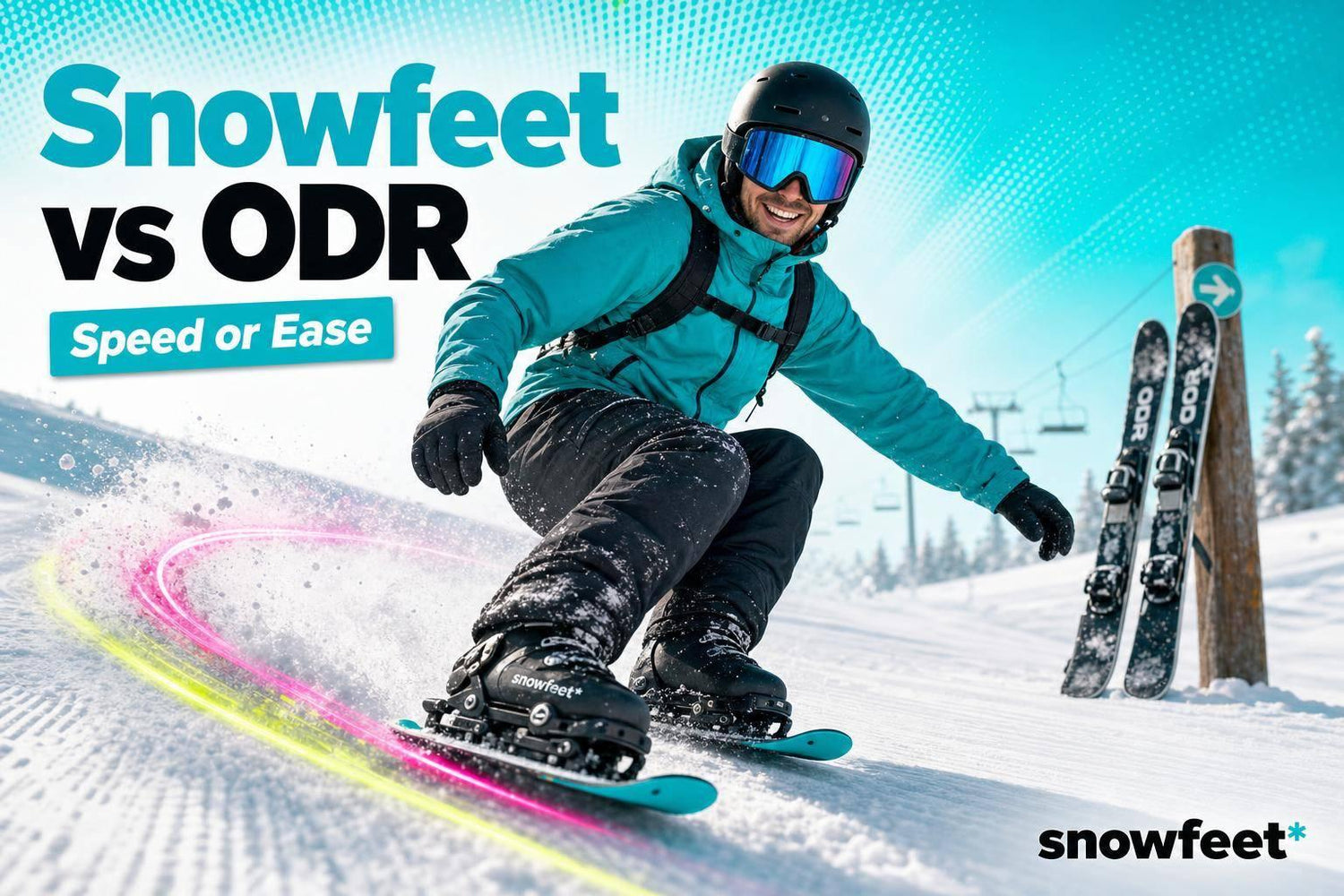
If I had to keep it simple: most casual riders should pick Snowfeet*, while ODR skis fit riders who want more speed and don’t mind extra gear.
Here’s the short version:
- Snowfeet* is easier to carry, easier to set up, and often cheaper to get on snow with.
- ODR skis have more of a ski-style feel and can reach about 30–35 mph on groomers.
- Snowfeet* models cover more use cases, from backyard hills to terrain parks to resort groomers.
- ODR needs its own boot setup, which adds cost and hassle.
- Snowfeet* starts at $299, while ODR starts around $449+ before boots.
If you’re a beginner, traveler, snowboarder, or just want a fun day without hauling half your closet to the mountain, I’d lean Snowfeet*. If you care most about top-end stability on groomed runs, ODR has a stronger case.
What this comparison looks at:
- learning curve
- boot fit
- portability
- turning feel
- terrain use
- speed and stability
- price
- overall fun
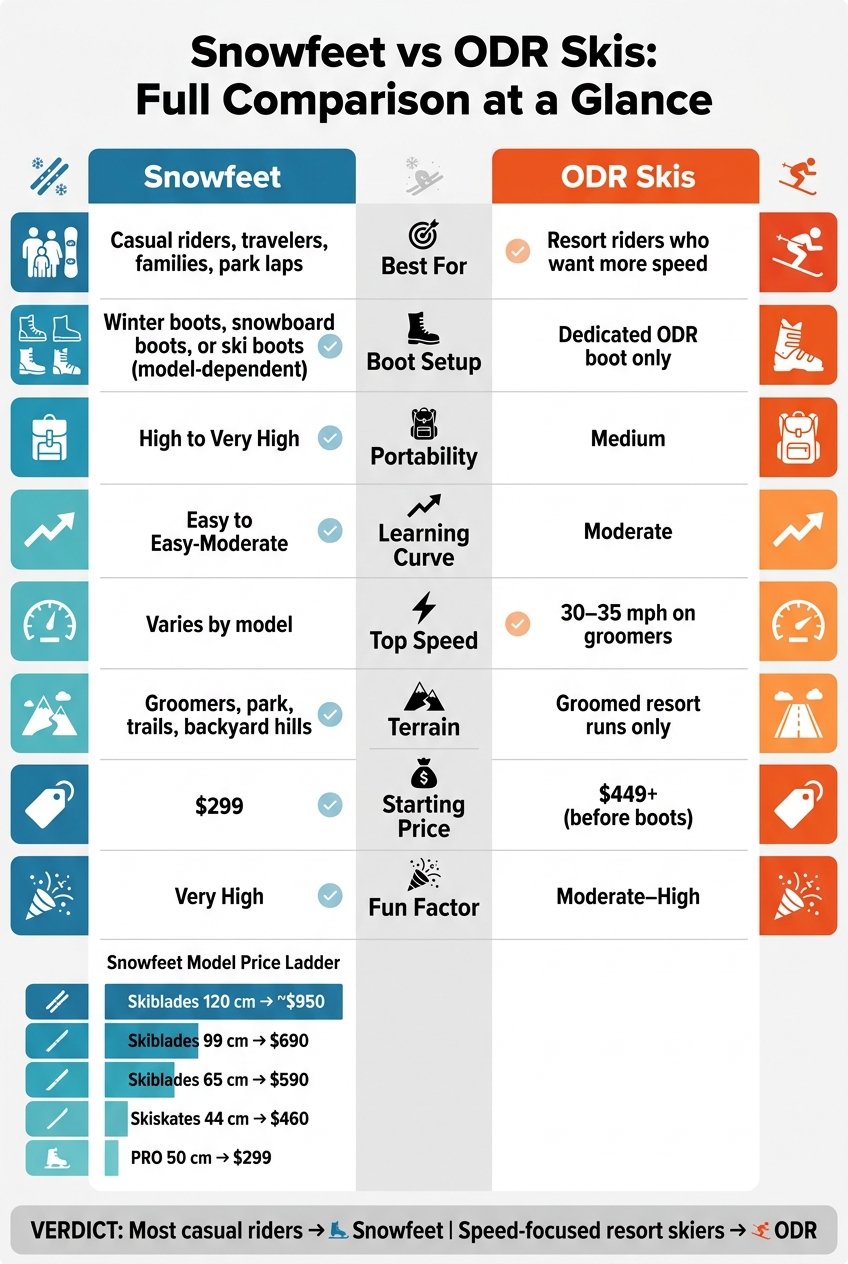
Snowfeet vs ODR Skis: Full Comparison at a Glance
Snowboarder tries Snowfeet* | Which Snowfeet* Short Ski is the Best? | Snowblades 44, 65, 99 Review
Quick Comparison
| Criteria | Snowfeet* | ODR Skis |
|---|---|---|
| Best for | Casual riders, travelers, families, park laps | Resort riders who want more speed |
| Boot setup | Winter boots, snowboard boots, or ski boots depending on model | ODR-only boots |
| Portability | High to very high | Medium |
| Learning curve | Easy to easy-moderate | Moderate |
| Speed | Low to good, based on model | Good |
| Stability | Better on longer models like 99 cm and 120 cm | Better at higher speeds |
| Terrain | Groomers, park, trails, backyard hills | Groomed resort runs |
| Starting price | $299 | $449+ |
So, yeah, this one comes down to a simple trade-off: Snowfeet* gives you less hassle and more ways to ride, while ODR gives you more of a ski-first feel. That’s the whole game.
Snowfeet* vs ODR Skis: Product Overview by Use Case

Snowfeet* runs from casual fun to resort use. ODR skis sit closer to the usual resort setup, with ski boots and a more classic on-snow feel.
Snowfeet PRO 50 cm and Mini Ski Skates
Let’s start with the easiest gear to pack.
The Snowfeet PRO 50 cm and Mini Ski Skates work with snowboard boots or regular waterproof winter shoes. That means you don’t need to own or rent ski boots, which is a nice little win for travel days. They make the most sense for short sessions on groomed slopes or for days when space matters and you want to keep things simple.
On snow, they handle groomed runs well and can manage up to about 4 inches (10 cm) of powder. But they’re not made for steep black diamond runs or long, fast carving. That’s the point where ODR skis pull ahead, since they stick with the more classic ski-boot resort setup.
If you want a setup that feels more agile and more park-focused, Skiskates 44 cm push further in that direction.
Skiskates 44 cm and Skiblades 65 cm, 99 cm, 120 cm
Skiskates 44 cm are the most playful pick in the group. They’re built for park laps, spins, switch riding, and tight terrain. Super fun, a little wild, and not shy about it :). The tradeoff is simple: they don’t give you the same straight-line stability at speed that ODR skis do.
If you want more stability but still like the short-ski feel, the Skiblades line makes more sense.
The Skiblades step up like this:
- 65 cm: Best for riders who want quick, playful handling.
- 99 cm: Best all-around pick for beginners and casual skiers.
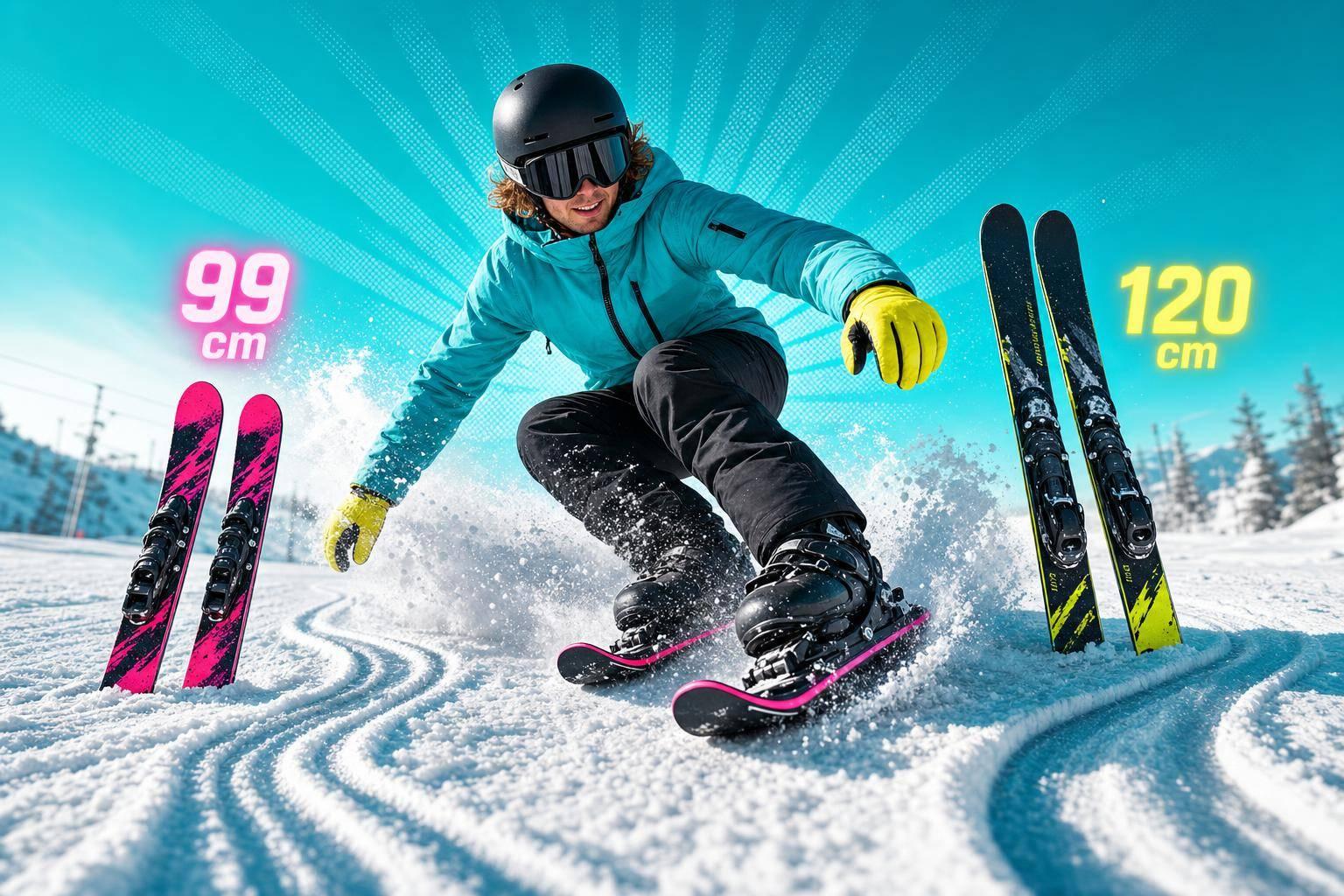
- 120 cm: Best for riders who want more speed and better carving stability.
Next comes the part that matters most on the mountain: how each setup feels on snow when you turn, pick up speed, and use it all day.
sbb-itb-17ade95
Side-by-Side Comparison: How They Perform in Use
Here’s how they compare when you actually use them.
Learning Curve, Boot Compatibility, and Day-to-Day Convenience
Once you get past the product lineup, the big difference comes down to feel.
The first thing most people notice is the setup. Snowfeet* works with boots you may already have. ODR skis don’t. They use their own boot-and-ski setup, so you need their boot to ride. That’s a bigger commitment, both in cost and in plain old hassle.
The Snowfeet PRO 50 cm fits US sizes 6–13 and works with winter boots or snowboard boots. That kind of flexibility makes life easier. You spend less, carry less, and skip a lot of the setup friction that casual riders usually don’t want to deal with.
| Factor | Snowfeet PRO 50 cm | Skiskates 44 cm | Skiblades 65 cm | Skiblades 99 cm | Skiblades 120 cm | ODR Skis |
|---|---|---|---|---|---|---|
| Learning curve | Easy | Easy | Easy | Easy–Moderate | Easy–Moderate | Moderate |
| Portability | Fits in a backpack | Very compact | Compact | Less compact | Less compact | Bulky |
| Boot required | Winter or snowboard boots | Ski boots or snowboard-boot version | Ski boots; some snowboard-boot bindings available | Ski boots; some snowboard-boot bindings available | Ski boots; some snowboard-boot bindings available | Dedicated ODR boot only |
| Maneuverability | High | Very high | High | Moderate–High | Moderate | Moderate |
| Best terrain | Groomed slopes, trails, backyard use | Park, tight terrain, groomed slopes | Groomed runs, park | Groomed resort runs | Groomed carving, higher-speed resort use | Groomed resort runs |
| Speed & stability | Moderate | Low–Moderate | Moderate | Moderate–Good | Good | Good |
| Fun factor | High | Very high | High | High | High | Moderate–High |
So, if you want something simple and low-fuss, Snowfeet* has the easier path.
Turning, Terrain, Speed, and Stability
ODR skis can hit 30–35 mph on groomed runs, but they lose momentum on flat sections and feel less steady in choppy snow. That can be a pain if you ride all over the resort instead of sticking to smooth groomers.
Snowfeet* models give up some top-end speed, but in return you get a more playful, quick-turning ride. The Skiskates 44 cm stand out here. They’re super nimble and a good match for tight turns and park laps. The Skiblades 99 cm and 120 cm bring more stability and feel closer to a standard ski on groomed runs.
To be fair, longer skis do better once speed picks up. That part’s not up for debate. But a lot of riders - especially beginners, travelers, and weekend cruisers - care more about control and ease of use than going full rocket mode. For those people, Snowfeet* will often feel simpler and more forgiving.
Price and convenience tend to settle the choice after that.
Price and Value for U.S. Buyers
After performance, total cost is the next big filter. And yeah, the sticker price is only part of the story.
ODR skis start at around $449 before boots. The Snowfeet PRO 50 cm starts at $299 and works with standard winter boots or snowboard boots, which means a lot of riders can use gear they already have.
That lineup gives buyers a few clear price tiers:
- Skiskates 44 cm from $460
- Skiblades 65 cm from $590
- Skiblades 99 cm from $690
- Skiblades 120 cm around $950
Here’s the price breakdown at a glance.
| Product | Approx. Price (USD) | Required Boots | Portability |
|---|---|---|---|
| Snowfeet PRO 50 cm | $299 | Winter shoes / snowboard boots | Very high |
| Skiskates 44 cm | $460 | Ski boots | High |
| Skiblades 65 cm | $590 | Ski boots | Medium |
| Skiblades 99 cm | $690 | Ski boots | Medium |
| Skiblades 120 cm | ~$950 | Ski boots | Low–Medium |
| ODR skis | ~$449+ (higher total cost if you need boots) | Dedicated boots | Medium |
Which Option Gives You More for Your Money
Price is one thing. How much use you get is the other half.
Snowfeet* gear gives you more ways to ride outside resort days. The PRO and Skiskates are small enough to toss in a backpack or the trunk, and you can use them on backyard hills, sledding hills, and at the resort. That makes them feel less like niche gear and more like something you’ll pull out often.
ODR skis are more tied to that exact boot-and-ski setup. So their value leans harder on whether that system is the one you want. Snowfeet* works beyond resort days, and that extra range of use is a big part of the value. For casual riders and families, that price gap can hit home fast.
Verdict: Snowfeet* or ODR Skis - Which Should You Buy?
After looking at boot fit, ease of use, speed, and price, the call is pretty simple. Snowfeet* is the better pick for most casual riders in the U.S.
Why? It stays easy to carry, easy to use, and fun at normal resort speeds. You don’t need to deal with as much gear drama, which is nice. Frankly, that matters more than people think.
ODR skis make more sense for serious resort skiers who want that more classic ski feel and are fine with the extra boot setup.
Best Snowfeet* Model by Rider Type
Here’s the fast match-up for each kind of rider.
| Rider Type | Best Snowfeet* Pick |
|---|---|
| Beginner / first-timer | PRO 50 cm or Skiblades 65 cm / 99 cm |
| Park / freestyle rider | Skiskates 44 cm or Skiblades 65 cm |
| Snowboarder | PRO 50 cm or Skiskates 44 cm (snowboard boot version) |
| Traveler | PRO 50 cm or Mini Ski Skates |
| Speed-focused resort carver | Skiblades 99 cm or 120 cm - for maximum edge hold and speed, longer skis still win |
Final Takeaway
So the last call is easy. ODR skis work best for a smaller group that puts speed first. Snowfeet* is the better buy for pretty much everyone else.
FAQs
Which Snowfeet* model should I choose?
Choose based on your riding style and experience:
- 44 cm Skiskates: best if you’re brand new or want more of an ice-skating feel
- 65 cm Skiblades: a great pick for newcomers on groomed runs and in parks
- 99 cm Skiblades: a nice middle ground between agility and stability
- 120 cm: best for high-speed carving and a more ski-like feel
Can I use Snowfeet* without ski boots?
Yes - one of the biggest perks of Snowfeet* is that you don’t need ski boots.
You can use them with regular winter boots, snowboard boots, and even hiking shoes. That’s a big shift from a standard ski setup, which usually locks you into stiff, bulky gear.
Snowfeet* bindings are more flexible and easier to use than ski bindings. For the best stability and control, go with footwear that has good ankle support.
Are Snowfeet* stable enough for resort runs?
Yes. Snowfeet* products are stable enough for resort runs. Their short-ski shape gives you solid edge grip and a fast response. On hard-packed or icy groomers, that can make them easier to handle than long skis.
The 99 cm Skiblades are a good example. They’re made for stable, all-around resort use, with easy turns on groomed trails, moguls, and crowded slopes.











Deja un comentario
Este sitio está protegido por hCaptcha y se aplican la Política de privacidad de hCaptcha y los Términos del servicio.