



















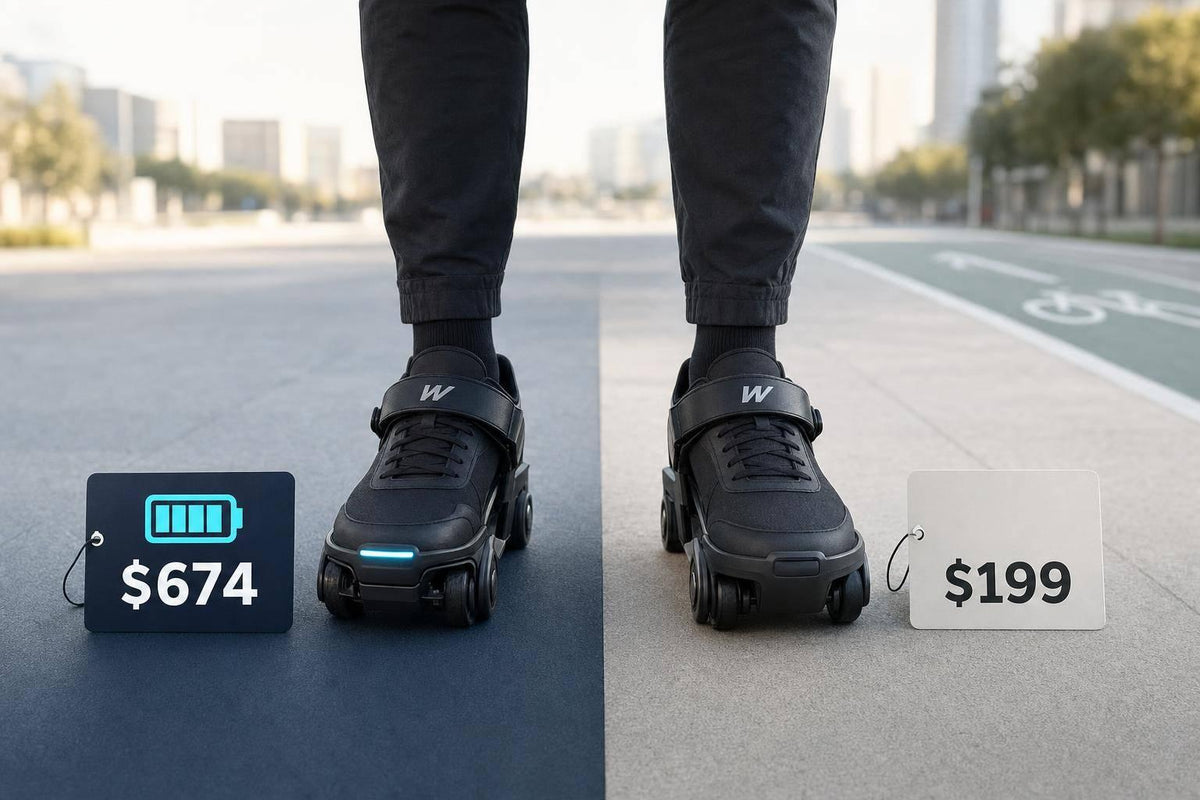
Short answer: only if you'll use the motor often. If you want Wheelfeet for commuting, hills, or longer rides, the $674 electric pair makes sense. If you want lower cost, less hassle, and a more active ride, the $199 non-electric pair is the better buy.
Here’s the whole thing in plain English:
- You’re paying $475 more for the electric model
- That extra money gets you:
- a motor
- a handheld thumb remote
- braking and reverse
- up to 15 mph
- about 9 miles per charge
- The non-electric pair skips the battery and remote
- That means:
- no charging
- less weight
- easier packing
- lower cost
So, if I were giving shop-counter advice, I’d put it like this: buy electric for transport; buy non-electric for fun and value. Simple as that :)
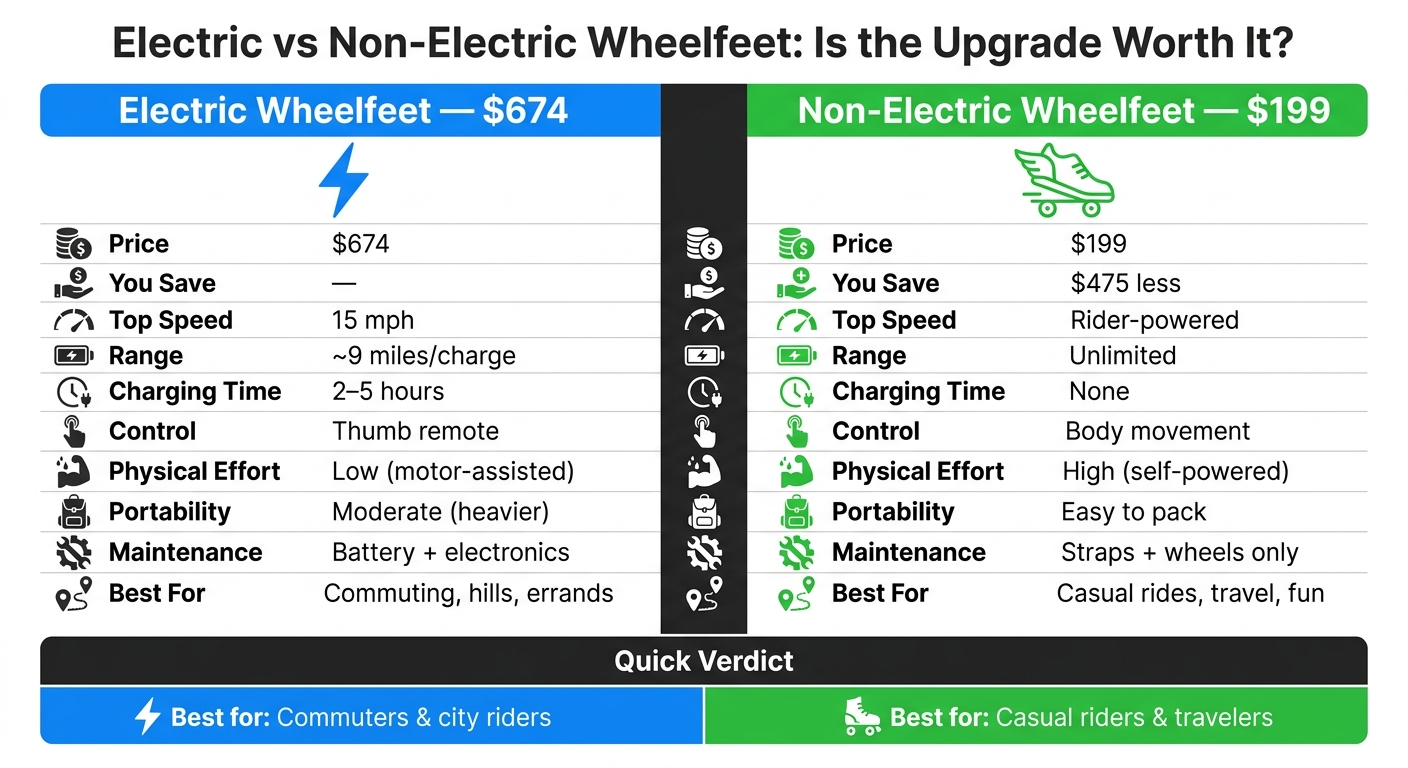
Electric vs Non-Electric Wheelfeet: Side-by-Side Comparison
Wearable Skates | Roller Blades | Skate on Shoes | Wheelfeet | Non-electric
Quick Comparison
| What matters | Electric Wheelfeet | Non-Electric Wheelfeet |
|---|---|---|
| Price | $674 | $199 |
| Extra cost | - | Saves $475 |
| Top speed | 15 mph | Depends on your push |
| Range | ~9 miles per charge | No battery limit |
| Charging | 2 to 5 hours | None |
| Control | Remote | Body movement |
| Travel | Harder due to battery | Easier to pack |
| Best for | Commutes, hills, repeated short trips | Casual rides, travel, lower spend |
What stood out to me most is this: the electric version changes the job it can do. It’s not just a skate with extra parts. It’s the one you buy if you want help getting from point A to point B. The non-electric version is the one you buy if you want to roll around, stay active, and keep life simple.
A few fast takeaways:
- Best for commuting: Electric
- Best for travel: Non-electric
- Best for lower effort: Electric
- Best for lower cost: Non-electric
- Best for most casual riders: Non-electric
One small note, though. The source says the electric model may be easier for beginners because of motor speed control, but it also says the non-electric ride can feel more natural at first. So I’d call that one a tie based on how comfortable you are with a remote in your hand.
If you want a good visual on how small electric rideables handle, these YouTube links can help:
My bottom line: if you’ll use the motor every week, the $475 jump can be worth it. If not, the non-electric pair gives you most of the fun for far less money.
Side-by-Side Specs: What You Get for the Extra Cost
Side by side, the differences are pretty straightforward.
| Feature | Electric Wheelfeet ($674) | Non-Electric Wheelfeet ($199) |
|---|---|---|
| Top Speed | 15 mph | Rider-powered (variable) |
| Range | ~9 miles per charge | Unlimited (rider-dependent) |
| Charging Time | 2–5 hours | N/A |
| Control Method | Handheld thumb remote | Body movement |
| Shoe Size Fit | US 6–13 | US 6–13 |
| Portability | Compact | No battery to carry or charge |
| Maintenance | Clean, keep dry, battery care | Clean, keep dry |
The specs help, sure. But the big gap shows up once you start riding.
What Electric Wheelfeet Add
The motor is the big upgrade. It cuts down on effort and gives you remote control over speed. A thumb-activated remote handles speed and braking, and the regenerative braking system helps recover energy while slowing down.
On paper, the electric pair goes up to 15 mph and gets about 9 miles per charge. That gives it actual day-to-day use for city trips and first- and last-mile commuting. So, the extra cost only pays off if you’ll use the motor, remote, and added range on a regular basis.
What the Non-Electric Pair Keeps Simple
The non-electric version skips the battery and remote, and it has fewer parts to deal with. You just strap in and ride.
That simple setup changes the feel of ownership too. There’s no charging step, no battery care beyond basic upkeep, and less gear to think about before heading out. It’s a more direct ride, powered by your own movement, which also changes the learning curve and daily use.
sbb-itb-17ade95
How Each Pair Rides: Speed, Control, Learning Curve, and Fun
Specs show the gap. Riding shows what that gap actually feels like.
How the Motor Changes Speed and Effort
The electric version changes the whole physical feel of the ride. Instead of pushing off with your legs to get moving, the motor does the work. The remote handles speed, braking, and reverse.
That means the ride feels smoother and takes a lot less effort. You're still balancing, of course, but you’re not also trying to build momentum with every push. It’s a bit like the difference between a kick scooter and an e-scooter: same basic idea, very different workload. That shift can help new riders feel at ease faster.
| Electric Wheelfeet | Non-Electric Wheelfeet | |
|---|---|---|
| Speed | Up to 15 mph | Rider-powered; depends on your skating pace |
| Physical effort | Minimal; motor handles propulsion | Higher; you create and maintain momentum yourself |
| Braking & control | Remote-triggered regenerative braking, plus speed and reverse control | Manual braking |
| Learning curve | More to coordinate at first | Simpler for most beginners; movement is more intuitive |
| Fun factor | More tech-driven, smooth, and lower-effort | More active and traditional; you stay engaged the whole time |
Which Pair Is Easier for Beginners
For most beginners, the non-electric pair feels easier. The movement is more intuitive, and there’s less to think about right away.
The electric pair isn’t hard, though. Some riders get comfortable on the first day. But there’s one extra layer: you’re balancing while also managing speed with a remote. For some people, that’s no big deal. For others, it takes a little time to click.
So the better pick depends on what kind of help you want. If speed control sounds nice, electric has a clear pull. If you want something that feels more natural from the start, non-electric makes more sense, especially if you already skate.
Who Gets More Fun from Each Option
Electric Wheelfeet lean toward speed and low effort. Non-electric Wheelfeet lean toward a more active, old-school skating feel.
That trade-off matters most once you start thinking about daily convenience, battery life, and travel.
Day-to-Day Trade-Offs: Commuting, Portability, Battery, and Upkeep
First-ride fun matters less than daily convenience.
When Electric Makes Daily Riding Easier
The electric pair earns its $475 premium most clearly when you use it for actual transportation. Think train-to-office trips, errands, or hilly commutes. That extra speed and range make it more useful for short daily routes, especially commuting and trips with hills. If you ride often, the added cost can be easier to justify because it cuts effort on hills and on repeated short rides.
The catch? Charging. With a 2–5 hour charge time, you need to plan ahead. Miss a night of charging, and your ride may not be ready the next morning. And the listed range isn’t always what you get on the street. Temperature, rider weight, and terrain all affect battery performance, so day-to-day range can be less predictable than the spec sheet makes it seem. Battery capacity also drops over time, which means range shrinks too. If the battery gets low, you can still roll manually.
So, the motor isn’t just about speed. It’s about convenience.
Why Non-Electric Is Easier to Travel With
The non-electric pair ($199) wins on simplicity. No charger to pack. No range to watch. No battery to think about. That makes it easier to pack, store, and use without any real planning.
That lower-friction setup is why the manual pair stays the easier travel choice.
| Electric Wheelfeet | Non-Electric Wheelfeet | |
|---|---|---|
| Commuting usefulness | Best for short urban routes, repeated errands, and hilly trips | Better for casual, spontaneous riding |
| Portability | ~8.8–9.6 lb per pair; packable but heavier | Lighter and easier to pack |
| Battery & charging | 2–5 hrs to charge; ~9-mile range per charge; store at about 50–70% charge for longevity | No battery, no charging, always ready |
| Maintenance | Battery care and electronics checks | Check straps and wheels |
These day-to-day trade-offs are what decide whether the $475 upgrade is worth it.
Bottom Line: Which Wheelfeet Should You Buy?
Your pick comes down to two things: how often you’ll use the motor and how simple you want the setup to be.
Buy Electric Wheelfeet If Speed and Commuting Are Your Priority
At $674, the electric pair is the better fit if you plan to ride often and want help on commutes. It tops out at 15 mph and gives you up to 9 miles of range, so it works well for short city trips and hills. If your goal is getting around, not just rolling for fun, this is the one that makes more sense.
Buy Non-Electric Wheelfeet If Simplicity and Value Matter More
At $199, the non-electric pair will be the smarter buy for most people. It costs a lot less, it’s easier to travel with since there’s no battery to pack or charge, and upkeep is pretty light. You’re mostly dealing with basic wheel and strap cleaning. If you like the feel of manual skating and don’t mind doing the work yourself, this pair is the better match.
For casual riders, the non-electric Wheelfeet gives you the better overall value. The electric version is more fun for commuting, but it won’t make sense for everyone.
FAQs
Can I still ride the electric pair if the battery dies?
Yes. Most electric skates, including Wheelfeet models, use a hybrid design. That means you can switch to manual mode if the battery dies.
So if you run out of charge, you’re not stuck. You can still ride them like a non-electric pair, just without motor help.
There is one tradeoff: the electric version weighs more because of the motor and battery. Still, you get the freedom to keep rolling instead of heading home on foot.
How much harder is the electric pair to travel with?
The electric Wheelfeet are tougher to travel with than the non-electric pair. The main reason is simple: they have motors, batteries, and electronics built in.
Each electric skate weighs 4.8 lbs, so you're adding nearly 10 lbs total. That’s not nothing when you’re stuffing gear into a carry-on or hustling through an airport.
They also need 2 to 5 hours of charging. On top of that, you have to pay close attention to airline lithium battery rules. That can turn a simple trip into a bit of homework.
The non-electric pair is way easier. There’s no charging, no battery prep, and no tech to deal with.
Which option makes more sense for a complete beginner?
For a complete beginner, the non-electric manual Wheelfeet are the better pick.
The electric models give you motor assist, but they also make things harder at the start. You have to manage throttle control, react faster, and stay more steady on your feet. That’s a lot to juggle when you’re still learning the basics.
The manual pair keeps it simple. You can focus on balance, foot placement, and stopping first. And at $199 instead of $674, it’s a much easier way to get started without spending a small fortune.












Deja un comentario
Este sitio está protegido por hCaptcha y se aplican la Política de privacidad de hCaptcha y los Términos del servicio.