



















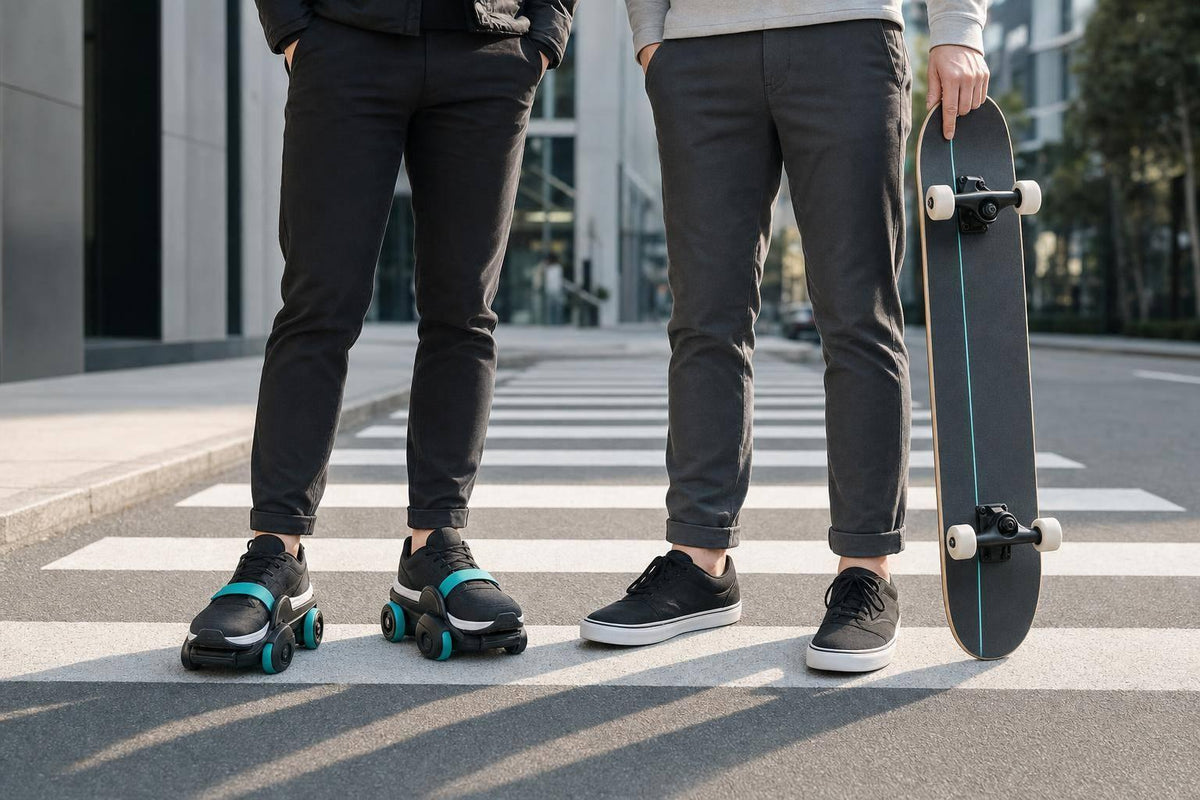
If you want the short answer: I’d pick Wheelfeet for carry ease and short mixed walk-and-ride trips. I’d pick a skateboard for lower price, tricks, and a more stable ride on rougher city pavement.
Here’s the whole thing in plain English:
- Wheelfeet fit people who care most about portability
- Skateboards cost much less, often around $80–$120
- Wheelfeet start at $199, while electric models start at $674
- Wheelfeet feel less scary for many first-timers because you face forward
- Skateboards tend to feel more planted once you get rolling
- Both work best on short urban rides, campus trips, and last-mile commutes
- If your route has rough sidewalks, cracks, and seams, a skateboard - mainly a cruiser with soft wheels - often feels better
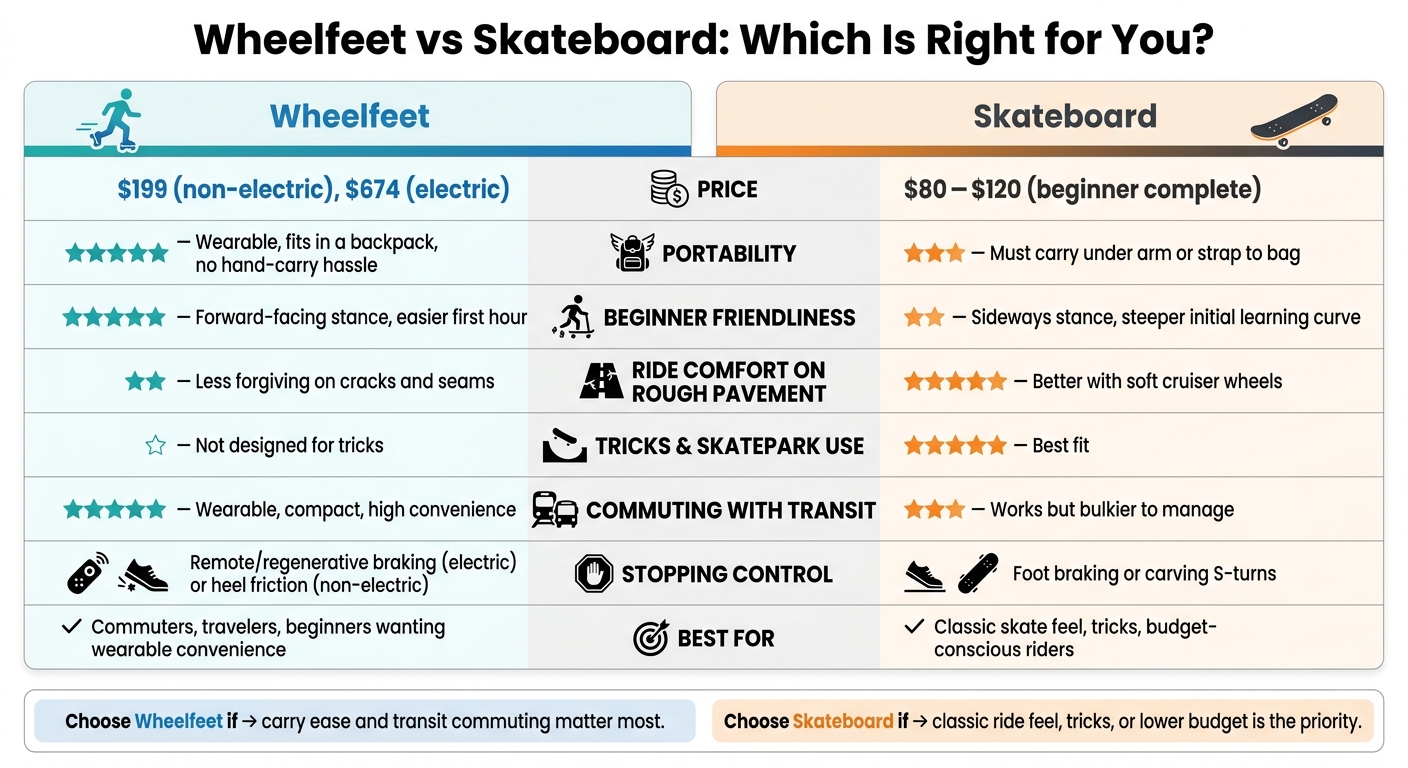
Wheelfeet vs Skateboard: Side-by-Side Comparison for Urban Riders
Wearable Skates | Roller Blades | Skate on Shoes | Wheelfeet | Non-electric
Quick Comparison
| What matters | Wheelfeet | Skateboard |
|---|---|---|
| Carrying between rides | Best - wearable or easy to stash in a bag | Fine, but you still carry it |
| Price | $199+ | $80–$120 for many beginner setups |
| Beginner feel | Easier for many people at low speed | Takes more time to get used to |
| Tricks and skatepark use | Not the main point | Best fit |
| Ride comfort on rough pavement | Less forgiving | Often better, mainly with soft wheels |
| Commuting with transit | Strong fit | Works, but bulkier |
| Stopping style | Model-based braking or friction methods | Foot braking and carving |
So, if you want a ride that’s easy to bring everywhere, Wheelfeet make more sense. If you want the classic board feel and a lower buy-in, a skateboard is still hard to beat.
What I like about this matchup is that the choice is pretty simple: wear-it convenience or board-first ride feel. No fluff. Just pick the one that fits your day. :)
Portability and Daily Convenience
What Is Easier to Carry Between Rides
A skateboard is easy enough to bring along, but once you step off, you still have to deal with it. You’re holding it, tucking it under your arm, or strapping it to a bag. Wheelfeet work differently. They stay on your shoes, so between rides, you just walk like normal. And if you want them out of the way, they pack into a bag fast.
| Feature | Wheelfeet | Standard Skateboard |
|---|---|---|
| Packability | Fits in a backpack | Requires separate carry |
| Hand-carry hassle | None while riding | Always under arm or strapped to a bag |
| Transit and travel use | High - wearable and compact | Moderate - still a separate item to manage |
That’s the part that matters once the ride stops and the rest of your day kicks back in.
Which One Works Better for Commuting and Travel
Picture a normal commute. You walk two blocks, hop on a bus, walk through a building, take an elevator, and sit down at your desk. A skateboard does fine on the rolling parts. After that, though, you’re carrying it around. Wheelfeet stay on your feet, or you can toss them in a bag in a few seconds.
For train-to-office or campus trips, Wheelfeet are easier to live with all day.
Carry convenience handles the day-to-day logistics; ride feel and stopping control decide the rest.
sbb-itb-17ade95
Ride Feel, Learning Curve, and Control
How Wheelfeet and a Skateboard Feel on Smooth Pavement
Wheelfeet put each foot on its own frame. So you ride upright, facing forward, with each foot able to move on its own. A skateboard does the opposite. Both feet stay on one deck, you stand sideways, and the whole board turns as one piece. That one change shapes how each ride feels from the first push.
On Wheelfeet, the split-foot setup can feel more familiar at first. You’re looking straight ahead, and if your balance shifts, it’s often easier to fix in the moment. It feels a bit more natural, kind of like your body already knows what to do. The downside? Smaller wheels don’t soak up cracks and seams as well, so rough pavement can feel choppier than it does on a skateboard.
A skateboard usually feels more planted once you get moving. The wider trucks and longer wheelbase help with stability, especially at speed. But you do need to commit to that sideways stance and use clear weight shifts to steer. If ride comfort is the goal, a cruiser with larger, softer wheels will usually feel better on normal city pavement.
Which One Is Easier for Beginners
For most first-time riders, Wheelfeet feel less intimidating. You stay facing forward, you can look where you’re going, and stepping off feels more natural if something goes sideways. That mental comfort matters a lot, especially in the first hour.
Here’s the quick breakdown:
| Factor | Wheelfeet | Skateboard |
|---|---|---|
| Starting stance | Upright, facing forward | Sideways, committed stance |
| First-hour feel | Easier to stand and roll slowly | Harder until the stance clicks |
| Turning | Gentle edging, like skates | Toe and heel pressure shifts |
| Learning curve | Faster for casual cruising | Steeper at first, with more progression potential for tricks and advanced riding |
If you just want short, low-speed city cruising, Wheelfeet will usually feel easier sooner. You can get comfortable without fighting the stance. After that, the next big thing is stopping.
Stopping, Speed Control, and Low-Speed Handling
This is where the gap gets pretty clear.
Electric Snowfeet* Wheelfeet use regenerative braking through a handheld remote or built-in control. In plain English: you press the control, and the system slows you down in a smooth, steady way, as long as you stay within a speed range it can handle well. Non-electric Wheelfeet work more through heel-based friction, a brake if the model has one, or a light outward stance to scrub speed. That works fine at low speeds, though it takes some reps before it feels automatic.
On a skateboard, most beginners start with foot braking. One foot stays on the board while the other drags lightly on the ground. Riders can also carve wide S turns to bleed speed, but that takes more skill and more space. If a beginner skips braking practice, stops and tight areas can get sketchy fast.
At low speeds, Wheelfeet have one big edge: each foot can adjust on its own. That makes small balance fixes easier. A skateboard usually needs more room and a bit more planning to change direction fast. You feel that most when the pavement is rough or the space gets tight.
Terrain Limits, Safety, and Real Commuting Use
Best Surfaces for Each Option
Once speed and stopping are clear, the next thing that hits you is the ground under your wheels. And yeah, rough pavement will show the gap fast.
Street skateboards do best on smooth pavement. They feel fine on clean streets and decent paths, but cracks, seams, and busted sidewalks can get old in a hurry. The ride gets less comfortable, and it takes more focus to stay steady.
Wheelfeet fit smooth city routes where carrying matters most. That’s their big selling point. You can wear them, move through a short route, and not deal with hauling a board around. On rough pavement, though, a more cushioned board still has the edge. Even so, Wheelfeet win on convenience.
Safety Trade-Offs for Casual Riders
For casual riders, the main safety risks are pretty simple:
- Surface changes
- Traffic
- Stopping distance
The same rule applies to both options: stay alert to pavement changes and keep speeds modest until the route feels familiar.
That sounds basic, but it matters. A route can look fine one day and throw a surprise crack, patch, or rough seam at you the next. Add cars, bikes, or pedestrians, and small mistakes can snowball fast.
How Far and How Often You Will Actually Ride
After surface limits, the next step is asking whether the ride fits your day-to-day route.
For short, frequent trips, both options can work. The better pick comes down to what you care about more. Wheelfeet fit riders who want a wearable ride. Skateboards fit riders who want a classic board and easier storage.
That trade-off is what sets up the final choice.
Which One Should You Buy?
Choose Snowfeet* Wheelfeet for Easy Carrying and Short Urban Rides
If easy carrying and low-hassle daily use matter most, this one’s pretty simple. Commuters, travelers, and beginners who want a ride they can wear will likely get more out of Wheelfeet than a standard skateboard.
The non-electric version starts at $199, and the electric version starts at $674. Yes, that’s more than a beginner skateboard. But you’re paying for a wearable setup you can strap on, ride, and put away fast. There’s no full deck to deal with at your desk, in a locker, or on the go.
Choose a Skateboard for Tricks, Lower Cost, or Classic Skate Feel
If ride style matters more than carry ease, a skateboard still has the edge. A good beginner complete skateboard usually costs about $80–$120, so it’s the cheaper way in if you’re still figuring out whether skating is your thing.
If you want tricks, skatepark sessions, or that classic board feel, a skateboard is still the better match.
Final Verdict
It comes down to one main choice: wearable convenience or classic board riding.
For most casual riders, Snowfeet Wheelfeet* are the better pick. Go with Wheelfeet for short rides, transit gaps, and easy carry. Go with a skateboard for tricks, park use, and that classic board feel.
FAQs
Can I wear Wheelfeet all day?
No. Wheelfeet are made for short, casual rides, not all-day wear.
Since they strap onto your own shoes, they don't give you the padding, airflow, or ankle support that dedicated inline skates do. After a while, that can get uncomfortable.
Are Wheelfeet safe for complete beginners?
Wheelfeet can work for complete beginners, but they’re not the easiest place to start. Since they strap onto your shoes instead of locking into a boot, you get less stability and less ankle support than you would with regular skates.
If you’re new, go with the non-electric manual model. Stick to smooth, flat, empty pavement. Wear a helmet and pads. And yes, learn to brake before you even think about going faster :)
Which is better for cracked sidewalks?
Both struggle on cracked sidewalks, but not in the same way.
Skateboards tend to feel bulky, and they can get knocked around by uneven pavement, cracks, and loose debris. Hit a rough patch, and yeah, you’ll feel it.
Wheelfeet do best on smooth pavement too. But for casual riders, they’re often the better pick for city streets. Why? You can step out and walk rough sections right away instead of fighting the surface. That makes them a better fit for stop-and-go use around town.











Efterlad en kommentar
Denne side er beskyttet af hCaptcha, og hCaptchas Politik om beskyttelse af persondata og Servicevilkår er gældende.