



















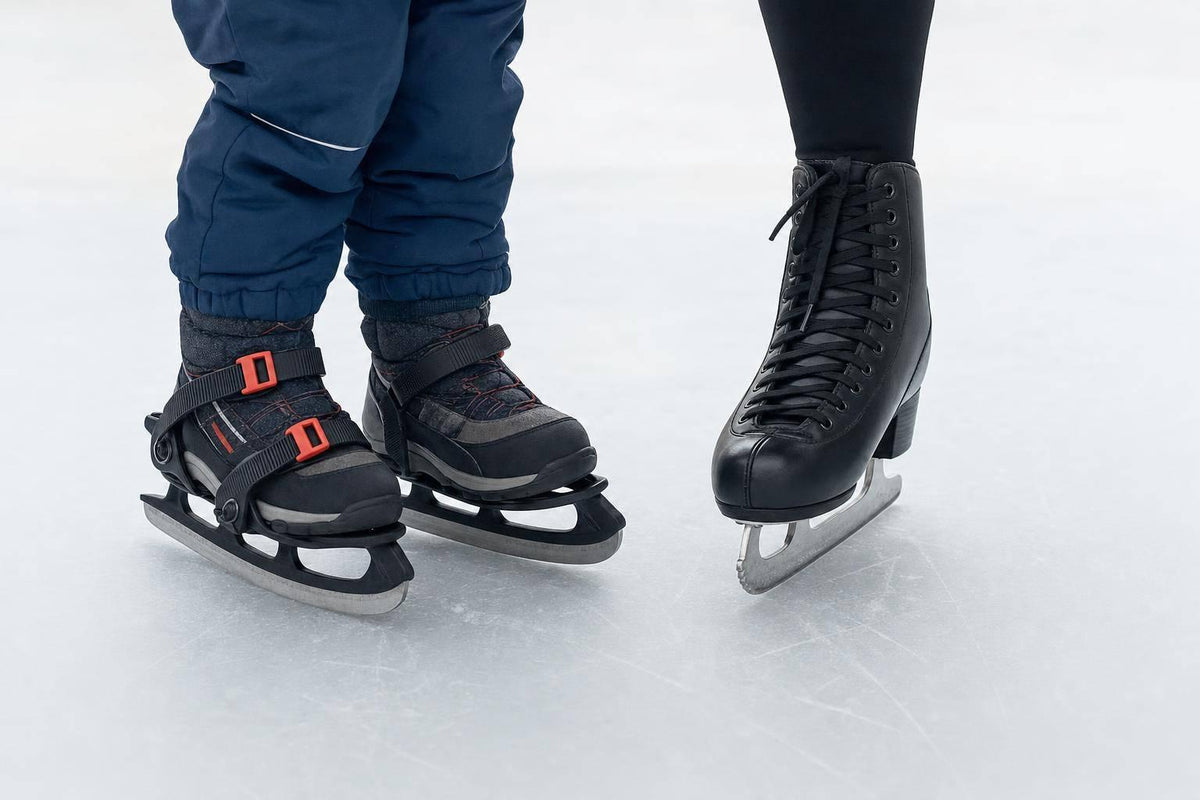
Short answer: mostly no for anyone who wants to skate with control. They’re fine for toddlers, short rink sessions, and once-in-a-while use. But for most people, the weak fit, low ankle support, and shaky blade feel make them hard to trust after 20 to 30 minutes on the ice.
Here’s the simple version:
- They work best for very short, casual use
- They don’t support skill building well
- Double-runner models can help with first steps, but not actual skating form
- Regular ice skates are the better pick for kids 4+ and most adults
- If you want small gear for snow, Snowfeet* gives you more use than ice-only strap-ons
So, if you just want to shuffle around the rink once or twice a season, strap-ons can do the job. If you want to glide, turn, stop, and not fight your gear the whole time, I’d skip them :)
Finally… Ice Skates Anyone Can Use!
Quick Comparison
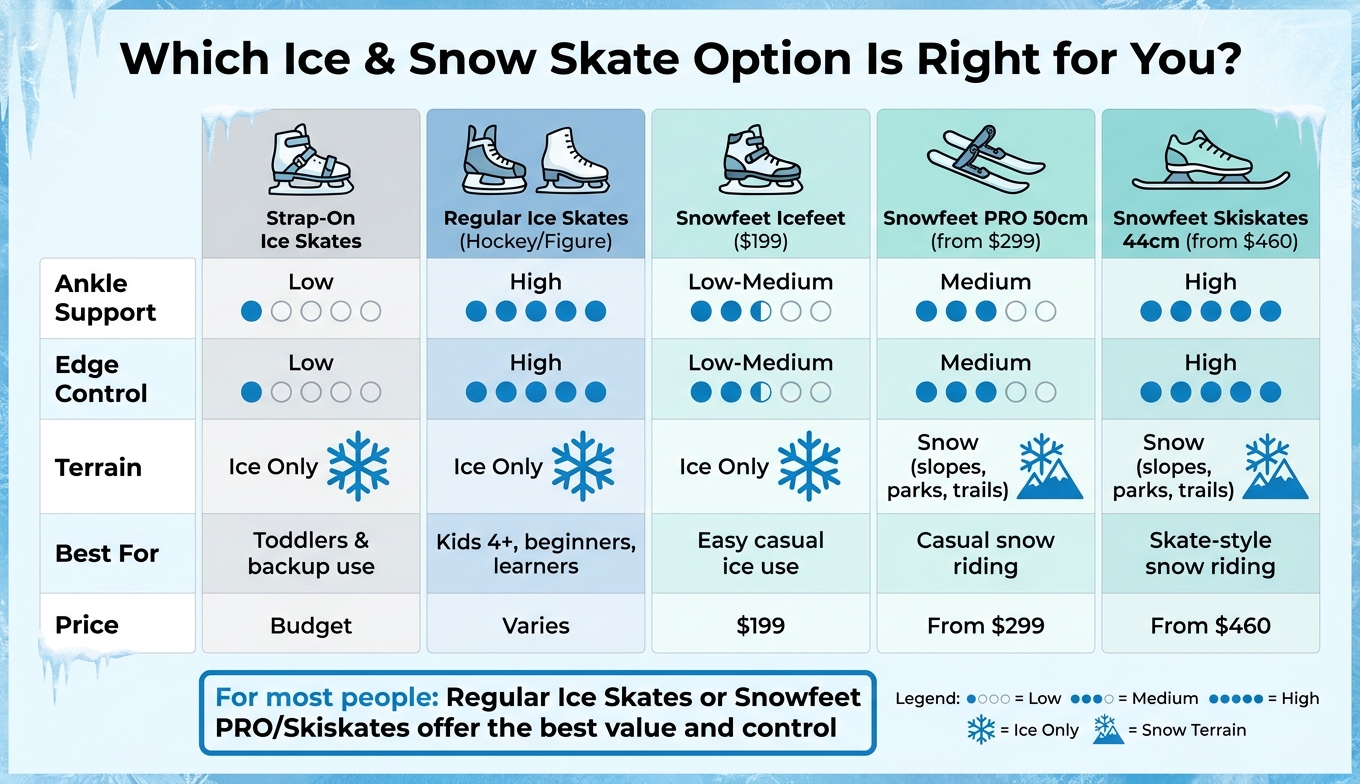
Strap-On Ice Skates vs Regular Skates vs Snowfeet: Which Is Right for You?
| Option | Best for | Support | Control | Use time | Price |
|---|---|---|---|---|---|
| Strap-on ice skates | Toddlers, backup use, rare casual laps | Low | Low | Short sessions | Budget |
| Regular ice skates | Kids 4+, beginners, anyone learning | High | High | Much longer | Varies |
| Snowfeet* Icefeet | Simple ice use | Low to medium | Low to medium | Short casual use | $199 |
| Snowfeet* PRO 50 cm | Casual snow riding | Better than strap-ons | Better than strap-ons | More range | From $299 |
| Snowfeet* Skiskates 44 cm | Skate-like riding on snow | High | High | More range | From $460 |
What I’d tell a friend is simple: strap-on skates are about convenience first, not skate quality. That trade-off is fine for a tiny kid or a one-off outing. For almost everyone else, they hit their limit fast.
The Main Problems With Strap-On Ice Skates
Poor Fit, Comfort, and Ankle Support
Strap-on skates go over winter boots. Sounds simple. On the ice, though, that setup has a catch.
The way they feel depends on the boot shape, sole thickness, and how much insulation is packed inside. So the fit can change a lot from one person to the next.
If the straps are loose, the blade can wobble side to side. If the straps are pulled too tight, pressure builds fast across the top of the foot or around the ankle. In both cases, staying balanced takes more work.
That discomfort often sneaks up after 20–30 minutes. A small fit issue at the start can turn into hot spots, numbness, or that shaky feeling where confidence starts to drop. Fine for standing around a bit, maybe. Not so great once someone wants to learn balance and control for real.
Stable for First Steps, but Limited for Learning
There’s another kind of strap-on skate too: double-runner bob skates.
These can help with the very first steps. Because they use two side-by-side blades, they put more metal on the ice. That can feel safer for a toddler, and yeah, that part makes sense. But the wider base comes with a trade-off: it doesn’t teach actual skating skills.
Feeling steady and learning to skate are not the same thing.
Skills like edging, weight transfer, single-blade balance, gliding, and stopping don’t develop in a natural way on double runners. A child may feel less nervous at first, but they can also hit a wall later. Once they want to skate faster or move with better form, switching to real technique can be tough.
Comparison Table: Strap-On Ice Skates vs Regular Ice Skates
| Feature | Over-Shoe Strap-On Skates | Traditional Hockey or Figure Skates |
|---|---|---|
| Ankle support | Weak - relies on straps over a winter boot, so support is inconsistent | Strong - designed to lock the heel and ankle while still allowing controlled flex |
| Comfort over time | Can develop pressure points, hot spots, or numbness after 20–30 minutes | Higher when properly fitted |
| Edge control | Low - less precise fit means less stability and control | High - built for edging, turning, and stopping |
| Learning potential | Limited - not built for real skill progression | Strong - supports real skating mechanics |
| Portability | High - easy to pack and use over winter footwear | Lower - requires dedicated skates/boots |
| Best fit | Toddlers, very short outings, backup gear | Anyone who wants to learn or improve |
Strap-on skates do one thing well: they’re easy to bring along and easy to throw on. That’s handy, no doubt. But once skating moves past a quick tryout, convenience starts to lose ground.
sbb-itb-17ade95
When Strap-On Ice Skates Are Actually Worth Using
Toddlers, Short Outings, and Backup Gear
Strap-on skates make sense in a few pretty small situations.
For toddlers ages 2 to 3, double-blade strap-on skates can be a simple first taste of skating. They go over winter boots, so setup is fast and easy. And that two-blade base gives little kids a steadier platform for those first wobbly, shuffling steps.
They work best for short sessions on smooth ice, like an indoor rink, with close adult supervision. The straps can loosen, and most toddlers get tired fast anyway. After that, the upside drops off in a hurry.
Travelers and Beginners Who Put Simplicity First
For adults who skate once in a while, strap-ons can do the job for easy, low-speed gliding. They pack well, go on fast, and save you from bringing a separate pair of boots. If all you want is a few mellow laps, that can be enough.
That said, they’re not made for sharp control, clean turns, or solid stopping. If you want to improve, even a little, you’ll probably hit their limit fast.
If you want more control without going all-in on a full skate setup, this is where strap-ons start to feel like a halfway fix.
Comparison Table: Which Skater Type Should Use Strap-On Skates
| Skater Type | Strap-On Skates? | Better Choice | Why |
|---|---|---|---|
| Toddlers (ages 2–3) | ✅ Yes, with close supervision | - | Wide base helps with first steps. |
| Kids age 4 and up | ❌ No | Regular skates | Better fit, support, and learning value. |
| Adult beginners | ⚠️ Limited use | Regular skates | Better ankle support and skill development. |
| Casual travelers (1–2 times/season) | ✅ Yes, for occasional use | - | Fine for gentle gliding when simplicity is the priority. |
| Anyone serious about skating | ❌ No | Regular skates | Strap-ons limit technique and edge control. |
A Better Option for Most Casual Riders: Snowfeet*
If strap-on skates feel shaky or too limited, Snowfeet* is a much better pick for most casual riders. You get more control, more places to ride, and a setup that feels less like a toy and more like actual gear.
The big shift is simple: Snowfeet* works on snow, not just ice.
How Snowfeet* Fixes the Biggest Frustrations
Snowfeet* solves a lot of the stuff that bugs people about basic strap-on skates. It comes with adjustable bindings and a better fit. The PRO fits U.S. shoe sizes 6–13 and works with winter boots or snowboard boots.
And you’re not stuck on one type of surface. You can use it on:
- Groomed slopes
- Snowparks
- Small hills
- Trails
- Backyard snow
That’s a pretty big jump from gear that only makes sense on ice.
Snowfeet* Skiskates 44 cm and Snowfeet PRO 50 cm vs Strap-On Ice Skates
In the Snowfeet* lineup, two models make the most sense for casual riders.
Snowfeet* Skiskates (44 cm) are the most skate-like option. They use a wood core and come in ski-boot or snowboard-boot versions, so they give you that quick, nimble, skate-style feel on snow. Starting at $460.
Snowfeet PRO (50 cm) is the lower-cost choice. It starts at $299 and uses universal adjustable bindings, with support for winter boots or snowboard boots.
If you only want something for ice, Snowfeet* Icefeet costs $199 and gives you a simple double-blade setup.
Comparison Table: Strap-On Ice Skates vs Snowfeet* Products
Here’s the practical difference at a glance.
| Feature | Basic Strap-On Ice Skates | Snowfeet* Icefeet | Snowfeet* PRO 50 cm | Snowfeet* Skiskates 44 cm |
|---|---|---|---|---|
| Terrain | Ice only | Ice only | Snow: slopes, parks, trails, and backyard snow | Snow: slopes, parks, trails, and backyard snow |
| Footwear | Winter boots | Winter shoes | Winter or snowboard boots | Ski or snowboard boots |
| Portability | High | High | High | High |
| Learning curve | Simple to try | Simple to try | Easy to learn | Easy to learn |
| Price (USD) | Budget-priced | $199 | From $299 | From $460 |
| Best use case | Casual ice use | Easy ice use | Casual snow use | Skate-style snow riding |
Conclusion: Are Strap-On Ice Skates Worth Buying?
For most people, no.
Strap-on skates make sense in a pretty small set of cases: toddlers, super short rink sessions, or as backup gear. They’re easy to throw on, sure. But that ease doesn’t make them a strong pick for skating.
The main problem is simple. Most skaters need more support and more control. Strap-on models don’t give you much ankle support, the fit can be hit or miss, and the design makes it harder to steer, stop, and improve. So if skating is something you plan to do more than a few times each season, regular ice skates are the better choice.
If you want something compact that still feels more secure, Snowfeet* makes more sense. For most casual riders, _Snowfeet Skiskates (44 cm)_* and Snowfeet PRO (50 cm) are the better buy. They give you better control and more ways to use them on snow than strap-on ice skates can.
FAQs
Are strap-on ice skates safe for beginners?
Yes. Strap-on ice skates are usually a safe, beginner-friendly pick. Since you wear your own comfy winter boots, they often feel less scary than standard skates. And models with a double-blade design give you a wider, steadier base, which helps cut down on wobbling and falls.
They’re also easier to steer and tend to feel more natural for first-timers. There’s no break-in period, and the motion is closer to walking than what you get with standard ice skates.
How do I know if regular skates are a better choice for me?
Regular ice skates are the better pick if your main goal is to learn technical skating skills. That includes competitive figure skating, formal hockey, and rink moves like crossovers or clean edge work.
They’re made for smooth indoor rinks, so you get more precision, more speed, and better support over time. If you’re in structured lessons or need certain performance features, traditional skates are the standard choice.
Can Snowfeet* replace strap-on skates for casual winter use?
Yes. For casual winter use, Snowfeet* can replace strap-on ice skates and often feel like a more flexible step up.
Basic strap-on skates tend to work best on smooth, clean ice. Snowfeet* PRO 50 cm and Skiskates 44 cm give you more room to play. You can use them on both ice and snow, which makes a big difference when winter conditions aren’t perfect.
They also attach to your winter boots, so they’re easy to carry and simple to use on more than one surface. That makes them a solid pick if you want something more portable than standard strap-on skates, without being stuck to the rink.
Related Blog Posts
- Best Strap-On Ice Skates for Adults and Kids (No Special Boots Needed)
- Strap-On Ice Skates vs. Traditional Ice Skates: Pros & Cons for Beginners
- Best Affordable Strap-On Skates: Skate on Any Shoes (2026 Guide) ← Snowfeet positioning
- Best Ice Skates for Family Fun (Affordable Strap-On Skates for Everyone)











Efterlad en kommentar
Denne side er beskyttet af hCaptcha, og hCaptchas Politik om beskyttelse af persondata og Servicevilkår er gældende.