




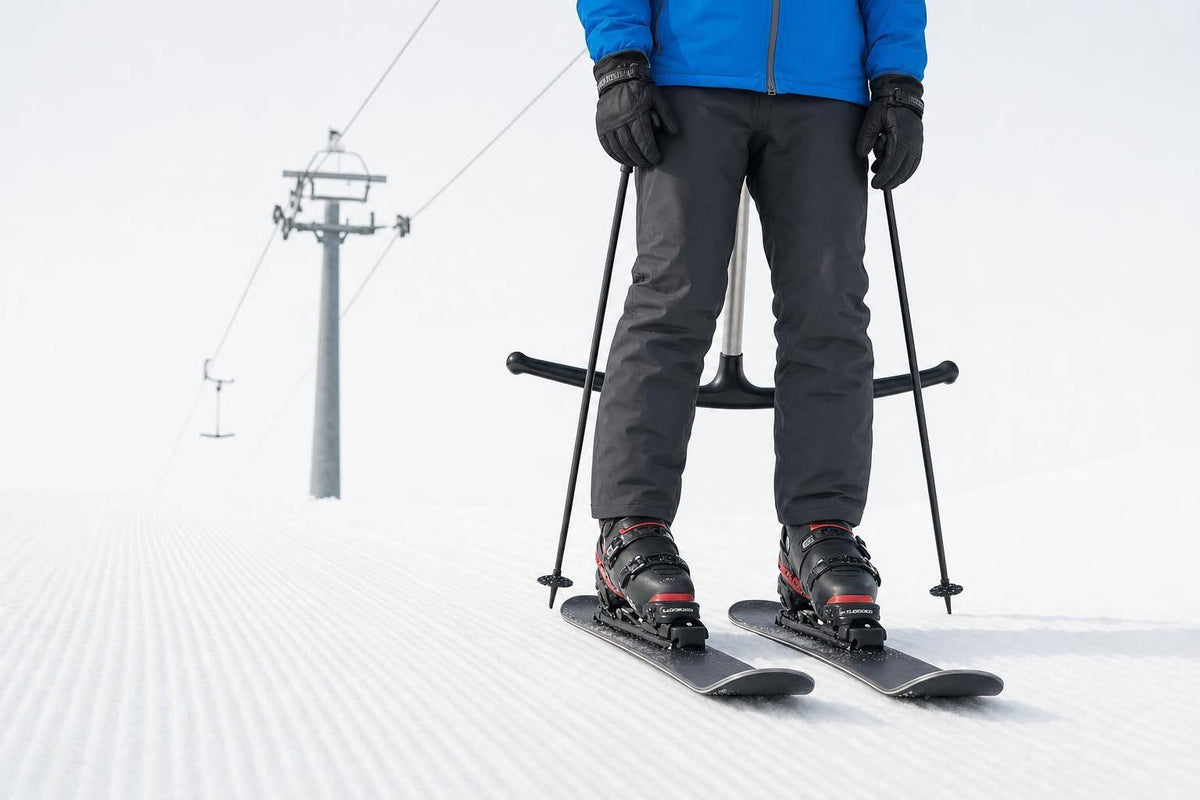
Yes - you can ride a T-bar on skiblades. The short answer is simple: if the resort allows short skis, and your setup is okay for the lift, you’re good to go.
Here’s the part that matters most: shorter skiblades feel less steady front to back, so you need to stay centered from the moment the bar pulls until you unload. Most falls happen at the start, when the tow line tightens and gives that little jolt at about 3 to 5.5 mph (1.5 to 2.5 m/s).
If you want the fast version, this is it:
- Keep both skiblades flat on the snow
- Stand centered over your feet
- Let the bar rest on the backs of your thighs
- Don’t sit on the bar
- Hold both poles in your outside hand
- Push the bar away only at the unload area
I’d put it like this: a T-bar on skiblades isn’t hard, but it is a little less forgiving. 65 cm blades feel the most twitchy. 99 cm is the easiest all-around pick for most riders. 120 cm feels calmer and gives more front-to-back support, which helps on steeper or icy lift tracks.
If you already ski green runs with control, you’ll likely get the hang of it fast. The lift isn’t the hard part. Your stance is.
For a quick visual on T-bar technique, these can help:
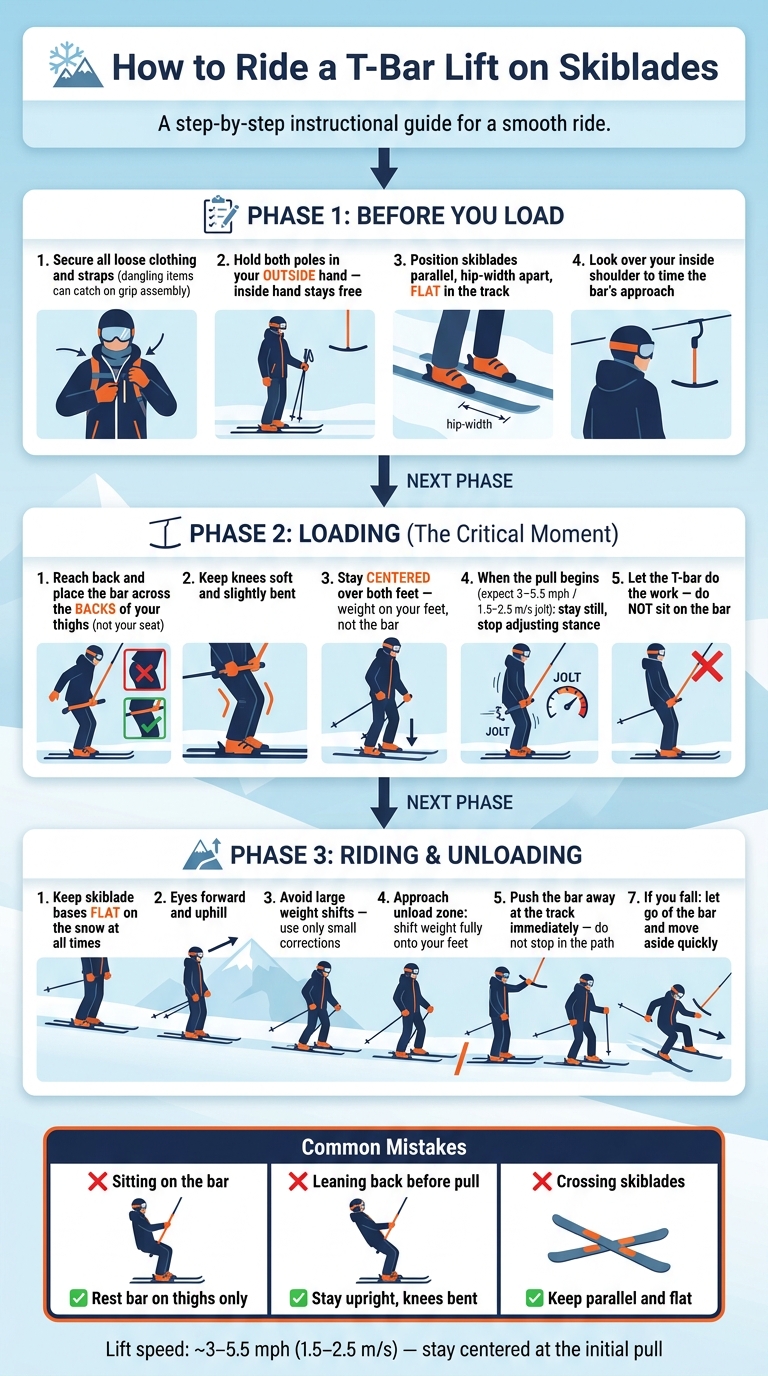
How to Ride a T-Bar Lift on Skiblades: Step-by-Step Guide
How to Use Snowfeet* Snowblades 99 CM | Short Skis | Skiblades | Tutorial
Quick Comparison
| Skiblade length | Feel on T-bar | Who it suits |
|---|---|---|
| 65 cm / 25.6 in | Most lively at the start | Riders with better balance who want the shortest setup |
| 99 cm / 39 in | Best middle ground | Most casual riders |
| 120 cm / 47 in | Most steady | Newer riders or steep/icy T-bar tracks |
So, if you want the plain answer: yes, you can ride a T-bar on skiblades, and the 99 cm length is the safest bet for most people. :)
Why T-Bars Feel Different on Skiblades Than on Regular Skis
The lift works the same either way. What changes is how much ski you have under your feet.
Snowfeet* Skiblades - 65 cm (about 26 in), 99 cm (about 39 in), and 120 cm (about 48 in) - give you a much shorter platform than regular skis. And yeah, you feel that fast on a surface lift.
Shorter Length Means Easier Tip Control but Less Fore-Aft Stability
With less ski in front of and behind the binding, your balance point gets tighter. On longer skis, that extra length works like a lever. It helps steady the forward-and-back pitching that can happen when the spring-loaded cable grabs and starts pulling.
On skiblades, that cushion is smaller.
So the first pull usually feels more twitchy. Surface lifts tend to run at about 1.5 to 2.5 meters per second (about 3 to 5.5 mph), and that little jolt can feel sharper when your platform is short. After you get moving, though, skiblades can track well. The shorter tips are easier to keep parallel, and they’re less likely to cross or catch in the lift track grooves.
"The initial jerk and acceleration is where most wipeouts happen. You have to get positioned just right and commit immediately." - DeltaWebDesign
That’s the deal: a twitchier start, but easier tip control once you’re in the groove.
Centered Stance Matters More Than Leaning on the Bar
On long skis, you can get away with being a little off-center. The ski smooths some of that out. On skiblades, even a small shift forward or back shows up right away.
The fix is simple:
- Keep your weight centered over both feet
- Keep your knees soft and slightly bent
- Let the bar rest against the backs of your thighs
- Don’t sit down into the bar
"Tension is your enemy. Your job is not to stay upright independently; your job is to let the bar support you and guide you." - DeltaWebDesign
Also, don’t use your poles for balance while riding. Tuck them under your outside arm. And try not to lean back against the pull. On short blades, leaning back can lift the tips and make you lose contact with the snow. Soft knees help soak up bumps, and a centered stance helps you stay on line.
sbb-itb-17ade95
How to Ride a T-Bar on Snowfeet* Skiblades Step by Step
With your stance dialed in, getting on the lift comes down to three simple moves.
Before you enter the load area, secure loose clothing and straps. Anything dangling can catch on the grip assembly and cause serious injury. Hold both poles in your outside hand so your inside hand is free to guide the bar.
Loading: Set Your Stance Before the Pull Starts
Step into the load area with your skiblades parallel, about hip-width apart, and flat in the track. Look over your inside shoulder so you can time the approach. Then reach back and place the bar across the backs of your thighs.
When the lift starts to pull, keep your knees soft and stay centered. Let the T-bar do the work. Don’t sit on it. Keep your weight on your feet.
Once the pull begins, stop fiddling with your stance and let the lift take you uphill.
Riding and Unloading: Stay Flat, Follow the Track, Exit Cleanly
Keep your bases flat and your eyes uphill. Follow the track and avoid big weight shifts. On shorter skiblades, a flat base and centered stance matter even more than on long skis. If you drift too far forward or back, you’ll feel it right away.
As you get close to the top, get ready early. At the unload point, shift all the way onto your feet, push the bar away, and ski clear right away. If you stop in the track, the rider behind you can run into you. If you fall, let go of the bar and move aside as soon as it’s safe.
Body Position, Common Mistakes, and Which Snowfeet* Length Feels Easiest
Once the lift starts pulling, tiny stance issues show up fast on skiblades. There’s no hiding from them :) Keep both bases flat and your weight centered over your feet.
Two Feet Down Is the Default; One-Foot Riding Is for Brief Corrections Only
Ride with both skiblades on the snow. If you need to fix your balance, you can lift one foot for a split second, then put it right back down. That’s it.
The 65 cm length reacts the fastest. That makes it fun, but it also means it asks for cleaner body position. If you get sloppy, it lets you know fast.
Common T-Bar Mistakes and How to Fix Them
Most T-bar trouble comes from the same handful of errors. The good news? They’re easy to fix once you know what to watch for.
| Mistake | What Happens | Fix |
|---|---|---|
| Sitting heavily on the bar | Pulls you off balance | Keep the bar against your thighs only - stand, don't sit. |
| Leaning back before the line tightens | Bar slides up or you lose contact | Stay upright, knees bent, weight centered. |
| Crossing or twisting skiblades | Instant tangle and fall | Keep blades parallel and flat in the track. |
| Holding poles on the inside hand | Interferes with the bar | Put both poles in your outside hand. |
| Putting the skis on edge in the track | Catches an edge; pulls you sideways | Keep the bases flat and let the track guide you. |
| Steering too aggressively | Over-correction leads to wobbling | Use small weight shifts only. |
| Releasing too early | You slide back into the next rider | Hold the bar until the unload zone. |
A lot of this comes down to one simple idea: let the tow do the work. You’re not trying to steer like crazy. You’re just staying centered, calm, and flat on the snow.
Snowfeet* 65 cm vs. 99 cm vs. 120 cm for T-Bar Use
Length makes a big difference here. More ski under your feet usually means a calmer, steadier ride on the tow.
| Length | Approx. Inches | T-Bar Feel | Best For |
|---|---|---|---|
| 65 cm | ~25.6" | Most compact; twitchiest at the start | Experienced or agile riders who prioritize portability |
| 99 cm | ~39" | Best all-around feel | Casual riders; most versatile choice |
| 120 cm | ~47" | Most stable on the tow; best fore-aft support on steep or icy tracks | Beginners; riders on steeper or icier T-bar terrain |
For most casual riders, the 99 cm hits the sweet spot. It feels easier without feeling bulky.
The 120 cm makes more sense if you’re newer to surface lifts or your home hill has a steep or icy T-bar track. It gives you more support front to back, which can feel like a nice little safety buffer when things get sketchy.
Conclusion: When Skiblades Work Well on a T-Bar
Yes - skiblades work on a T-bar when the resort allows them and you stay centered, flat, and parallel in the track.
Stay parallel. Stay flat. Stay upright.
That’s the whole game, honestly. Once you do that, the big thing is keeping your cool during the pull and at the exit.
If you already have solid control on green runs, you’ll probably get used to it fast. The main challenge is balance, not speed.
For most riders, the Snowfeet* 99 cm is the best T-bar choice. The 65 cm takes more balance, while the 120 cm gives you more stability. Go with 99 cm if you want the easiest all-around T-bar ride. Pick 120 cm if you want extra stability. Choose 65 cm only if you want the shortest, most agile option.
For casual riders, the 99 cm hits the sweet spot for control, stability, and lift-friendly handling.
FAQs
Do all ski resorts allow skiblades on T-bars?
No. Not all ski resorts allow skiblades on T-bar lifts.
Many U.S. resorts permit short skis like Snowfeet* if they meet safety standards, but the rules can change from one resort to the next. In some cases, they can even change from one lift to another on the same mountain. Yeah, it’s a bit of a patchwork.
Before you head out, check the resort’s equipment policy for terms like "short skis" or "snowblades." If the site isn’t clear, call guest services and ask ski patrol. That quick call can save you a long drive and an awkward chat at the lift line :)
Are T-bars harder on skiblades than regular skis?
Not always, but skiblades do ask for a different kind of balance.
Because they’re shorter, they can feel twitchier than regular skis. Small shifts forward or back can affect your stance fast. That’s why it helps to stay centered over your feet and avoid leaning too far in either direction.
Here’s the simple version:
- 44 cm skiskates call for the most active balance
- Snowfeet 65 cm or 99 cm skiblades* feel more stable
- The longer options also make lift lines and unloading easier for casual riders
So, if you’re new to skiblades, the longer models tend to feel a bit less squirrely :)
What skiblade length feels safest on a T-bar?
For a T-bar, the safest-feeling skiblade length is 65 cm (Snowfeet Skiblades 65 cm).
Why? It tends to feel steadier at slow speeds. You also get more front-to-back control than with shorter options like 44 cm. Those shorter skiblades can feel twitchy in the lift line and near the unload ramp.
If you’re not sure which to pick, or the ramp is rutted, start with the calmer 65 cm.











Efterlad en kommentar
Denne side er beskyttet af hCaptcha, og hCaptchas Politik om beskyttelse af persondata og Servicevilkår er gældende.