



















No - short skis aren’t always harder on ice. In most U.S. resort conditions, they can feel easier for new and casual skiers because they turn fast, scrub speed with less effort, and feel less intimidating than 160 cm+ skis.
Here’s the short version:
- On firm groomers: short skis are often easier to control
- On steep, slick runs: longer skis hold a line better
- On true boilerplate: almost any ski can feel sketchy
- For short skis: sharp edges and centered stance matter a lot
- Best middle ground: 65 cm and 99 cm lengths for many riders
So, if you ski normal hardpack - not shiny East Coast death-cookie ice :) - short skis can work well. But as speed, steepness, and slickness go up, more length helps.
What matters most:
- 44 cm: fun, loose, least planted on ice
- 65 cm: easiest for many beginners
- 99 cm: more grip and calmer feel
- 120 cm: strongest edge hold in the short-ski group
- 160 cm+ skis: most edge contact and calm at speed
Snowboarder tries Snowfeet* | Which Snowfeet* Short Ski is the Best? | Snowblades 44, 65, 99 Review
Quick Comparison
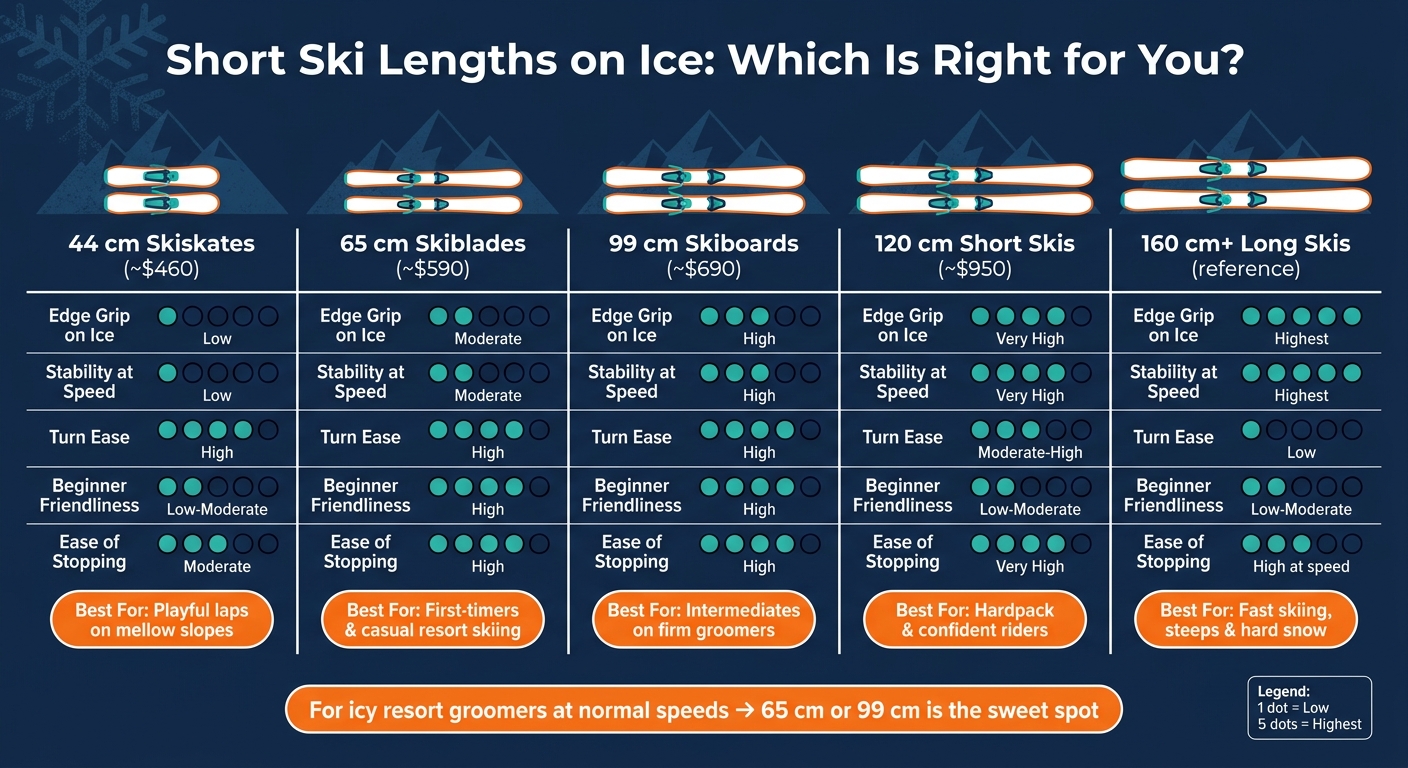
Short Ski Lengths on Ice: Grip, Stability & Best Use Comparison
| Ski Length | Grip on Ice | Stability | Turn Ease | Best For |
|---|---|---|---|---|
| 44 cm | Low | Low | Very high | Playful laps on mellow slopes |
| 65 cm | Medium | Medium | High | First-timers and casual resort skiing |
| 99 cm | High | High | Medium-high | Intermediates on firm groomers |
| 120 cm | Very high | Very high | Medium | Hardpack days and more confident riders |
| 160 cm+ | Highest | Highest | Lower | Fast skiing, steeps, and hard snow grip |
A good rule I’d use: if you ski icy blues at normal resort speeds, go 65 cm or 99 cm. If you see hardpack all the time, 120 cm gives you more bite underfoot.
Why ski length affects grip, balance, and confidence on ice
The big idea is edge contact length: how much of the ski’s edge touches the snow when you tip it on edge. Longer skis give you more of that contact. And that matters.
More edge on the snow spreads your weight across a longer surface. That helps the edge bite into firm snow and hold a steadier line through the turn instead of slipping sideways. Short skis have less edge contact, so they pivot fast and feel playful. But they also skid sooner if you back off your edge pressure. You can see that trade-off pretty clearly across Snowfeet* lengths from 44 cm to 120 cm.
More edge contact vs. quicker maneuvering
A longer ski gives you more edge contact and a steadier platform on the snow. That extra length helps smooth out small balance mistakes and keeps the ski following a more predictable arc, especially on firm groomers. A 65 cm skiblade is a different animal. It reacts almost the second you move your feet. That’s fun in tight turns, but if your edge angle slips even a little, the ski can skid right away.
Longer skis also resist twisting better, so more of the edge stays locked in. On hard snow, that helps the whole edge work more evenly. Short skis, with less material and less leverage, can let part of the edge wash out if your stance gets lazy. Ice is not very forgiving like that. It’s kind of the snow version of a snarky referee.
When short skis feel less stable on icy slopes
On steep black runs, gravity puts more force on the ski, and a longer edge gives you more ski to push against. At higher speeds, those forces build fast, and longer skis handle that energy with a smoother feel. Short skis can start to feel bouncy or twitchy when the pace picks up.
The same thing happens when you’re going straight fast on a firm groomer. Longer skis track through little bumps and surface ripples with less drama. Short skis can get knocked around more easily and feel less settled if you’re not actively absorbing the terrain with your legs.
When short skis are easier to control than long skis
On a busy blue groomer, short skis often feel easier to handle. They’re quick, light, and simple to move where you want them.
- Speed checks happen fast because there’s less ski to swing around
- Turn initiation takes very little effort
- If a rut or another skier throws you off balance, they’re easier to pull back under you
For people building confidence, that can be a huge plus. Short skis make speed control and quick recovery feel less intimidating. The next step is matching that trade-off to the right Snowfeet* length.
sbb-itb-17ade95
Snowfeet* lengths on ice: 44 cm, 65 cm, 99 cm, and 120 cm
Snowfeet* lengths change grip, turn speed, and stability on firm snow. And yeah, the trade-off shifts a lot as the ski gets longer.
Snowfeet* Skiskates 44 cm and Skiblades 65 cm on hardpack
The 44 cm Skiskates (from about $460) feel the most like skating. On mellow blue groomers, they pivot fast and make speed checks simple. That part is fun.
But on steeper or icier terrain, things get shaky fast. The short edge just doesn’t hold in a steady way, and even small balance errors can turn into skids. They work best for riders who already have sharp edge instincts and don’t mind a lively, loose feel.
Step up to the 65 cm Skiblades (from about $590), and you get more edge hold right away. That extra length helps the ski bite when you tip it over, especially in skidded turns and hockey stops on firm snow. The nervous feel of the 44 cm calms down into something that feels easier to trust.
For beginners and intermediates dealing with normal icy resort days, the 65 cm lands in a nice middle ground: easy to turn, but with enough edge hold to help you stay in control.
At 99 cm and 120 cm, Snowfeet* start holding a line more like a ski.
Snowfeet* 99 cm and 120 cm for better edge hold on icy groomers
The 99 cm models (from about $690) feel closer to a compact all-mountain ski. The longer edge comes into the turn in a smoother way, which cuts down on that pivot-and-skid feel you get with shorter lengths. On icy groomers at moderate speeds, the 99 cm tracks straighter and stays on line better. That makes it a strong pick for intermediates who want to carve instead of mostly skid.
The 120 cm Short Skis (from about $950) are the top option in the lineup for icy conditions. On refrozen morning corduroy or scraped-off pitches, the 120 cm feels more like a standard ski. It holds an edge through the turn instead of washing across the surface, and it deals with moderate speeds and small terrain changes with more calm than the shorter models.
If you deal with icy starts on a regular basis but don’t want full-length skis, this is the model that tends to inspire the most trust underfoot.
Comparison table: Snowfeet* lengths vs. long skis on ice
| Length | Edge Grip | Stability at Speed | Ease of Turning | Ease of Stopping | Beginner Friendliness |
|---|---|---|---|---|---|
| 44 cm Skiskates | Low | Low | Very High | Moderate | Low–Moderate |
| 65 cm Skiblades | Moderate | Moderate | High | High | Highest |
| 99 cm Skiboards | High | High | Moderate–High | Very High | High |
| 120 cm Short Skis | Very High | Very High | Moderate | Very High | High |
| Long Skis (160 cm+) | Highest | Highest | Low | High at speed | Low–Moderate |
Once you’ve picked the right length, sharp edges and a balanced stance play a huge role in how well it works on ice.
How to ride short skis safely on icy snow
Why sharp edges matter more on short skis
Once you’ve picked the length, the next big thing is tune and stance. On ice, short skis show dull edges fast. Faster than longer skis. That’s why edge sharpness matters so much here.
Keep the edges sharp and clean. If they’re dull, short skis can lose grip in a hurry on hardpack. If the edge feels rough or dead, sharpen it. Simple as that.
Balance, stopping, and turning on firm snow
The most common mistake? Leaning back.
Yeah, it feels natural when things get slick. But it does the opposite of what you want. It takes pressure off the edges and makes the tails wash out. On icy snow, centered balance matters even more because short skis react fast to tiny body movements.
A good stance looks like this:
- Weight centered over the balls of your feet
- Slight flex in your ankles and knees
- Hands forward
- Chest facing down the hill
- Shoulders over knees, knees over toes
If you need to stop, do it progressively. A controlled side-slip, snowplow, or skidded parallel stop is usually safer than throwing the skis sideways at the last second. Short skis answer fast, so giving them a moment to grip makes the stop a lot more predictable.
For turns, start with your feet, not your shoulders. Tip first, then turn. That helps the edges stay engaged instead of forcing a pivot that just skids across the surface. Once the turn starts, build pressure on the outside ski bit by bit and add more edge angle through the middle of the arc.
On true ice, a small brushed finish is often easier to manage than a full carve. Tip the ski, let it grip, then stand a touch taller halfway through the turn so the tail slips just a little across the fall line. That bleeds speed without giving up all your grip. Then finish the turn across the hill before starting the next one.
Which Snowfeet* model fits your terrain and skill level
Getting the right length for your riding style matters just as much as technique on firm snow. The chart below helps match edge hold and stability to your terrain.
| Rider Type | Best Length | Why |
|---|---|---|
| Playful skater, gentle slopes | 44 cm Skiskates (~$460) | Quick pivots, skating feel; not for steep ice |
| First-timer, casual groomer laps | 65 cm Skiblades (~$590) | Easy to turn, enough edge for moderate speeds |
| Solid intermediate, all-around resort use | 99 cm Skiblades (~$690) | Better edge hold on steeper blues and firm groomers |
| Heavier or more confident rider, frequent hardpack | 120 cm Short Skis (~$950) | Most stability and grip; closest feel to traditional skis |
That trade-off is exactly why the right Snowfeet* length matters most on icy resort days.
Conclusion: Picking the right short ski for icy resort days
After edge sharpness and stance, length is the last thing that changes how short skis feel on ice.
Here’s the key point: short skis aren’t automatically worse on ice. Longer skis still have the edge on steep, slick runs because more edge contact usually means more stability and grip. But let’s be honest - most casual riders aren’t charging race-level ice. They’re skiing firm groomers and normal resort hardpack.
So the choice is pretty simple: pick your ski length based on how much grip or agility you want.
For icy groomers, the Snowfeet* 65 cm and 99 cm models are the easiest to control:
- 65 cm: easiest to pivot
- 99 cm: adds more edge hold
- 120 cm: gives the most stability
- 44 cm: best to skip on ice unless you want the most playful, least stable option
Pick the length that fits your terrain and speed, and you’ll have an easier time staying in control on icy resort days.
FAQs
Are short skis safe on icy slopes for beginners?
Short skis and snowblades are usually a safe pick for beginners on groomed resort runs. The big reason is simple: they’re easier to control and turn than long, standard skis.
That said, they’re not the best tool for icy or steep terrain. Even with metal edges, shorter skis give you less surface area on the snow. And that can mean less stability when you hit hard, slick patches.
For beginners, Snowfeet* 65 cm, 99 cm, and 120 cm models tend to feel more stable and forgiving than the 44 cm option. Think of it like this: a little more length gives you a little more margin for error, which is never a bad thing when you’re still getting your ski legs :)
How do I know whether to choose 65 cm, 99 cm, or 120 cm?
It comes down to your skill level and how you like to ride:
- 65 cm: best for beginners, tricks, and tight, quick turns
- 99 cm: the best mix of agility and stability
- 120 cm: best for advanced riders who want more stability at speed, better float in powder, and a feel that’s closer to regular skiing
Pick the length that fits your style and the kind of terrain you ride most.
Do short skis need sharper edges than long skis?
No. Sharp edges matter on both short and long skis, mainly when you're carving or skiing on ice.
Ski length doesn't change that. Clean, smooth, burr-free edges help you hold control and stay steady.
Short skis feel quicker and easier to turn, sure. But they still need good metal edges to grip firm, icy snow and keep you stable.











Efterlad en kommentar
Denne side er beskyttet af hCaptcha, og hCaptchas Politik om beskyttelse af persondata og Servicevilkår er gældende.