




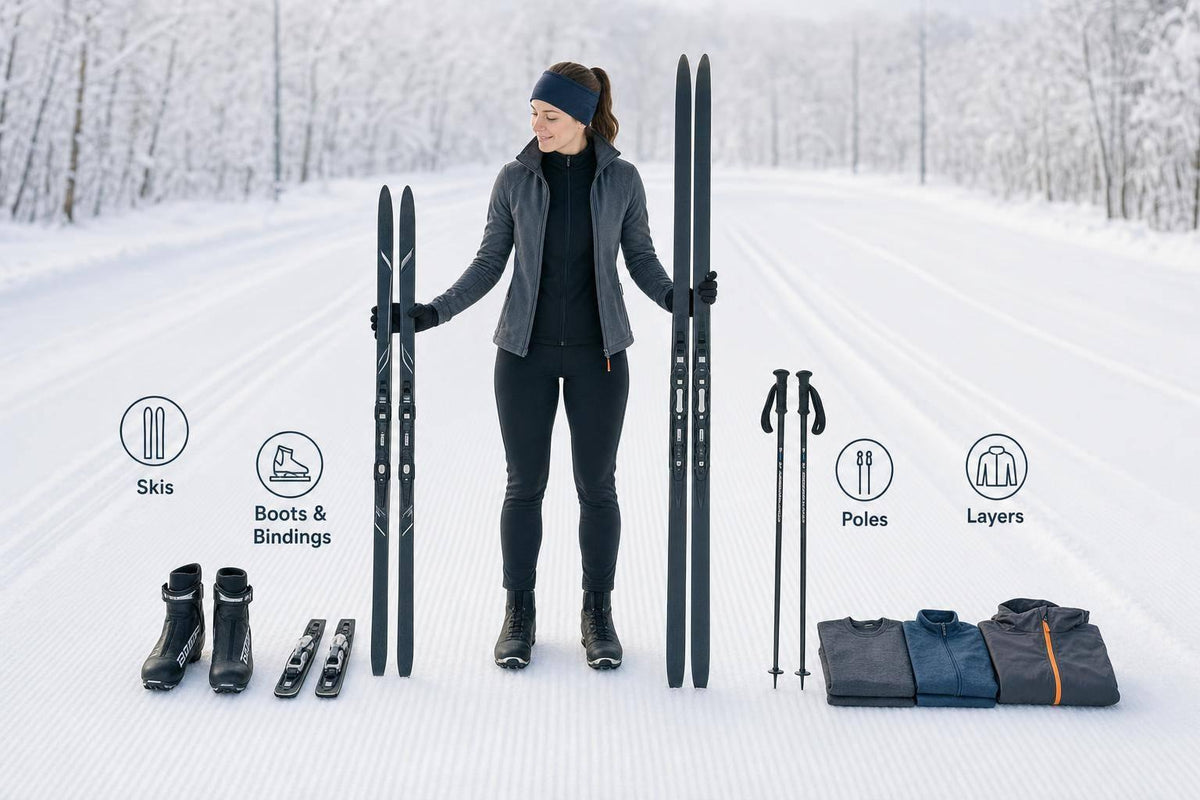
If I were starting skate skiing today, I’d keep it simple: get skis that feel easy to control, boots and bindings that match, poles that reach chin-to-nose height, and light layers. That’s it.
For most first-timers, the best setup is the one that cuts down the learning pain on day one. In this guide, I’d narrow it to three paths:
- Snowfeet* NORDIC 90 cm for the easiest first sessions
- Snowfeet* WALKSKI 100 cm for mixed snow and more support off groomed trails
- Full-length skate skis if you care most about glide, distance, and fitness
A few facts jump out fast:
- The NORDIC 90 cm weighs 3.84 lb per pair (1.74 kg) and starts at $450
- The WALKSKI 100 cm starts at $595
- Full-length skate skis are often 5 to 10 cm taller than the skier
- Skate poles should land between your chin and nose
- Universal bindings on compact skis fit many winter shoes in U.S. sizes 6–13
So, my short take is simple: go short and simple if you want less stress, go full-length if you want more glide. Don’t spend money on race gear, fancy wax tools, or old SNS boot setups for your first outing. That stuff can wait.
This Nordic Ski Can Be Attached to Any Winter Shoes | Snowfeet Cross-country Skate Skis | 90 cm
Quick comparison
| Option | Best for | Boot setup | Main tradeoff | Starting price |
|---|---|---|---|---|
| Snowfeet* NORDIC 90 cm | First-timers, short groomed sessions, travel | Winter shoes or NNN boots | Less glide than full-length skis | $450 |
| Snowfeet* WALKSKI 100 cm | Packed snow, light off-trail use | Winter shoes or NNN boots | More touring-focused feel | $595 |
| Full-length skate skis | Groomed trails, training, longer outings | Skate boots + NNN bindings | Harder to control at first | Varies |
What I like here is that the choice doesn’t need to be a whole gear drama. Pick the ski format first, then match the boots, bindings, poles, and layers. Nice and clean :)
If you want a fast visual on skate-ski basics, these are worth a look:
- Cross-country skate skiing basics on YouTube
- How to size skate ski poles on YouTube
- NNN vs SNS boot binding fit on YouTube
From there, I’d focus on one thing: buy gear that helps you stay upright, not gear that looks fast in the parking lot.
What First-Timers Actually Need to Buy
For your first skate-ski outing, keep it simple. You only need skis, boots and bindings, poles, and breathable layers. Skip race-grade parts and waxing tools for now. That stuff can wait.
The easiest path is to start with a setup that doesn’t fight you. Then pick the ski style based on how much fuss you want to deal with.
Compact options like the Snowfeet* NORDIC Cross-country 90 cm cut out a lot of the sizing headache and fit a broad range of shoe sizes. You also don’t need special skate boots with them. That’s a nice little shortcut for day one. Once you’ve picked your ski format, check that your boots and bindings match.
Go with NNN-compatible boots and manual bindings. For beginners, manual bindings are simpler and less likely to ice up than automatic ones. Fewer moving parts, fewer annoying surprises.
For poles, buy skate poles sized to your height. No need to overthink the shaft material yet. And for clothing, wear breathable, moisture-wicking layers instead of bulky outerwear. You want to move, not feel like a marshmallow in a parka.
If portability matters, a compact touring ski can be a smart next step for easier first sessions.
| Gear Item | Buy This | Skip for Now |
|---|---|---|
| Skis | Weight-matched skate skis or compact 90–100 cm option | Race-level carbon components |
| Boots | Skate-specific high-cuff boot (or standard winter shoes with compact skis) | Classic-only or oversized boots |
| Bindings | Manual, NNN-compatible | Automatic bindings, older SNS system |
| Poles | Skate poles sized to your height | Pure carbon (fragile), aluminum (heavy) |
| Clothing | Breathable, moisture-wicking layers | Heavy parkas, elite racing suits |
1. Snowfeet* NORDIC Cross-country 90 cm
The Snowfeet* NORDIC 90 cm is 35 inches long, or 90 cm. That’s much shorter than most skate skis, and for a first-timer, that can feel like a gift. You get more stability, easier turns, and less of that “why are these things so long?” feeling. In plain English: it’s easier to balance and steer without wrestling a full-length ski.
That shorter setup tends to feel more beginner-friendly. The NORDIC 90 cm also comes with metal edges, which help with control and make stopping on packed snow easier.
You can get it in two versions:
- Universal binding: fits standard winter shoes in sizes 6–13 US / 38–47 EU
- Pro XC version: comes with Rottefella NNN bindings for more precise control
That binding pick matters because it decides which boots you’ll want to buy next.
The pair weighs 3.84 lb (1.74 kg), so it stays light on snow. It works best on groomed trails and firm, packed snow. The waxless base means you can skip kick wax, which is nice when you just want to get out and ski instead of fiddling with gear. If you want better glide later, you can add glide wax. On the Snowfeet store, the NORDIC 90 cm starts at $450.
2. Compatible Skate Boots and Bindings
For the NORDIC 90 cm, you’ve got two clean options.
Buy the universal binding model if you want to use your regular winter shoes. Or go with the Pro XC model if you plan to use NNN skate boots. That’s what makes the NORDIC 90 cm such an easy starter setup: you can get going without turning boot shopping into a whole side quest.
The universal binding model fits standard winter shoes in US sizes 6–13, so you can skip buying boots at the start.
If you want a more ski-focused setup, the Pro XC version makes more sense. Just make sure you get NNN-compatible boots. SNS boots will not fit.
Here’s the simple breakdown:
- Universal binding: works with regular winter shoes, US sizes 6–13
- Pro XC binding: made for NNN skate boots
- SNS boots: not compatible
Boot choice matters more than a lot of people think. Skate boots have a higher cuff and stiffer ankle support, which helps with balance and control. That extra support can make your first sessions feel a lot less wobbly.
You can use combi boots since they work for both styles. But for a beginner setup focused on skate skiing, dedicated skate boots are the better match.
And yeah, try boots on in person if you can. Fit has a bigger effect on balance than almost any other gear choice.
Once the boot fit is sorted, the next piece that shapes control is pole length.
3. Skate Poles Sized to Nose-to-Chin Height
Once your boots fit well, poles are the next easy fix. Even on compact Snowfeet setups, pole length changes your balance and your push. Set the tip next to your boot. The grip should hit somewhere between your chin and nose. If you’re stuck between sizes, go shorter. It gives you more control while you’re still getting the hang of things.
Skate poles are about 4 inches (10 cm) longer than classic cross-country poles. So if you’re borrowing gear or buying used, double-check that the poles are made for skating. Classic poles can push you too far forward and cut down your leverage.
For most beginners, composite poles hit the sweet spot on weight, durability, and price. Aluminum costs less, but it feels heavier in your hands. Carbon is lighter, but it’s easier to damage and usually costs more.
Also, look for a secure adjustable strap instead of a basic loop. It wraps around your hand and helps with control and power transfer, so you don’t have to squeeze the grip like you’re hanging off a chairlift :)
Next, pair the right poles with breathable layers and basic safety gear.
4. Breathable Layers and Basic Safety Gear
After poles, clothing makes the biggest difference in how your first session feels. Skate skiing is high output, so most beginners get too warm in heavy jackets. Then the sweat builds up, you slow down, and suddenly you're cold. Not fun :) The goal is to stay comfortable, not dress like you're heading to a race.
Start with a wicking base layer. Add a breathable mid-layer or shell on top. That combo helps you move, dump heat, and avoid that soggy, chilled feeling later.
Before you leave home, test your gloves with your pole straps. It’s a small thing, but it saves you from fumbling around at the trailhead with cold fingers.
Bring a few basics:
- Sunglasses or goggles
- Water
- A snack
Skip the race suit and the extra gear. Keep it simple.
sbb-itb-17ade95
5. Snowfeet* WALKSKI Backcountry Touring 100 cm
If you want to go beyond groomed trails, this is the next move. The WALKSKI Backcountry Touring 100 cm is a good pick for first-timers who want less stress and more confidence off the beaten path. It’s made for groomed trails and light off-trail terrain, and it starts at $595.
At 100 cm, WALKSKI is still compact. But the wider platform gives beginners a steadier feel on uneven snow. That can make a big difference when the surface gets choppy or a bit icy.
You also get metal edges for better grip on icy patches and a fishscale (waxless) base. So you get natural climbing grip without messing with a wax kit. Nice and simple :)
The universal binding fits standard winter shoes in US sizes 6–13. If you want tighter control later, the Pro XC option uses NNN bindings. That tradeoff matters when you stack compact skis against full-length skate skis.
Here’s the simple split:
- Choose NORDIC 90 cm for groomed trails and a faster learning curve.
- Choose WALKSKI 100 cm for more stability and more freedom to roam.
Next, it helps to compare these compact options with full-length skate skis before you decide.
Full-Length Skate Skis vs Compact Short-Ski Options
Full-length skate skis are usually sized 5 to 10 cm taller than the skier. That length helps with speed and glide. The camber gives you rebound, and the base grooves help the skis run straight when you're moving fast. If you want to ski for fitness or work your way toward racing, that setup makes sense.
But for a first-timer, there’s a catch: longer skis glide farther, but they’re tougher to control at first.
That’s where the Snowfeet* NORDIC 90 cm changes the feel of the first day out. It’s easy to lift, easy to steer, and small enough to carry in a compact bag. That means less wrestling with gear and more time just getting the hang of skiing.
The downside is glide. Full-length skis travel farther with each push, while the NORDIC 90 cm uses a fishscale base that leans toward grip, not speed. So the split is pretty simple:
- Full-length skis: better glide, more distance, more speed
- Compact skis: easier control, easier learning, less stress on day one
| Feature | Snowfeet* NORDIC (90 cm) | Conventional Beginner Skate Skis (165–185 cm) |
|---|---|---|
| Portability | Fits in a small bag; 3.84 lb/pair | Needs a long ski bag or roof rack |
| Glide efficiency | Lower; fishscale base prioritizes grip | Higher; cambered base maximizes distance |
| First-session control | Easier; shorter length reduces balance demand | Steeper initial curve |
| Best use | Groomed trails, short sessions, beginners | Fitness skiing, longer distances, higher speeds |
| High-speed stability | Great at low speeds and easy for beginners to control | More stable at higher speeds |
Once ski length is clear, the next buy is the boot-and-binding match.
Boot and Binding Fit: What to Check Before You Buy
After you pick ski length, check boot and binding fit next. This part matters more than people think. If the boot and binding don’t match, the setup just won’t work.
Match the boot to the binding. For first-timers, Snowfeet's universal winter-shoe binding is the easiest way in. You can keep things simple and skip the whole boot-change dance at the trailhead :). If you want a setup with dedicated cross-country boots from day one, go with the Pro XC version, which fits NNN boots.
Buying used gear? Slow down and check the match before you pay. The easiest way is to look at the sole pattern:
- NNN-family boots use two ridges
- SNS boots use one
That small detail can save you a headache later.
For skate skiing, boots should fit snugly and have a stiff, high cuff for ankle support. Try them on with one technical ski sock. You want your heel locked down while your toes can still wiggle. That’s the sweet spot.
Skip oversized, fleece-lined boots. They make it harder to control your skis, and they don’t reliably keep your feet warmer. Sounds cozy on paper. On snow, not so much.
For the easiest start, the Snowfeet* NORDIC 90 cm universal binding lets you wear your own winter shoes. No boot swap needed when you get to the trail. If you already know you want a more dedicated cross-country setup, the Pro XC version with NNN bindings is the right pick.
Once your boots and bindings match, pole length is the next fit call.
How to Size Poles and Layer Clothing for Your First Session
Pole sizing is pretty simple. Put the tip on the ground and check where the grip lands. You want the grip to sit between your chin and nose.
Here are a few handy reference points:
| Your Height | Recommended Skate Pole Length |
|---|---|
| 5'4" (163 cm) | 145–150 cm |
| 5'8" (173 cm) | 155–160 cm |
| 6'0" (183 cm) | 165–170 cm |
For straps, go with a harness or cradle-style strap instead of a simple loop strap. It gives you better hand support and feels much nicer once you start pushing. For pole material, composite is a smart starter pick. Aluminum costs less and takes more abuse, while carbon is lighter but easier to damage and costs more.
Once your poles are dialed in, clothing is the last easy fit call before snow time. Think in simple layers:
- A moisture-wicking base layer
- A light insulating mid-layer
- A wind-resistant shell
- Thin gloves
- One pair of moisture-wicking ski socks
- Sunglasses or goggles, plus a breathable hat or headband
That setup keeps you warm without turning you into a sweaty burrito. And yeah, that matters more than most first-timers expect.
With poles and layers sorted, the next decision is which ski length gives you the easiest first day.
NORDIC 90 cm vs WALKSKI 100 cm vs Full-Length Skate Skis: Side-by-Side
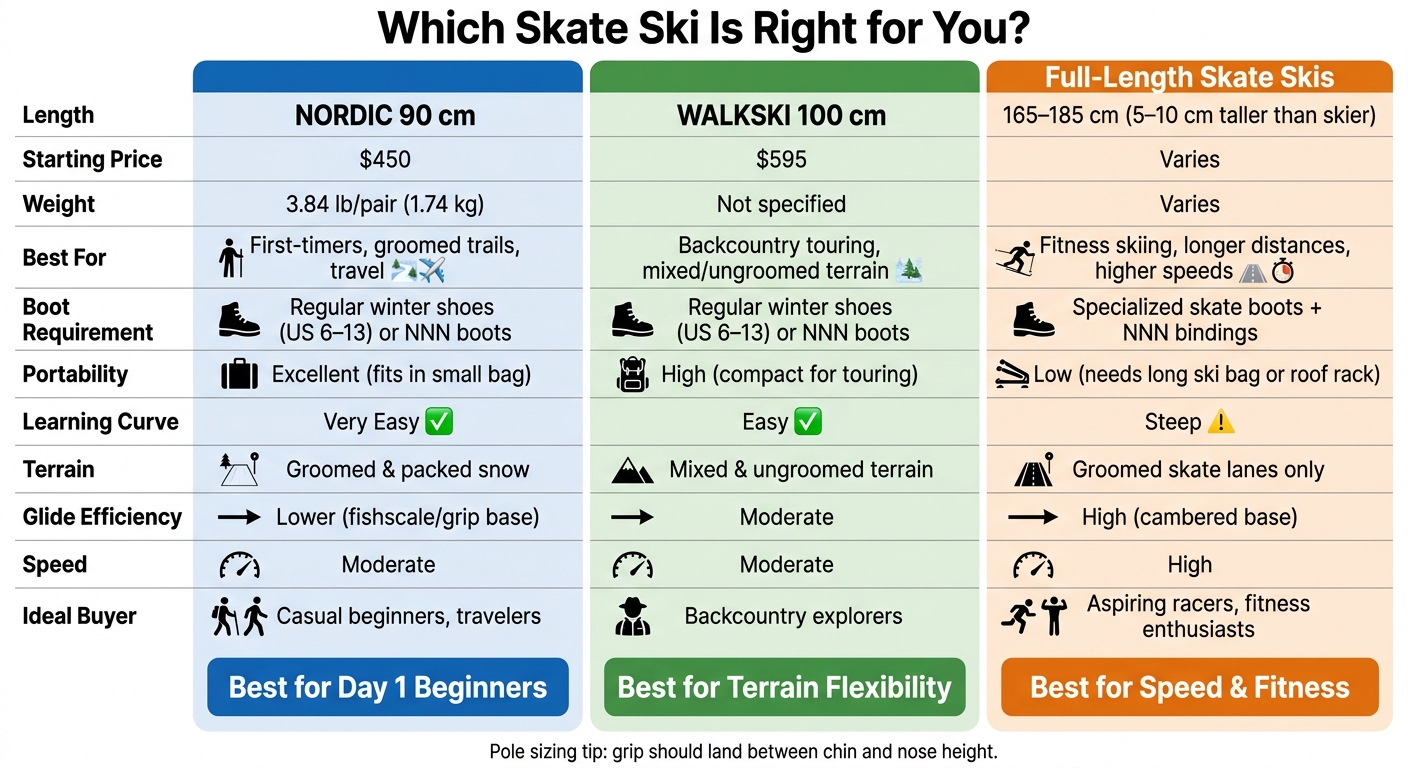
Skate Ski Options for Beginners: NORDIC 90cm vs WALKSKI 100cm vs Full-Length
With poles and layers sorted, ski length is the big call for beginners. And honestly, this is where things get a lot simpler.
Here’s how the three main options compare:
| Feature | NORDIC 90 cm | WALKSKI 100 cm | Full-Length Skate Skis |
|---|---|---|---|
| Intended Use | Groomed and packed snow, casual use | Backcountry touring, ungroomed snow | Best on groomed skate lanes |
| Portability | Excellent - easy to carry and store | High - compact for touring trips | Low - usually needs a long ski bag or roof rack |
| Learning Feel | Very easy; quickest to pick up | Easy; stable for touring | Steep curve; requires more technique |
| Terrain Flexibility | Versatile - groomed or packed snow | Better for mixed or ungroomed terrain | Best on groomed skate lanes |
| Speed | Moderate; control-first design | Moderate; built more for stability than speed | High; optimized for long glides |
| Boot Requirement | Regular winter shoes or NNN bindings | Regular winter shoes or NNN bindings | Specialized skate boots and bindings |
| Ideal Buyer | First-timers, casual users, travelers | Backcountry explorers, mixed-terrain riders | Fitness enthusiasts, aspiring racers |
The short version: short skis are easier to control and easier to carry. Full-length skis, on the other hand, glide faster and farther.
For first-timers, the best pick is usually the one that makes balance, control, and setup feel easy from the start. No drama. No wrestling with gear in the parking lot :)
So the choice comes down to one simple rule:
- NORDIC 90 cm for the easiest learning curve
- WALKSKI 100 cm for more terrain flexibility
- Full-length skate skis for skiers who care most about speed
Once you choose ski length, use the checklist below to confirm boots, bindings, and poles.
Day One Buying Checklist
Once you’ve got ski length sorted out, keep day one simple. If you go with Snowfeet* NORDIC, it’s even simpler.
Start with fit. Then skip anything your setup doesn’t need.
| Item | Status | Notes |
|---|---|---|
| Skate skis or compact option (Snowfeet* NORDIC 90 cm) | Essential | Sized to your weight and height |
| Boots | Essential for traditional skate skis | Needed only with old-school bindings; skip with Snowfeet* NORDIC universal bindings |
| Bindings | Essential for traditional skate skis | Manual NNN-compatible bindings for ski boots; not needed with Snowfeet* universal bindings |
| Poles | Essential | Nose-to-chin height; check that the straps fit over your gloves |
| Moisture-wicking base layer | Essential | Wicking top and bottoms; skip cotton and bulky layers |
| Light shell, gloves, eye protection | Essential | Keep layers breathable |
| Waxing iron or home kit | Skip for now | A local shop can glide-wax your skis for a small fee |
| Race-level skis | Skip | Too stiff and narrow for learning balance |
Before you head out, do one dry run at home. Clip into your bindings, grab your poles, and make sure the straps fit over your gloves. It takes five minutes and can save you a lot of parking-lot fumbling. Nobody wants their first ski moment to feel like wrestling an octopus :)
If you just want to test the technique, renting makes sense. If not, buy once and keep it simple. Snowfeet* NORDIC 90 cm (~$490) trims down the starter setup because the universal binding works with regular winter shoes.
Conclusion
After comparing ski length, the answer is pretty simple: pick the setup that feels easiest on day one. If you're new, the best ski is the one that helps you balance, stay in control, and get going without a fuss. That’s the heart of it. The main choice comes down to how you want to ski.
Snowfeet* NORDIC 90 cm is the easiest place to start if you want a setup that works with regular winter shoes, feels beginner-friendly, and doesn’t force you to buy boots first. That alone takes a lot of pressure off.
If you want more stability and a bit more room to roam, WALKSKI is the next move. Snowfeet* WALKSKI 100 cm makes more sense if your goal is backcountry touring or getting across uneven, packed snow. The wider platform and metal edges help a lot once you leave groomed tracks behind.
Full-length skate skis still come out on top for glide, speed, and fitness training. But for most beginners, Snowfeet* NORDIC is the simplest, most confidence-building start.
FAQs
Should I rent before I buy?
Renting gives you a simple way to figure out whether you like classic or skate skiing before you spend money on a full setup.
If you want an easier, more laid-back way to start, Snowfeet NORDIC* skis can help you skip the rental shop. They work with the winter boots you already have, so you can avoid the extra cost, the special boots, and the usual fitting headache that comes with standard gear.
Can I learn skate skiing with regular winter shoes?
Yes - if you use the right gear. Traditional cross-country setups usually need special ski boots. But Snowfeet NORDIC Cross-country Skate Skis* come with adjustable bindings that work with regular winter shoes.
That means you can skip the extra boot cost, which makes skate skiing a lot easier to try for the first time. And at just 90 cm, they’re also easier to learn on and turn with than long, standard skis.
Pretty nice deal for beginners :)
How do I know if I need compact or full-length skis?
Choose compact skis for casual, low-stress sessions when you want gear that feels easier to handle, easier to carry, and less fussy to learn on. Models like the Snowfeet NORDIC 90 cm* are a great fit for beginners.
Switch to full-length skate skis when your focus shifts to fitness training, club skiing, or racing. At that point, speed, distance, and max glide start to matter more than convenience and quick handling.











Efterlad en kommentar
Denne side er beskyttet af hCaptcha, og hCaptchas Politik om beskyttelse af persondata og Servicevilkår er gældende.