



















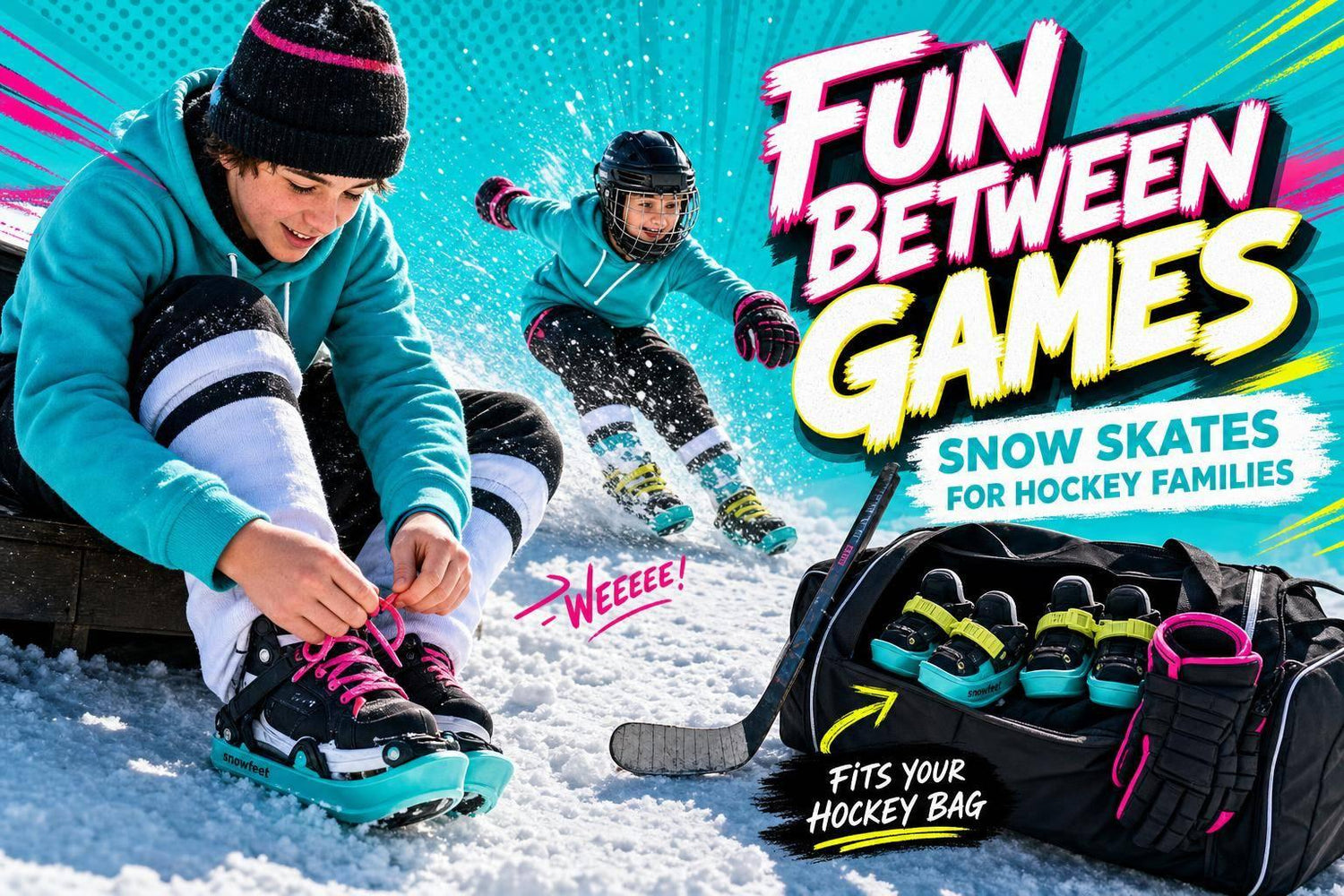
If your family has just 15 to 40 minutes between hockey games, snow skates make more sense than full ski gear. I’d sum it up like this: they take less space, go on fast, work on small hills, and feel more natural for hockey players than skis or a snowboard.
Here’s the short version:
- Snowfeet* Mini Ski Skates (38 cm / 15 in.) fit young kids and first-timers
- Snowfeet* Skiskates (44 cm / 17 in.) fit teens and hockey players best
- Skiblades (65 cm or 99 cm) fit longer sessions and adults who want more stability
- Many families have 2 to 4 hours between games, but even 10 to 20 minutes can be enough for a few runs
- Snow skates work well on park hills, rink-side slopes, hotel snowbanks, backyards, and packed paths
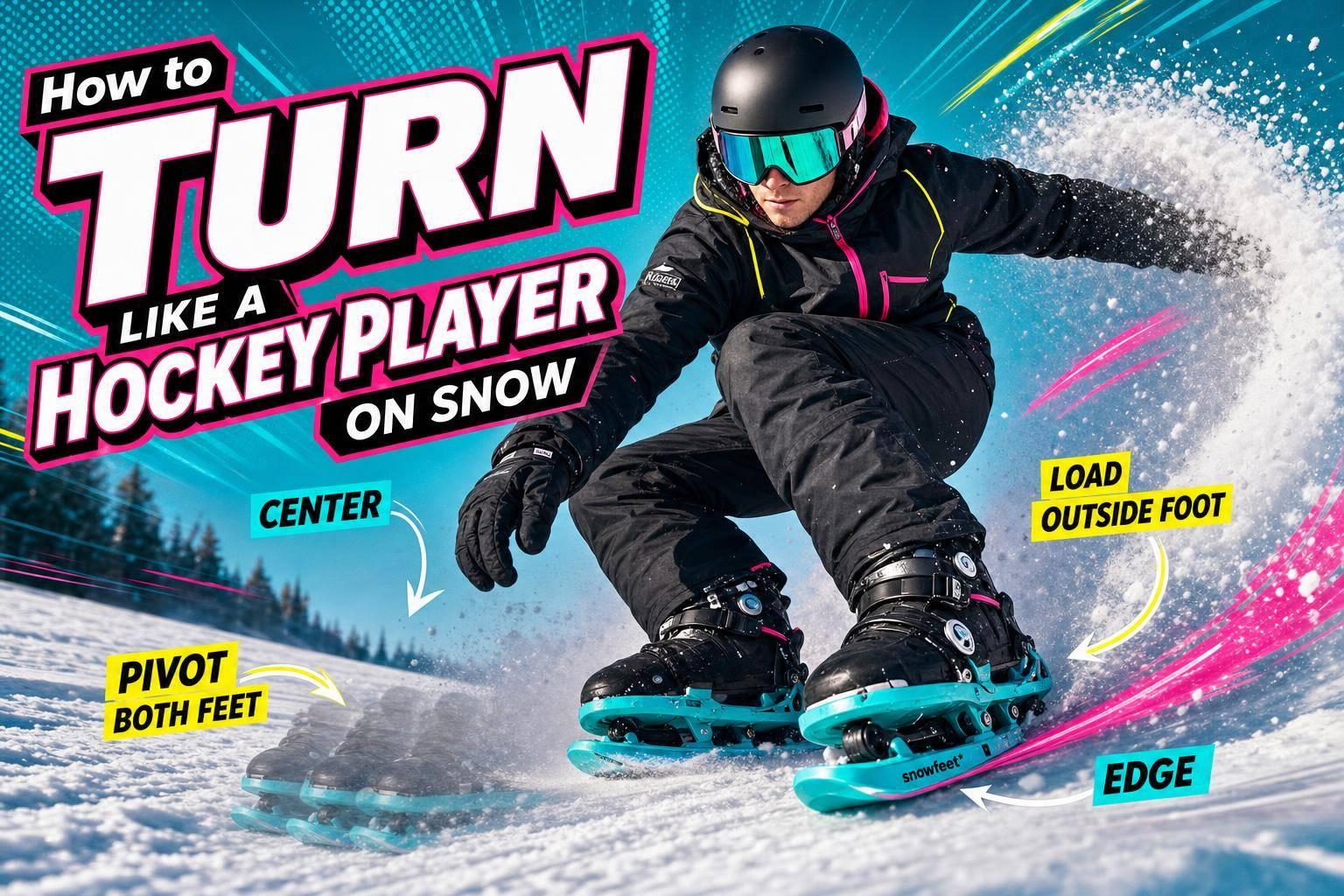
- Hockey skills like edge control, balance, and tight turns carry over fast
So, if you don’t want to haul skis that are often 59 to 71 inches long, plus boots, bags, and the usual car chaos, this is a much simpler way to turn waiting time into snow time :)
What I’d take away from the article:
- Pick 38 cm for small kids and new riders
- Pick 44 cm for teens and most hockey players
- Pick 65 cm or 99 cm if you have more time and want a bit more glide
- Use them on small local hills, not just at a resort
- Pack helmets, gloves, wax, dry layers, and a spare strap
- Keep sessions short, safe, and away from roads, ice patches, and parking traffic
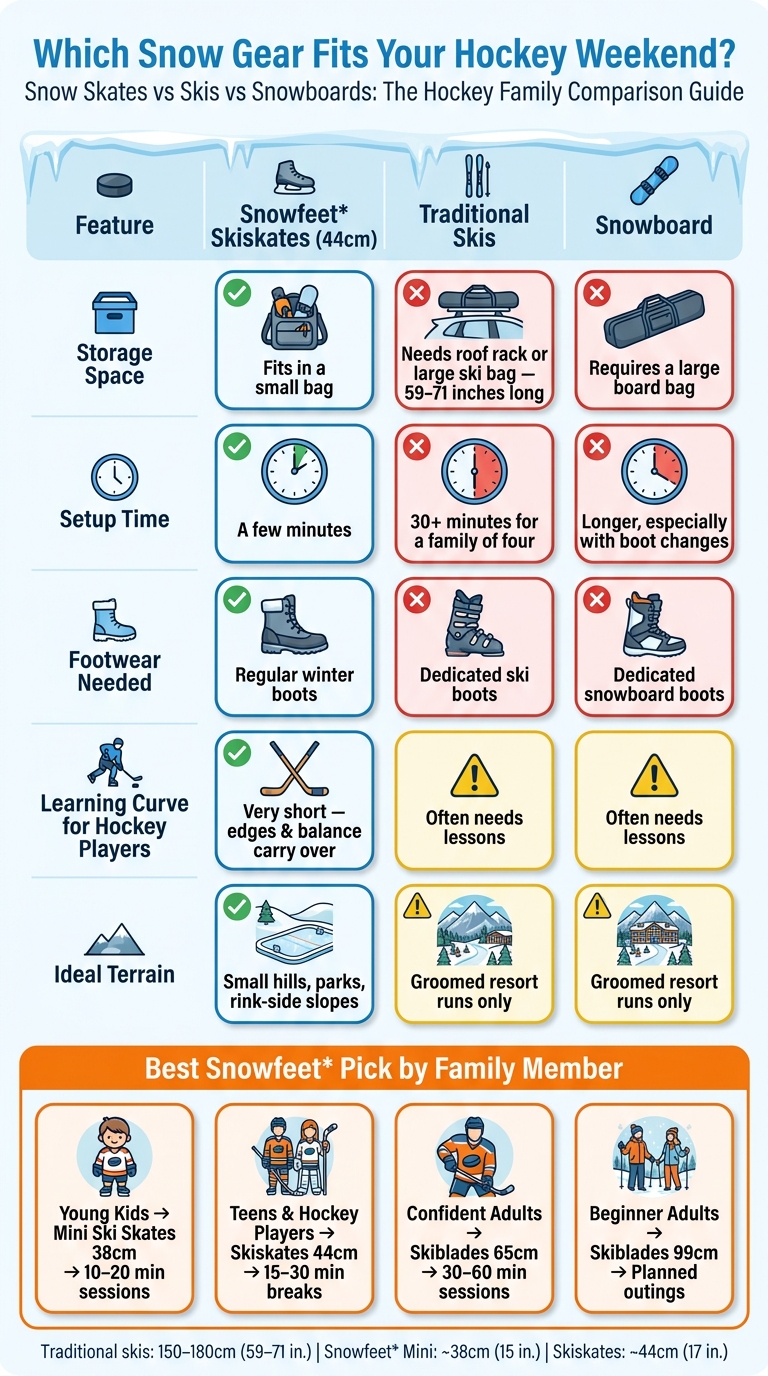
Snow Skates vs Skis vs Snowboards: The Hockey Family Comparison Guide
How to Use Snowfeet* Skiskates 44 CM | Skates for Snow | Mini Ski | Snowblades | Snowskates

Quick Comparison
| Option | Best For | Space in Car | Setup | Best Spot |
|---|---|---|---|---|
| Mini Ski Skates 38 cm | Kids, new skaters | Very small | Fast | Small hills, parks |
| Skiskates 44 cm | Teens, hockey players | Very small | Fast | Rink hills, park slopes |
| Skiblades 65 cm | Older teens, adults | Small | Fast | Longer local runs |
| Skiblades 99 cm | Adults who want more support | Small to medium | Fast | Planned outings |
| Skis | Full ski days | Large | Slower | Resort runs |
| Snowboard | Full snow sessions | Large | Slower | Resort runs |
I see the main idea as simple: if your weekends revolve around rinks, bags, and snack runs, snow skates give you a low-fuss way to use the snow that’s already around you.
Let’s get into the main points.
Why Snowfeet* Works Better Than Skis for Busy Hockey Weekends
Less Trunk Space, Faster Setup, and No Resort Trip Required
When your weekend is packed with games, gear, and snack bags, convenience wins.
That’s where Snowfeet* stands out. Hockey weekends don’t leave much room in the trunk, and Snowfeet* keeps things simple with a setup that’s easy to pack and easy to use. The Mini Ski Skates, at about 15 inches long, fit in a standard sports bag right next to the rest of your gear. Traditional adult skis are usually 150–180 cm long, or about 59–71 inches, so they often need a roof rack or a large ski bag. Then you’ve got rigid ski boots on top of that. It’s more stuff, more planning, and more hassle for a tournament weekend.
A Shorter Learning Curve for Hockey Players and Siblings
Snowfeet* straps onto winter boots, so families can move from the car to the snow in minutes. With skis or a snowboard, a big chunk of that break can disappear into setup instead of actual fun.
For hockey players, the feel is familiar right away. Edges, balance, and quick turns line up well with how they already move on the ice. That’s the whole point of Snowfeet*. Many hockey players get the hang of quick turns fast on a small hill, and siblings and parents can join in on the same mellow slope.
Comparison Table: Snowfeet* vs Skis vs Snowboards
Here’s the quick breakdown for hockey families.
| Feature | Snowfeet* Skiskates (44 cm) | Snowfeet* Mini Ski Skates (38 cm) | Traditional Skis | Snowboard |
|---|---|---|---|---|
| Storage Space | Fits in a small bag | Fits in a small bag | Requires a roof rack or large ski bag | Requires a large board bag |
| Setup Time | A few minutes | A few minutes | 30+ minutes for a family of four | Longer, especially with boot changes |
| Footwear Needed | Regular winter boots or snowboard boots | Regular winter boots or snowboard boots | Dedicated ski boots | Dedicated snowboard boots |
| Learning Curve | Very short for hockey players | Very short for hockey players | Often needs lessons | Often needs lessons |
| Ideal Terrain | Small hills, parks, local slopes | Small hills, parks, local slopes | Groomed resort runs | Groomed resort runs |
sbb-itb-17ade95
Best Snowfeet* Options for Kids, Teens, and Parents
Once your family picks Snowfeet* over skis, the next step is simple: match the right model to each person. The best choice comes down to age, skating skill, and, yep, how much room is left in the car.
Best Picks for Kids and Younger Siblings
For elementary-age kids or anyone new to skating, the Mini Ski Skates 38 cm are the best place to start. They’re about 15 inches long, so they feel light underfoot and stay easy to control on small hills. They also work with sturdy winter boots, which is a big win for parents. No gear shuffle. No extra hassle. Kids can strap them over the boots they already have and get on the snow in minutes.
That makes them a great fit for short sessions too, like a quick 10–20 minute break between games.
If a child is brand new to skating, go with the 38 cm model. If they already skate with confidence, move them up to the 44 cm Skiskates. So, for younger siblings who want a fast run down the hill without a long learning curve, the 38 cm option is the easiest way in.
Best Picks for Teens and Adult Hockey Players
For teens and adult hockey players, the 44 cm Skiskates usually feel the most natural. The edges, balance, and tight turning style line up well with how hockey players already move on ice. That means even a 15–30 minute break between games can be enough time for a few solid runs.
Got more time, like a free afternoon during a tournament weekend? Then the Skiblades 65 cm make a lot of sense. They give you more carving and more speed, but they’re still much easier to pack than full-size skis. If the adult rider is newer and wants a bit more stability, the 99 cm Skiblades are the better call.
For families with different ages and skill levels, this setup works well. Everyone gets a way to join the same snow break without needing the exact same gear.
Comparison Table: Which Snowfeet* Model Fits Each Family Member
| Model | Best For | Skill Level | Ideal Time Window |
|---|---|---|---|
| Mini Ski Skates 38 cm | Young kids and new skaters | Beginner | 10–20 min sessions |
| Skiskates 44 cm | Teens and hockey players | Intermediate | 15–30 min breaks |
| Skiblades 65 cm | Confident adults and older teens | Intermediate to advanced | 30–60 min sessions |
| Skiblades 99 cm | Beginner parents and adults | All levels | Planned snow outings |
Where Hockey Families Can Use Snowfeet* Between Games
Rink-Side Hills, Parks, and Neighborhood Slopes
Once each family member has the right model, the fun part starts: finding quick spots to use it.
You don’t need a mountain. In fact, some of the best places are right near the rink. Plowed snow piles at the edge of parking lots, grassy berms along access roads, and small slopes behind or beside the facility can all do the job. These are easy, rink-adjacent spots to squeeze in a spare 15 minutes. Snowfeet* works well here because it can turn and stop in tight spaces.
Local parks and schoolyard hills can work just as well. If a hill gets used for sledding, there’s a good chance the slope is about right. Still, do a quick walk first. Check for rocks, grates, and rough patches, and make sure the runout stays clear. A few inches of packed snow is ideal. Glare ice? Not so much. Also, check local rules before you go, since some school districts limit winter use during school hours.
Travel Tournaments, Hotel Downtime, and Road-Trip Stops
Tournament weekends usually come with chunks of downtime, and that’s where this gets fun.
Families often have 2 to 4 hours between morning and evening games. That’s plenty of time for a nearby park hill, sledding slope, or a school hill or open park slope close to the arena. A quick map search for a public park with winter access can go a long way.
Hotel grounds can work too. A gentle lawn slope or a plowed snowbank away from the parking lot entrance is often enough for a short session. Pick a spot you can see from the lobby or your room. It keeps things simple and helps everyone relax a bit.
On longer drives through snowy states like Minnesota, Wisconsin, or Michigan, rest areas with snow-covered grassy embankments can turn a plain stop into a fun break. Just give yourself an extra 20–30 minutes beyond the usual stop. That little buffer helps a lot, and no one has to scramble back into the car half-zipped and out of breath.
Backyards, Local Trails, and Snow Days at Home
At home, even a small hill or packed path can turn into a quick session.
Even smaller backyards can work with Snowfeet*. You can pile driveway snow into a low mound, pack down a backyard slope, or use a wide packed path. Snow shoveled from a driveway or deck can be stacked into a low mound, even just 2–3 feet high, for short backyard runs. If your yard already has a gentle slope, pack the snow a bit to smooth things out and keep the finish area open. Because Snowfeet* is short, it’s easy to use in tighter spaces.
Local multi-use trails and unplowed neighborhood paths are another good fit. Snowfeet* lets you step-turn, glide, and walk across snow-to-pavement crossings without a big fuss. Look for wide, low-traffic sections with packed snow instead of deep powder or icy patches.
A few basics matter here:
- Wear helmets
- Set clear boundaries
- Keep runs away from roads and fences
That way, a quick after-school lap or snow day session stays fun instead of turning into a trip to urgent care. Nobody wants that :)
Packing, Safety, and a Simple Family Setup Plan
How to Pack Snowfeet* Alongside Hockey Gear
Once your family lands on the right model, keep the setup dead simple. Put the Snowfeet* gear in one small bin or duffel and leave it in the car all season. That way, you’re not hunting for pieces at dawn with coffee in one hand and a hockey bag in the other.
Store the skates base to base. Toss in universal wax, a microfiber towel, a spare strap, and extra gloves. Cover the metal edges with an edge guard so they don’t nick hockey sticks or tear up your car upholstery. It’s a small step, but it saves headaches.
Slip a small laminated checklist inside the lid too - Snowfeet*, helmets, gloves, wax, socks. On a 6:00 a.m. tournament morning, that little card can feel like a lifesaver.
What to Wear and What Protection to Prioritize
Once the gear is packed, protection comes next. Dress in layers that make sense for cold, wet winter days:
- A moisture-wicking base layer
- A fleece midlayer
- A waterproof shell
- Snow pants
Hockey players often come off the ice warm and damp, so keep a dry base-layer shirt in the bin for a fast swap. Below 20°F, insulated mittens and thicker wool or synthetic socks make a big difference. Skip cotton. It stays wet and gets cold fast, and that’s no fun for anyone.
A helmet is required. Kids can use hockey helmets with a cage or visor for short hill sessions, so there’s no need to buy extra head protection. Add waterproof gloves for grip and hand protection. Knee pads can help beginners who are still getting their balance. Wrist guards are also a smart pick for adults and kids who tend to throw their hands out during a fall.
Conclusion: Turn Waiting Time into Winter Fun
Snowfeet* Skiskates 44 cm and Mini Ski Skates 38 cm are made for spontaneous, low-commitment fun. They’re easy enough for a first-timer to start moving fast, and compact enough that the whole setup fits in one bin.
One bin, one hill, 20–40 minutes. That’s the whole idea.
FAQs
Do snow skates work with regular winter boots?
Yes. Snowfeet products work with regular waterproof winter boots or snowboard boots.
So you can skip the bulky, stiff, and pricey ski boots that old-school ski gear usually calls for. They clip onto footwear you already own, which makes them a simple, low-hassle pick for families.
Are snow skates safe for beginners and younger kids?
Yes. Snow skates are safe and beginner-friendly, especially for younger kids.
They feel a lot like ice skates, so most people can pick up the basics in about 5 minutes. That’s a much easier start than what you usually get with ski lessons.
Their short length also helps. You don’t have long ski tips getting crossed up, which is a common beginner issue. On top of that, the metal edges help with stopping and turning, so riders get more control right away.
For kids, the MINI KIDS model is light and easy to handle. That can help them build confidence and control without feeling like they’re wrestling with bulky gear.
What kind of hill is best between hockey games?
Local sledding hills, groomed slopes, or even a packed-snow backyard area are great between hockey games. Snowfeet Skiskates* are only 44 cm (17.3 inches) long, so they’re easy to use in small, spur-of-the-moment spots where full skis can feel clunky.
At a local park or community sledding hill, you can use them to practice hockey-style glides, stops, and turns on almost any patch of snow.











Zanechte komentář
Tento web je chráněn službou hCaptcha a vztahují se na něj Zásady ochrany osobních údajů a Podmínky služby společnosti hCaptcha.