



















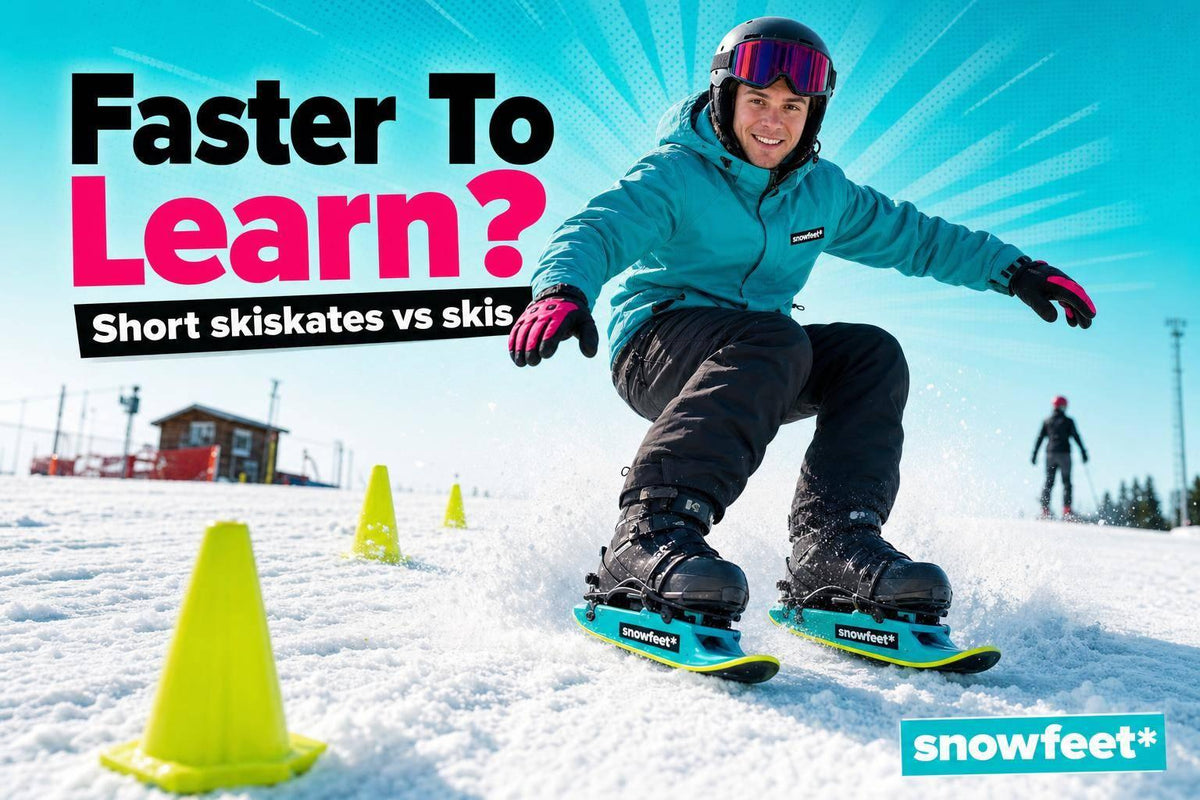
Yes - if your goal is to get comfortable on snow fast, short Snowfeet* gear usually beats long alpine skis for beginners. From day one through week one, 44 cm skiskates and 65 cm skiblades often help you balance, stop, and turn with less struggle than 150–170 cm rental skis.
Here’s the plain-English takeaway:
- 44 cm skiskates: best if you already skate and want the fastest start on mellow runs
- 65 cm skiblades: best pick for most first-timers who want easy control plus more stability
- Long skis: harder at first, but still the better path if you want higher speed, steeper runs, or powder later on
A few numbers stand out:
- Beginner rental skis in the U.S. often land around 150–170 cm
- The article notes many new skiers on long skis need about 3–7 days to build basic skills
- Short gear in this comparison comes in at just 44 cm and 65 cm, which is a big drop in length - and you feel that right away
So, if you want the short version: shorter gear usually means less fight, less fatigue, and more early confidence. That doesn’t mean long skis are bad. It just means they ask more from you at the start.
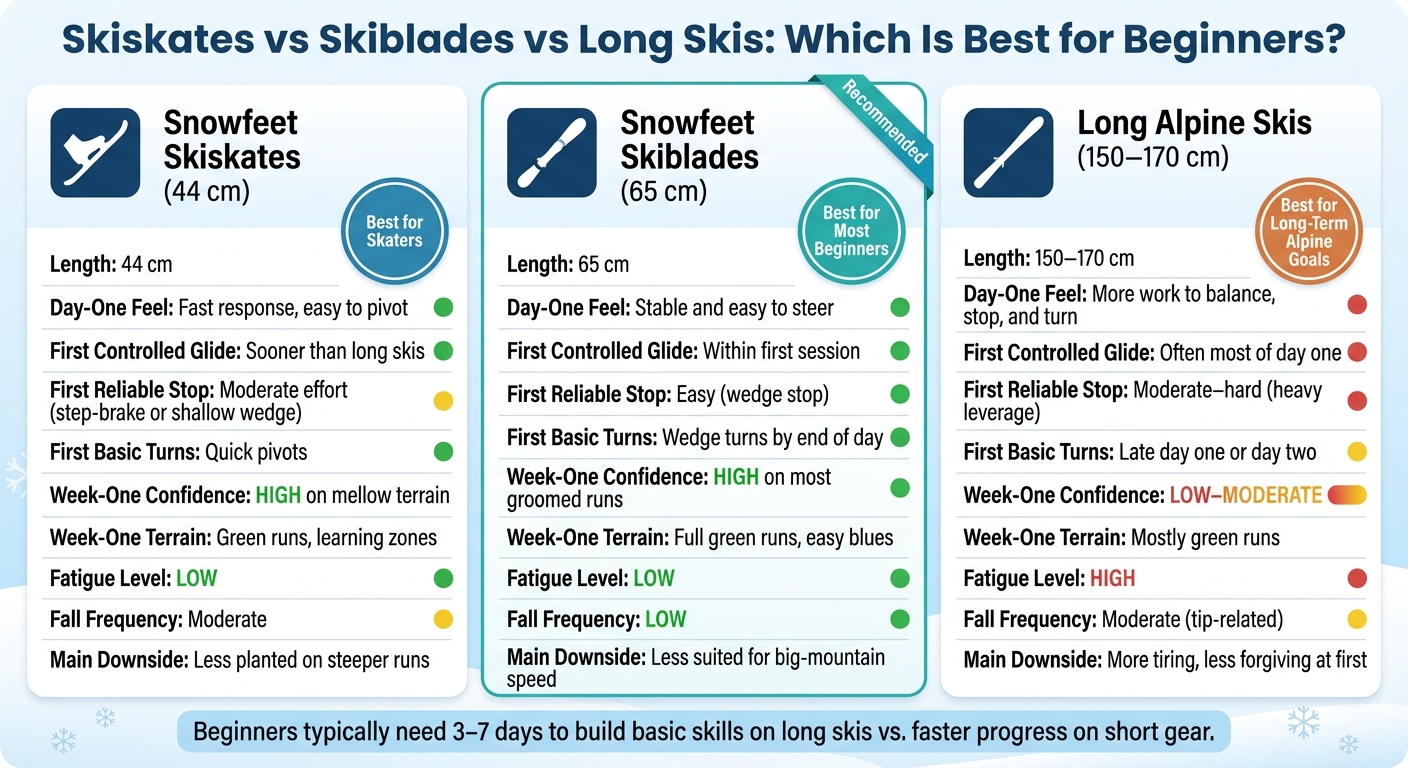
Skiskates vs Skiblades vs Long Skis: Beginner Comparison Chart
Is it hard to learn on Skiskates? Not really 👇
Quick Comparison
| Setup | Best for | Day-one feel | Week-one outlook | Main downside |
|---|---|---|---|---|
| Snowfeet* Skiskates (44 cm) | Skaters, playful beginners, short green runs | Fast response, easy to pivot | High confidence on mellow terrain | Less planted on steeper runs |
| Snowfeet* Skiblades (65 cm) | Most first-timers | Stable and easy to steer | Strong jump in confidence on greens and easy blues | Less suited for big-mountain speed |
| Long Alpine Skis (150–170 cm) | People focused on full alpine skiing later | More work to balance, stop, and turn | Slower early progress | More tiring, less forgiving at first |
If I were helping a new rider in the shop, I’d keep it simple: go 65 cm if you’re unsure, go 44 cm if you already skate, and go long only if your end goal is full-on alpine skiing. That’s the cleanest answer :)
For a visual on short skis vs long skis, these YouTube searches can help:
Skiskating on Snowfeet*: Why Beginners Usually Progress Faster
Short Snowfeet* gear tends to feel easier because there’s simply less ski to handle. Edging, turning, and balance react faster. Small moves in your ankles and knees lead to instant feedback, which helps beginners connect cause and effect much sooner. You feel what works right away instead of wrestling with a long ski. That edge shows up most with the two shortest Snowfeet* setups.
Snowfeet* Skiskates 44 cm: Easy-to-Manage Control
At 44 cm, Snowfeet* Skiskates often feel most natural for riders who already have some skating or board-sport background. The edging and steering feel close to skating: shift your weight, tip your ankle, and the ski responds. You don’t have to force yourself into a stance that feels off.
Because of that, riders with that kind of background often get to controlled turns within their first few sessions.
The 44 cm length works best on short, groomed beginner runs and magic carpet laps. It’s not the top pick for steep runs, icy snow, or powder.
If you want a bit more stability but still want easy control, 65 cm skiblades are the next move.
Snowfeet* Skiblades 65 cm: the easiest middle ground for most first-timers
For total beginners, Snowfeet* Skiblades at 65 cm hit the sweet spot. They’re long enough to feel steady at moderate speeds and on easy blue runs, but still short enough that pivoting and stopping feel natural. So you get ski-like glide and light carving without the balance demands that come with full-length skis.
That’s a big deal on day one. Most complete beginners learn stopping and turning faster on 65 cm skiblades than on long skis because they feel steady, forgiving, and easy to pivot.
Boot options and setup simplicity
Snowfeet* gear also makes boot setup simpler. Depending on the model, Snowfeet* skiskates and skiblades work with winter boots, snowboard boots, or ski boots. So there’s no special rental fitting to deal with.
That means:
- Less setup time
- Fewer rental headaches
- More focus on learning
Long skis still have the edge for speed and bigger terrain, but they ask more from beginners right out of the gate.
sbb-itb-17ade95
Long Skis: Slower at First, Better at Speed and Bigger Terrain
Compared with the short Snowfeet* setups above, long skis ask more from beginners right out of the gate. Standard U.S. beginner rentals usually run from 140 to 170 cm, which is a lot longer than Snowfeet* Skiskates at 44 cm or Skiblades at 65 cm. For a first-timer, that extra length changes one main thing: control on day one.
Why the first day often feels harder on long skis
The biggest hurdle at the start is simple. You have to manage more ski.
Long skis stick out well past the boot in front and behind, so even small mistakes can show up fast. Turns tend to start slower. At low speed, long skis don’t like to change direction on a dime, so beginners often get the feeling that the skis want to keep going straight. That can make first turns and first stops feel awkward, even when the slope is mellow.
With short Snowfeet* gear, the response is almost instant. A small ankle tip or slight weight shift can change direction fast. On long skis, you need more body control and a steadier stance before the ski starts to come around. That gap stands out most when you're trying to link early turns or scrub speed without panic.
REI's beginner advice recommends a shorter ski for beginners and a longer ski for faster, more aggressive skiers and open terrain.
Where long skis genuinely outperform short skis
Long skis can feel tougher on day one, but they start to shine once speed goes up. They’re more stable at higher speeds. And on long blue or black runs, that added stability matters.
They also do better in soft or deeper snow. More surface area helps the skier stay on top of the snow instead of sinking into it. So, yeah, there’s a trade-off: harder at first, steadier later. That split shows up clearly in the day-one and week-one comparison below.
Side-by-Side Comparison: Day One, Week One, and Beginner Confidence
Day one: glide, stop, and basic turns
This is where the gap starts to show: in the first session and across the first few days.
On Snowfeet* Skiskates 44 cm, most beginners go from shaky first moves to a controlled glide sooner than they do on long skis. Quick pivots often come next, and a shallow braking stance usually shows up in that first session too. On Snowfeet* Skiblades 65 cm, the feel is closer to standard skiing, but it’s still easier to get into. That extra edge length helps with wedge stops, so a lot of first-timers can make it down a short green run before the day ends.
Long skis are a different beast. Day one often turns into a balance-and-control lesson. Many beginners spend most of that first session just learning to stand, glide, and stop.
Here’s the simple version: shorter gear tends to get beginners gliding, stopping, and turning sooner.
| Day-One Marker | Skiskates 44 cm | Skiblades 65 cm | Long Skis (150–170 cm) |
|---|---|---|---|
| First controlled glide | Sooner than long skis | Within first session | Often most of day one |
| First reliable stop | Moderate effort (step-brake or shallow wedge) | Easy (wedge stop) | Moderate–hard (heavy leverage) |
| First basic turns | Quick pivots | Wedge turns by end of day | Late day one or day two |
| Terrain by end of day | Short green runs | Short-to-full green runs | Magic carpet / short green |
| Effort | Low–moderate | Low | High |
Week one: confidence, falls, and usable terrain
By week one, the big thing isn’t just skill. It’s whether you feel calm on terrain you can ski without white-knuckle panic.
Skiblades 65 cm tend to give most beginners the biggest jump in confidence. By the end of week one, many riders can handle full green runs, blend wedge turns with basic parallel steering, and test easy blue sections with care.
Skiskates 44 cm build confidence fast on mellow slopes. Falls often feel more like slips than full slam-down crashes, which helps keep nerves in check. The downside is pretty clear: once the slope gets steeper, they feel less planted, so most beginners stay on greens during that first week. With long skis, PSIA-based guidance says many beginners need 3–7 days to build basic skills, and a lot of people don’t feel at ease on green runs until after 3–5 days of focused practice.
| Week-One Metric | Skiskates 44 cm | Skiblades 65 cm | Long Skis (150–170 cm) |
|---|---|---|---|
| Confidence level | High on mellow terrain | High on most groomed runs | Low–moderate |
| Terrain access | Green runs, learning zones | Full green runs, easy blues | Mostly greens |
| Fall frequency | Moderate (balance-related) | Low | Moderate (tip-related) |
| Fatigue | Low (lightweight) | Low | High |
| Speed control | Good at low speeds | Solid at moderate speeds | Difficult to master early |
Balance, stopping, and turning trade-offs
Each setup asks your body to do something a little different. And that’s the heart of it: shorter Snowfeet* gear cuts down the control load for beginners.
Skiskates 44 cm keep you in a more natural, upright stance. Small corrections go a long way. If you drift a bit off-center, there isn’t a long ski yanking you out of position, which makes recovery easier. Skiblades 65 cm ask for gentle foot rolling onto the edges, but the shorter platform keeps those mistakes from snowballing. That makes it easier to practice good ski posture without feeling like you signed up for a wrestling match with your equipment.
Long skis ask for the most precision. Lean too far forward or too far back, and they let you know right away. Twisting errors can lead to crossed tips or sudden edge catches, and for beginners, that’s the kind of stuff that can rattle confidence fast.
| Factor | Skiskates 44 cm | Skiblades 65 cm | Long Skis (150–170 cm) |
|---|---|---|---|
| Edge response | Very quick, agile | Smooth, predictable | Powerful but demanding |
| Braking feel | Step-brake or tight wedge | Natural snowplow | High leverage required |
| Turning effort | Minimal (skating motion) | Low (easy carving) | High (deliberate weight shift) |
| Balance demand | Centered, upright, skating-like | Moderate, forgiving | Precise fore-aft control required |
| Best for | Agility, playful riding | All-around beginner learning | Long-term mountain progression |
Which Should You Choose: Snowfeet* Skiskates 44 cm, Skiblades 65 cm, or Long Skis?
After looking at first-day control and first-week confidence, the pick mostly depends on your background and where you want to ride.
Choose Snowfeet* Skiskates 44 cm for the Fastest Learning Start for Skaters
If you already skate - on ice, inline, or roller - Snowfeet* Skiskates 44 cm will feel familiar almost right away. The skating motion carries over in a way that just clicks. That means less time feeling awkward and more time moving.
Their short size also makes them easy to pack, carry, and stash. No wrestling with giant gear in the parking lot. For beginners who already have skating habits, Skiskates 44 cm are the fastest way to get started, mostly on mellow groomed runs, small hills, and learning zones.
Choose Snowfeet* Skiblades 65 cm for the Best Beginner Option for Most First-Timers
For most first-timers with no skating background, Snowfeet* Skiblades 65 cm are the best bet. They’re short enough to help cut down on crossed-tip falls, but still long enough to give you solid fore-aft balance and a proper wedge stop.
That mix matters a lot when you’re new. You get a setup that feels less intimidating than long skis, without giving up the basic support many beginners need. For most first-timers, this is the fastest path to confidence on groomed terrain.
Choose Long Skis if Your Goal Is Long-Term Alpine Progression
If your main goal is speed, steeper terrain, or powder, then the equation changes. Long skis are still the right call if you want to spend the long haul skiing steep runs, floating through deep powder, or going fast.
The catch? The early learning curve is tougher. No sugarcoating that. But if you're aiming for alpine skiing, racing, or backcountry touring down the line, long skis make sense. For casual riders, though, Snowfeet* is the faster route to fun :)
FAQs
Do I need lessons with skiskates or skiblades?
No. You don’t need formal lessons to learn Snowfeet skiskates or skiblades.
Most people can get the basics down - like turning and stopping - in as little as five minutes. That’s a big part of the appeal. They’re short, light, and feel natural on the snow, so the learning curve doesn’t hit like a brick wall.
You can teach yourself with Snowfeet’s free video tutorials.
That means you can get to the fun part faster and spend less on lessons and rentals. Nice deal :)
What boots work best with Snowfeet* gear?
Snowfeet* gear is built for flexibility, so in many cases you can use the boots you already own instead of stiff ski boots. With the 38 cm to 65 cm models, regular waterproof winter boots or snowboard boots work well. They’re also usually easier to walk in, which is a nice bonus.
Want a bit more control and a tighter feel? Ski boots fit these shorter models too.
For the longer 99 cm and 120 cm models, ski boots are required. At those lengths, you need the ankle support that ski boots provide, especially once speeds pick up and carving comes into play.
Can I switch to long skis later if I start short?
Yes. Starting on shorter gear like Snowfeet can be a helpful first step if you want to move to long skis later.
It gives you a chance to build confidence, get used to balancing on snow, and learn basic turns without the awkward feel of long skis. Long equipment can seem like a lot at first. Shorter gear feels less intimidating, which helps many beginners relax and focus on the basics.
Then, when you switch to longer skis, that change often feels a bit easier.











Zanechte komentář
Tento web je chráněn službou hCaptcha a vztahují se na něj Zásady ochrany osobních údajů a Podmínky služby společnosti hCaptcha.