



















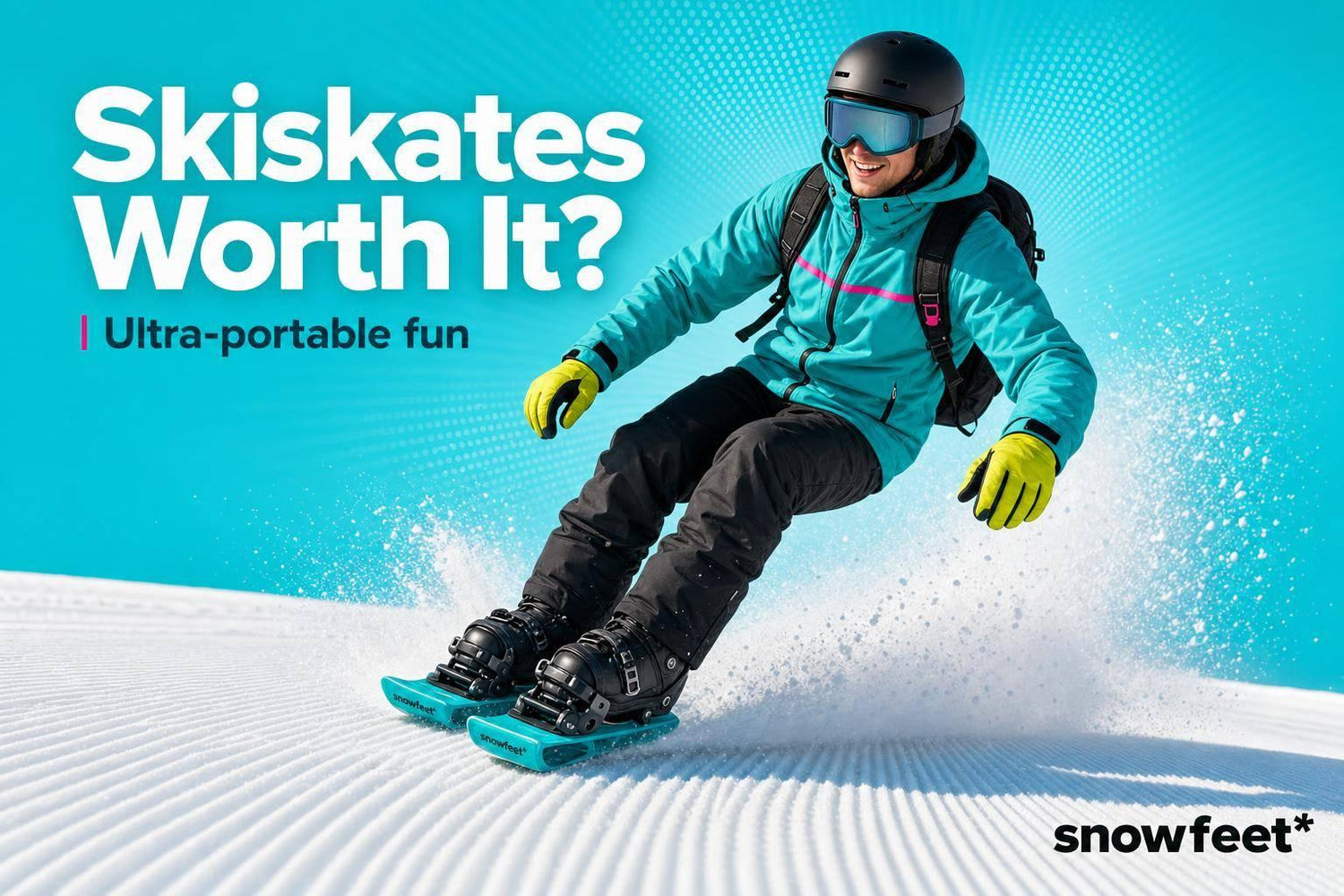
Yes - skiskates are worth it in 2026 if you want fun, easy-to-carry snow gear for groomed runs, park laps, and short sessions. If you want deep powder, high-speed carving, or all-day resort skiing, I’d skip them and go with longer skis or skiblades instead.
Here’s the short version:
- Best for: beginners, skaters, snowboarders, travelers, and casual riders
- Best snow: groomed runs, packed snow, small hills, terrain parks
- Weak spots: deep snow, rough chop, steep high-speed riding
- Best value: Snowfeet PRO 50 cm at $299
- Most portable: Snowfeet 38 cm
- Most ski-like: Snowfeet 65 cm or 99 cm
So, if you’re asking, “Will I have fun on these?” - yeah, most likely. If you’re asking, “Can they replace my full ski setup?” - nope.
A few facts that stand out:
- Skiskates are usually just 15 to 20 inches long
- Some fit in a backpack
- They work best in up to about 4 inches of light powder
- Snowfeet lists a 4.9/5 rating from 5,799 verified reviews
- The shorter models use non-release bindings, so control matters a lot
Snowfeet* & Skiskates Complete Guide | All you need to know about Skiskating
Quick Comparison
| Model | Best For | Boots | Main Trade-Off | Starting Price |
|---|---|---|---|---|
| Snowfeet 38 cm | Fast, casual laps and travel | Winter or snowboard boots | Less support and stability | - |
| Skiskates 44 cm | Classic skiskate feel | Ski or snowboard boots | Less stable than longer options | $460 |
| PRO 50 cm | Most riders | Ski or snowboard boots | Still not made for powder days | $299 |
| Skiblades 65 cm | More comfort and mixed resort use | Ski boots | Less compact | $590 |
| Skiblades 99 cm | More ski-like control | Ski boots | Higher price, less grab-and-go | $690 |
What I like most is simple: they remove a lot of hassle. No giant ski bag. No wrestling gear into the car like you’re moving a couch uphill :) But the trade-off is just as clear: short skis get twitchy when speed goes up.
If you want a quick visual before you buy, these YouTube searches can help:
- Snowfeet skiskates review on YouTube
- Skiskates vs skis on YouTube
- Snowfeet PRO 50 cm review on YouTube
My take: skiskates make sense as a fun niche tool, not as a full replacement for skis. If you know that going in, they can be a blast.
What Skiskates Are and How They Ride in 2026
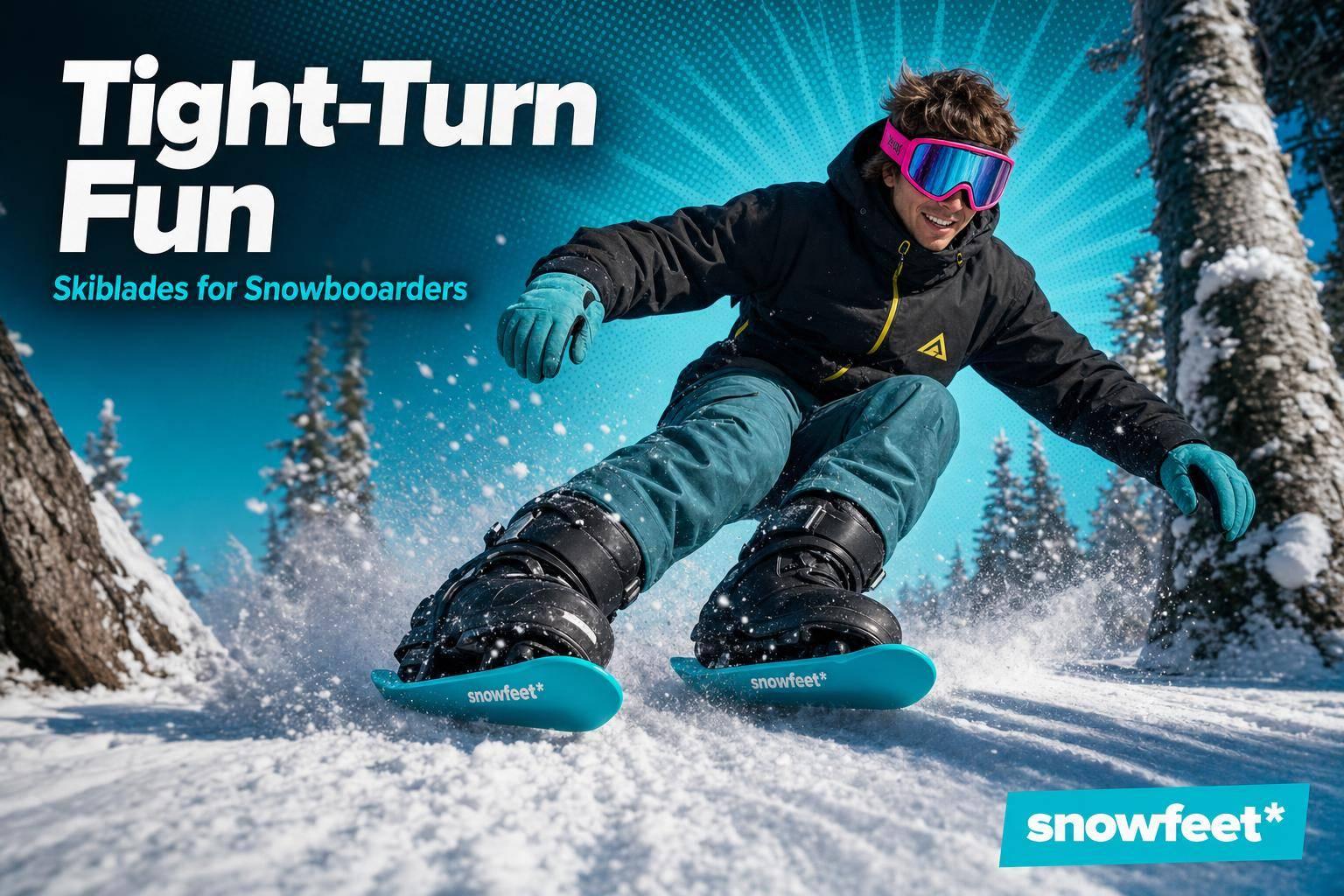
Skiskates are very short skis made to feel closer to skating on snow than skiing. That’s a big deal, because the model you pick changes both how they ride and what you get for your money.
The design is what shapes the ride. Skiskates use a wood core and metal edges. Snowfeet 38 cm uses a lighter plastic shell with boot straps. Same basic idea, very different feel once you’re on snow.
One more thing matters here: these use non-release bindings, so the skates stay attached during a fall. That means control isn’t just nice to have - it’s part of the whole setup. Many models also come with a leash for extra safety.
How Snowfeet 38 cm, Skiskates 44 cm, and PRO 50 cm Feel on Snow
Snowfeet 38 cm straps onto regular winter boots, so it’s the easiest one to toss in a bag and try without much fuss. If you want the most travel-friendly way in, this is it.
Skiskates 44 cm uses a wood core and metal edges, plus bindings for ski or snowboard boots. PRO 50 cm adds a bit more length, which can give you a little more stability.
All three work best on:
- Groomed runs
- Small hills
- Terrain park features
Snowfeet says their short products can handle light powder up to about 4 inches (10 cm) and work best on packed snow. That’s where the gap shows up between these models and regular skis or longer skiblades. Put simply, they’re built for fun, quick turns, and a tight, playful feel - not for charging through deep snow like a full ski setup.
Boot Compatibility, Ankle Support, and Where You Can Use Them
Boot choice changes control, and control changes where these skates make sense.
Snowfeet 38 cm fits regular winter boots with adjustable straps. That’s handy, no doubt. But winter boots don’t give you as much ankle stiffness, so you may feel less locked-in.
The 44 cm and PRO 50 cm models use ski or snowboard boot bindings. That setup gives better support and more direct control, which usually feels smoother and more efficient on snow.
Most resorts allow them, but rules can change from one place to another, so check before you go. They’re best on groomed runs and in terrain parks. Deep snow? Not their happy place. So, they fit a clear niche: great for packed snow and playful riding, but not a one-tool-for-every-condition setup.
Skiskates vs Traditional Skis and Short Skis: Pros and Cons
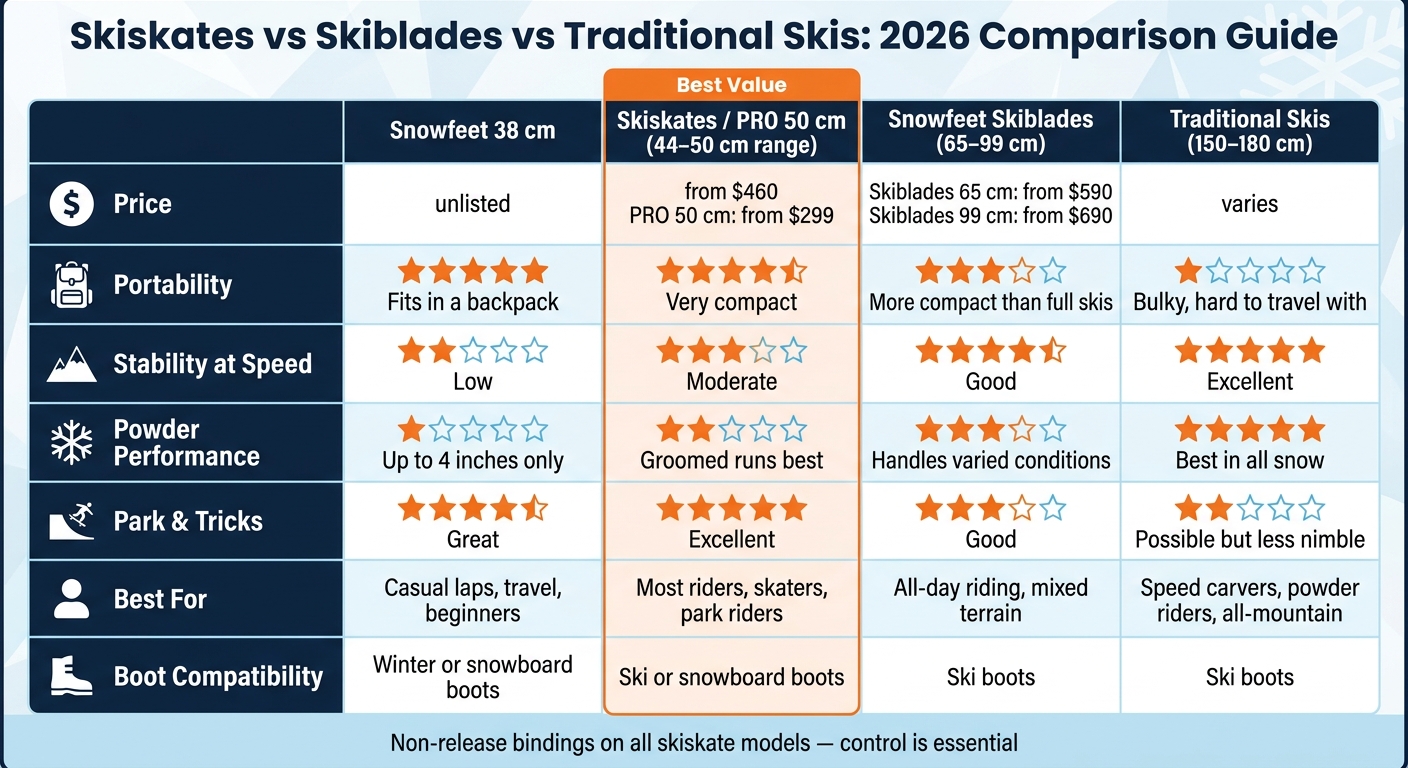
Skiskates vs Skiblades vs Traditional Skis: 2026 Comparison Guide
Now that the basics are clear, here’s the big trade-off: skiskates are easy to carry, but they give up some downhill performance.
That part is simple to see. A pair of 44 cm Skiskates can fit in a backpack. Traditional skis, at about 59–71 inches (150–180 cm), are much more annoying to pack, travel with, and store. If you live in a small apartment or hate wrestling with roof racks, that matters a lot.
The short length also feels less scary for many people, especially skaters and hockey players. But there’s no free lunch here. Less length means less stability at higher speeds. On rough, chopped-up, or mixed terrain, you’ll feel bumps more than you would on a longer ski. And since the bindings do not release, staying in control matters even more than it does on standard skis.
Skiskates vs Traditional Skis
Long skis flat-out win on speed, carving power, and confidence in mixed conditions. If you're flying down a steep groomer or dealing with variable snow, a 180 cm ski with a proper release binding gives you tools that skiskates just don’t have.
Here’s the side-by-side view:
| Aspect | Skiskates (44–50 cm) | Traditional Skis (150–180 cm) |
|---|---|---|
| Portability | Fits in a backpack | Harder to travel with and store |
| Learning curve | Gentle, especially for skaters | Steeper for most beginners |
| Stability at speed | Limited; best at moderate speeds | Strong; built for high-speed carving |
| Powder performance | Weak in deeper snow; best on groomed runs | Better in variable snow, depending on the ski |
| Park suitability | Great for features and playful tricks | Possible but less nimble |
| Ideal user | Casual riders, travelers, skaters, beginners | Committed skiers, speed carvers, all-mountain riders |
So, yeah, this one is pretty straightforward: skiskates win on convenience, and full-size skis win on speed and control.
Skiskates vs Skiblades and Other Short Skis
This is a tighter comparison. The gap here is smaller, and it’s more about how much than what kind.
Competing snowblade products like Salomon snowblades or Bigfoot skiboards tend to ride more like short skis than skiskates. They usually cruise better and feel more planted over longer sessions. But they give up the ultra-compact size and skating-style feel that make skiskates stand out.
Snowfeet sits right in the middle with 65 cm and 99 cm options. The 65 cm Skiblades, for example, have an approximately 4 m turn radius and fit ski boots from US size 4.5 to 14.5. That gives riders a nice middle lane if they want more stability and better cruising comfort without moving all the way to full-length skis.
| Aspect | Skiskates (44–50 cm) | Snowfeet Skiblades (65–99 cm) | Competing Snowblades (e.g., Salomon, Bigfoot) |
|---|---|---|---|
| Snow conditions | Best on groomed snow; weak in deeper snow | More capable in varied conditions | Varies by model |
| Tricks and park | Excellent | Good | Moderate |
| Cruising comfort | Moderate | Strong | Strong |
| Beginner ease | Very easy | Easy to moderate | Moderate |
| All-day comfort | Best for shorter sessions | Good for full days | Good for full days |
With that in mind, the next step is figuring out who gets the most out of skiskates. That trade-off leads straight to the next question: who should actually buy skiskates in 2026?
sbb-itb-17ade95
Who Should Buy Skiskates in 2026
Skiskates are worth it for riders who care more about portability, easy learning, and pure fun than top-end speed or deep powder days. So, rider type is the thing that matters most here.
Good Fits: Beginners, Travelers, Skaters, Snowboarders, and Park Riders
The best matches are pretty simple:
- Beginners - they’re easier to learn than full-length skis, so progress often comes faster.
- Travelers and anyone short on storage space - easy to pack and easy to stash at home.
- Skaters and snowboarders - most adjust fast.
- Terrain-park riders and casual riders - also a strong match. Reviews keep pointing to the easy learning curve and fun factor.
If you like a setup that feels light, playful, and low-hassle, skiskates make a lot of sense. They’re the kind of gear you can toss in a bag without turning your trip into a whole production.
Poor Fits: Speed Carvers, All-Mountain Skiers, and Powder Riders
If your main goal is speed, hard carving, or floating through deep powder, skiskates aren’t the right main tool. Longer skis do that job better. Simple as that.
That means speed carvers, aggressive all-mountain skiers, and powder riders will usually be happier on a longer setup. If you still like the Snowfeet feel, the next section breaks down which length makes the most sense for each rider.
Advanced riders sometimes keep skiskates as a second setup for easy park laps or mellow groomer days.
That leaves one last question: which Snowfeet length is the best buy in 2026?
Which Snowfeet Model Is the Best Buy in 2026
If skiskates match how you like to ride, the main choice comes down to length. And, honestly, it’s pretty simple: go short for easy carry and quick fun, or go longer for a feel that’s closer to skiing.
So the last thing to figure out is this: which Snowfeet length gives you the best mix of control, comfort, and price?
Snowfeet 38 cm vs Skiskates 44 cm vs PRO 50 cm: Side-by-Side
Here’s how the three main skiskate-length options compare:
| Snowfeet 38 cm | Skiskates 44 cm | PRO 50 cm | |
|---|---|---|---|
| Boot compatibility | Regular winter or snowboard boots | Ski or snowboard boots | Ski or snowboard boots |
| Best terrain | Small hills, groomed snow, quick sessions | Groomed resort runs | Groomed runs, mixed resort terrain |
| Best for | Quick laps, small hills, grab-and-go use | Pure skiskate feel on groomed runs | Best all-around choice for most riders |
| Stability at speed | Lower | Moderate | Best of the three |
| Portability | Highest - fits in a backpack | High | High |
The 38 cm model is the easiest to carry and the simplest way to get started. It works well for small hills, casual laps, and those “let’s just get outside for a bit” sessions.
The 44 cm gives you the purest skiskate ride. On groomers, it feels more planted and a bit more dialed in than the 38 cm.
For most riders, though, the PRO 50 cm is the best buy. At $299, it hits the sweet spot between stability, control, and range of use. That extra length helps a lot. It makes the ride steadier and easier to handle, which is a big plus if you want a little more margin for error.
For beginners, the PRO 50 cm stands out even more. It helps build confidence fast, but it still feels nothing like old-school full-length skis.
When to Step Up to Snowfeet 65 cm or 99 cm Instead
If the shorter skiskate lengths start to feel a bit limiting, the next move is a longer Snowfeet setup.
The Skiblades 65 cm (from $590) do a better job in mixed snow than the shorter options. They also give you more confidence at moderate resort speeds, without jumping all the way to a full-length ski setup. The Skiblades 99 cm (from $690) lean even more toward ski-like behavior, which makes them a smart pick if progression and variable terrain matter most.
A simple rule works here:
- If portability and quick fun matter most, stick with the 38–50 cm range.
- If you want all-day riding, variable snow, or more ski-like performance, the 65 cm or 99 cm models are worth the higher price.
Both longer options are still far easier to carry than full-length skis. But they make more sense when you want that ski-like feel, not just pure skiskate grab-and-go use.
That brings up the last question: whether skiskates are worth buying in the first place.
Final Verdict: Are Skiskates Worth Buying in 2026?
After looking at portability, control, and where they work best, the answer is pretty simple: yes - skiskates are worth buying in 2026 if you're a casual rider who wants something easy to carry and easy to learn. They shine on groomed runs, terrain parks, and local hills. If you skate or play hockey, odds are you'll get the hang of them fast. Snowfeet's rating points the same way: 4.9/5 from 5,799 verified reviews.
That said, skiskates aren't the right pick for everyone. If your main goal is speed or powder, I'd pass. They're not built for high-speed carving, steep terrain, or deep powder. That's where longer skis make more sense.
Here’s the quickest way to pick the right setup:
- Snowfeet 38 cm - most portable; best for quick, casual laps
- Skiskates 44 cm (from $460) - classic skiskate feel for groomed slopes
- Snowfeet PRO 50 cm (from $299) - best all-around value
- 65 cm or 99 cm Skiblades - better if you want more ski-like stability
A nice bonus: some models work with boots you already own, which makes the setup a lot simpler.
FAQs
Are skiskates safe for beginners?
Yes. Skiskates are generally safe and easy for beginners to use, especially on groomed slopes and mellow terrain.
Their short length makes them feel less intimidating than regular skis. They’re also easier to steer, which gives you more precise control. If you’ve done ice skating or inline skating before, the skating-like motion will often feel natural.
Can I use skiskates at any ski resort?
Most U.S. ski resorts allow Snowfeet skiskates.
Why? They have metal edges and secure bindings, just like standard skis. So in most cases, you can use them on:
- lifts
- groomed runs
- terrain parks
If a staff member asks about them, keep it simple. Explain that your gear uses the same metal-edge tech as regular skis.
It’s also smart to check the resort’s equipment policy before you head out. And yeah, make sure you’re comfortable doing a hockey-style stop. That part matters a lot more than people think :)
Should I get 38 cm, 44 cm, or 50 cm skiskates?
It depends on your goals and the kind of gear you like to use.
- 38 cm: the most portable option and the easiest for beginners. It’s a good pick for casual fun on smaller hills or mellow slopes.
- 44 cm: the best middle ground for agility and control, especially for skaters or on groomed, icy terrain.
- 50 cm: gives you more stability and a bit more technical range while still staying easy to carry.
All three skip the bulk of old-school ski gear.











Zanechte komentář
Tento web je chráněn službou hCaptcha a vztahují se na něj Zásady ochrany osobních údajů a Podmínky služby společnosti hCaptcha.