




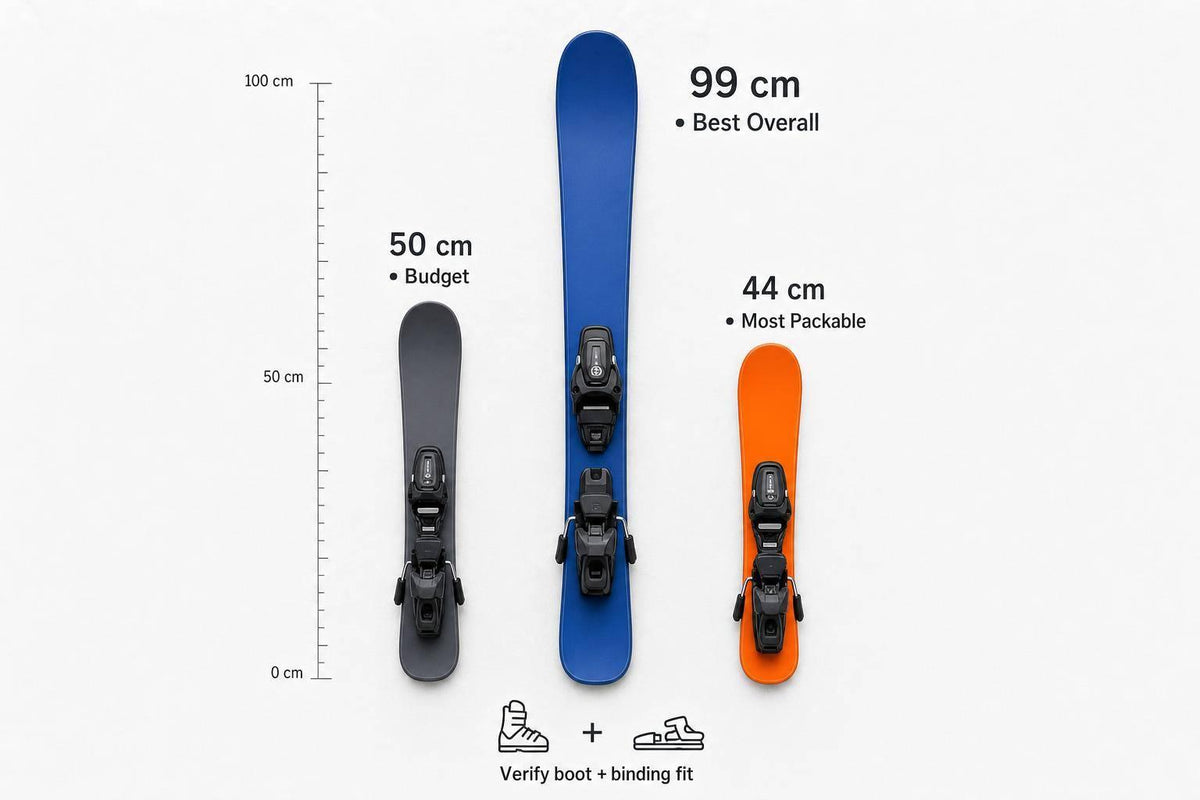
If I skied just once a year, I’d skip full-size rentals and look hard at short skis. For most casual resort days, the Snowfeet* Skiblades 99 cm look like the best all-around pick, the PRO 50 cm is the low-cost pick at $299, and the 44 cm Skiskates win on pack size.
Here’s the short version:
- Best overall for most once-a-year skiers: Snowfeet* Skiblades 99 cm
- Best low-cost option: Snowfeet PRO 50 cm at $299
- Smallest to pack: Skiskates 44 cm
- Most steady ride in this group: Skiblades 120 cm
- Best for nervous first-timers: Skiblades 65 cm
What matters most is simple:
- Shorter skis turn with less effort
- Longer models in this group feel calmer at speed
- Most of these work best on groomed runs
- Boot fit can make or break the buy
So if your ski trip is one week a year, not 30 days a season, I’d focus on easy packing, easy learning, and less gear hassle over top-end speed.
Snowboarder tries Snowfeet* | Which Snowfeet* Short Ski is the Best? | Snowblades 44, 65, 99 Review
Quick Comparison
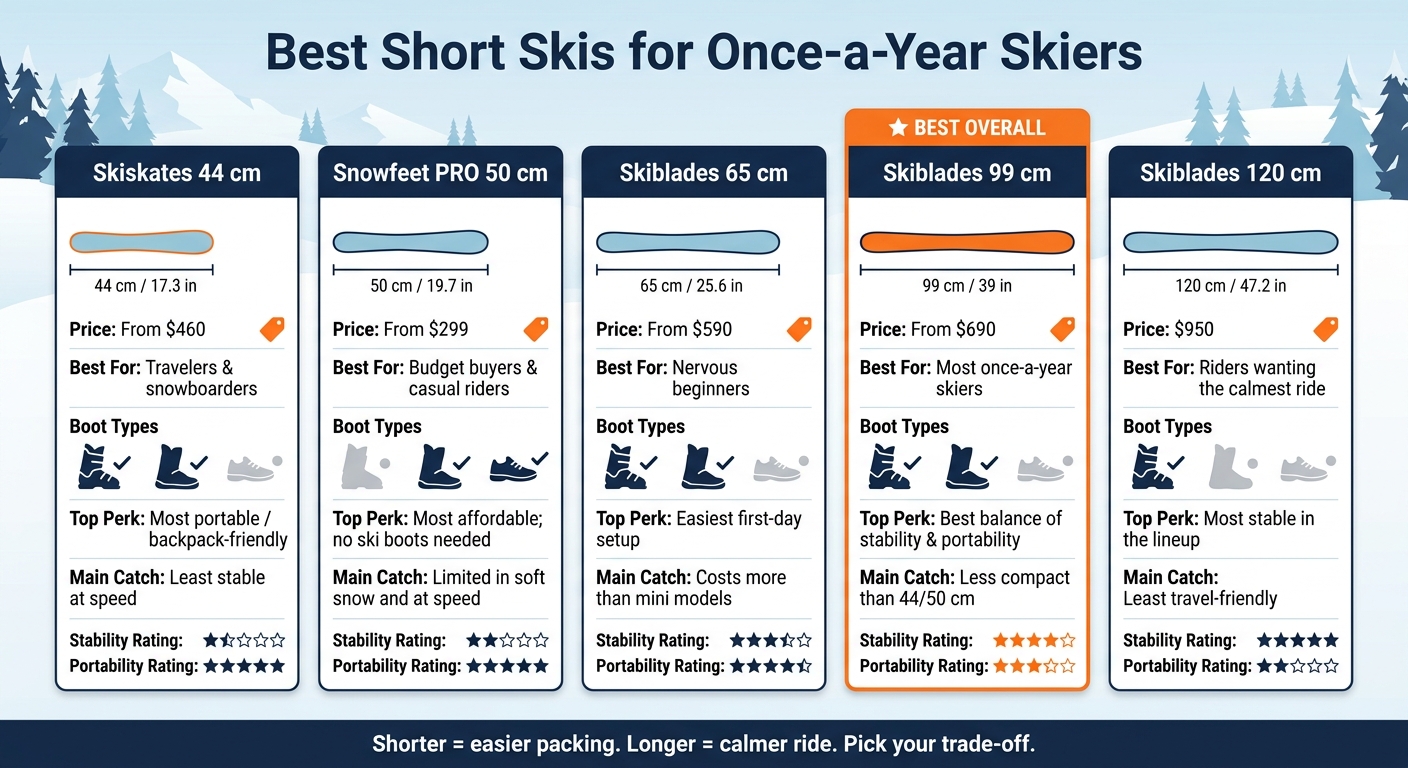
Best Short Skis for Once-a-Year Skiers: Side-by-Side Comparison
| Model | Best for | Price | Boot setup | Main catch |
|---|---|---|---|---|
| Skiskates 44 cm | Travelers and snowboarders who want the smallest setup | From $460 | Ski boots or snowboard boots | Least steady at speed |
| Snowfeet PRO 50 cm | Budget buyers and casual resort riders | From $299 | Winter boots, shoes, or snowboard boots | Limited in soft snow and at speed |
| Skiblades 65 cm | Nervous beginners who want more ski underfoot | From $590 | Ski boots or snowboard boots | Costs more than the mini models |
| Skiblades 99 cm | Most once-a-year skiers | From $690 | Ski boots or snowboard boots | Less compact than 44/50 cm |
| Skiblades 120 cm | Skiers who want the calmest ride here | $950 | Ski boots only | Biggest and least travel-friendly |
A few numbers stand out. The lineup runs from 17.3 in to 47.2 in, and price runs from $299 to $950. That’s a big spread. And it tells me this choice is less about “best ski” and more about which trade-off fits your trip.
My simple take:
- Pick 44 cm if pack size is your top concern.
- Pick 50 cm if you want the cheapest way in.
- Pick 65 cm if you want an easier first day.
- Pick 99 cm if you want the best middle ground.
- Pick 120 cm if you care most about a calmer ride.
If you already own snowboard boots, that can tilt the choice fast. The 44 cm, 65 cm, and 99 cm have snowboard-boot options, and the PRO 50 cm also works with winter boots or shoes. That can save you from renting ski boots, which, uh, is nice for both your feet and your wallet :)
If you want a quick visual before buying, these videos may help:
- Short skis / skiblades basics on YouTube
- Snowfeet skiblades reviews on YouTube
- Beginner short ski tips on YouTube
Bottom line: if I wanted one pair for a yearly resort trip, I’d start with the 99 cm Skiblades. If I wanted the lightest, easiest pack job, I’d go 44 cm or 50 cm. And before I bought anything, I’d double-check the binding and boot size range. That boring step saves a lot of pain later.
1. Snowfeet* Skiskates 44 CM
Price: from $460
The 44 cm (17.3 in) Skiskates are the shortest, easiest-to-pack option in this lineup. On snow, they feel closer to skates than skis. They turn fast, feel playful, and they’re not made for speed.
Stability vs. Agility
The short length makes turning simple and quick. That’s great on easy groomed runs. The tradeoff is less stability once you pick up speed or hit rough snow. For someone who skis once a year, that tradeoff matters more than going fast. If 44 cm sounds a bit too twitchy, the 65 cm Skiblades are the safer move.
Boot Compatibility
The 44 cm Skiskates come in two binding versions:
- one for ski boots (US sizes 4.5–14.5)
- one for snowboard boots (US sizes 6–14.5)
Pick the version that matches what you already use. You can’t use regular winter shoes or sneakers with this model. You need alpine ski boots or snowboard boots.
Travel Portability
This is where they shine. At 44 cm, they fit in a backpack, so you can skip the ski bag and roof rack. If you fly to a resort once a year, that can make the trip a lot easier. You’ll still need to pack boots, a helmet, gloves, and the right outerwear, of course.
Best Trip Use
These work best for travelers or snowboarders who already have compatible boots and plan to stay on easy groomers. They’re a fun pick for short turns and easy packing, not for speed or messy snow. Start on a wide beginner slope and get comfortable stopping before heading onto steeper terrain. If you want a bit more control without giving up a compact setup, the 50 cm Snowfeet PRO is the next step up.
2. Snowfeet PRO 50 CM
Price: from $299
If the 44 cm Skiskates feel a bit too jumpy, the PRO gives you a steadier short-ski feel without turning into a hassle to carry. At 50 cm (19.7 in), it adds more stability than the 44 cm Skiskates, but it still turns with ease. In this lineup, it hits a nice middle ground on price and ride feel.
Stability vs. Agility
The PRO does best on groomed slopes. Once you get into soft snow or start pushing the speed, its limits show up sooner than they do with longer skis.
Boot Compatibility
This is where the PRO stands out. It works with regular winter boots or shoes, and it also works with snowboard boots. So, yep, you can skip ski boot rental. It fits US sizes 6–13 (EU 38–47).
For groomed runs, snowboard boots are the better pick because they give you more ankle support. Winter boots or shoes are fine for casual use.
Travel Portability
At 50 cm, it still fits in a backpack. You give up a little portability compared with shorter models, but you get more stability in return.
Best Trip Use
The PRO is the easiest way in for someone who skis once a year. You don’t need to rent ski boots, the boot setup feels familiar, and the 50 cm length is easier to learn on. At $299, it’s also the most budget-friendly option in this group.
If you’re new, start on a flat area first. Get used to the bindings and find your balance before heading onto a gentle groomed slope. If you want more length and a steadier ride, the 65 cm Skiblades are the next step.
3. Snowfeet* Skiblades 65 CM
Price: from $590
For riders who want a bit more control than the PRO 50 cm, the 65 cm Skiblades are the next step up. At 65 cm (26 in), they give you more platform underfoot while staying much shorter than full-length skis. That extra length helps them feel calmer on groomed snow, but they still stay easy to steer. This is the first model in the lineup that starts to feel more like a ski without turning into a bulky setup.
Stability vs. Agility
The 65 cm model sits in a nice middle ground. It gives casual skiers more calm than the 50 cm version, but it doesn’t lose that easy, low-stress handling. If you’re not ready to jump to the 99 cm model, this one makes a lot of sense.
Boot Compatibility
The 65 cm Skiblades come with either ski-boot or snowboard-boot bindings. That’s a nice perk if you already own snowboard boots and don’t want to buy extra gear for a trip.
Travel Portability
At 65 cm, they’re much easier to pack than full-size skis. That matters when you’re loading a car, checking bags, or just trying not to wrestle with gear before your first run :)
Best Trip Use
This model fits a casual vacation rider who plans to spend most of the trip on beginner and intermediate groomed runs and wants a compact setup with familiar footwear. If your trip will include icy high-speed runs, powder, or rough snow, the 99 cm or 120 cm models will be a better fit. If you want more speed and a steadier ride, step up to the 99 cm Skiblades.
sbb-itb-17ade95
4. Snowfeet* Skiblades 99 CM
Price: from $690
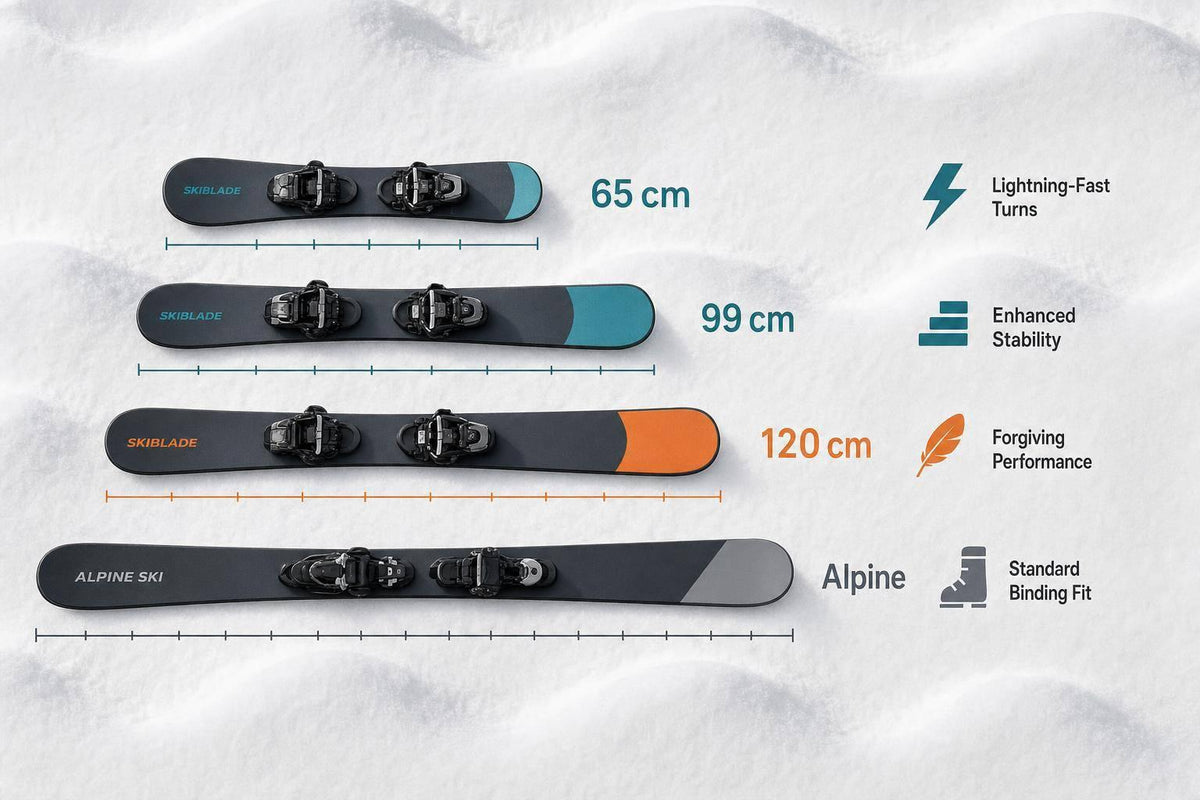
The 99 cm Skiblades land right between the playful 65 cm model and the steadier 120 cm version. At 99 cm, or about 39 in, they give you enough length to feel planted on groomed runs without getting bulky or hard to steer. For casual skiers, this is often the sweet spot. You get more calm than the 65 cm option, but you don’t need to jump all the way to full skis.
Stability vs. Agility
These Skiblades have a 6-meter turning radius, so turns stay quick and controlled. They feel calmer at moderate speeds and do their best work on groomed runs. In plain English: they’re nimble, but they won’t feel twitchy every second.
Boot Compatibility
You can choose from three binding options: simple ski-boot bindings, pro ski-boot bindings, and snowboard-boot bindings. The simple ski-boot bindings fit about US men’s sizes 4.5–14.5, while the snowboard-boot bindings fit about US sizes 6–14.5.
That snowboard-boot option is a nice fit for snowboarders who want to try a shorter-ski ride without jumping into a standard ski setup. That said, snowboard boots and alpine ski boots feel different on snow, so it’s smart to start on easy terrain and get the feel for it first.
Travel Portability
At about 4.94 lb with ski bindings or 5.60 lb with snowboard bindings, these are still easy to pack and carry. They fit in a car trunk, rental car, closet, or padded travel bag. That’s handy if you’re driving to the resort or checking a bag at the airport. Less wrestling with gear is always a win :)
Best Trip Use
This model makes a lot of sense for the once-a-year skier who wants a strong mix of confidence, easy turning, and a travel-friendly size. It also works well for snowboarders who are curious about a shorter ski format. If you want more stability or a ride that feels closer to standard skis, the 120 cm Skiblades are the next step.
5. Snowfeet* Skiblades 120 CM
Price: $950
The 99 cm model sits in the middle. The 120 cm version is the next step for riders who want more control and a calmer ride. At about 47 inches long, these are the most stable and fastest skis in the five-model Snowfeet lineup.
Compared with the 65 cm and 99 cm versions, the 120 cm skiblades trade some quick turning for a steadier feel. If you ski once a year and just want something that feels less twitchy, that swap can be a good one.
Stability vs. Agility
The 120 cm model has an 8-meter turning radius, so it feels more predictable than the 65 cm or 99 cm options, especially on groomed runs and at moderate speed. It also has better edge hold and feels more planted than the shorter models.
You do give up some of that fast, playful pivoting. But in return, you get the most stable ride in the Snowfeet* skiblade lineup. Think of it like this: less go-kart, more small sports sedan.
Boot Compatibility
This model works with standard ski boots and release ski bindings only. Snowfeet lists compatibility at about Mondo 26–36.1, so check your exact boot size before you buy.
Unlike the 65 cm and 99 cm models, this one does not come with a snowboard-boot option.
Release bindings can help cut twisting risk in a fall. Before you ski, have a shop check the bindings. The release setting depends on your boot sole length, weight, height, and ability level.
Travel Portability
These won’t fit in a carry-on or backpack, so you’ll need a ski bag for flights. It’s smart to check airline sports gear rules and fees before your trip.
That said, they’re still much smaller than full-length skis, which makes travel a bit less of a headache.
Best Trip Use
This is the best pick for a casual skier who wants a more stable ride on groomed runs and already owns ski boots. It also fits a returning skier who wants compact gear but still likes a normal ski-binding setup.
So, yeah, it’s a bit of a niche pick. It makes the most sense for skiers who care more about stability than easy packing.
The trade-off is simple: more confidence, less portability.
Pros and Cons
For someone who skis once a year, the choice usually comes down to easy travel vs. more confidence on snow.
Here’s the quick comparison for the five models. Then we’ll look at short skis vs. long skis.
| Product | Main Advantages | Main Trade-offs | Skip If |
|---|---|---|---|
| Snowfeet Skiskates 44 cm* (~17 in) | Most portable; backpack-friendly; highly maneuverable; works with ski or snowboard boots | Least stable at speed; limited float in soft snow; can feel twitchy | You want high-speed stability, powder performance, or the easiest first-day setup |
| Snowfeet PRO 50 cm (~20 in) | Compact and easy to carry; versatile for casual resort use; works with winter boots | Very short - limited edge grip, speed stability, and soft-snow float | You need conventional ski handling or sustained high-speed resort skiing |
| Snowfeet Skiblades 65 cm* (~26 in) | Quick turns; beginner-friendly on groomed runs; more platform than the two shortest models | Less compact than 44/50 cm; still sacrifices speed stability and powder float vs. longer options | Trips likely to involve deep powder, long fast descents, or a conventional ski feel |
| Snowfeet Skiblades 99 cm* (~39 in) | Best balance of portability and stability; more confident on groomed runs than shorter models | Less backpack-friendly; not as playful as the mini options; won't match long skis in powder | Your top priority is the smallest travel package |
| Snowfeet Skiblades 120 cm* (~47 in) | Most stable in the lineup; longest effective edge; closest to a traditional ski feel | Bulkiest to transport; slower to pivot in tight spaces; won't fit in a standard checked bag | You value backpack portability or want the easiest first-day setup |
The first table is for picking a Snowfeet model. The second one explains why short skis can make more sense than long skis for occasional trips.
If you’re stuck between Snowfeet and rental skis, this is the list that matters most.
| Factor | Short Skis (Snowfeet* Lineup) | Traditional Long Skis |
|---|---|---|
| Learning curve | Easier initial turning and maneuvering; approachable for first-time or once-a-year riders | More demanding to control at first, especially for beginners |
| Speed stability | Lower; can feel nervous above moderate speed | Higher; longer platforms track more calmly |
| Deep-snow float | Limited - most models are best on groomed snow and light powder | Much better; larger surface area keeps you higher in soft snow |
| Carving grip | Good for tight, quick turns; less effective on long, fast arcs | Stronger edge engagement for sustained carving |
| Transport & storage | Fits in a backpack or standard luggage; no roof rack needed | Requires a ski bag, roof rack, or oversized luggage |
| Boot flexibility | Some models work with ski boots, snowboard boots, or winter boots | Requires compatible rigid ski boots |
| Overall trip hassle | Lower - less gear, easier packing, simpler logistics | Higher - more equipment, more planning, more storage |
A simple way to think about it: short skis are like a hatchback, while long skis are more like a full-size truck. One is easier to park, pack, and live with. The other feels calmer when you open it up.
Before you buy, check boot and binding compatibility for your exact model. That little detail can save you a headache later :)
Which One Should You Buy for a Once-a-Year Ski Trip
For most once-a-year resort skiers, the Snowfeet* Skiblades 99 CM (~39 in) are the best overall pick. They hit the sweet spot: stable enough to feel in control, short enough to turn with less effort, and simple to use on groomed runs.
If you want the short version, use this quick match:
| Rider type | Best pick | Why |
|---|---|---|
| Nervous beginner or first-timer | Snowfeet* Skiblades 65 CM (~25.6 in) | Easiest short ski for nervous beginners on groomed runs |
| Snowboarder or minimalist traveler | Snowfeet* Skiskates 44 CM (~17.3 in) | Smallest setup; skating-like feel |
| Budget-conscious traveler | Snowfeet PRO 50 CM (~19.7 in) | Most affordable, backpack-friendly option |
| Rider who wants a more conventional ski feel | Snowfeet* Skiblades 120 CM (~47.2 in) | Closest to a traditional ski feel; most stable in the lineup |
Still stuck between short skis and rentals? Here’s the plain-English version: long skis still do better on steep runs, powder, and high-speed carving, but Snowfeet* makes more sense for a once-a-year resort trip because it’s easier to pack, easier to learn, and easier to have fun on. For a lot of casual trip skiers, that trade-off is worth it.
One last thing before you click buy: check boot and binding compatibility. It’s not the fun part, but it’ll save you a headache later :)
FAQs
Are short skis easier than rentals?
Yes. Short skis are usually easier to handle than rental skis, which are often long, heavy, and matched with stiff, uncomfortable boots.
Snowfeet short skis and skiskates feel more nimble, less intimidating, and easier to turn at low speeds. Their compact size also means less hassle with rental lines and bulky gear, so they tend to feel more fun and natural for casual riders.
Which length should I choose?
It comes down to what matters most to you: stability, portability, or terrain.
For most casual adult riders, 99 cm Skiblades are the best all-around pick. They give you easy turns, solid stability on groomed runs, and a size that’s still easy to travel with. Kind of the sweet spot, honestly.
Here’s the quick breakdown:
- Choose 44 cm Skiskates if you want the most portable option.
- Choose 65 cm Skiblades if you want a ride that feels more beginner-friendly.
- Choose 120 cm Short Skis if you want the most ski-like feel and more stability on steeper runs.
Do I need ski boots?
No. Most Snowfeet products work with snowboard boots or sturdy, waterproof winter boots, so you don’t need ski boots.
Here’s the simple version:
- Snowboard boots or winter boots = more comfort and easier walking around the resort
- Ski boots = better edge control and a feel that’s closer to regular skis
So it comes down to what you want. If you like a more locked-in ride, go with ski boots. If comfort matters more and you don’t want to clomp around like a robot in the parking lot, snowboard boots are a great pick :)
There’s just one exception: the 120 cm model requires standard ski boots.











Zanechte komentář
Tento web je chráněn službou hCaptcha a vztahují se na něj Zásady ochrany osobních údajů a Podmínky služby společnosti hCaptcha.