





If you fly a lot, shorter skis are the easy answer. Full-size skis usually run 59–67 in. (150–170 cm), which means ski bags, checked luggage, and airport hassle. In this lineup, I’d keep it simple: 44 cm Skiskates are the smallest, 50 cm Snowfeet PRO hit the best middle ground, and 65 cm Skiblades give you more control while still fitting in a normal checked suitcase.
Here’s the short version:
- Best for the smallest packed setup: Snowfeet Skiskates 44 cm
- Best all-around travel pick: Snowfeet PRO 50 cm
- Best if you want more stability: Snowfeet Skiblades 65 cm
- Harder to travel with: Bigfoot, Figl, Salomon snowblades, and ODR
- Big watch-out: airline carry-on rules still apply, and the gate agent has the final say
I like this lineup because the trade-off is clear:
shorter = easier to pack
longer = more stable on snow
A few numbers tell the story fast:
- 44 cm = 17.3 in.
- 50 cm = 19.7 in.
- 65 cm = 25.6 in.
- Many airlines use about 22 x 16 x 9 in. carry-on limits and around 15.4 lb. (7 kg) for some cabin bags
- Checked bag fees often kick in once you pass 50 lb. (23 kg)
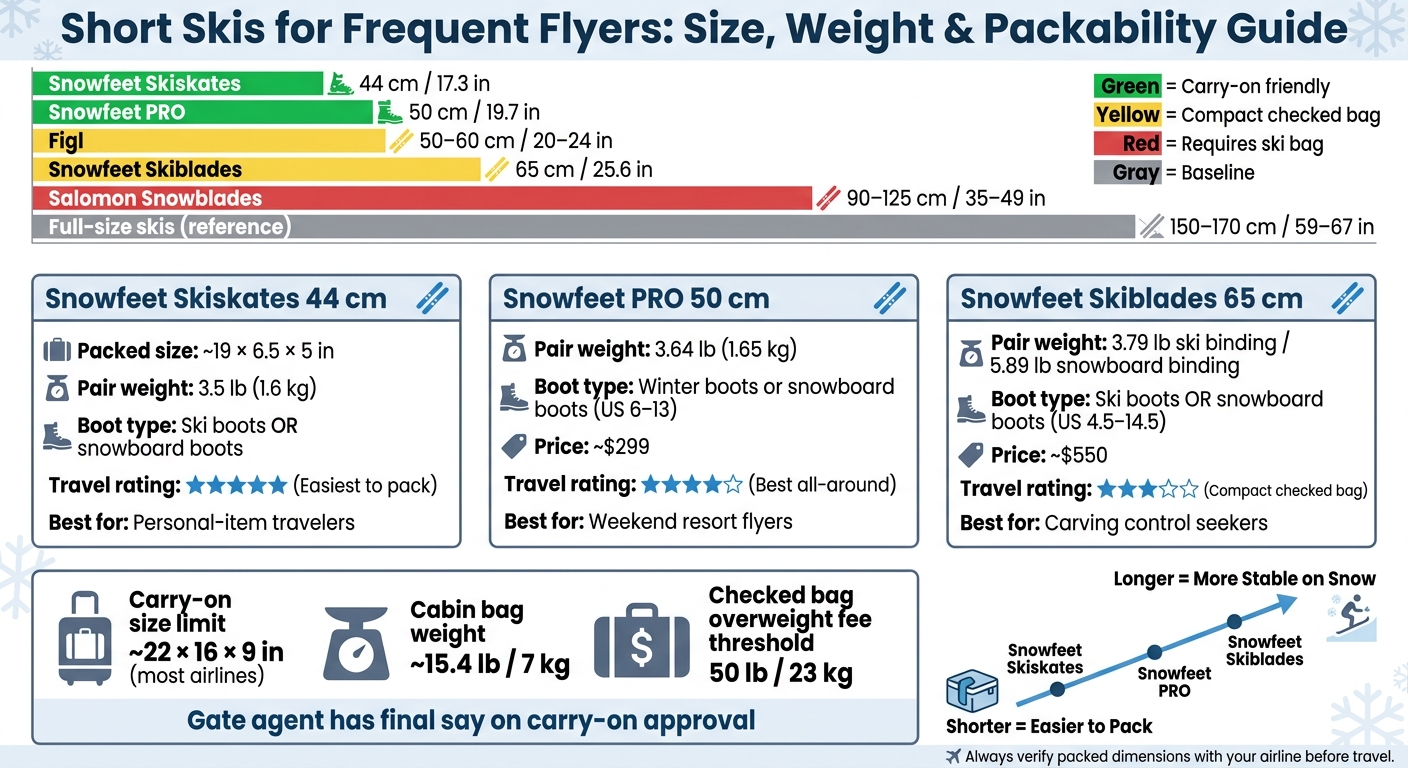
Short Skis for Travel: Size, Weight & Packability Compared
Snowboarder tries Snowfeet* | Which Snowfeet* Short Ski is the Best? | Snowblades 44, 65, 99 Review
Quick Comparison
| Model | Length | Boot setup | Travel use | Main downside |
|---|---|---|---|---|
| Snowfeet Skiskates | 17.3 in. (44 cm) | Ski boot or snowboard boot version | Best for the smallest luggage footprint | Least stable at speed and in soft snow |
| Snowfeet PRO | 19.7 in. (50 cm) | Winter boots or snowboard boots | Best mix of size, weight, and easy packing | Less support than longer ski setups |
| Snowfeet Skiblades | 25.6 in. (65 cm) | Ski boot or snowboard boot version | Best for compact checked travel with more control | Too bulky for most carry-on plans |
| Bigfoot | Varies | Varies by model | Works only if you confirm the exact setup | Specs are all over the place |
| Figl | 20–24 in. (50–60 cm) | Strap or plate binding | Small, but more awkward to pack | Bulkier binding setup |
| Salomon snowblades | 35–49 in. (90–125 cm) | Alpine ski boots | Fine if you don’t mind checking gear | Much longer and less flight-friendly |
| ODR | Boot-length units | Built-in boot-ski system | Compact in length | Heavy, bulky, and costs more |
So, if you want the plain answer: go as short as you can tolerate on snow. For most travelers, that means PRO 50 cm. If your whole goal is to skip the ski bag, Skiskates 44 cm are the top pick. And if you want a bit more ski feel, 65 cm Skiblades make more sense than hauling full-length skis through Terminal B like a lost ladder salesman :)
1. Snowfeet* Skiskates 44 cm
At 44 cm, the Snowfeet* Skiskates are the shortest option in this group. That makes them the easiest to toss in a bag and take on a trip.
Packability
The Skiskates pack down to about 19 × 6.5 × 5 inches, based on reported dimensions. So yes, they take up less space in your luggage.
That said, airline carry-on rules can still be a mixed bag. Smaller gear helps, but cabin approval still comes down to the airline.
Boot Compatibility
This part matters more than people think.
The Skiskates come in two binding versions, and you need to pick the right one. The ski-boot version fits US sizes 4.5–14.5 (EU 36–49), while the snowboard-boot version fits US sizes 6–14.5 (EU 38–49).
Here’s the key thing:
- Ski boots do not fit snowboard-boot bindings
- Snowboard boots do not fit ski-boot bindings
So, double-check your boot type before you order. Then test the fit before your trip. It’s a lot better to find a fit issue at home than at the mountain. Nobody wants that parking-lot surprise :)
Travel Weight
Snowfeet lists the Skiskates at about 1.6 kg (3.5 lbs). That’s light.
But the skis are only part of the travel equation. Your boots take up a lot of room too, and they add a lot of bulk. So while the Skiskates are easy to carry, the full setup still depends on what you’re wearing on your feet.
There’s also a trade-off here: easy packing usually means less stability on snow.
On-Slope Stability
With a 44 cm length, these turn fast and feel nimble. That’s the fun part.
The downside? You give up stability and flotation. They’re not a good pick for deep powder, high-speed carving, or touring. They work best on groomed runs at moderate speed.
If your main goal is the smallest ski-style setup for travel, Skiskates are the easiest to pack. If you want a bit more surface area without adding much bulk, the next step is the Snowfeet PRO 50 cm.
2. Snowfeet PRO 50 cm
At 50 cm, the Snowfeet PRO lands in the sweet spot between the tiny Skiskates and the longer Skiblades. That extra length gives you more ski under your feet, and yep, you can feel it on snow.
Packability
At 19.7 in (50 cm), the PRO is small enough to fit in a normal suitcase. Cabin approval still depends on the airline, so don’t assume it’ll slide through every time.
The bigger win is simpler: the PRO works with boots you may already bring on a trip. That means less gear to pack and less hassle at the airport.
Boot Compatibility
This is where the PRO shines. Its adjustable bindings fit winter boots and snowboard boots in U.S. men's sizes 6–13 (EU 38–47).
So instead of packing ski boots too, you can often just use what you already have. That cuts bulk and makes your bag easier to deal with.
There’s one thing to watch. If you wear bulky snowboard boots in U.S. sizes 12–13, the binding strap may be too short to secure them well. In that case, measure the actual boot before you order.
Travel Weight
The pair weighs about 3.64 lb (1.65 kg), which keeps it easy to pack in a normal travel bag.
That matters because many airlines charge overweight fees once checked sports gear goes over 50 lb (23 kg). It’s a good idea to weigh the full packed bag before you leave for the airport. A quick check at home beats a bad surprise at the counter.
On-Slope Stability
Compared with the 44 cm Skiskates, the extra length gives the PRO better stability on groomed runs. That makes it a nicer pick for casual cruising and for learning basic short-ski movement.
It’s best on groomed runs and relaxed laps. This is still a compact model first, so the tradeoff is simple: you give up a bit of agility to get more stability. If you want a bit more confidence underfoot without giving up easy packing, the 65 cm Snowfeet* Skiblades are the next step.
3. Snowfeet* Skiblades 65 cm
If the PRO feels a bit too short, the 65 cm (26 in) Skiblades give you more control without dragging you all the way to full-size skis. They offer the most control in Snowfeet's compact lineup. That makes them a nice middle ground for riders who want cleaner carving on groomed runs but don't want to lug around a full ski bag.
Packability
These Skiblades can fit inside many standard hard-sided checked suitcases. Pack them base-to-base, add some padding, and place them near the center of the suitcase so the edges have more protection. A pair can ride in the same checked suitcase as your other travel gear, which can help you skip a separate ski bag.
That said, don’t plan on bringing them as carry-on. Treat them like compact checked sports gear.
Boot Compatibility
The Skiblades come in two binding options:
- The ski-binding version fits alpine ski boots in about US men's sizes 4.5–14.5 (EU 36–49)
- The snowboard-binding version fits snowboard boots in about US sizes 6–14.5 (EU 38–49)
If you already own snowboard boots, that second option is a nice little win. You can skip packing a separate pair of ski boots. Still, test the fit at home before your trip. Airport day is a bad time for surprises.
Travel Weight
Here’s where the binding choice matters most. The ski-binding version weighs about 3.79 lb (1,720 g) per pair. The snowboard-binding version weighs 5.89 lb (2,638 g) per pair.
If you're trying to stay under the airline 50 lb (23 kg) checked bag limit, the ski-binding version gives you more room for the rest of your stuff. That extra space adds up fast once jackets, gloves, and boots enter the chat.
On-Slope Stability
At 65 cm, these feel more stable and controlled than the 44 cm Skiskates or the 50 cm PRO. The sidecut helps them hold a clean line on groomed runs. You get better edge hold and a calmer ride, which many riders will notice right away.
The trade-off is pretty simple: they still won’t float as well in powder or stay as planted at high speed as full-length skis. On groomed terrain and packed snow, though, they feel steady and quick to respond.
From here, the article moves to older compact models that offer similar travel benefits with different trade-offs.
4. Bigfoot short skis
After Snowfeet’s neat, easy-to-read lineup, Bigfoot gets a bit messy. And that’s the big thing to know before you fly.
Bigfoot isn’t one standard product. It’s more like a loose bucket of very short skis. So the exact model matters a lot. For air travel, that can be a pain. Why? Because model-to-model differences make packing and boot planning less clear.
Packability
The main plus is simple: they’re short.
Some 42 cm kids’ versions can fit into a small ski bag or even a duffel. That’s nice if you want to keep gear compact. But not every Bigfoot setup packs the same way. Fixed-binding versions and packages that come with boots take up more space and are less handy to travel with.
Boot Compatibility
Boot fit depends on the model, and that’s where things can get confusing.
Some kids’ Bigfoot skis use strap bindings, which work with regular winter boots. Adult versions, though, often need ski boots. If the set includes boots, packing gets more awkward fast. More gear, more bulk, less fun at the airport.
Travel Weight
Weight is another wildcard. Bigfoot skis vary too much by model to pin down one solid number.
That makes trip planning less predictable than with Snowfeet. You may be fine with one setup, then hit extra bulk with another. It’s a bit of a grab bag.
On-Slope Stability
Bigfoot-style skis tend to feel forgiving at low speed, which is great for easy cruising and casual use. But many versions are made for kids or laid-back riders, not all-around adult use.
That shows up in the details. The strap-binding version listed here has a weight limit of 66 lb. So, no, it’s not a go-to adult option.
Next up are more established compact-ski choices, including models that line up more closely with Snowfeet when it comes to travel ease.
sbb-itb-17ade95
5. Figl short skis
After Snowfeet’s plug-and-play setups, Figl feel a bit more old-school. They use bulkier bindings and lean more toward a ski-like setup. These are short spring-snow skis, usually 50–60 cm long or about 20–24 inches.
Packability
A Kohla Figl with a plate binding measures 60 cm × 12 cm and weighs about 1,135 g per pair or roughly 2.5 lbs. So, yes, they’re still small. But they’re heavier than the Snowfeet PRO, and the stiff binding parts make them more awkward to shove into a carry-on.
A 50–66 cm pair might fit diagonally inside some larger carry-on bags or compact ski luggage. Some models can also strap to a backpack for the hike in, which is nice once you're on the mountain. Still, that doesn’t mean an airline will wave it through as a carry-on. That’s the trade-off: short enough to travel with, but not nearly as neat to pack as Snowfeet.
Boot Compatibility
Figl usually come with two binding styles:
- A strap-style binding for winter boots or hiking boots
- A plate binding for touring boots that needs careful adjustment
The strap version is the easier travel pick since you can skip bringing ski boots. Plate bindings lock you into a narrower setup and can be more of a hassle.
Travel Weight
Check the exact product page before you buy, since weight changes by model. For the Kohla plate-binding version, the listed weight is 1,135 g per pair.
On-Slope Stability
Figl work best on firm spring snow and mellow, controlled gliding. They’re not trying to act like full-length skis. Their short, wide shape can feel friendly on gentle terrain, which is part of the appeal.
That said, the short length gives you less fore-aft stability and less float in soft or mixed snow. You also ride them with a different technique, using a more rearward stance and shifting your weight to speed up or slow down. It’s a bit of its own thing.
For most casual flyers, Snowfeet still feels like the easier travel-first pick. Figl make more sense if you already want that firn-glider style. Up next is another compact option with a simpler travel setup.
6. Salomon snowblades
After Figl, Salomon is the alpine-boot pick most people know. But for air travel, they’re a lot less handy.
Yes, Salomon snowblades are short skis. But that’s only short by normal ski standards. Most adult models sit around 90 cm to 99 cm, and some stretch out to 125 cm. So compared with Snowfeet* models, they’re much harder to toss in a bag and go.
Packability
A 90–99 cm pair will usually need a ski bag or checked luggage. It’s not the kind of setup you slide into a carry-on and head for the gate with a smile.
Boot Compatibility
Most Salomon snowblades use alpine ski boot bindings. That means winter boots, snowboard boots, and hiking boots usually won’t work.
Stick with alpine ski boots unless the model says otherwise. Don’t guess here.
Travel Weight
Weight changes from model to model, but the longer base and alpine bindings add bulk fast. You feel that at the airport, in the car, and when you’re dragging gear through the lodge parking lot.
On-Slope Stability
Salomon snowblades feel more stable than ultra-short skiskates on groomed runs because the longer platform gives you more support underfoot. That extra length helps, especially if you want a ride that feels closer to skiing.
The trade-off is simple: you get more stability, but you lose most of the travel ease that makes Snowfeet* stand out.
For frequent flyers, Snowfeet* Skiskates and Snowfeet PRO are still the easiest to pack. ODR comes next if you want another compact ski travel option.
7. ODR short skis
ODR goes in a totally different direction from the other products here. Instead of a ski that straps onto boots you already own, ODR is a single boot-and-ski setup. The ski base, steel edges, and boot are built together as one piece. So, there are no separate bindings, no poles, and no standard ski boots in the mix. Models include the Eclipse and the R43.
Packability
ODR is much shorter than full-size skis, and the brand says the blades are about boot-length. That’s a lot easier to fit into a suitcase than a 6-foot ski. Nice, right?
Still, small doesn’t always mean flight-ready. You’re packing two hard boot-ski units, and the posted product specs don’t confirm packed size or airline approval. Before you head to the airport, measure your full packed setup and check your airline’s current bag limits.
Boot Compatibility
This is where ODR stands apart from Snowfeet* the most. ODR does not go over your own winter boots. It comes with its own ski boot made for this system, which gives you more ankle support but also adds more heft than a normal ice-skating shoe.
So you can’t just grab your insulated boots and go. You’ll need to pack one more sport-specific item, which cuts into the whole “travel light” idea.
Travel Weight
Current ODR specs do not show a verified pair weight. Even without that number, one thing is clear: the built-in boot adds bulk. Once you add the boot-ski units and maybe a protective bag, your travel load can stack up.
That looks very different next to Snowfeet* PRO 50 cm, which is listed at about 0.9 lb per pair. Price is another gap. Current listed ODR prices run from about $379.99 to $599.99, based on model and seller. So yes, it sits well above most Snowfeet* options.
On-Slope Stability
ODR uses built-in steel edges and a higher-support boot to help with grip, turning, and control on groomed, hard-packed, or icy snow. On tighter turns, that setup can feel sharp and quick. If you like a nimble ride, that’s the appeal.
Deep snow is still a weak point. That’s pretty common with very short skis. If you’re new to this style, start on mellow groomers and wear a helmet.
For people who fly often and want the smallest luggage footprint, ODR still doesn’t beat Snowfeet* models. The built-in boot system adds size, weight, and cost that many weekend travelers just won’t want. ODR makes more sense for riders who want a dedicated all-in-one snow-skating setup and don’t mind packing special boots for it.
Packing, Airline Limits, and Travel Trade-Offs
After you compare the models, the next thing that matters is simple: will they fit airline limits once they’re packed?
That’s where people get tripped up. A 44 cm ski setup sounds tiny on paper. But once you add padding, straps, and bindings, the packed size grows fast. So don’t measure the ski by itself. Measure the full packed setup.
A smart starting point is 55 x 40 x 23 cm and 7 kg (15.4 lb), then check your airline’s exact rules. Some airlines count wheels and handles in the bag size. Some don’t. That little detail can make or break a carry-on. And yeah, weigh the bag at home before you leave. Airport scale surprises are no fun :)
For people who fly a lot, the pecking order is pretty clear: Skiskates are the easiest to pack, PRO gives you the best middle ground, and Skiblades make the most sense in a compact checked bag. If you’re flying with Bigfoot, Figl, Salomon, or ODR, check the packed dimensions before your trip.
The basic trade-off is easy to understand: choose short skis for travel ease, and choose long skis for powder and speed.
| Traveler scenario | Best-fit option | Why it fits | Main limitation |
|---|---|---|---|
| Personal-item traveler | Snowfeet* Skiskates 44 cm | Smallest listed format; easiest to place in a padded backpack or compact bag | Must verify fully packed personal-item dimensions; least float and ski feel |
| Weekend resort flyer | Snowfeet PRO 50 cm | Best balance of portability, low pair weight, and boot compatibility | Less glide and high-speed stability than longer skis |
| Compact checked-bag skier | Snowfeet* Skiblades 65 cm | More platform and control while remaining far shorter than traditional skis | Bindings and protection add bulk; better suited to checked luggage |
| Bulkier short-ski alternatives | Salomon, ODR, Bigfoot, Figl | More substantial platform than ultra-short skiskates | Harder to pack; may require checked baggage |
Use this trade-off map for the final picks below.
Pros, Cons, and Final Picks
With the comparisons done, here’s the fast way to choose.
| Product | Biggest advantage | Biggest drawback | Best traveler type |
|---|---|---|---|
| Snowfeet* Skiskates 44 cm | Smallest carry-friendly option | Least stable in rough snow or at speed | Weekend flyers, personal-item travelers, casual resort riders |
| Snowfeet PRO 50 cm | Compact with broad boot flexibility | Less support than full ski bindings | Travelers who want portability without being tied to one boot style |
| Snowfeet* Skiblades 65 cm | Best control in the Snowfeet lineup | Larger packed footprint than the 44 cm and 50 cm options | Resort skiers who want more carving control in a still-compact setup |
| Other compact short skis (Bigfoot, Figl, Salomon, ODR) | Familiar groomer feel or all-in-one design | Harder to pack; check packed size, boot fit, and airline rules before buying | Riders who have confirmed specs work for their airline and luggage setup |
For most travelers, Snowfeet comes out on top for size, ease of use, and airline-friendly packing.
Final picks, straight up:
- Snowfeet* Skiskates 44 cm - best for the smallest travel setup. You can pack them in a backpack and keep your luggage simple.
- Snowfeet PRO 50 cm ($299 at time of research) - best if you want one compact setup and don’t want to deal with ski boots.
- Snowfeet* Skiblades 65 cm ($550 at time of research) - best for stability and carving control while still being much smaller than full-length skis.
- Longer skis - go this route only if powder, backcountry, or speed matter more to you than packing light.
FAQs
Can I really carry short skis onto a plane?
Yes, but it depends on the model and the airline.
Snowfeet models in 38 cm, 44 cm, and sometimes 50 cm can fit within standard U.S. carry-on limits of 22 x 14 x 9 inches. In many cases, you can pack them diagonally in a backpack or duffel. That’s the sweet spot if you want to skip the baggage claim circus :)
Models 65 cm and longer are usually too big for cabin storage, so you’ll need to check them.
One heads-up: always check your airline’s policy. Even if your gear fits the listed carry-on size, tight overhead bin space can still lead to a gate check.
Which Snowfeet* model is best for my trip?
For most frequent-flyer trips in the U.S., Snowfeet Skiskates 44 cm* are the best pick if you want airline-friendly packing and less luggage to deal with.
They hit the sweet spot between easy carry-on or backpack packing and solid stability on snow. Compared with the shorter 38 cm model and the longer 50 cm PRO, 65 cm, 99 cm, and 120 cm options, the 44 cm version gives you the best all-around mix for fast weekend flights with fewer travel hassles.
Do I need special boots for Snowfeet*?
No. Most Snowfeet* models don’t need standard alpine ski boots. Models like the 38 cm and 50 cm PRO work with regular waterproof winter boots or snowboard boots, which can save space and cut down on weight when you travel.
For models like the 44 cm Skiskates or 65 cm Skiblades, you can use ski boots or snowboard boots, depending on the binding version.












Zanechte komentář
Tento web je chráněn službou hCaptcha a vztahují se na něj Zásady ochrany osobních údajů a Podmínky služby společnosti hCaptcha.