



















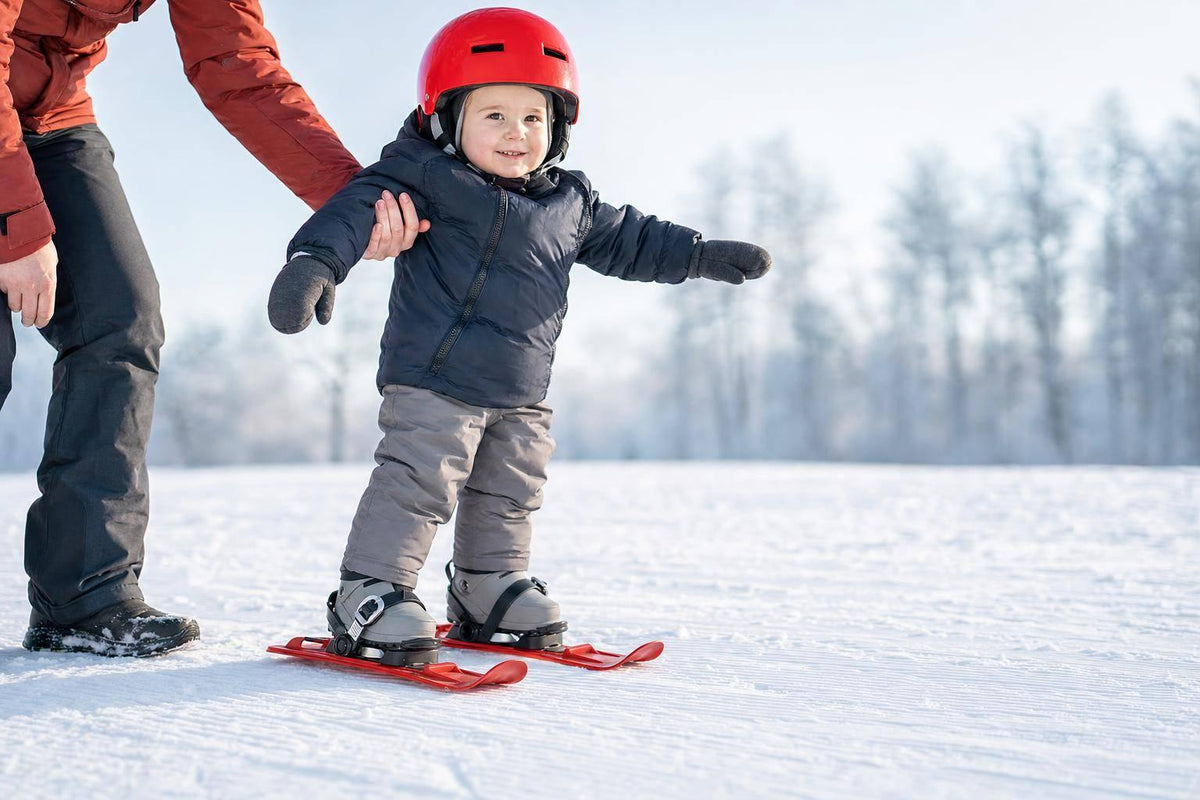
If I had to give one short answer, it’s this: for most toddlers and preschoolers, I’d start with Snowfeet* MINI KIDS at $250. They’re light, short, and work with regular winter boots. That means less gear, less fuss, and a much easier first day on snow.
Here’s the simple breakdown:
- Best first pick: Snowfeet* MINI KIDS
- Best for kids with better balance: Snowfeet* 38 cm
- Best for groomed resort runs: Snowfeet* Skiskates 44 cm from $490
- Best step-up option for bigger kids: Snowfeet* PRO 50 cm from $299
- Best if you already do ski school and own ski boots: standard beginner kids’ skis
A few things matter most:
- Age and balance: some kids are ready at 3, some aren’t ready yet, and that’s normal
- Boots: MINI KIDS and 38 cm can work with winter boots; 44 cm often needs ski or snowboard boots
- Snow type: these all work best on packed snow, not powder deeper than 4 inches (10 cm)
- Control: shorter gear is easier to carry and less clunky, but longer skis can feel steadier to some kids
Snowfeet* Review: Are Skiskates Worth It? | Mini Ski | Skates for Snow | Skating Ski | Short Ski
Quick Comparison
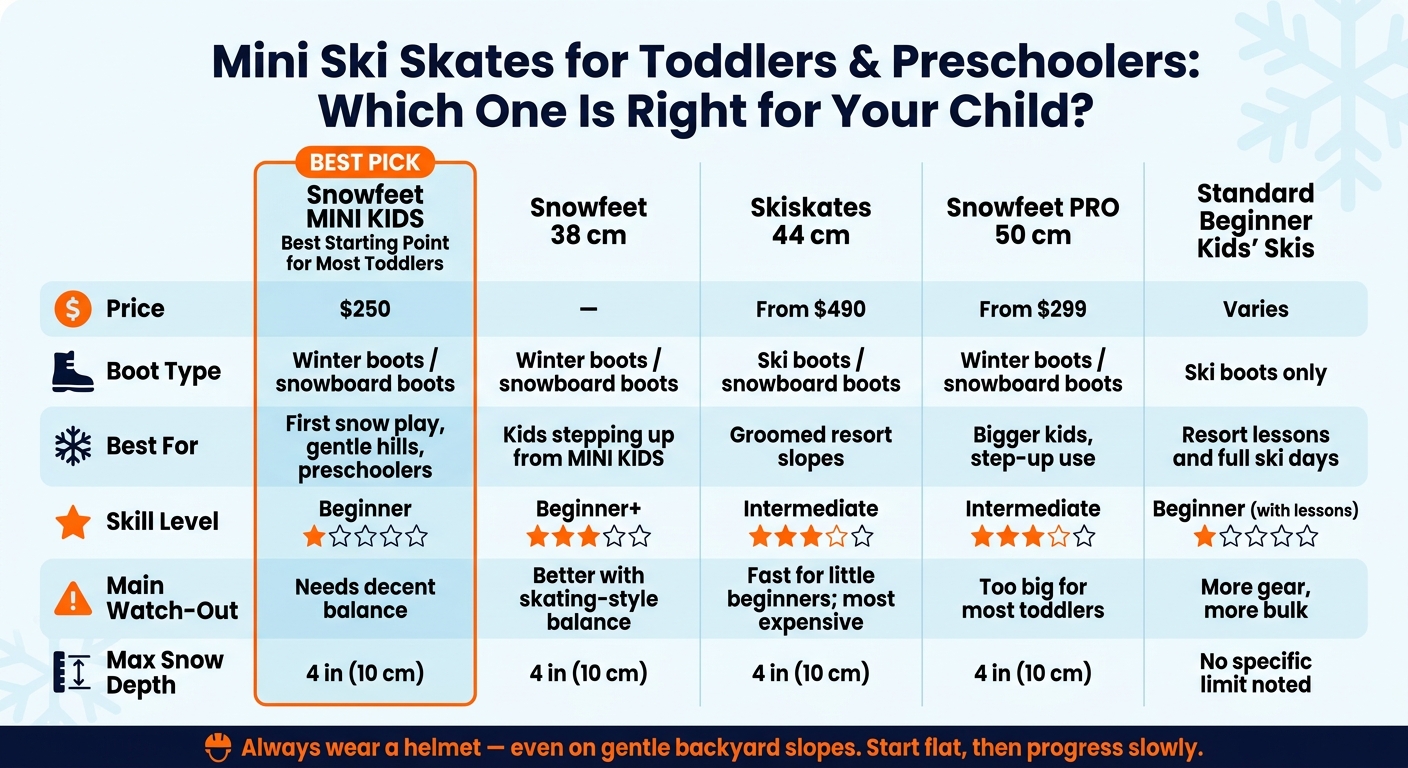
Mini Ski Skates for Toddlers: Side-by-Side Comparison Guide
| Option | Price | Boots | Best For | Main Watch-Out |
|---|---|---|---|---|
| Snowfeet* MINI KIDS | $250 | Winter boots / snowboard boots | First snow play, gentle hills, preschoolers | Needs decent balance |
| Snowfeet* 38 cm | - | Winter boots / snowboard boots | Kids stepping up from MINI KIDS | Better with skating-style balance |
| Skiskates 44 cm | From $490 | Ski boots / snowboard boots | Groomed resort slopes | Fast for little beginners |
| Snowfeet* PRO 50 cm | From $299 | Winter boots / snowboard boots | Bigger kids, step-up use | Too big for most toddlers |
| Beginner kids’ skis | Varies | Ski boots only | Resort lessons and full ski days | More gear, more bulk |
My take? Start simple. If your child can stand, listen, and glide a little, MINI KIDS makes the most sense for day one. If not, it may be smarter to wait a season than force it. A happy 20-minute snow session beats a one-hour meltdown every time :)
For a quick look at mini ski skates in action, here are a few YouTube links you can check before you buy:
So, if you want the short version: pick the shortest, simplest setup your child can handle well, and keep them on flat or very mellow packed snow first.
1. Snowfeet* MINI KIDS
Age and Readiness
Snowfeet* MINI KIDS fits U.S. Kids' shoe sizes 10 through U.S. Adult 6 (EU 27–38), so it covers a pretty big range for small feet. For most toddlers and preschoolers, this is the most forgiving place to start in the lineup. It’s a good match for kids who can stand, keep their balance, and have fun with short glides.
Boot Compatibility
It works with waterproof winter boots, hiking boots, and snowboard boots, though stiff ankle support gives kids better stability. Snowboard boots in EU 27–33 fit best. Larger shells can be too wide for the bindings, which adjust with straps and a screwdriver.
Stability and Control
Once you dial in the fit, control is the big selling point. The MINI KIDS comes with stainless steel edges for better control and an integrated heel brake for stopping. That heel brake gives beginners a simple way to slow down, and the short design is easier to handle during a fall.
Best Terrain
This model works best on groomed snow, gentle slopes, and backyard snow play. It doesn’t do well in more than about 4 inches of snow (10 cm). One nice bonus: it fits in a regular backpack.
For kids who are ready for a bit more glide, the 38 cm model is the next step up.
2. Snowfeet* 38 cm
Age and Readiness
The 38 cm model is a nice next step for kids who already have solid balance on ice skates or inline skates. It feels more like skating on snow than skiing, so that jump tends to feel natural for kids with that kind of background.
Boot Compatibility
You can use it with waterproof winter boots, hiking boots, and snowboard boots. No ski boots needed. The strap-on bindings can be adjusted at home with a screwdriver, which is handy if you want to get the fit dialed in before heading out.
Stability and Control
The 38 cm model uses reinforced composite and stainless steel edges for carving. It also has an integrated heel brake for stopping. Since it's shorter than long skis, falls are usually easier to handle, which can take some stress out of the learning phase.
Parents often say it feels sturdy and that kids pick it up fast.
Best Terrain
This model works best on:
- Groomed slopes
- Sledding hills
- Packed trails
Skip deep snow over 4 inches (10 cm), or it'll feel like trying to skate through mashed potatoes.
For kids who are ready for more speed and resort riding, the next step is Skiskates 44 cm.
3. Snowfeet* Skiskates 44 cm
If the 38 cm model feels a bit too simple, Skiskates 44 cm give kids more speed and better control at the resort.
Age and Readiness
Skiskates 44 cm are best for kids who already have strong balance from ice skating, inline skating, or hockey. They’re less forgiving than the MINI KIDS or 38 cm models. So, for most first-time toddlers, this isn’t the easiest place to start. Out of the mini options covered here, this one is the most focused on performance and the least friendly for beginners.
Boot Compatibility
These need ski boots or snowboard boots, not regular winter boots. The bindings can be adjusted for smaller boots using the strap holes and a screwdriver.
Stability and Control
The wood-core build and steel edges help with grip on packed snow and ice. A firm ankle hold gives kids more control and makes quick stops easier to learn.
Best Terrain
These work best on groomed slopes and ski resort terrain, not for messing around in the backyard or riding through loose snow. It’s smart to skip deep powder over 4 inches (10 cm) and steep, uneven terrain.
Starting at $490, the Skiskates 44 cm are the most performance-focused option in this lineup for resort riding.
For older kids who want a longer, more stable ride, the next step is the PRO 50 cm.
sbb-itb-17ade95
4. Snowfeet* PRO 50 cm
If a kid has outgrown the 44 cm Skiskates, the PRO 50 cm is the next step up. It’s a step-up model, not a toddler starter.
Age and Readiness
The PRO 50 cm fits U.S. adult sizes 4.5–14.5 (EU 36–49), so it’s too big for toddlers and preschoolers. If your child is still wearing kids’ shoe sizes, MINI KIDS is still the better match.
Boot Compatibility
The PRO 50 cm works with waterproof winter boots or snowboard boots that give firm ankle support. That extra support helps with control, which matters a lot once kids start going a bit faster.
Stability and Control
The longer platform gives more front-to-back stability, so it’s easier to stay balanced on groomed snow. It also has steel edges for carving on packed snow and ice, plus an integrated heel brake for slowing down and stopping.
Kids with skating or hockey experience will usually get the hang of it faster. So, this model makes more sense as a stability comparison point than as the main pick for very young beginners.
Best Terrain
The PRO 50 cm works best on:
- Groomed snow
- Resort slopes
- Packed trails
- Sledding hills
It’s not recommended for snow deeper than 4 inches (10 cm) or for steep, ungroomed slopes with bumps and holes. Starting at $299, it’s one of the lower-cost options in the longer Snowfeet* lineup.
Next, compare these mini ski skates with standard beginner kids' skis.
5. Standard Beginner Kids' Skis
Standard beginner kids' skis are often the default pick for families who already own ski boots, bindings, and spend their time on resort slopes. That said, for a very young beginner, it’s fair to ask if all that extra gear is worth it.
Age and Readiness
For the youngest kids, standard skis can feel a bit steadier because there’s more length under each foot. If a toddler is still small or a little shaky, that longer platform can help with balance.
Boot Compatibility
Standard skis need ski boots and bindings. Snowfeet don’t, which can save money and cut down on gear.
Stability and Control
Traditional kids' skis give more front-to-back stability. That can help very young children feel less tippy while they learn to stand, slide, and get a feel for the snow.
Best Terrain
Standard beginner skis make the most sense if your family is already geared up for a full day at the resort with ski boots and bindings. That tradeoff sets up the next section, where fit, safety, and family use start to shape the better pick.
Fit, Safety, and Family Use: How Each Option Compares
After looking at each model, the pick comes down to four things: your child’s age, the boots they’ll wear, how much stability they need, and where they’ll use it. This table gives you the fast version, then the notes below help sort out what works best for first-time toddlers.
| Product | Best Fit | Boot Compatibility | Control | Best Use |
|---|---|---|---|---|
| Snowfeet MINI KIDS | Toddlers/preschoolers | Winter boots or snowboard boots | Low; best for kids who already have balance | Backyards, sledding hills, groomed slopes |
| Snowfeet 38 cm | Older kids/adults | Winter boots or snowboard boots | Low; best for kids with skating or inline experience | Trails, groomed slopes |
| Skiskates 44 cm | Kids/adults | Ski boots or snowboard boots | Moderate; better grip and edge hold | Ski resort slopes |
| Snowfeet PRO 50 cm | Kids/adults | Winter boots or snowboard boots | Moderate; more front-to-back stability | Slopes, snow parks, trails |
| Standard Beginner Skis | Toddlers only if already ready for ski boots and lessons | Dedicated ski boots only | High; longest platform and most traditional feel | Resort runs, lessons |
Snowfeet MINI KIDS is the most practical pick for young children. The big reason is simple: it works with winter boots, so it’s the easiest way to get little kids started. That alone can save a lot of hassle when you’re dealing with a toddler who’s half dressed, one glove off, and already eyeing the snack bag.
It also has a heel brake, which gives beginners a simple way to slow down. The short design is more forgiving in falls too, so it makes the most sense for first-time snow play on flat ground or very gentle slopes. If a child already has better balance, Snowfeet 38 cm is the next move up.
Like MINI KIDS, the 38 cm model uses the same boot-friendly setup, but it fits older, more coordinated riders better. Snowfeet PRO 50 cm follows the same idea, but the longer base adds more front-to-back stability for kids moving toward resort terrain. If your family wants more stability than Skiskates but still likes the compact feel, PRO 50 cm lands in that middle zone.
Skiskates 44 cm leans the most toward resort use, and it needs ski or snowboard boots. Its wood core and steel edges give it better grip and control on packed snow, but for first-time toddlers, it’s the least forgiving option.
Standard beginner skis make more sense if your family is already doing ski-school lessons or spending full days on resort runs. They give the most front-to-back stability, but they also ask for more gear and a bigger time commitment. That tradeoff matters. For some families, it’s perfect. For others, it’s a lot on day one.
On the safety side, keep it simple and strict:
- Put a helmet on your child every time, even on a mellow backyard slope.
- Start on flat ground or a very gentle slope before trying any resort run.
- Teach the heel brake first, then bring in the hockey-stop technique as confidence builds.
One more thing: all five options work best on packed snow. Deep powder over 4 inches is a bad match for all of them.
Pros and Cons of Each Option
For parents, this choice comes down to one thing: the easiest way to get boots on and start sliding or a setup that feels more like skiing on groomed slopes.
| Option | Best Advantages | Main Drawbacks | Best For |
|---|---|---|---|
| Snowfeet MINI KIDS | Works with regular winter boots; integrated heel brake; ultra-lightweight | Struggles in deep powder (over 4 in); requires front-back balance | True beginners, toddlers, gentle slopes |
| Snowfeet 38 cm | Metal edges for ice control; works with winter boots; compact fit | Better for kids with skating balance; not ideal for very steep terrain | Kids with some skating experience; groomed trails and sledding hills |
| Snowfeet PRO 50 cm | More stable than MINI KIDS; metal edges for ice control; works with winter boots | Less forgiving than MINI KIDS; not for deep powder | Kids with skating experience moving toward resort terrain |
| Skiskates 44 cm | Best edge grip on packed snow; designed for groomed resort slopes | Requires ski or snowboard boots; too fast for most preschoolers; most expensive in this group | Older kids or confident beginners on groomed slopes |
| Standard Beginner Kids' Skis | Highest stability; longest platform; most traditional feel | Heavy; requires dedicated ski boots; more awkward to carry | Families doing full resort days with lessons |
Snowfeet MINI KIDS is the easiest pick for toddlers. It works with regular winter boots, has a heel brake, and stays light for short sessions on mellow snow. That makes it a nice match for first-timers and backyard fun.
Skiskates 44 cm are a better fit for kids who already feel steady and want to ride groomed slopes. They offer the best edge grip on packed snow, but there’s a catch: they need ski or snowboard boots, and they move faster than the other Snowfeet options. For most preschoolers, that’s a lot of machine.
If your family already has ski boots and plans to book lessons, standard beginner kids' skis still make sense. They give kids the most stability and the longest platform underfoot. But they’re also heavier, need dedicated boots, and add more gear to carry from the parking lot to the lift. That setup fits full resort days better than casual play in the yard or at the local hill.
That tradeoff is a big reason Snowfeet works so well for casual young beginners. It keeps things simple, light, and less of a production for families who just want to get outside and have some fun.
Conclusion
After looking at fit, boots, and terrain, the pick is pretty clear: for most toddlers and preschoolers, Snowfeet MINI KIDS ($250) is the best place to start. They’re light, easy to handle, work with winter boots, and make sense for backyard snow and mellow slopes. Step up to PRO 50 cm ($299+) when your child’s balance gets better. Go with Skiskates 44 cm if your kid is more confident and already using ski or snowboard boots.
The main thing to watch is readiness. Mini ski skates are a good match for kids who can already balance well and follow simple directions. If that’s not there yet, it’s smart to wait a season.
Before heading out, set the bindings at home with the exact boots your child will wear. That small step can save you a lot of hassle once you’re out in the snow.
Bottom line: Snowfeet MINI KIDS is the best choice for most young beginners; choose longer models only when the child is ready for more speed and control.
FAQs
How do I know if my child is ready for mini ski skates?
Readiness has a lot more to do with balance, coordination, and feeling okay on snow than with age.
A child may be ready if they can:
- walk, run, and stand without wobbling in winter boots
- follow simple instructions
- show interest in playing in the snow
For very young beginners, Snowfeet MINI KIDS are the safest pick for casual, supervised use on gentle slopes or small backyard hills. Start with a properly fitted helmet, and keep them within arm’s reach at first.
Can my child use mini ski skates with regular winter boots?
Yes. Models like Snowfeet MINI KIDS work with regular waterproof winter boots, so you can skip ski boots.
For the best fit, pick boots that are:
- insulated
- waterproof
- snug
- supportive around the ankle
Try to avoid boots with very soft, bendy soles. A firmer boot gives kids better control and more stable footing.
Are mini ski skates or beginner skis better for a first snow day?
Yes. Mini ski skates are often a better pick for a first snow day than long skis. They’re shorter, lighter, and easier to turn, so beginners can dodge a lot of the usual first-day headaches.
Snowfeet models like MINI KIDS (38 cm) clip onto regular winter boots. That means kids can spend more time working on balance and sliding, and less time dealing with big, clunky gear. Traditional skis still make more sense for formal lessons and long-term alpine progress.











Zanechte komentář
Tento web je chráněn službou hCaptcha a vztahují se na něj Zásady ochrany osobních údajů a Podmínky služby společnosti hCaptcha.