






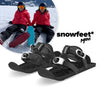













Skiboards are changing the game for winter sports in 2026. These short, twin-tipped boards (also called skiblades or snowblades) combine the best of skiing, snowboarding, and even skating. They’re easier to control, quicker to learn, and more portable than traditional skis or snowboards - perfect for beginners who want to enjoy the slopes without the steep learning curve.
Here’s why skiboards might be your next favorite winter gear:
- Easy to Learn: Most people feel comfortable after just 1–2 runs.
- Compact and Portable: Sizes range from 26–55 inches, making them lighter and easier to carry than traditional skis or snowboards.
- Beginner-Friendly: Their short length and wide base provide better balance and control, even on steep slopes or powder.
- Compatible Gear: Works with ski or snowboard boots, so no need to buy special footwear.
- Affordable Options: Prices start around $520 for top brands like Snowfeet*, which also offers adjustable bindings and durable wood-core construction.
Want to get started? Snowfeet* offers three main sizes to match your style:
- 65 cm: Great for tricks and quick turns.
- 99 cm: A versatile choice for carving and powder.
- 120 cm: Ideal for beginners seeking stability and confidence.
Whether you’re a skater, snowboarder, or total newbie, skiboards make it fun and easy to hit the slopes. Plus, they’re low-maintenance and built to last. Ready to give them a try? Let’s dive into the details.
Snowfeet* Snowblades | Skiboards | Skiblades | Short Skis - Complete Guide | All you need to know
Skiboards vs. Traditional Skis and Snowboards
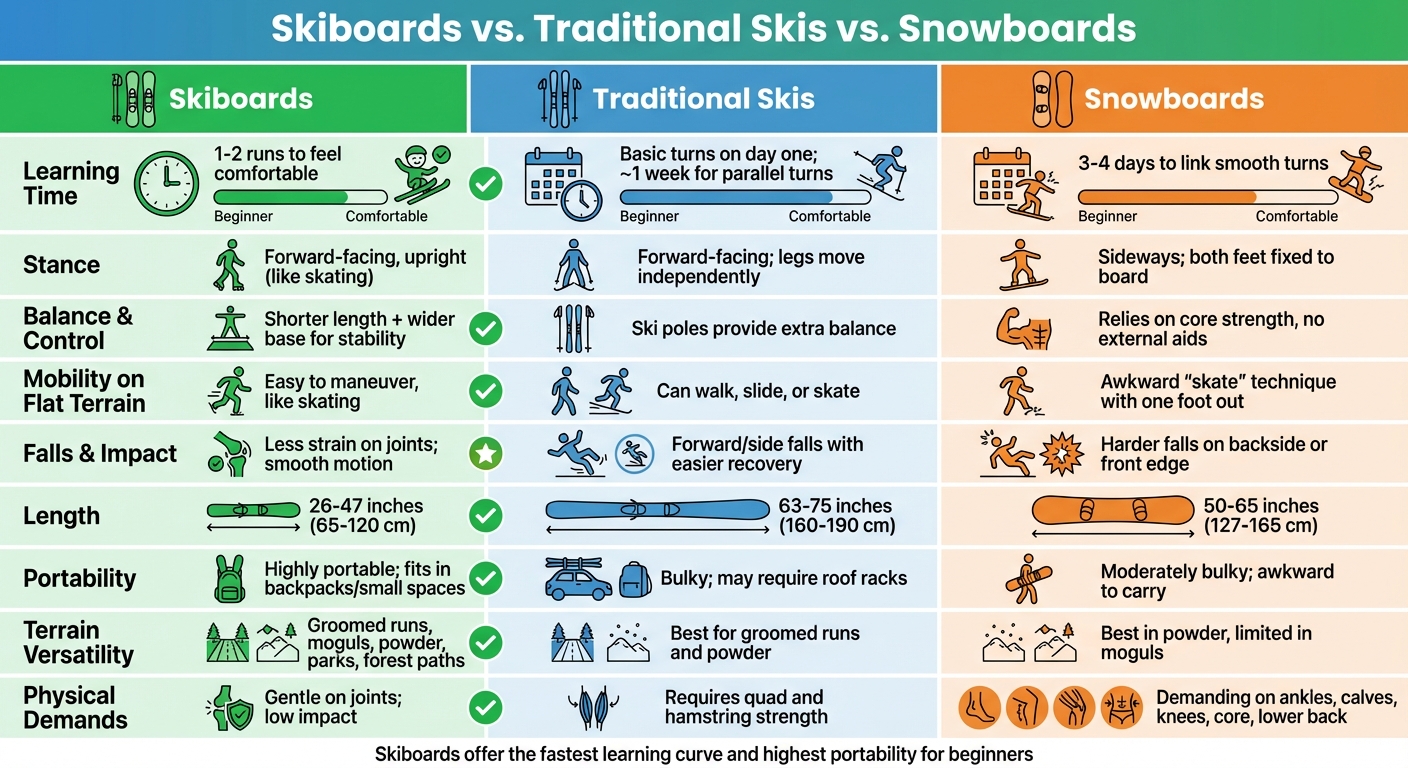
Skiboards vs Traditional Skis vs Snowboards: Complete Comparison Guide
Learning Curve: Skiboards vs. Skis vs. Snowboards
Skiboards are a game-changer when it comes to learning. Most people feel comfortable riding them after just 1–2 runs. Compare that to traditional skiing, where your first day is all about mastering the snowplow technique. Progressing to smooth, linked parallel turns typically takes about a week. Snowboarding, on the other hand, can be a bit tougher at the start. The sideways stance and unified leg movement often lead to some hard falls early on. But once you get the hang of it, many riders can link smooth turns within three to four days.
So, why are skiboards so beginner-friendly? It boils down to their design. Their shorter length and wider base make balancing, turning, and stopping feel intuitive right from the start. Plus, the forward-facing stance feels natural, especially for anyone with experience in rollerblading, ice skating, hockey, or even dancing. Traditional skis also offer a forward stance, but they require more leg strength and coordination with ski poles. Snowboards demand even more from your core and legs, which can make the learning curve a bit steeper.
Now, let’s see how skiboards stack up when it comes to portability.
Portability and Convenience
If you’ve ever lugged traditional skis or a snowboard around, you know it’s no picnic. This is where skiboards truly shine. With lengths ranging from 26 to 47 inches, Snowfeet* skiboards are much shorter and lighter than traditional skis (63–75 inches) or snowboards (50–65 inches). Their compact size makes them easy to stash in a car trunk, closet, or even bring along on public transportation. And since many skiboards don’t require poles, you’re carrying less gear overall. That’s a huge plus when you’re navigating crowded ski lodges or parking lots.
Traditional skis and snowboards, by contrast, can be a hassle to transport. Fitting 75-inch skis into a sedan or lugging a snowboard through an airport often feels like a logistical puzzle. Skiboards eliminate all that stress, making last-minute trips to the mountains so much easier. Here’s a quick look at how they compare:
Comparison Table: Skiboards, Traditional Skis, and Snowboards
| Feature | Skiboards | Traditional Skis | Snowboards |
|---|---|---|---|
| Learning Time | 1–2 runs to feel comfortable | Basic turns on day one; about a week for parallel turns | 3–4 days to link smooth turns |
| Stance | Forward-facing, upright (like skating) | Forward-facing; legs move independently | Sideways; both feet fixed to the board |
| Balance & Control | Shorter length and wider base for stability | Ski poles provide extra balance | Relies on core strength with no external aids |
| Mobility on Flat Terrain | Easy to maneuver, like skating | Can walk, slide, or skate | Requires an awkward "skate" technique with one foot out |
| Falls & Impact | Less strain on joints; smooth motion | Typically results in forward or side falls with easier recovery | Often involves harder falls on the backside or front edge |
| Length | 26–47 inches (65–120 cm) | 63–75 inches (160–190 cm) | 50–65 inches (127–165 cm) |
| Portability | Highly portable; fits in backpacks or small spaces | Bulky; may require roof racks or large storage | Moderately bulky; can be awkward to carry |
| Terrain Versatility | Excels on groomed runs, moguls, powder, parks, and forest paths | Best suited for groomed runs and powder | Generally performs best in powder, with limited versatility in moguls |
| Physical Demands | Gentle on joints; low impact | Requires significant quad and hamstring strength | Demanding on ankles, calves, knees, core, and lower back |
How to Choose the Right Snowfeet* Skiboards
Sizing Guide: Length and Intended Use
The length of your skiboards plays a big role in how they handle on the slopes. Snowfeet* offers three main lengths - 26 inches (65 cm), 39 inches (99 cm), and 47 inches (120 cm) - each suited for different riding preferences.
- 65 cm skiboards: These are all about agility. Perfect for tricks, quick turns, and tackling moguls. Skaters, hockey players, or kids learning balance will feel right at home with these.
- 99 cm skiboards: A great mix of agility and stability. These are versatile enough for carving, powder, or even hitting the terrain park.
- 120 cm skiboards: Designed for extra stability, these are ideal for beginners who want to explore powder and carving with confidence.
Snowfeet* Models Overview
After choosing the right length, it's time to pick the model that best matches your style. Snowfeet* offers a variety of skiboards, all designed with beginners in mind but versatile enough for different skill levels.
- Snowfeet Skiblades 65 cm*: Starting at $635, these skiboards accommodate ski or snowboard boots and boast a perfect 5.0/5 rating. Made with fiberglass-reinforced material, they're built to last.
- Snowfeet Skiblades 99 cm*: Also starting at $675, this model works with ski and snowboard boots. Its 5.0/5 rating highlights its versatility for carving, powder, and jumps.
- Snowfeet POWDER 99 cm*: Specifically designed for powder, this $675 model offers the float and control needed for deeper snow while maintaining a compact length.
- Snowfeet Short Skis 120 cm*: At $775, these require ski boots for proper support and provide extra stability with a more traditional skiing experience. They're also easier to transport than standard skis.
Matching Skiboards to Your Background and Goals
Your experience and goals can guide you to the best model for your needs. Snowfeet* skiboards are built to be welcoming for beginners while offering plenty of fun for seasoned riders.
- Skaters, rollerbladers, and hockey players: The 65 cm models will feel intuitive thanks to their familiar motion.
- Complete beginners: The 120 cm skiboards are a great choice for stability and support, while the 99 cm models offer a beginner-friendly platform that also allows for growth into tricks and freestyle.
- Snowboarders: If you're looking to try something new, the 65 cm or 99 cm skiboards with snowboard boot bindings let you enjoy the comfort of your boots while exploring the benefits of a forward-facing stance and independent leg movement.
- Carving and speed enthusiasts: The 99 cm or 120 cm models provide the stability and edge control needed for faster runs. For powder, the 99 cm POWDER model or the 120 cm skiboards will help you stay afloat in deeper snow.
With over 50,000 riders worldwide and recognition from prestigious organizations like ISPO and the A'design competition, Snowfeet* skiboards have proven their reliability on the slopes.
sbb-itb-17ade95
Beginner Setup: Gear, Techniques, and Safety Tips
Boots, Bindings, and Protective Gear
Getting started with Snowfeet* skiboards is all about choosing the right gear to match your setup. The great thing? Snowfeet* skiboards work with standard ski or snowboard boots, making it easy to transition. For instance, the 65 cm and 99 cm models are compatible with both ski and snowboard boots, while the 120 cm Short Skis are designed specifically for ski boots, offering extra support. This flexibility means you don’t need to buy special boots if you already have ski or snowboard gear.
Don’t skimp on protective gear. Always wear a helmet and goggles, and consider wrist guards for added protection. Secure gloves are a must, and layering your clothing will help you stay comfortable. Plus, safety leashes are non-negotiable - they keep your skiboards in check if they come off.
First Day Techniques for Beginners
Start slow. Gentle slopes are your best friend as you learn the basics of balance, turning, and stopping. Thanks to the compact design of Snowfeet* skiboards, these skills are easier to pick up compared to traditional skis . Their shorter length also makes chairlift rides a breeze - no awkward dangling skis to deal with. On the slopes, shifting your weight helps with smooth turns, and stopping is simple. You can either angle your skiboards into a wedge (the classic "pizza position") or use the built-in heel brake on Snowfeet* models. Take your time, build confidence, and only move to steeper slopes when you’re ready.
Staying Safe While Learning
One of the perks of Snowfeet* skiboards is that their shorter length helps reduce the impact of falls. But safety doesn’t stop there. Always follow resort rules and posted signs, stay in control, and give priority to others downhill. Mastering the basics now will set you up for a safer, more enjoyable experience as you tackle tougher runs later on.
Care, Maintenance, and Progression
Beyond mastering the slopes, keeping your Snowfeet* gear in great shape and knowing when to upgrade can make all the difference in your experience.
Simple Maintenance Tips
Taking care of your Snowfeet* skiboards doesn’t have to be complicated, but it’s important to keep them in top condition. After each session, dry the metal edges to avoid rust. If rust does show up, you can remove it with a steel brush. For long-term storage, give the edges a quick wipe with oil and apply a layer of universal or cold-snow wax to the base. To clean the base, melt kerosene wax, spread it evenly, and scrape off any debris with a plastic scraper. Keep those edges sharp by using a tuner or sharpening stone - don’t worry if you get a few small plastic nicks during tuning; they won’t impact performance. A little consistent care goes a long way in helping you improve your skills.
Progressing with Snowfeet* Skiboards
Once you’ve nailed the basics, it’s time to level up. Start by fine-tuning your stance: keep your legs shoulder-width apart, bend your knees slightly, and center your weight over the middle or back of your feet. When you’re ready, move beyond simple turns and stops. Try out tricks, jumps, and twists in the snow park, learn to ride backward or spin, or challenge yourself with moguls and light powder.
Choosing the right model can make progression even smoother:
- The 65 cm model is ideal for tricks and park riding, offering a skate-like feel.
- The 99 cm skiboards shine in powder and parks, giving you deeper carving ability and more freedom of movement.
- For advanced riders, the 120 cm Short Skis deliver unmatched carving performance. Daniel Siouffi, after testing the 120 cm model, shared that he felt a new level of control and speed once he adjusted his weight distribution.
Stick with consistent practice, and you’ll be amazed at how quickly your skills improve.
When to Add or Upgrade Your Snowfeet* Setup
As you get better, you might find yourself wanting to explore different styles of riding or needing gear that matches your progression. Here’s when to think about adding to or upgrading your setup:
- For powder days, consider moving from the 65 cm model to the 99 cm POWDER model, starting at $675.
- For carving enthusiasts, the 120 cm Short Skis ($775) are a solid upgrade.
- Keep your 65 cm pair for park tricks, but add the 99 cm or 120 cm models for all-mountain adventures.
It’s also worth upgrading if your bindings start to loosen, edges wear down despite sharpening, or your riding style becomes more demanding. Having the right gear for the conditions and your skill level can make every run more fun and rewarding.
Conclusion: Why Snowfeet* Skiboards Are the Best Choice for Beginners
Let’s break it down - Snowfeet* skiboards are a game-changer for anyone new to winter sports. They take the stress out of learning by ditching the bulk of traditional skis or snowboards. With over 50,000 riders worldwide and a patented design that’s even snagged awards at ISPO, it’s clear Snowfeet* is all about making winter adventures accessible.
Forget lugging around long skis or a cumbersome snowboard. Snowfeet* skiboards are lightweight, portable, and compatible with your everyday winter or snowboard boots. No need to splurge on pricey, specialized gear. Just grab your skiboards, and you’re ready to hit the slopes. That ease of use is a big deal for beginners who want to dive in without overcomplicating things.
What really sets Snowfeet* apart is their versatility. Whether you’re cruising groomed slopes, hitting the snow park, trekking through trails, or even playing around in your backyard, these skiboards have you covered. The 65 cm model is perfect for those who love a skate-like feel and want to try tricks, while the 99 cm model is built for powder and all-mountain adventures. It’s a setup that grows with you, helping you move from beginner to advanced at your own pace. As pro skater Logan (@xskyskaterx) put it:
"I can rip all of my inline tricks on these! Boxes and jumps and spins are all fresh and new but familiar enough to learn without bailing too much! Honestly this is my snow sport. I really can't see myself picking up skis ever again."
Another bonus? The compact design of Snowfeet* skiboards helps soften falls, making the learning curve feel less intimidating. With over 2,200 reviews and a glowing 90% positive rating, it’s clear that beginners love how easy and fun these skiboards make the experience. Whether you’re carving a perfect turn, mastering a trick, or just exploring the snow in your own way, Snowfeet* skiboards let you enjoy the ride from day one. Ready to step up your winter game? Snowfeet* is where the fun begins.
FAQs
Why are skiboards easier for beginners to learn compared to traditional skis or snowboards?
Skiboards are a great option for beginners because their shorter length and wider shape make them easier to control and more stable. This design helps new riders feel more balanced and pick up the basics faster. Unlike traditional skis or snowboards, skiboards let you stand in a natural, skating-like position, making it easier to turn and carve without needing tons of practice.
If you’ve ever tried skating or rollerblading, you’ll probably find skiboards - like Snowfeet Skiblades - to be second nature. They feel familiar, which can quickly boost your confidence on the slopes. Plus, their compact size makes them less intimidating, so they’re perfect for anyone just starting out in snow sports.
How do I pick the best Snowfeet skiboards for my height, weight, and skill level?
Choosing the right pair of Snowfeet skiboards comes down to a few key factors: your height, weight, skill level, and where you plan to ride. If you're just starting out, skiboards in the 65 cm to 99 cm range are a great pick. They’re easy to control and let you maneuver quickly - perfect for building confidence on the slopes. The 65 cm skiboards are especially good for beginners and freestyle tricks, while the 99 cm boards strike a nice balance between agility and stability.
For intermediate riders or anyone wanting a smoother experience on mixed terrain, the 120 cm skiboards are a solid option. They’re designed to handle varied conditions with ease.
Here’s a quick tip: shorter skiboards are your go-to for tight turns and maximum agility, while longer ones give you more stability, especially at higher speeds. Think about your riding style and what feels most comfortable for you. And if you're still on the fence, Snowfeet offers size recommendations to help you find your perfect match.
What safety gear do I need to start skiboarding?
When you're getting started with skiboards, having the right safety gear isn't just a good idea - it's a must. At the very least, grab a helmet to keep your head safe, wrist guards to protect your wrists during tumbles, and a tailbone protector to cushion your lower back.
This gear is particularly important for beginners. Skiboards are super responsive, making sharp turns and quick moves easier than traditional skis or snowboards. But that also means falls can catch you off guard. Wearing proper safety equipment not only keeps you safe but also helps you feel more confident, so you can focus on having fun instead of worrying about injuries.












Leave a comment
This site is protected by hCaptcha and the hCaptcha Privacy Policy and Terms of Service apply.