




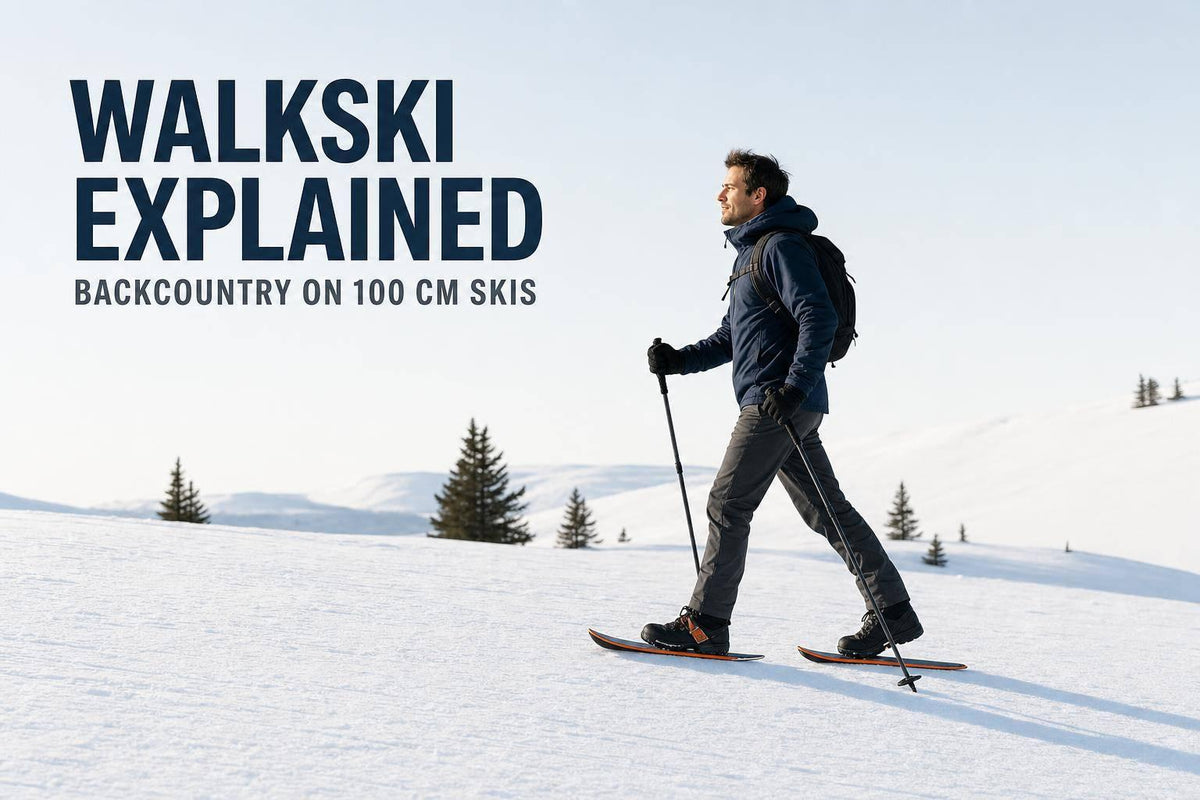
If you want a simple way to hike up and ski down without hauling a full touring kit, 100 cm WALKSKI makes sense. I’d sum it up like this: it’s lighter on gear, easier to carry, works with more boot types, and fits mellow winter days far better than steep, deep backcountry missions.
Here’s the short version:
- Weight: 6.9 lb per pair (3,116 g)
- Price: starts at $595
- Boots: works with winter boots, snowboard boots, and ski boots
- Best for: forest roads, park trails, cabin access, short tours, low-angle snow
- Main tradeoff: less float and less stability than full-length touring skis
- Best alternative: full touring skis still win for deep powder, long descents, and steep terrain
So, if you want one setup for the whole outing, this format is a neat middle ground between snowshoes and a full backcountry ski setup. It won’t replace a 160–190 cm touring ski for big mountain days. But for casual days out? It checks a lot of boxes without turning your trunk into a gear shop :)
Quick Comparison
| Feature | WALKSKI 100 cm | Full-Length Touring Skis |
|---|---|---|
| Length | 100 cm | 160–190 cm |
| Price | From $595 | About $2,200 |
| Weight/Carry | Easier to pack and strap on | Bulkier to carry |
| Boots | Winter, snowboard, or ski boots | AT boots in most cases |
| Uphill feel | Free-heel, hike-like movement | Better for long climbs |
| Downhill feel | Short turns, skid control | More stable on long runs |
| Best snow | Packed snow, mixed terrain | Deep snow, steep lines |
I’d look at WALKSKI as a fun, low-fuss tool for normal winter outings - not a powder weapon. That’s the whole story in one line.
How Snowfeet* WALKSKI Performs Going Up and Coming Down
Going Up: Skins, Stride, and Free-Heel Movement
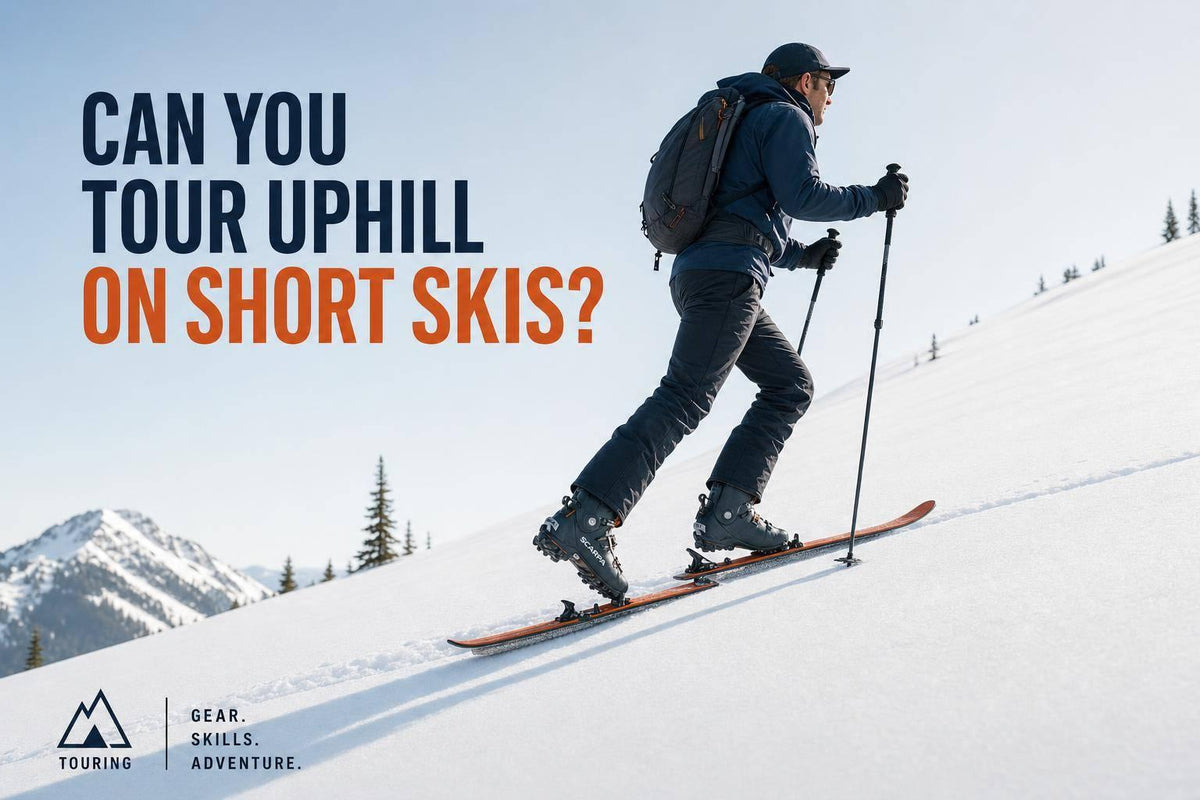
Climbing with WALKSKI uses skins for grip and a free-heel binding, so the motion feels a lot like hiking. In Walk mode, your heel moves freely. That gives you a more natural stride than a locked touring setup.
For moderate slopes, use Climb 1 with the low riser. When the pitch gets steeper, or you’re crossing a slope on a traverse, switch to Climb 2 with the high riser. That helps take some strain off your calves.
The short ski length also helps in tight spots. On narrow trails and switchbacks, WALKSKI are easier to pivot and place where you want them.
On the way down, that same short and light setup gives the skis a very different feel underfoot.
Coming Down: Short Turns and Controlled Descents
Before you drop in, switch to Ski mode and take off the skins. From there, WALKSKI feel like short skis made for quick pivots, fast edge changes, and controlled skids. Speed control comes less from long carving arcs and more from skidding sideways or linking short, quick turns.
That style works best on:
- Gentle hills
- Packed forest roads
- Short descents between flatter sections
There’s a tradeoff, of course. In deep powder and on long descents, shorter skis lose some flotation and feel less steady at higher speeds.
That’s why the 100 cm format fits mellow tours and mixed winter days so well.
How the 100 cm Length Changes the Experience
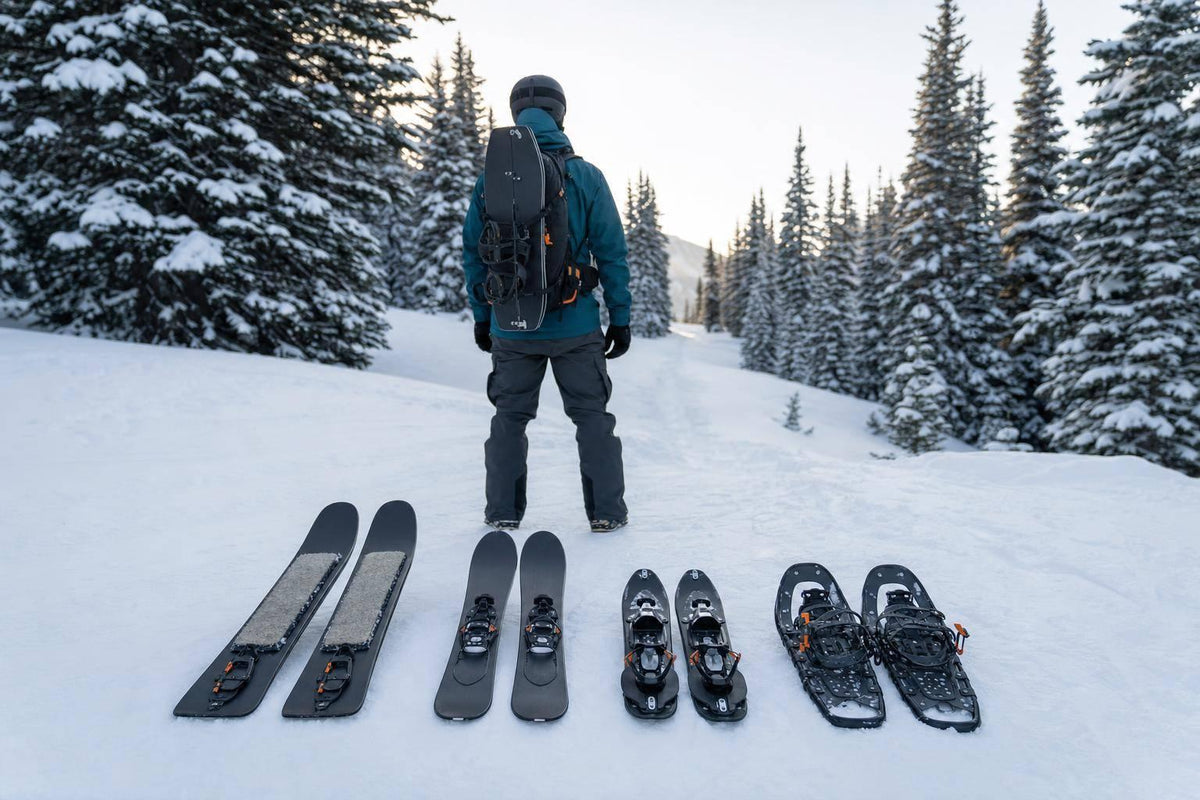
The 100 cm size is easy to strap to a pack, which is nice when you don’t want your gear fighting you every step of the way. It also feels easier to handle on mixed snow.
On approaches and thin-snow sections, the shorter length cuts down on bulk. Just as important, you don’t have to swap gear mid-outing to keep moving.
Next comes the big question: who gets the most out of that tradeoff?
Who WALKSKI Is Best For and Where It Works Well
Best For Travelers, Hikers, and Casual Winter Explorers
WALKSKI makes the most sense for riders who want touring mobility without dealing with a full ski setup. It’s built for people who want to move through snowy ground without dragging along extra gear, like travelers on road trips or weekend cabin stays, hikers who spend time on snow-covered forest roads, and casual winter explorers who want a simpler day out.
The biggest plus in day-to-day use is boot compatibility. WALKSKI's universal binding works with winter boots, snowboard boots, and ski boots, covering boot sole lengths from roughly 9.5 to 15 inches. That’s a big deal. Most users can skip AT boots, which cuts out one of the main hurdles to trying this kind of winter travel.
And that simple setup matters most on short, low-commitment outings. You can get out, move around, and not feel like you packed for an alpine expedition just to stroll through the snow.
Best Terrain: Mellow Tours, Packed Snow, and Short Descents
On snow, that flexibility pays off most on short approaches and mixed terrain. WALKSKI works best where maneuverability matters more than top speed. Think forest roads, packed park trails, frozen lake approaches, and uneven low-angle snow.
On firm or packed snow, the 100 cm length makes quick direction changes and tight pivots easy. That helps a lot on narrow paths where longer skis can feel clunky, like trying to park a long truck in a tiny city spot.
In U.S. settings - state park trails, multi-use greenways, golf courses, and cabin access roads - this is exactly the kind of mellow, low-risk terrain where WALKSKI stands out.
When to Choose Full-Length Touring Skis Instead
WALKSKI does have limits. If your usual winter day means deep powder, long descents, steep objectives, or technical backcountry lines, full-length touring skis are the better pick.
Longer skis give you more flotation in deep snow, better edge hold on steep terrain, and more directional stability at speed. So, if you’re planning bigger mountain objectives and want stronger downhill performance, a standard touring setup still makes more sense.
That tradeoff leads straight into the comparison with full-length touring skis.
Snowfeet* WALKSKI Backcountry Touring Skis | 100 CM
sbb-itb-17ade95
WALKSKI vs Full-Length Backcountry Skis: A Direct Comparison
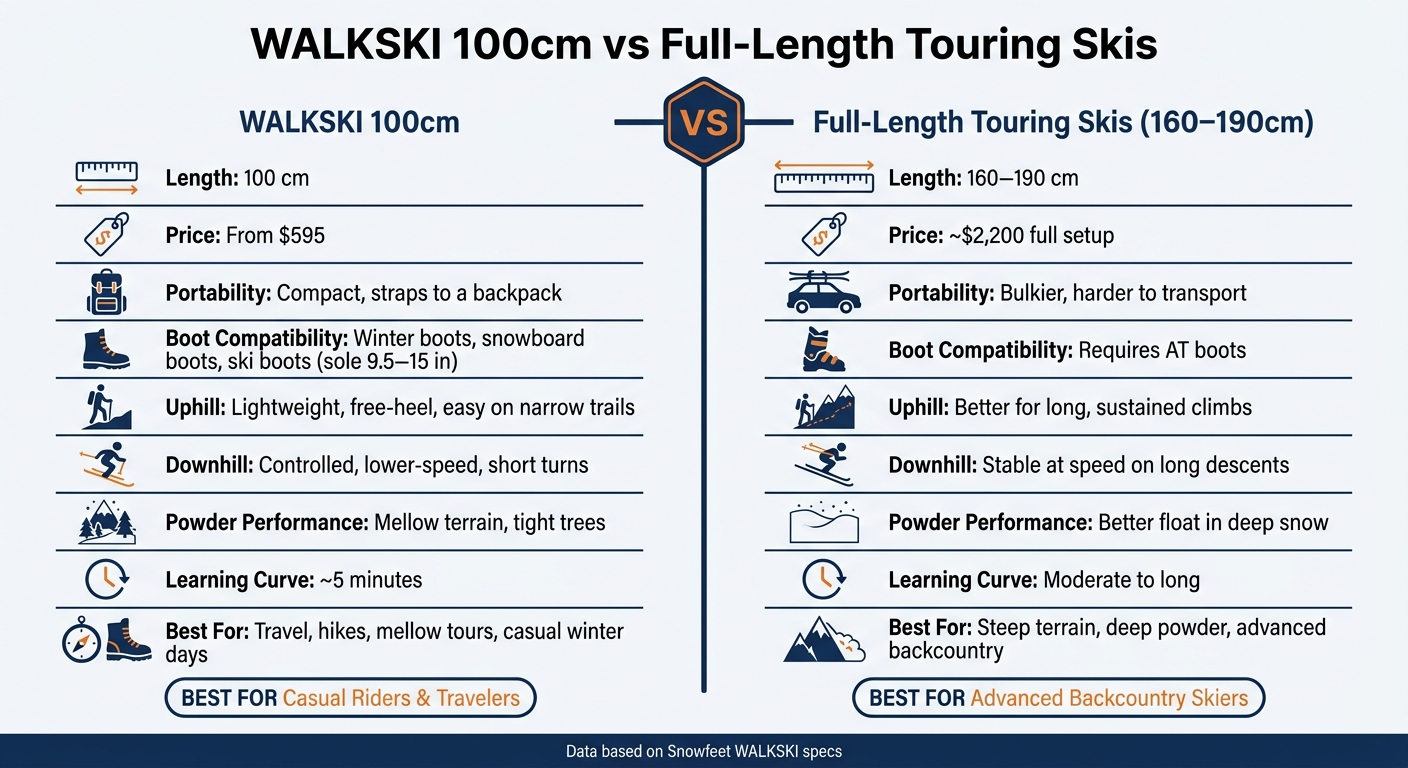
WALKSKI 100cm vs Full-Length Touring Skis: Side-by-Side Comparison
Now that the uphill and downhill feel is clear, here’s the straight tradeoff between WALKSKI and full-length touring skis.
WALKSKI and full-length touring skis solve the same problem in two different ways: easy carry and low hassle versus more stability and better float. For mixed-use winter days, the main question isn’t which one wins in perfect test conditions. It’s how much gear you want to haul around, and how much ski you’ll use. One leans toward convenience. The other leans toward speed, float, and edge hold.
| Feature | Snowfeet* WALKSKI (100 cm) | Full-Length Touring Skis (160–190 cm) |
|---|---|---|
| Length | 100 cm | 160–190 cm |
| Portability | Compact enough to strap to a backpack and easy to store | Takes more room for transport and storage |
| Boot Compatibility | Works with winter, snowboard, or ski boots | Requires specialized AT boots |
| Uphill Comfort | Lightweight and easy to maneuver on narrow trails | Better for long, sustained climbs |
| Downhill Stability | Best for controlled, lower-speed descents | More stable at speed on long descents |
| Powder Performance | Maneuverable in tight trees and mellow terrain | Better float in deep, unconsolidated snow |
| Learning Curve | Very short; marketed as a 5-minute learning curve | Moderate to long; requires technique practice |
| Price | From $595 | Around $2,200 for a full setup |
| Best Use Case | Travel, hikes, and mellow tours | Advanced peaks, steep terrain, deep powder |
That table lays it out pretty clearly. The next step is figuring out which one makes sense for how people ski in normal life, not just on dream powder days.
Where Snowfeet* WALKSKI Has the Edge for Most Casual Riders
WALKSKI removes a lot of setup friction. It works with regular winter, snowboard, or ski boots, and it starts at $595. That means casual riders can skip the big cost and extra gear that come with a full AT setup.
For travelers and occasional skiers, that matters a lot. If you’re heading out for short tours, mellow hills, or a fun day where you don’t want to wrestle with a pile of gear, WALKSKI makes the whole thing feel lighter and simpler. Less stuff. Less fuss. More time on snow.
Where Full-Length Touring Skis Still Win
Full-length skis are flat-out better in some cases. In deep powder, longer skis float better because they have more surface area. On steep terrain, they give you more edge hold and more stability when speed picks up.
So, if the plan is steep lines, deep snow, or long backcountry days, full touring skis still hold the lead. If the day is more about easy access, light travel, and mellow terrain, WALKSKI makes a lot more sense.
Next comes the setup basics: boots, bindings, and how to tell whether the 100 cm format fits your skiing.
Setup, Fit, and Buying Considerations
Boots, Bindings, and Fit Basics
After the performance tradeoff, fit is the next thing to sort out.
The good news: the WALKSKI uses a universal binding that clamps onto your boot. That means it works with winter boots, snowboard boots, and ski boots. You don’t need a special touring boot to get started.
Before you buy, check your boot sole length. WALKSKI fits soles in the 9.5–15-inch (24–38 cm) range.
If you plan to swap between two boot types, make life easier on yourself:
- Pre-set the strap lengths for each pair
- Mark the settings so you can change them fast in the cold
That little step can save a lot of fumbling when your fingers are half-frozen.
There’s one more thing to keep in mind. The WALKSKI binding is not a DIN-rated alpine binding. So, don’t think of it like a standard resort ski binding. It’s better viewed as a touring-focused system.
How to Decide If the 100 cm Format Is Right for You
Once fit is handled, the last piece is simple: does the 100 cm size match how you ski?
This format makes a lot of sense if your winter days look like this:
- Short approaches
- Mellow descents
- Narrow forest trails
- Easy transport in a car or ski bag
That’s where short skis can feel like a smart, low-fuss option.
On the flip side, if you’re headed for sustained descents above treeline, steep technical lines, or multi-day remote missions, full-length touring skis are the better tool. No way around it.
Price matters too. At $595, WALKSKI sits well below the cost of a full touring setup. For casual riders who head out a few times each season, that gap is tough to ignore.
Conclusion: When WALKSKI Makes the Most Sense
WALKSKI makes the most sense for travelers, hikers, and casual winter adventurers who want one compact setup for the climb and a fun, manageable way down. It works with boots you may already own, packs small enough to strap to a backpack, and costs far less than a full touring kit.
Less gear drama. More time on snow. :)
FAQs
Can beginners use WALKSKI?
Yes. Snowfeet WALKSKI* is a great pick for beginners.
Its 100 cm length is much easier to turn and control than long touring skis. That means it feels less intimidating right from the start. For a new rider, that matters a lot.
It also works with standard winter boots or snowboard boots. So you can skip the cost and hassle of specialized alpine touring gear.
Most new users feel confident within a few hours.
How does WALKSKI handle icy snow?
Snowfeet WALKSKI 100 cm does well on icy, uneven snow if you set it up right.
For better grip on hard, slick surfaces, trim the climbing skins so 5 to 7 mm of metal edge stays exposed on each side. That small gap matters more than you'd think. It lets the edge bite into the snow instead of getting covered up.
Nylon skins are also a good pick for traction on steep, icy slopes. And while longer skis can feel more planted in extreme conditions, WALKSKI stays nimble and responsive on mixed winter terrain.
Do I need poles with WALKSKI?
Yes, you should use poles with your WALKSKI. They help with balance and stability on snow, which matters a lot once the terrain gets uneven or a bit choppy.
Adjustable poles are the best pick. You can shorten them for uphill climbs, then lengthen them for descents. That small change makes a big difference.
Because WALKSKI is shorter and more agile, poles play a big part in helping you stay steady on mixed backcountry terrain. Think of them as your extra set of legs out there :)











留下評論
此網站已受到 hCaptcha 保護,且適用 hCaptcha 隱私政策以及服務條款。