




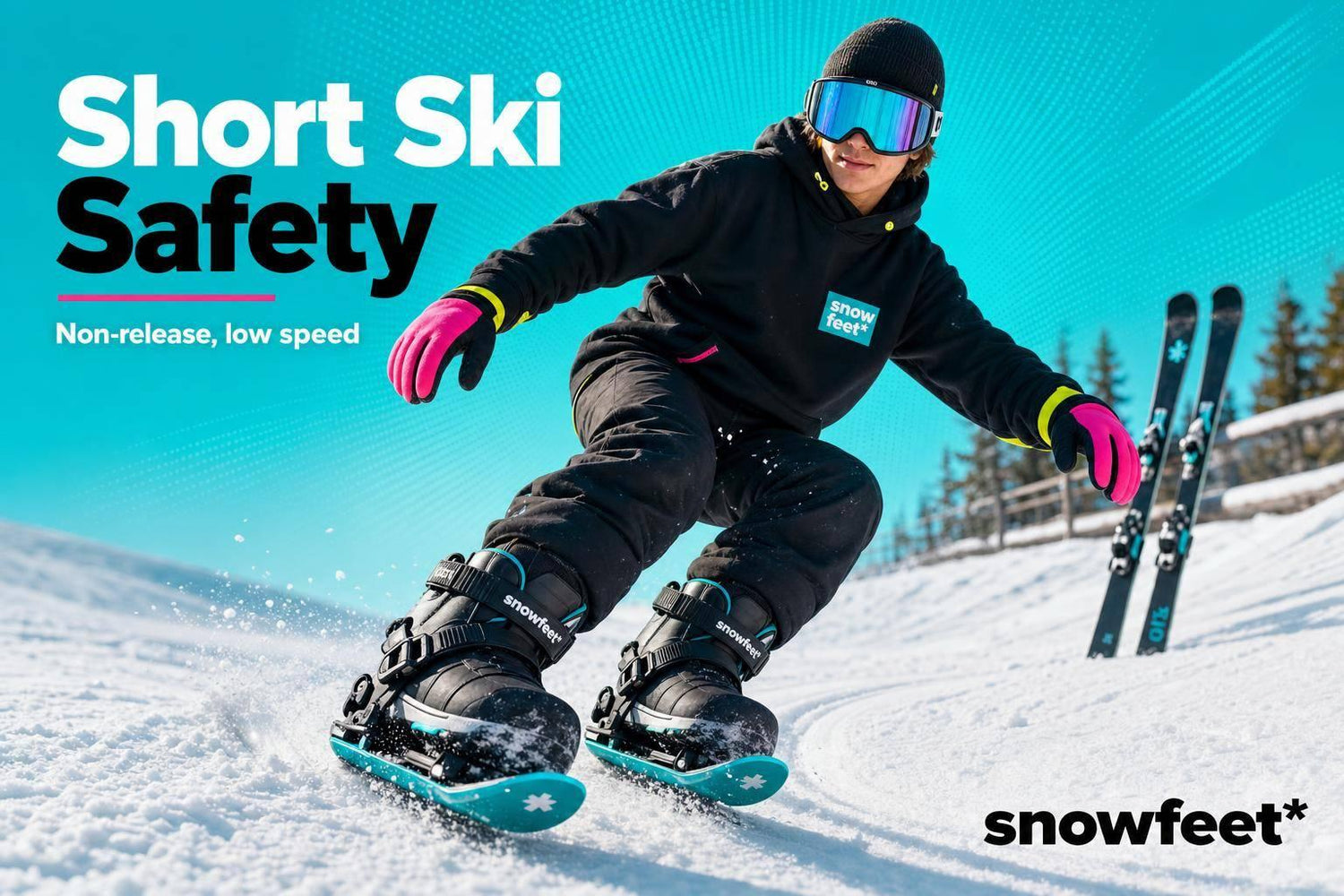
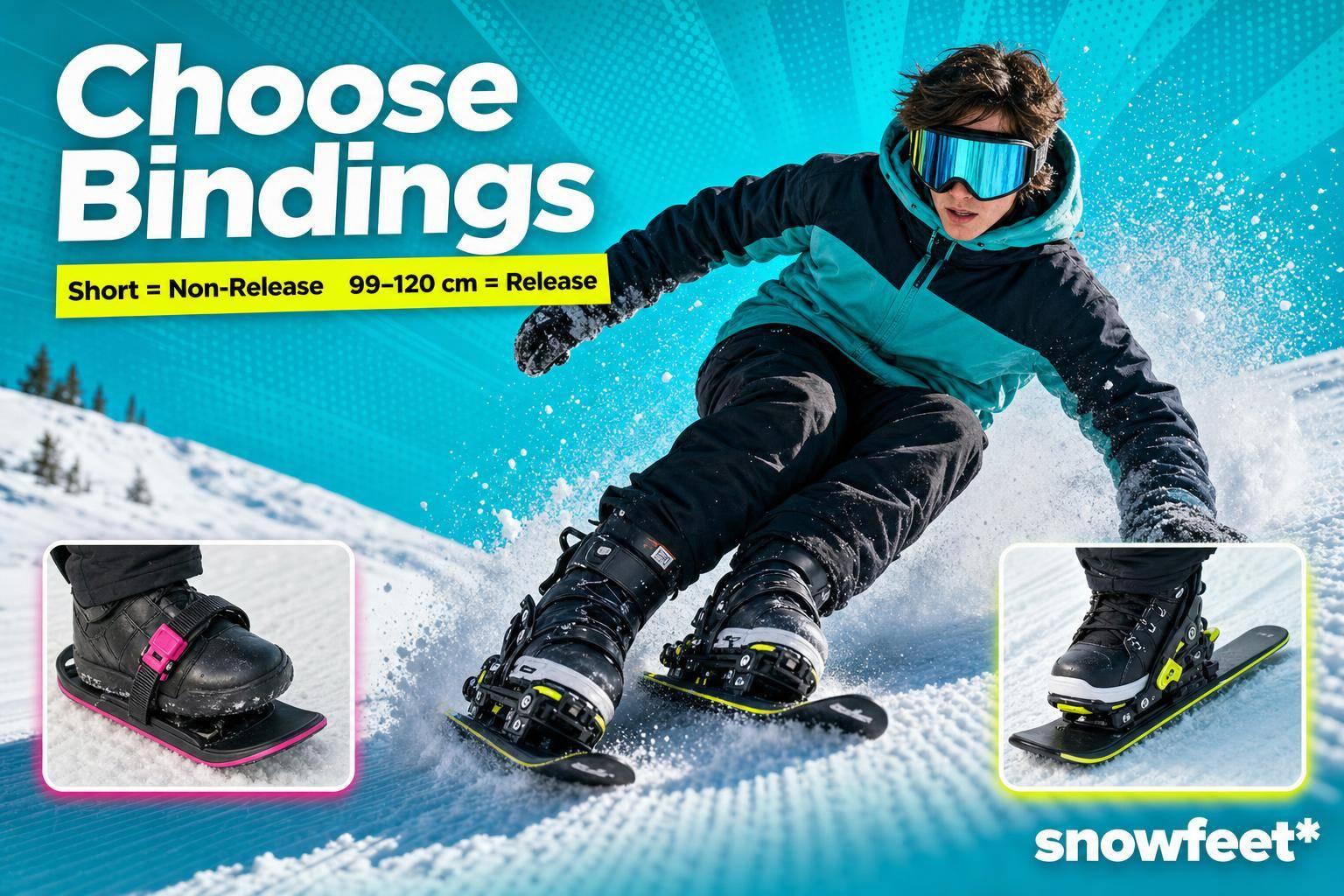
Yes - sometimes. I’d say non-release bindings are usually okay on very short skis (about 15–20 in / 38–50 cm) if you keep speeds low, stay on groomed runs, and have solid control. But once you move to 39 in / 99 cm and up, release bindings are the safer bet because the ski puts more twist into your leg during a fall.
Here’s the plain-English version:
- Shorter ski = less leverage on your knee and ankle
- More speed = more force in a crash
- Beginners, kids, and anyone with past knee or ankle issues should lean toward release bindings
- 38–50 cm Snowfeet* models can work with non-release bindings in calm, low-speed use
- 99 cm and 120 cm models are better with release bindings
- 65 cm sits in the middle: okay for some skilled riders, but less forgiving as speed goes up
A lot of this comes down to one thing: what happens when you fall. If the ski stays on, the twist can go into your leg. If the binding releases, that load may drop before your knee takes the hit. That’s why setup matters more than people think.
| Ski length | Binding call | Best use |
|---|---|---|
| 38–50 cm | Non-release can work | Low-speed groomers, playful laps |
| 65 cm | Mixed case | Skilled riders, small features, modest speed |
| 99–120 cm | Release | Resort skiing, faster runs, mixed terrain |
So, if you want the short answer: non-release on tiny skis can make sense; non-release on longer skiblades gets a lot sketchier, fast. Below, I’ll walk through who should use what, where the risk jumps, and how to pick the setup that fits your riding without turning your knees into unpaid test dummies. :)
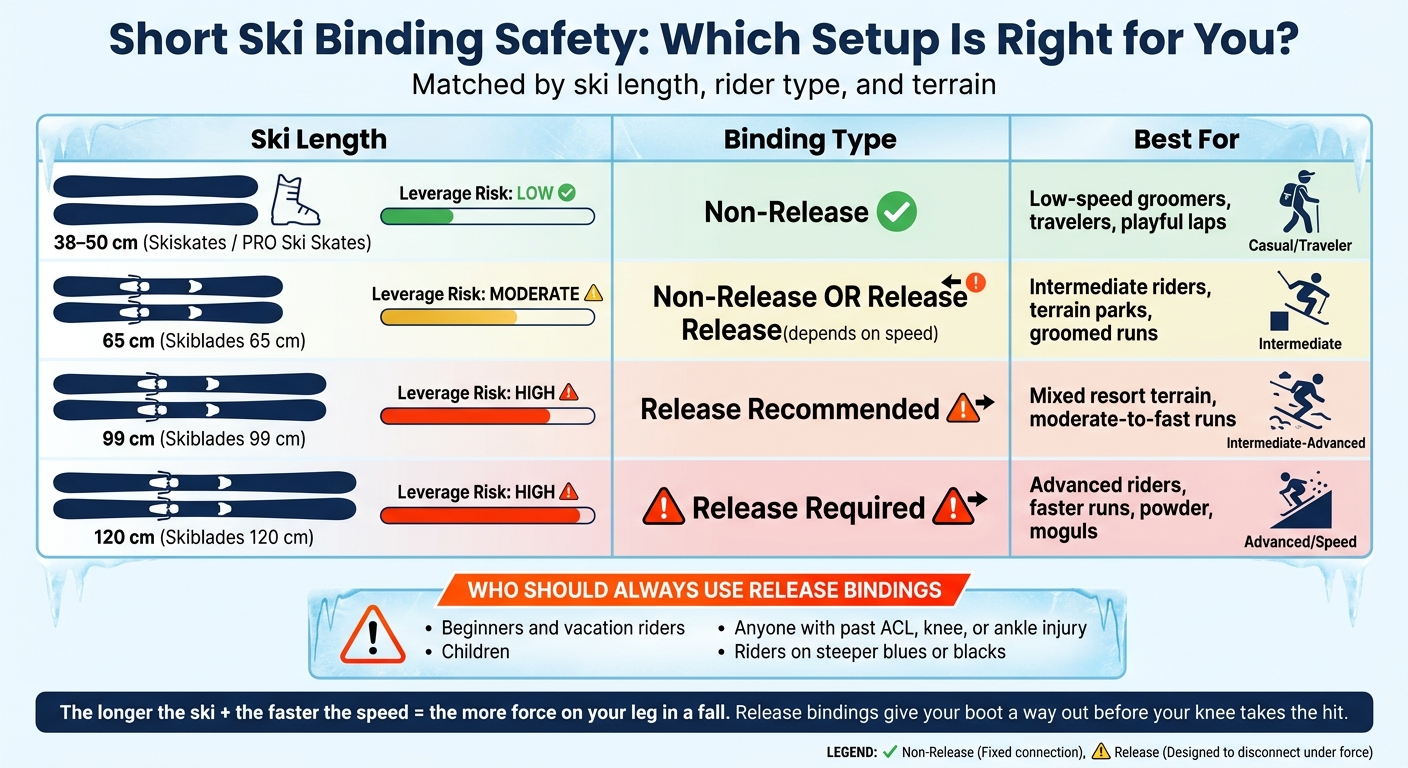
Short Ski Binding Safety Guide: Non-Release vs. Release by Ski Length
Bindings for Short Skis | All You Need to Know
The problem: why bindings matter more as skis get longer and speeds increase
It comes down to force transfer. A non-release binding can keep twisting force locked onto your leg during a fall. A release binding gives the boot a way out before that force gets to your knee or ankle.
How ski length changes leverage and fall forces
Longer skis act like a bigger lever, and your leg becomes the pivot point. That’s the whole game.
Very short skis like the 38 cm Skiskate keep that leverage low. They’re also less likely to jam into the snow during a crash. Once you get past 99 cm, the story changes. Those skis create a lot more leverage and are much more likely to twist or catch in a fall.
Speed adds another layer. The faster you go, the harder the impact. So when you crash or stop all of a sudden, your body takes more of that load. That jump in risk shows up fast as you move from ultra-short Snowfeet* models to 65 cm, 99 cm, and 120 cm skiblades.
Here’s the practical cutoff:
| Ski Length | Snowfeet* Models | Leverage Risk | Recommended Binding |
|---|---|---|---|
| Under 65 cm | 38 cm, 44 cm, 50 cm | Low | Non-release or snowboard binding |
| 65 cm | Skiblades 65 cm | Moderate | Non-release or release, depending on speed |
| 99 cm and above | Skiblades 99 cm, 120 cm | High | Release bindings |
Who faces the most risk on non-release setups
Beginners are near the top of the list. They tend to fall in odd, off-balance ways, and that can put rough twisting force on the knee and ankle. Kids also face more risk. Same goes for riders with a past knee or ankle injury. For those groups, release bindings are the safer pick.
An experienced rider doing low-speed, playful laps on short Skiskates deals with much lower forces. But once speed goes up, or the slope gets steeper and firmer, those forces climb in a hurry.
That gap in risk is exactly why the next section matches specific Snowfeet* lengths to non-release or release bindings.
Model-by-model breakdown: which Snowfeet* setups work with non-release and which need release bindings
Using that risk scale, here’s how each Snowfeet* length tends to play out on snow.
Snowfeet* 38 cm, 44 cm, and 50 cm: non-release can work at low speed
The shortest Snowfeet* models - the 38 cm version, Skiskates 44 cm, and PRO Ski Skates 50 cm - use fixed, non-release bindings because they’re built for low-speed use. These models fit winter shoes or snowboard boots, and they’re best on groomed runs during short, controlled sessions.
If you ride smooth, keep your speed in check, and don’t ski like you’re late for first chair, a non-release setup can be a fair trade-off at these lengths.
Snowfeet* 65 cm, 99 cm, and 120 cm: release bindings are the safer call
At 65 cm, both fixed and release-compatible setups can work, but release bindings are the safer pick for general resort use. That’s where things start to shift. Length matters, sure, but rider style matters just as much.
At 99 cm, release bindings are the safer choice. These models pick up speed fast and put much more force into a fall. Once you get to 99 cm and 120 cm, use release bindings. At 120 cm, that choice is pretty clear - even more so for faster riding or mixed terrain, where release bindings can do a better job protecting knees and ankles.
How Snowfeet* compares with long skis and older short-ski products
Snowfeet* goes in a different direction than alpine skis: easier to carry, easier to learn, and more playful on moderate terrain. That’s a big part of the appeal. Toss them in the car, head to the hill, and you’re off.
The shorter models also use non-release bindings that you can adjust at home with a simple screwdriver. By contrast, standard release bindings on alpine skis usually need a certified technician to set the DIN correctly.
| Model Length | Typical Binding | Best Rider Profile | Common Terrain | Speed Range | Safety Trade-off |
|---|---|---|---|---|---|
| 38–50 cm | Non-release (fixed) | Confident users, travelers | Groomers, small hills | Low–Moderate | No release in falls; low leverage risk |
| 65 cm | Non-release or snowboard | Intermediate, park riders | Terrain parks, groomed runs | Moderate | Crossover point; fixed attachment lacks release ejection |
| 99 cm | Release (recommended) | Intermediate–advanced | Mixed resort terrain, groomed runs | Moderate–High | Release helps prevent leg twisting at speed |
| 120 cm | Release | Advanced, speed-focused | Mixed resort terrain, powder, moguls | High | Essential for high-force impact protection |
Next comes the part that matters most: matching the setup to your skill level and the terrain you ride.
sbb-itb-17ade95
The solution: match your binding setup to your skill level, terrain, and injury tolerance
The rule here is pretty simple: match the binding to how fast you ride, where you ride, and how much experience you have.
Use this as the quick version. If your riding is short, slow, and under control, non-release can work. If you're going faster or skiing more mixed terrain, release bindings are usually the better pick.
When non-release short skis make sense
Non-release bindings make the most sense when everything lines up in your favor. You're on the Snowfeet* 38 cm, 44 cm, or 50 cm models. You're riding groomed green or easy blue runs. Your pace stays relaxed. You already have solid edge control and know how to fall without getting twisted up. And your boots fit snugly, with no heel lift or sloppy movement.
At 65 cm, non-release can still work for experienced riders on small features. But once speed goes up or terrain gets more mixed, release bindings start to make more sense as the better all-around setup. This is not a beginner setup. If even one of those boxes isn't checked, the answer changes fast.
Once speed, terrain, or skier weight goes up, the safer choice shifts fast too.
When release bindings are the better option
If you're a beginner, a vacation rider, or skiing with family, release bindings on the 99 cm or 120 cm models are the smarter call.
Why? Because beginners don’t always fall in clean, neat ways. They catch an edge. They twist. They get off-balance in weird positions. Without a release mechanism, that force goes straight into the knee and lower leg. Medical research links failed release to lower-leg injuries, including tibial shaft fractures. Release bindings let the boot eject before that twisting load reaches the leg.
The same idea applies if any of these sound like you:
- You have a past ACL or knee issue
- You plan to ski steeper blues or blacks
- You tend to pick up speed on longer runs
Best setup by rider type
Here’s the short version.
| Rider Type | Recommended Model | Binding Type | Key Condition |
|---|---|---|---|
| Beginner / vacation rider | Snowfeet* 99 cm or 120 cm | Release | Have DIN set by a tech |
| Casual resort rider | Snowfeet* 99 cm or 120 cm | Release | Varied resort runs |
| Experienced park rider | Snowfeet* 38–50 cm or 65 cm | Non-release | Use release bindings for bigger jumps or mixed terrain |
| Traveler / portability-first | Snowfeet* Skiskates 44 cm | Non-release | Modest speed; strict safety habits |
| ACL-conscious / injury history | Snowfeet* 99 cm or 120 cm | Release | Steeper or faster runs; professional DIN fitting essential |
Conclusion: short skis can be safe - if the binding matches the job
In day-to-day use, non-release bindings can work on Snowfeet* 38 cm, 44 cm, and 50 cm models when you're riding at moderate speeds on groomed runs.
Once you move up to 99 cm and 120 cm, release bindings are the safer pick. Why? Fall forces climb fast at those lengths.
That’s where Snowfeet* makes things pretty simple. The lineup gives riders a clear split: shorter models with fixed bindings, and longer models that pair better with release bindings. So instead of guessing, you can match the binding setup to the ski length you actually plan to use.
FAQs
How do I know if my speed is too high for non-release bindings?
Your speed is probably too high if you start to feel shaky, lose control, or notice that your setup just doesn’t fit the terrain or the way you ride.
Snowfeet non-release bindings are made for quick response and moderate speeds on groomed runs. They’re usually the best match for skis under 100 cm.
If you spend a lot of time on steep slopes, fast carving runs, or tougher terrain, a setup with release bindings is the safer pick.
What boots work best with Snowfeet* non-release bindings?
Snowfeet* non-release bindings work with a few boot types, so the best pick comes down to how you ride.
Snowboard boots are a go-to option for casual resort laps or freestyle. They pair especially well with shorter models like the 44 cm Skiskates. They feel more relaxed, a bit more playful, and many riders find them easy to use.
Ski boots give you the most stability, precision, and control. If you're heading onto steeper runs and want a tighter, more locked-in feel, that's usually the better call.
On very short models like the 38 cm Skiskates, sturdy waterproof winter boots with good ankle support can work too. That's a nice option if you want to keep things simple and not clomp around in ski boots all day :)
Whatever boots you use, make sure the two-strap bindings are fastened securely.
Should I switch to release bindings if I have a past knee injury?
If you’ve had a knee injury before, the best binding for you comes down to how you ride and the ski length you like.
Release bindings are made to come off during a fall. That can help lower injury risk and give you a bit more peace of mind, especially on longer skiblades.
Snowfeet products use a compact shape, so they put less leverage on your joints than long skis. In plain English: there’s less force twisting through your knees, which can help ease strain on the slopes.











留下評論
此網站已受到 hCaptcha 保護,且適用 hCaptcha 隱私政策以及服務條款。