




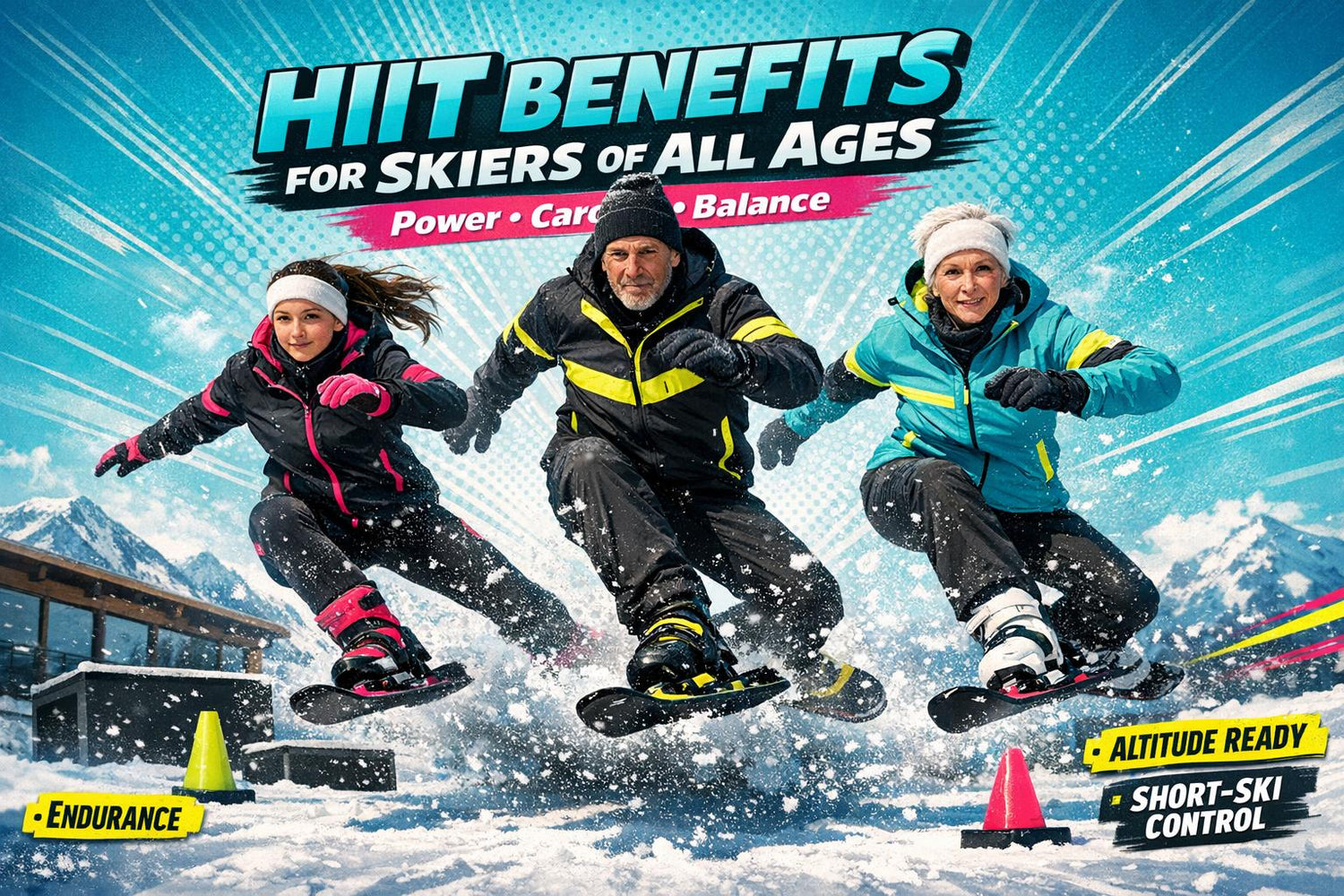
If you want to ski harder, longer, and with better control, HIIT (High-Intensity Interval Training) is the way to go. Here’s the deal: skiing isn’t just cruising downhill - it’s bursts of intense effort mixed with quick recoveries. That’s why HIIT works so well. It trains your body for those explosive movements, builds endurance, and sharpens balance.
Key Takeaways:
- Boost Leg Strength: HIIT helps reduce muscle fatigue and that quad burn you feel after a few runs.
- Improve Cardio for Altitude: Skiing at 8,000+ feet means less oxygen. HIIT preps your lungs and heart for the challenge.
- Better Balance: Quick, side-to-side movements are easier when your core and stabilizers are strong.
- Save Time: Just 20–30 minutes of HIIT, three times a week, can make a big difference.
Whether you’re a teen hitting moguls, an adult juggling work and ski trips, or over 50 easing back onto the slopes, HIIT can be tailored to your needs. Plus, it’s perfect for short skis like Snowfeet*, which demand even more agility and control. Let’s dive into how HIIT can transform your skiing game.
Common Fitness Challenges Skiers Face
Skiing is exhilarating, but it’s also physically demanding. By the third or fourth run, many skiers start to feel the burn - literally. Whether it’s leg fatigue, shortness of breath, or struggling to stay balanced, these are challenges skiers of all ages and skill levels face. Let’s break down these common issues and see how focused HIIT routines can help tackle them.
Muscle Fatigue and Quad Burn
Skiing puts your quadriceps to the test. Every turn, bump, and edge requires your quads to absorb impact and maintain control. Studies using electromyography reveal that quadriceps activation during recreational skiing can hit 70–90% of maximal voluntary contraction, especially on steep slopes. That’s like pushing your legs to near-max effort - repeatedly.
Short skis add to the challenge. They demand quicker turns and constant micro-adjustments, which can wear out your legs even faster. And it’s not just your quads - hip stabilizers, adductors, and calves also take on extra work, muscles that are often overlooked in typical training. This is where well-designed HIIT workouts come into play, targeting these areas to build endurance and strength.
Cardio Endurance at High Altitude
Ever notice how skiing feels extra tough at higher elevations? Most U.S. ski resorts sit between 6,000 and 10,000+ feet above sea level. For example, Breckenridge’s base elevation is around 9,600 feet. Here’s the catch: at 8,000 feet, your VO₂max (a key measure of cardio fitness) drops by 10–15% compared to sea level. Your body has to work harder because there’s less oxygen in the air.
If you’re coming from a lower altitude, you might find yourself out of breath, with a racing heart and slower recovery between runs. The CDC notes that acute mountain sickness affects 25–50% of people who rapidly ascend above 8,000 feet, causing fatigue and shortness of breath - issues that can seriously impact your time on the slopes. HIIT training, especially with a focus on cardio, can prepare your body to handle these challenges better.
Balance and Stability on the Snow
Staying balanced on snow isn’t just about strong legs - it’s a full-body effort. You’re constantly adjusting forward, backward, side to side, and even rotationally as you steer. Using short skis or Snowfeet* products makes this even trickier, as their smaller base amplifies the effects of every weight shift. As Snowfeet* describes:
"With Snowblades, you use your whole body for front back balancing, which makes skiing not only more exciting, but also a more holistic exercise strengthening your body too."
For older adults or beginners, reduced core strength and slower reaction times can make it harder to recover from unexpected slips or changes in snow texture. Research shows that neuromuscular training - focused on strength and balance - can lower ACL injury risk in sports by 40–70%, highlighting just how critical stability work is for skiers.
Limited Time for Off-Snow Training
Here’s a common scenario: most recreational skiers in the U.S. hit the slopes fewer than 10 days per season, often with little to no preseason conditioning. Life gets busy, and fitness takes a backseat until right before a trip. The result? Fatigued legs and limited stamina after just a few runs.
This gap in preparation is even more noticeable for Snowfeet* and short-ski enthusiasts. Their fast, playful riding style is especially demanding on the legs and cardio system. Without prior conditioning, exhaustion sets in quickly. The solution? Short HIIT sessions - 20–30 minutes, three times a week - can build the strength and endurance you need without eating up too much of your time.
How HIIT Addresses Skiers' Fitness Problems
HIIT (High-Intensity Interval Training) tackles common fitness hurdles skiers face, offering targeted benefits whether you're carving up the slopes in Vail or mastering Snowfeet* for quick, agile movements. The principles remain the same: build endurance, boost cardio, and sharpen stability - all in less time.
Building Leg Endurance and Reducing Fatigue
You know that burning sensation in your quads? That’s your body signaling it’s reaching its limit. HIIT helps by improving your muscles' ability to handle and clear lactate and hydrogen ions - the culprits behind that burn. For example, a study in March 2026 by the Chinese National Alpine Skiing Team tested an intense 4-week HIIT program called Speed Endurance Maintenance Training (SEMT). Participants performed 60-second all-out efforts followed by 3 minutes of recovery. The results? A 3.91% boost in relative mean power and a 3.38% drop in fatigue index. For recreational skiers, this translates to more runs before your legs give out.
HIIT also directly trains your anaerobic system, which is essential since skiing relies on quick bursts of energy about 65% of the time. Snowfeet* users, in particular, benefit from these workouts as the short skis demand explosive power and precise control.
Boosting Cardio Fitness in Less Time
If you’re short on time, sprint-based HIIT can improve your cardio fitness faster than steady-state exercises like jogging. A study in October 2025 by the Latvian Academy of Sports Education put this to the test. Ten trained cross-country skiers followed a two-week HIIT protocol on treadmills set at a 6% incline. The results? Maximal skiing speed jumped from 8.4 mph to 9.2 mph, and time to exhaustion improved by 32.9% - all in just six sessions. These gains are especially valuable for skiers tackling high altitudes, where oxygen efficiency is critical.
Training Balance and Stability
Balance is everything on the slopes, and single-leg or lateral drills can help you stay sharp. Lateral box jumps, for instance, mimic the side-to-side transitions you make when skiing. A 4-week RST program improved lateral box jump performance by 9.21% in national-level alpine skiers. For Snowfeet* users, this is even more crucial. The shorter skis amplify every weight shift, making strong stabilizer muscles and a responsive core essential for control.
Getting Results from Short Workouts
The best part? You don’t need hours of training. Just 10- to 20-minute HIIT sessions, three times a week for 2–4 weeks, can deliver noticeable gains in anaerobic power. Think of it as a quick "shock cycle" to get your legs and lungs mountain-ready. For Snowfeet* enthusiasts, these sessions are a perfect match for the demands of short skis, giving you better control and agility compared to traditional long skis.
| HIIT Mode | Work:Rest Structure | Best For |
|---|---|---|
| Repeated Sprint (RST) | 10 seconds all-out / 5 seconds rest | Explosive turns; ideal for Snowfeet* movements |
| Speed Endurance (SEMT) | 60 seconds all-out / 180 seconds rest | Long-run fatigue resistance and reducing quad burn |
| Dynamic HIIT | Variable work to exhaustion | Improving cardio efficiency and altitude preparation |
HIIT Workouts by Age Group
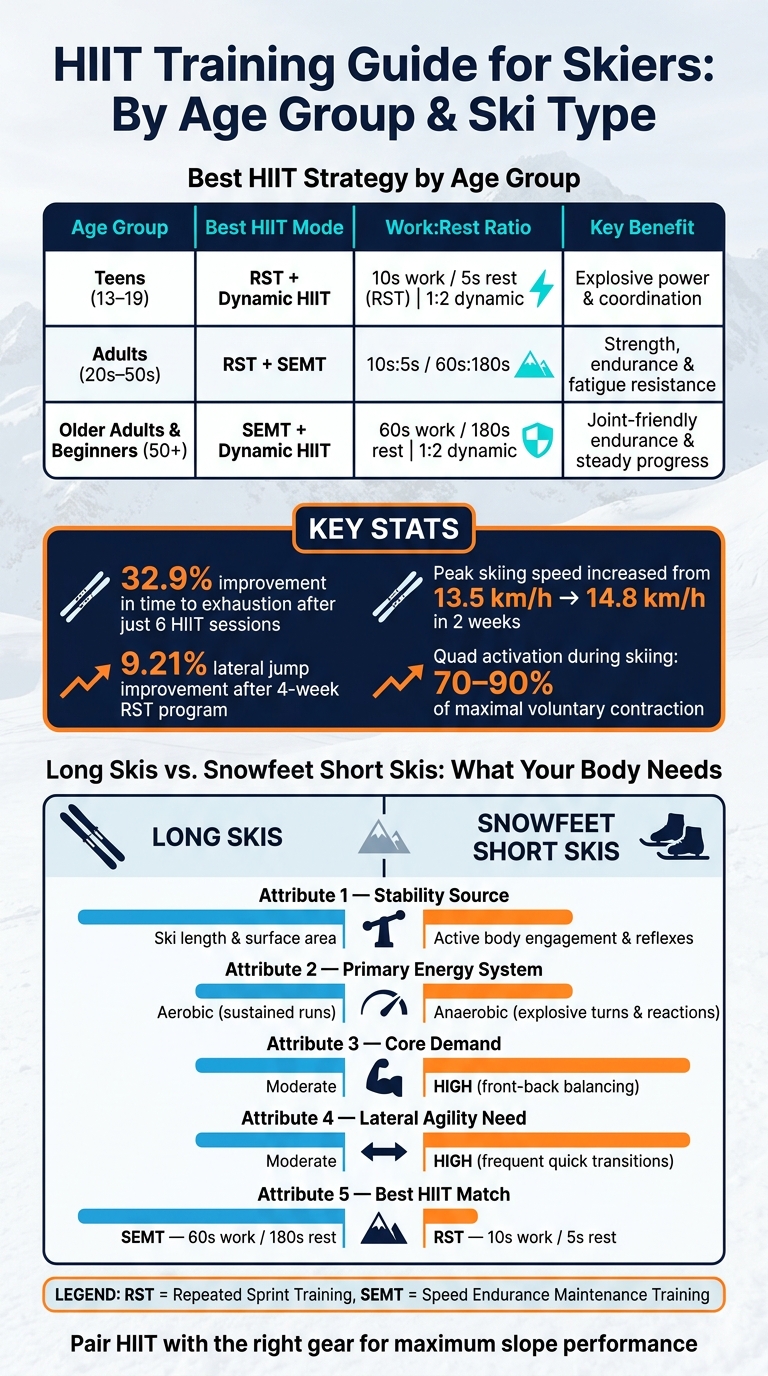
HIIT Training Guide for Skiers by Age Group & Ski Type
HIIT (High-Intensity Interval Training) can be tailored to meet the needs of skiers of all ages. Whether you're a teenager tearing up the moguls or a 55-year-old easing back onto the slopes, there's a way to make HIIT work for you. The beauty of HIIT lies in its adaptability, offering benefits for everyone.
HIIT for Teens and Young Skiers
For teens, short bursts of intense activity - like 10-second sprints followed by rest - are ideal. This approach boosts power and coordination without overloading their growing bodies. Instead of rigid intervals, a more flexible method works better. Marcis Jakovics from the Latvian Academy of Sports Education explains:
"The dynamic protocol keeps exercise intensity constant while allowing interval duration to be the variable based on individual tolerance, aiming to minimize load mismatches and reduce the risk of non-functional overreaching."
In practice, teens can ski or cycle at full intensity until they naturally tire, then rest for twice as long. This method improves neuromuscular coordination, translating into smoother and more controlled skiing. Think of it like fine-tuning a car for precision handling - it’s all about agility and control.
HIIT for Adults in Their 20s Through 50s
Adults in this age range can handle more structured and higher-volume HIIT sessions. Depending on your skiing goals, you can mix two approaches:
- RST (Repeated Sprint Training): Great for technical runs and quick turns.
- SEMT (Speed Endurance Maintenance Training): Ideal for longer, endurance-focused skiing days.
For example, if you're prepping for all-day groomer runs, SEMT's 60 seconds of all-out effort followed by 3 minutes of rest is a solid choice. Add lateral box jumps (on a 20-inch box) to mimic skiing’s side-to-side motion and build leg strength. Three sessions a week of this combo can help you ski harder and longer.
As you get older, balancing strength with recovery becomes more important. That’s why combining RST and SEMT helps maintain power while also improving your ability to recover.
HIIT for Older Adults and Beginners
For those over 50 or just starting out, the goal shifts to protecting joints while still building fitness. SEMT with a 1:3 work-to-rest ratio (60 seconds of effort, 3 minutes of rest) is a safer, effective option. It builds endurance and power without the intensity of RST.
Low-impact exercises, like cycling on a stationary bike, are perfect for this group. They provide a solid cardio workout without stressing the joints. A dynamic HIIT approach - working at a challenging pace until your form falters, then resting for double that time - works wonders here. Research shows that after just six sessions over two weeks, trained skiers improved their time to exhaustion by 32.9%. That’s a big boost for anyone gearing up for the slopes.
Age-Specific HIIT Summary
Here’s a quick breakdown of the best HIIT strategies for each age group:
| Age Group | Best HIIT Mode | Work:Rest Ratio | Key Benefit |
|---|---|---|---|
| Teens (13–19) | RST + Dynamic HIIT | 1:2 (dynamic) / 10s:5s (RST) | Explosive power, coordination |
| Adults (20s–50s) | RST + SEMT | 10s:5s / 60s:180s | Strength, endurance, fatigue resistance |
| Older Adults & Beginners | SEMT + Dynamic HIIT | 60s:180s / 1:2 (dynamic) | Joint-friendly endurance, steady progress |
With these tailored approaches, skiers of all ages can hit the slopes with confidence and skill.
sbb-itb-17ade95
HIIT Training for Short Skis and Snowfeet* Users

What Short Skis and Snowfeet* Demand Physically
Short skis, like Snowfeet*, aren't just smaller versions of traditional skis - they require a completely different approach to balance and movement. Because they have a much shorter surface underfoot, your body has to work harder to maintain stability, especially in the front-to-back direction. As Snowfeet* explains:
"With Snowblades, you use your whole body for front back balancing, which makes skiing not only more exciting, but also a more holistic exercise strengthening your body too."
This means your core, stabilizing muscles, and fast-twitch leg muscles are constantly engaged - way more than they would be on longer skis. The explosive power you need for these quick, precise adjustments is exactly what RST (Repeated Sprint Training) is designed to build. The fitness requirements for short skis are on a whole different level compared to traditional, longer skis.
Snowfeet* vs. Long Skis: Different Fitness Needs
The physical demands of short skis like Snowfeet* are unique. Long skis provide a lot of built-in stability thanks to their length and larger surface area, which helps smooth out errors and maintain control at high speeds. However, they’re heavier, less maneuverable, and harder to handle in tight spots like moguls.
With Snowfeet*, the game changes. Models like the 65 cm Skiblades (starting at $635) and 99 cm short skis (starting at $675) are lightweight and highly maneuverable, but they put the responsibility for stability squarely on you. That means you need quicker reflexes, stronger stabilizing muscles, and sharper lateral agility. While fitness for long skis focuses more on endurance, short-ski fitness is all about explosiveness and precision. This is why RST and SEMT (Sprint-Endurance Mixed Training), discussed earlier, are perfect for Snowfeet* users.
| Fitness Quality | Long Skis | Snowfeet* Short Skis |
|---|---|---|
| Stability source | Ski length and surface area | Active body engagement and reflexes |
| Primary energy system | Aerobic (sustained runs) | Anaerobic (explosive turns, reactions) |
| Core demand | Moderate | High (front-back balancing) |
| Lateral agility need | Moderate | High (frequent quick transitions) |
| Best HIIT match | SEMT (60s work / 180s rest) | RST (10s work / 5s rest) |
HIIT Exercises That Match Snowfeet* Movements
To get the most out of Snowfeet*, focus on HIIT drills that mimic the movements your body makes on the snow. Lateral box jumps are excellent for building the side-to-side agility needed for carving and quick transitions, while countermovement jumps (CMJ) develop the explosive leg power required for popping off jumps or absorbing mogul impacts. In fact, a 4-week RST program improved lateral box jump performance by 9.21% and CMJ height by 2.77% in national-level skiers.
"Short repeated sprints with limited recovery emphasize rapid phosphocreatine resynthesis and repeated peak power production, which may be particularly relevant for the explosive turning demands of technical disciplines." - Scientific Reports
For a balanced training plan, combine these exercises into your weekly routine. Do two RST sessions (10 seconds work/5 seconds rest, 6–8 rounds) and one SEMT session (60 seconds work/180 seconds rest). This approach mirrors the reactive, explosive demands of Snowfeet*, helping you improve control, agility, and overall performance on the slopes.
Conclusion: Pair HIIT with Snowfeet* for Better Skiing
HIIT is a quick and effective way to get slope-ready. In fact, a two-week HIIT program showed impressive results - time to exhaustion improved by 32.9%, and peak skiing speed increased from 13.5 km/h to 14.8 km/h. These results prove that even a short training period can lead to real improvements, no matter your age or fitness level.
By combining RST (10 seconds of work, 5 seconds of rest) and SEMT (60 seconds of work, 180 seconds of rest), you can train for skiing’s unique physical demands. Add exercises like lateral box jumps and countermovement jumps to mimic the movements needed for better control on the slopes.
Pairing these fitness gains with the right gear takes your performance to the next level. Snowfeet* products are designed to maximize the benefits of your HIIT training. Their short skis, like the 50 cm Ski Skates ($275), 65 cm Skiblades (starting at $635), or 99 cm Skiblades (starting at $675), require full-body engagement and quick reflexes. The explosive power and lateral stability you build through HIIT translate directly to improved control and agility on these skis.
This combination of HIIT and Snowfeet* gear is a game-changer for skiers of all ages. Whether you're a teen building athletic skills, an adult juggling a busy lifestyle, or an older skier aiming to stay sharp, this approach works. As Snowfeet* explains:
"With Snowblades, you use your whole body for front back balancing, which makes skiing not only more exciting, but also a more holistic exercise strengthening your body too."
When HIIT meets Snowfeet*, every ride becomes a chance to push your limits and enjoy the slopes like never before.
FAQs
How soon will HIIT improve my skiing?
With regular HIIT workouts, you could notice better skiing endurance and control in as little as six weeks. Just three 30-minute cardio sessions a week, paired with core-strengthening exercises, can significantly boost your stamina, helping you power through those long days on the slopes without burning out. Using Snowfeet* can take it up a notch - thanks to their lightweight and compact design, they cut energy use by 30–50%. That means less strain on your quads and more time enjoying the snow.
What’s the safest HIIT plan if I’m over 50?
For those over 50, creating a safe and effective HIIT plan means prioritizing leg strength, core stability, and endurance. This approach helps lower the risk of injuries caused by fatigue. Begin prepping about six weeks before skiing with 30-minute cardio workouts - cycling, hiking, or running are great options. Pair this with bodyweight exercises like air squats, wall sits, and planks to build strength and stability.
Also, think about using lightweight Snowfeet* gear. It puts less strain on your legs compared to traditional skis, which can help you stay safer and enjoy your time on the slopes a bit longer.
Which HIIT drills help most with Snowfeet* control?
To get better control when using Snowfeet*, work on your core strength with exercises like planks, mountain climbers, and sit-ups. These will help improve your stability and posture, making skiskating smoother. Mix in three high-intensity cardio sessions each week - running is a great option - to build endurance and keep your legs from tiring out too quickly. And don’t skip the warm-up! Spend 5–10 minutes warming up your muscles to get them ready for the agility and precision Snowfeet* requires.
Related Blog Posts
- How Strong Do You Need to Be for Backcountry Skiing? Real Training Benchmarks
- Endurance Training for Backcountry Skiers: Preparing for Long Climbs
- How to Train for Touring Season: Strength, Endurance, and Cardio Workouts
- Cross-Country Skiing for Weightlifters: Off-Season Training for Strength Athletes












留下評論
此網站已受到 hCaptcha 保護,且適用 hCaptcha 隱私政策以及服務條款。