




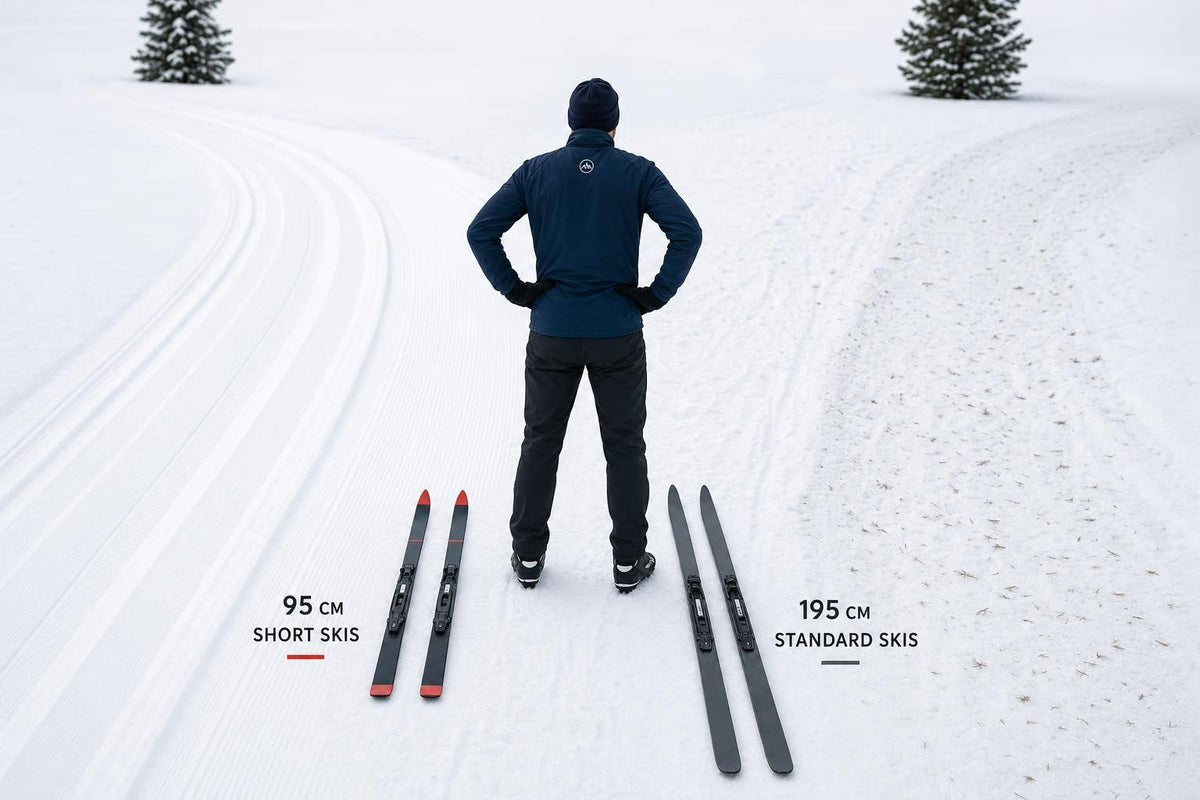
Yes - you can cross-country ski on short skis. If you stick to flat, packed trails and keep outings in the 1–3 mile range, short skis can be a simple, fun pick. But if you want more glide, longer tours, or deep snow, longer Nordic skis still do the job better.
Here’s the short version:
- I’d look at 90–100 cm as the main short-ski range for cross-country use.
- 90 cm works best for groomed trails and easy park loops.
- 100 cm makes more sense for mixed terrain and light off-trail use.
- Very short options like 44 cm skiskates are fun, but they’re not built for touring.
- Short skis are easier to carry, easier to store, and often work with regular winter boots.
- The tradeoff is simple: less glide, less float, and more work over long distances.
If you want the plain answer, here it is: short skis are a good fit for beginners, families, travelers, and casual winter users. They’re not the best tool for all-day touring. Think of them like the snow-sport version of a hatchback: easy to park, easy to use, not what I’d pick for a cross-country road trip :)
Quick comparison:
| Option | Best use | Main upside | Main downside |
|---|---|---|---|
| Snowfeet* NORDIC 90 cm | Groomed trails, packed snow, easy loops | Easy to learn, light, works with winter boots | Shorter glide, not made for long tours |
| Snowfeet* WALKSKI 100 cm | Mixed terrain, rolling routes, light backcountry | Better for off-track use, includes climbing setup | Still limited in deep snow and on long outings |
| Long Nordic skis | Distance skiing, track use, steady touring | Better glide, better efficiency, more float | More gear, more storage space, steeper learning curve |
A few numbers stand out. The NORDIC 90 cm weighs 3.84 lb per pair, starts at $450, and fits winter shoes in US sizes 6–13. The WALKSKI 100 cm starts at $595 and adds climbing modes and skins for mixed snow. Those details matter if you want gear that fits in your trunk and doesn’t turn into a garage project.
If I were helping a friend shop for this, I’d keep it simple:
- Choose NORDIC 90 cm for packed trails and easy touring
- Choose WALKSKI 100 cm for mixed routes and light backcountry
- Choose long Nordic skis if your goal is distance, speed, or classic technique
If you want a fast answer before you buy: match the ski to the terrain, not just the length. That’s the whole game.
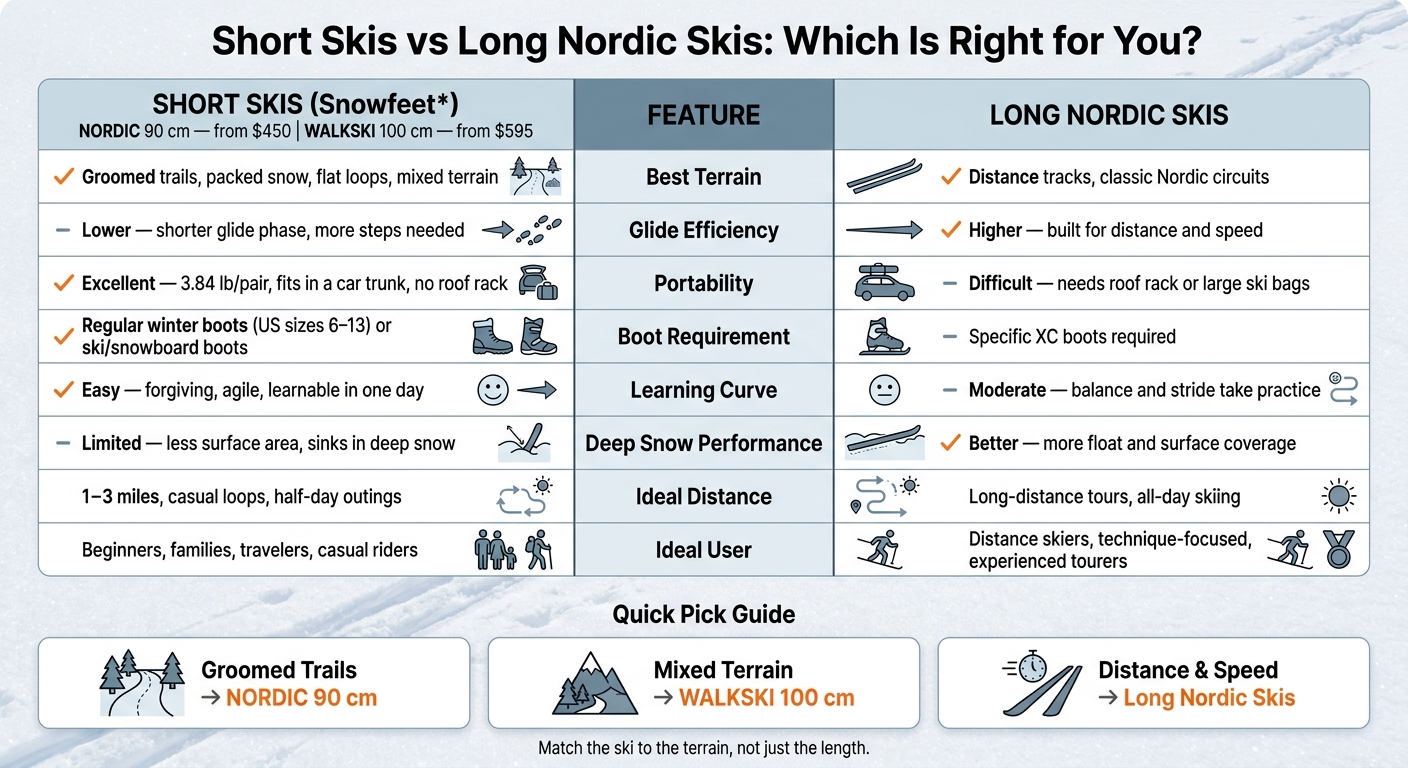
Short Skis vs Long Nordic Skis: Which Is Right for You?
Is Cross-Country Skiing Possible with Mini Ski Skates? | Snowfeet*
When Short Skis Work Well for Cross-Country
Short skis work best on flat, packed trails and easy loops.
Best Terrain: Flat Routes, Packed Trails, and Casual Loops
The Snowfeet* NORDIC Cross-country 90 cm is in its sweet spot on groomed trails, packed snow, and flat to gently rolling routes. Think local park loops, campground trails, or beginner-friendly Nordic centers. That’s where short skis make the most sense.
Because they’re shorter, they’re easier to move around obstacles, easier to stop, and less awkward on narrow or cluttered routes. For casual outings in the 1–3 mile range, that extra control often matters more than glide.
Go with the 90 cm NORDIC for groomed trails. Pick the 100 cm WALKSKI if your route is more mixed or lightly off-trail. That same easy handling is also a big reason short skis feel less scary for first-timers.
Why Short Skis Appeal to Beginners and Casual Riders
Long Nordic skis can feel like a lot on day one. A small balance mistake can turn into a big wobble fast. Short skis dial that down. They make starting, stopping, turning, and getting your balance back feel more forgiving.
They’re also just easier to live with. At 3.84 lb per pair, the Snowfeet* NORDIC is light enough to carry without a fuss, simple to store, and easy to toss in a car trunk. No roof rack. No XC boots needed. The standard binding version works with standard winter shoes in sizes 6–13 US.
That’s where short skis pull ahead for casual use. Less gear drama, more time on snow :)
Short Skis vs Long Nordic Skis: Side-by-Side Comparison
Here’s how the two options compare for a typical recreational U.S. skier:
| Feature | Snowfeet* NORDIC 90 cm | Traditional Long Nordic Skis |
|---|---|---|
| Ease of Use / Learning Curve | High - agile, forgiving, easy to control from the first outing | Moderate - balance and stride take more practice |
| Portability | Excellent - compact and easy to fit in a car | Difficult - often needs roof racks or large bags |
| Stability | Stable at casual speeds | Better at high speeds with proper technique |
| Glide Efficiency | Lower - built for fun and maneuverability | Higher - made for distance and speed |
| Boot Requirement | Standard winter shoe or Pro XC binding | Specific XC boots required |
| Distance Comfort | Best for short casual loops | Better for longer touring days |
| Terrain Fit | Flat routes, groomed trails, narrow paths | Long-distance tracks and classic Nordic circuits |
For casual riders, short skis come out ahead on portability and ease of use. Long Nordic skis do better when distance and glide matter more. But as snow gets deeper or your outings get longer, that gap starts to matter more. That’s when the trade-off shows up: more glide, more distance, or deeper snow usually favors the longer setup.
Where Short Skis Fall Short
Short skis are a blast, and for casual laps they make a lot of sense. But yeah, they have limits. Once speed picks up, the route gets longer, or the snow gets deeper, those tradeoffs show up fast.
Less Glide and Efficiency Than Full-Length Nordic Skis
Short skis trade glide for quick handling. On a 90 cm ski, the glide phase ends sooner. So you need to push sooner too. That’s fine on a short local loop where you want easy control and quick turns.
On longer outings, though, that short glide starts to cost you. You take more steps, use more energy, and cover the same ground with more effort. That’s why short skis work well for casual trail laps, but they’re not the best pick for efficient touring.
They can also feel more twitchy at higher speeds. You’ll notice it most on descents or on firm snow. Small bumps, grooves, or ruts can force faster balance corrections than you’d need on a full-length ski. In plain English: they’re fun, but they don’t feel as calm once things speed up.
Short Skis Struggle Most in Deep Snow and Long Outings
The biggest limit is flotation.
Longer skis spread your weight across more snow. That bigger platform helps you stay closer to the surface instead of punching down into it. Short skis have less surface area, so they sink sooner in deep, loose snow. And when that happens, forward movement gets slower and a lot more work.
That extra effort stacks up fast on half-day or full-day trips, even more if you’re carrying a pack. What feels light and playful near the trailhead can turn into a bit of a leg burner later on.
The Snowfeet* WALKSKI 100 cm is still the better short-ski choice for mixed terrain and light backcountry use. But even then, it works best in shallow, packed snow and on shorter outings. WALKSKI 100 cm pushes short-ski use a bit farther into mixed terrain, but it still doesn’t give you the flotation of a real backcountry setup.
sbb-itb-17ade95
Choosing the Right Snowfeet* Model
Once you know where short skis struggle, picking the right Snowfeet* model gets a lot simpler. This choice is mostly about where you’ll ski, not just how long the ski is.
Snowfeet* NORDIC Cross-country 90 cm: Best for Groomed Trails and Easy Touring
The NORDIC 90 cm is made for groomed cross-country tracks, packed park loops, and mellow local trails. If you want a simple setup for flat-terrain skiing, this is the clearest fit.
Here’s why it works so well:
- The waxless fishscale base gives you grip without kick wax.
- The metal edges help with control and stopping.
- The Winter Shoes binding works with regular winter boots in sizes US 6–13.
- If you want a more ski-specific setup, Snowfeet* also sells a Pro XC version with NNN bindings.
That setup makes the NORDIC 90 cm feel less like a gear puzzle and more like, “Okay, let’s just go ski.” :)
Martina MacLean, a Verified User, put it simply:
"It didn't take long to get used to these shorter skis, much easier than the original longer XC skis I used to own a long time ago!"
- Martina MacLean, Verified User
Another reviewer, makinola, said:
"Exactly what I was looking for... within 45 minutes I was gliding along in the tracks at my local cross country trails."
- makinola, Verified User
That kind of quick start is a big plus for beginners, families, and anyone who wants casual winter exercise without spending a ton on gear. At $450, it’s also the lower-cost starting point of the two.
Snowfeet* WALKSKI Backcountry Touring 100 cm: Best for Mixed Terrain and Light Backcountry Use
The WALKSKI 100 cm is built for a different kind of day. It uses a four-mode binding system - Walk, Ski, Climb 1, and Climb 2 - and it comes with removable climbing skins for uphill travel. So if your route includes forest roads, rolling meadows, ungroomed snowmobile tracks, or low-angle backcountry terrain, this model makes a lot more sense.
You’re not just gliding on flats here. You’re dealing with climbs, changing snow, and mixed ground. That’s where WALKSKI earns its keep.
It works with:
- Winter boots
- Snowboard boots
- Ski boots
Snowfeet* presents it as a compact option instead of a full touring kit, which can cost around $2,200. The WALKSKI starts at $595.
Snowfeet* NORDIC 90 cm vs WALKSKI 100 cm: Which One Is Right for You
If your local trails are groomed and mostly flat, go with the NORDIC 90 cm. It’s the easy, grab-and-go choice.
If you want to leave packed tracks, deal with a bit of climbing, and roam over mixed terrain, the WALKSKI 100 cm gives you the tools for that. Think of it like this: NORDIC is for a smooth neighborhood spin, while WALKSKI is for heading down the side road just to see where it goes.
| Feature | NORDIC 90 cm | WALKSKI 100 cm |
|---|---|---|
| Primary terrain | Groomed trails, packed snow, flat loops | Mixed terrain, rolling hills, light backcountry |
| Boot compatibility | Winter Shoes binding for regular winter boots (US 6–13) or Pro XC NNN version | Winter boots, snowboard boots, or ski boots |
| Learning curve | Very easy - easy to learn in one day | Easy to moderate; mode-switching adds steps |
| Touring range | Best for short to half-day casual outings | Better for half-day mixed-terrain tours |
| Snow conditions | Firm, packed, groomed | Packed to variable; skins handle soft climbs |
| Portability | 3.84 lb per pair; fits in a trunk or bag | Slightly heavier; still compact and packable |
| Starting price | From $450 | From $595 |
| Ideal rider | Beginners, families, local trail users | Light tourers, explorers, experienced casual riders |
One more option worth a quick mention: the Skiskates 44 cm. They’re the shortest and most portable Snowfeet* model, but they make more sense for slopes and groomed hills than for flat touring or longer outings where glide and directional stability matter.
Conclusion: When Short Skis Work and When Long Nordic Skis Are Still Better
Yes - you can cross-country ski on short skis, as long as you stay within the right terrain and distance range.
Short skis are easy to carry, easy to use, and easy to enjoy. But they’re not built for top speed or long days covering mile after mile. If you want a fun, low-hassle outing on groomed trails or packed snow, Snowfeet* short skis are a solid fit. If you want to move fast, go far, or build strong classic Nordic technique, long Nordic skis are still the better pick.
The main thing is simple: choose based on terrain, not ski length alone.
- Use the NORDIC 90 cm for groomed trails and easy touring.
- Use the WALKSKI 100 cm for mixed terrain and light backcountry.
Long Nordic skis still do better when you want more glide, more steady speed, more stability, and better performance on long tours. But for many casual riders, Snowfeet* comes out ahead on portability, simplicity, and plain old fun :)
FAQs
Can I use short skis in groomed XC tracks?
Yes. Short skis like Snowfeet NORDIC* can work in groomed cross-country tracks.
They’re easier to handle, simple to carry, and less intimidating than full-length skis. That makes them a nice pick for beginners, casual laps, or anyone who wants a low-fuss day on snow.
The catch? You give up some glide, top speed, and efficiency over long distances compared with standard 160–195 cm Nordic skis.
Are short skis good enough for beginners?
Yes. Short skis are a great pick for beginners.
At 90 cm to 100 cm, they’re much easier to control, turn, and balance on than standard 160–210 cm cross-country skis.
They also feel less awkward and less intimidating. That matters a lot when you’re starting out. For many people, that means learning the basics in just one day.
The downside? You’ll give up some top-end glide and speed.
But if you want low-fuss fun and want to build skills fast, short skis are a solid choice.
Which Snowfeet* model should I choose?
Choose based on where you plan to ski and what you want out of it:
- NORDIC 90 cm: best for groomed Nordic trails, casual fitness, travel, and beginners.
- WALKSKI 100 cm: a better fit for light backcountry exploring, mixed terrain, uphill touring, and off-trail use.
- Skiskates 44 cm: a fun, playful pick for flat ground, but not for true cross-country technique.
If your main goal is top speed, long distance, or racing, stick with long skis. They’re still the better tool for that job.











留下評論
此網站已受到 hCaptcha 保護,且適用 hCaptcha 隱私政策以及服務條款。