





If you’re both new, go short first. In this lineup, 44 cm is the easiest to turn, 50 cm adds a bit more balance, 65 cm is the middle pick, and 99 cm feels the most like a ski.
Here’s the fast answer:
- Pick 44 cm if you want the least intimidating start and backpack-size gear.
- Pick 50 cm if you want a small step up in balance from 44 cm.
- Pick 65 cm if you both want the same setup with more calm underfoot.
- Pick 99 cm if one of you wants more support and plans to stay on groomers.
- Check boot fit first. That can decide the whole thing before length does.
For most couples, it comes down to one simple choice: same length for the same feel, or 65 cm + 99 cm if one person is more confident.
Snowboarder tries Snowfeet* | Which Snowfeet* Short Ski is the Best? | Snowblades 44, 65, 99 Review
Quick Comparison
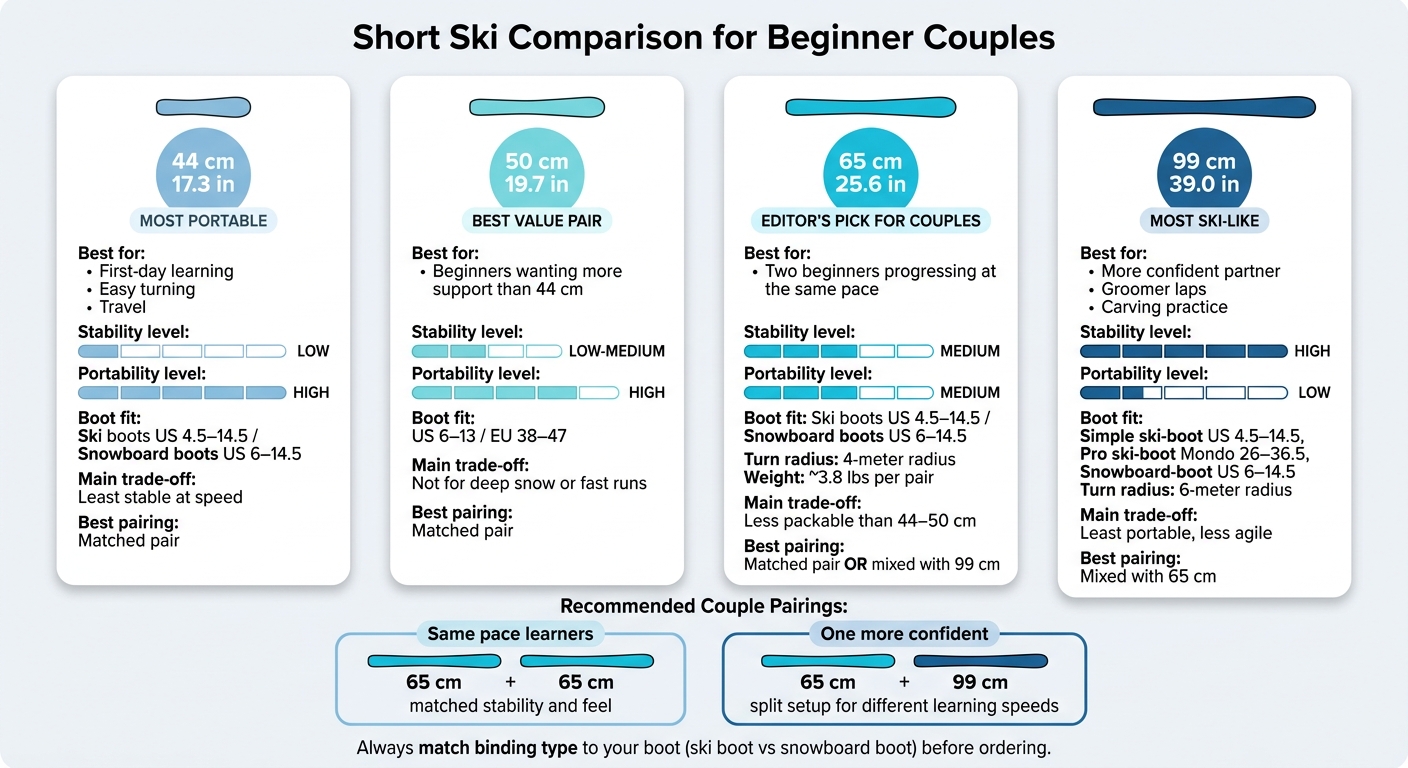
Short Ski Comparison for Beginner Couples: 44cm vs 50cm vs 65cm vs 99cm
| Model | Length | Best for | Main trade-off | Boot note |
|---|---|---|---|---|
| Snowfeet* Skiskates | 44 cm / 17.3 in | First-day learning, easy turning, travel | Least stable as speed builds | Ski-boot or snowboard-boot version |
| Snowfeet* PRO | 50 cm / 19.7 in | Beginners who want a bit more support than 44 cm | Still not made for deep snow or fast runs | Check fit range before you buy |
| Snowfeet* Skiblades | 65 cm / 25.6 in | Couples learning at the same pace | Less easy to pack than 44–50 cm | Ski-boot or snowboard-boot version |
| Snowfeet* Skiblades | 99 cm / 39.0 in | More support, smoother groomer laps, carving practice | Bigger to carry, less playful | Most binding choices in the group |
I’d keep it simple: matched 65 cm for two steady beginners, or 65 cm + 99 cm if one partner says, “I want more ski under me.” That split usually saves a lot of slope-side drama :) and gets both people on gear that fits how they learn.
1. Snowfeet* Skiskates 44 cm
Learning Confidence
For two beginners, the 44 cm Skiskates are the most playful and least intimidating place to start. They’re short, light, and easy to move around. At 44 cm, this is the most compact option in the group, so they’re the easiest to pivot and the easiest to carry.
That said, let’s keep it honest: these are a beginner practice tool, not a stand-in for full-length skis. They work best on groomed beginner runs at a controlled pace. Steep slopes and deep powder? Not their happy place.
Stability and Progression
The short platform helps a lot with turning. That’s the big draw. But there’s a trade-off: you get less front-to-back stability than you would with longer skis, and you’ll feel that more as speed picks up.
So the sweet spot here is simple:
- Firm, groomed snow
- Beginner-friendly runs
- Moderate speed
This model makes the first steps feel less stressful, which is a big win when two new skiers are learning together. If things click and you want a bit more balance without giving up that short-ski vibe, moving up in length makes sense.
Boot Compatibility
The Skiskates come with adjustable, tool-free bindings. The ski-boot version fits US 4.5–14.5 (EU 36–49), and the snowboard-boot version fits about US 6–14.5 (EU 38–49). Regular winter shoes won’t work.
This is the easiest setup when both partners already have the same type of boots and want matching gear. Before you order, double-check that both of you pick the binding version that matches your boots. It’s a small step, but it saves a big headache later.
Portability
At 44 cm, these fit in a backpack. That’s a huge plus if you want gear that’s easy to carry, stash, and bring along without feeling like you’re hauling half the garage to the hill.
For a couple who want the same setup and low-pressure first runs, this is the simplest pick. Compared with the 50 cm PRO or 65 cm Skiblades, it’s the easiest shared starting point. The flip side is that it’s also the least forgiving once speed starts to build. If you like the short-ski feel but want a bit more room to settle your balance, the 50 cm PRO is the next move.
2. Snowfeet* PRO 50 cm
Learning Confidence
If you want a bit more support than the 44 cm Skiskates, the PRO 50 cm is the next move. It sits right in the sweet spot of this lineup: more stable than the ultra-compact 44 cm, but still much shorter and easier to handle than the 65 cm Skiblades.
That extra length helps. First turns tend to feel smoother and less twitchy, which can be a big deal when two people are learning at the same time.
Wired Italia described the 50 cm version as having a wider and longer supporting surface than the earlier 38 cm design, making it resemble a mini ski more closely. For couples learning together, that balance between playfulness and control is exactly the point.
Stability and Progression
The PRO 50 cm gives both partners more fore-aft stability and a stronger directional feel than the 44 cm Skiskates. That matters when one person wants a little more help staying centered without jumping all the way to a longer ski.
That said, it still isn't built for everything. It won't feel like full-length skis in powder or at high speed. Deep powder and fast, advanced skiing are outside its lane.
Boot Compatibility
The PRO 50 cm fits US sizes 6–13 (EU 38–47).
Before you head out, test both pairs of boots with winter socks on. Fit can change more than people expect, and bulky snowboard boots may sit differently, so it's smart to check before buying.
Portability and Shared Practicality
At 50 cm, the PRO still fits the backpack-friendly idea that makes this lineup so appealing, but it gives you more stability than the 44 cm Skiskates. For two beginners, it also offers the lowest-cost matched setup in this lineup.
If one of you ends up wanting more support, the 65 cm Skiblades are the next step up.
sbb-itb-17ade95
3. Snowfeet* Skiblades 65 cm
For couples who want more stability than the 44 cm and 50 cm options, but don’t want to jump straight to the longest model, the 65 cm Skiblades hit a nice middle spot.
Learning Confidence
The 65 cm Skiblades are the in-between option. They feel more settled than the 44 cm and 50 cm models, but they’re still short enough to keep the learning curve friendly. If one partner wants a bit more balance while the other still likes that short-ski feel, this is the pick that makes the most sense.
Stability and Progression
With a 4-meter turning radius, these stay quick and easy to turn on beginner terrain. That said, they’re still at their best on green runs and mellow slopes. Think easy cruising, not full-send charging.
Boot Compatibility
The 65 cm Skiblades come with two binding options: ski-boot bindings or snowboard-boot bindings.
- Ski boots: about US 4.5 to 14.5 (EU 36–49)
- Snowboard boots: about US 6 to 14.5 (EU 38–49)
Match the binding to your boot type, and double-check the fit before you head out. It’s a small step, but it saves a lot of hassle later.
Portability and Shared Practicality
At about 3.8 pounds per pair with ski bindings, the 65 cm Skiblades are easy to carry, store, and pass back and forth between partners if both boot sizes work. That’s a nice setup for couples who want one simple pair instead of two very different ski setups.
If you do trade off, recheck the bindings each time before riding. Better to take a minute in the lodge than deal with a bad surprise on the slope :)
If you want a calmer, more forgiving ride, the 99 cm Skiblades are the next step up.
4. Snowfeet* Skiblades 99 cm
The 99 cm Skiblades are the longest Snowfeet* option in this lineup. They also feel the most like skis. For couples who want more stability but don't want to jump to full-length skis, this is the sweet spot. They work best on groomed runs and for carving.
If the 65 cm model feels a bit too twitchy, this is the next move. You still keep the short-ski feel, but things calm down a lot. That can be a big deal when one partner wants more support and the other still wants something short and easy to steer.
Learning Confidence
At 99 cm, these still feel much shorter and less intimidating than full-length skis. That makes it easier for both partners to work on balance and basic turns without feeling like they're wrestling giant planks down the hill.
Compared with the 65 cm and 50 cm models, the extra length gives a more settled feel underfoot. Not night and day, but enough that you'll notice it. You get more calm without crossing into full-size ski territory.
Stability and Progression
A 6-meter turn radius plus a rockered tip and tail helps keep them quick on groomed terrain while still steady enough to build carving habits.
They're a good fit for easy resort laps and steady progress at a beginner pace. If one or both partners want a short ski that still makes sense over several trips, this is the model that fits that path best. In plain English: it gives you room to improve without feeling like you outgrew it after one weekend.
Boot Compatibility
There are three binding setups available, which gives couples more room to work with the boots they already own. That's handy when each person shows up with a different setup. No drama, less guesswork.
| Binding type | US size range | Mondo range |
|---|---|---|
| Simple ski-boot | US 4.5–14.5 | 22.5–32.5 |
| Pro ski-boot | - | 26–36.5 |
| Snowboard-boot | US 6–14.5 | - |
Confirm each boot's Mondo size before ordering. Then adjust each binding to each boot before riding.
Portability and Shared Practicality
Compared with adult skis, the 99 cm Skiblades are much easier to carry, pack, and store. That's a nice perk for couples, especially if your trunk already looks like a gear explosion :)
The 99 cm model gives up some edge hold at higher speeds compared with longer skis. But that's the trade-off. You get a calmer, easier bridge between short skis and full-length skis, which is exactly what many beginner couples want. That middle-ground feel is why this model sets the bar for the pros-and-cons breakdown coming next.
Pros, Cons, and Pairing Picks for Two Beginners
After the model-by-model breakdown, here’s the fast way to match each option to two beginner skiers.
| Model | Main Pros | Main Cons | Best For | Best Pairing |
|---|---|---|---|---|
| Skiskates 44 cm | Most portable; easiest to pivot | Less fore-aft stability at speed | Maximum portability and low-speed practice | Matched |
| Snowfeet PRO 50 cm | Compact; works with winter shoes or snowboard boots | Some bulky US 12–13 snowboard boots may not fit | Couples without ski boots wanting the simplest shared setup | Matched |
| Skiblades 65 cm | Good middle ground; more stable than shorter models | Less packable than 44–50 cm | Two beginners progressing at the same pace | Matched |
| Skiblades 99 cm | Most stable in the lineup; multiple binding options | Least portable; less agile | One partner wants more stability or carving confidence | Mixed (with 65 cm) |
Use the table for the quick answer. Then line it up with your boots and how fast each person is learning.
44 cm matched: Best for two beginners who want maximum portability and playful, low-speed practice. It’s the easy toss-in-the-car option. One thing to watch: ski-boot and snowboard-boot binding versions are sold separately, so if the two partners use different boot types, you’ll need two different configurations.
50 cm matched: Best for couples using winter shoes or snowboard boots and wanting the simplest shared setup. That’s a big plus if you don’t want to deal with ski boots. Measure the actual boot, not street-shoe size, especially at US 12–13 in snowboard boots.
65 cm matched: Best for two beginners progressing at the same pace. This is the middle-lane choice. Since both people are on the same length, you’re dealing with the same feel, the same turns, and the same little learning quirks, which makes it easier to practice together and swap tips without guessing.
65 cm + 99 cm mixed: This setup works best when one partner wants easier handling and the other wants more stability. The less-confident partner takes the shorter, easier-to-pivot 65 cm. The more confident partner gets the calmer 99 cm for building speed control. If one person tends to learn faster, this is the strongest pairing in the lineup.
For couples, boot type can matter just as much as length. Different Snowfeet models use different bindings, so each partner needs to match boot type to model before ordering.
From here, choose the setup that fits both partners’ boot types, confidence, and travel needs.
Which Setup Should You and Your Partner Choose?
Here’s the fastest way to pick the right pair if you’re both new. Start with the boot type. Then pick the length that fits your comfort level.
Choose 44 cm Skiskates if you want the most portable option. They work with ski or snowboard boots across a broad size range, and they’re the easiest setup for groomed beginner slopes.
Choose 50 cm Snowfeet PRO if you want to skip ski boots and keep things simple.
Choose 65 cm Skiblades if both partners want the same stable, easy-turning setup.
Use 99 cm Skiblades for the more confident partner and 65 cm for the other if you want one ski that feels more planted up front.
Traditional skis still win for speed, powder, and advanced terrain. Snowfeet* is the better pick for learning, control, and easy resort use.
FAQs
Should couples get the same ski length or mix lengths?
You don’t need the same ski length for both people. Pick each setup based on weight, skill level, and the kind of terrain each person likes to ride.
For example, a lighter or smaller partner may feel better on 38 cm or 44 cm models. A taller or heavier partner may do better with the added stability of 65 cm, 99 cm, or 120 cm options.
Matching setups might sound neat on paper, but on snow, comfort and control matter more.
Can we use snowboard boots instead of ski boots?
Yes - most Snowfeet* models, including the 44 cm Skiskates, 50 cm PRO, and 65 cm Skiblades, work with snowboard boots when you pick the snowboard boot binding option.
That’s a nice plus for comfort and ease. You can skip stiff ski boots and ride in something that feels a lot less harsh on your feet. For the best setup, go with waterproof boots that have firm ankle support.
Ski boots give you more precise edge control. But snowboard boots are a solid, lower-cost pick if you’re learning or just cruising around the resort.
How quickly will beginners outgrow short skis?
Not at first. Most beginners can learn basic turns and stopping on short skis in a single day, then start working their way onto slightly steeper terrain.
Once they get past the bunny hill and start feeling more sure of themselves, a longer ski can help with stability on blue runs and at higher speeds. 65 cm is a simple next step. 99 cm or 120 cm gives them more room to grow.













留下評論
此網站已受到 hCaptcha 保護,且適用 hCaptcha 隱私政策以及服務條款。