





If I had to pick one for most teens, I’d go with the 99 cm model. It hits the middle: more stable than 44 cm and 65 cm, easier to handle than 120 cm, and it works for resort laps plus light park use.
Here’s the short version:
- 44 cm Skiskates: most playful, easiest to carry, least steady at speed
- 65 cm Skiblades: nimble and fun, better than 44 cm for linked turns
- 99 cm Skiblades: best middle pick for most teens
- 120 cm Short Skis: most steady, closest to a standard ski feel
Prices in the article range from $460 to $950. Boot fit matters just as much as length. Some setups use non-release bindings, while the 120 cm option can come with release bindings, which may help on faster runs.
So if your teen wants:
- Agility: 44 cm or 65 cm
- One ski for most days: 99 cm
- More control at speed: 120 cm
Snowboarder tries Snowfeet* | Which Snowfeet* Short Ski is the Best? | Snowblades 44, 65, 99 Review
Quick Comparison
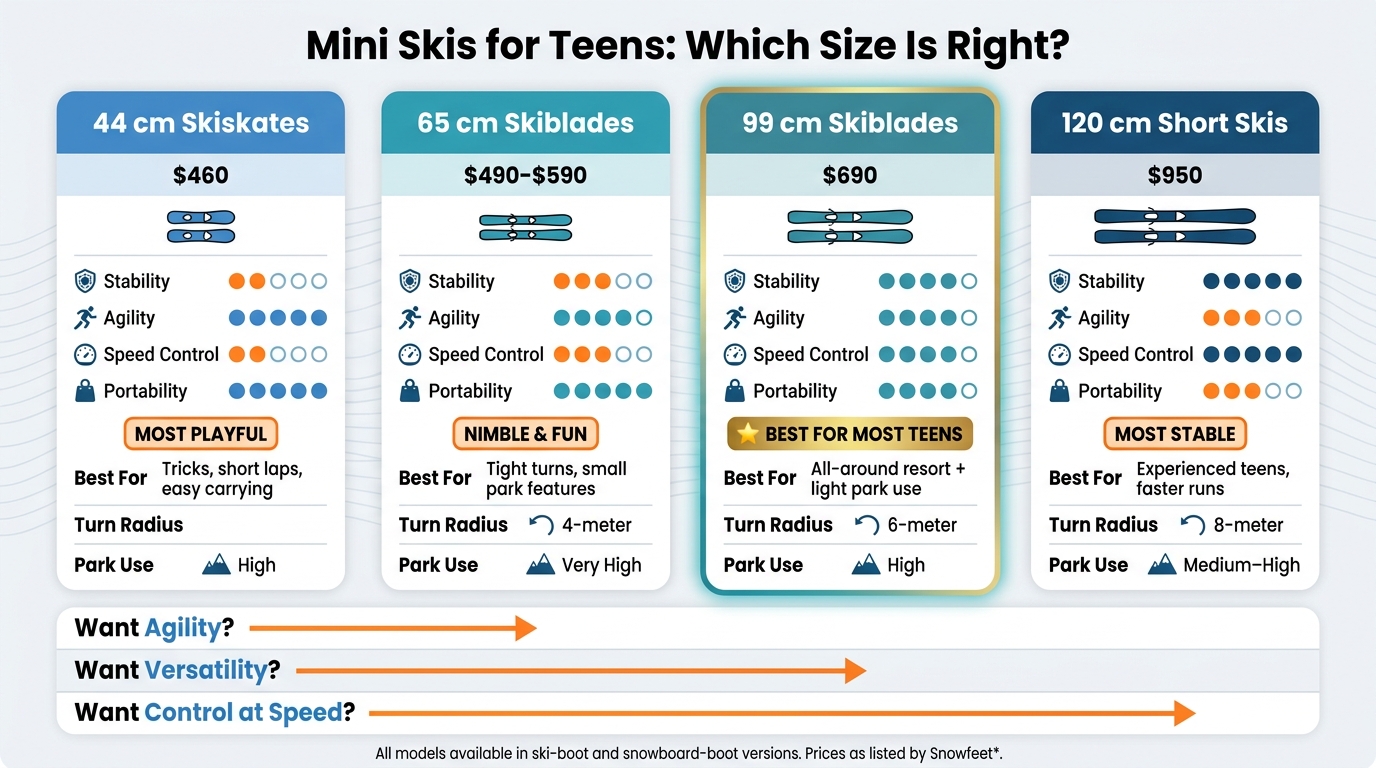
Mini Skis for Teens: Size Comparison Chart (44cm to 120cm)
| Model | Best for | Stability | Agility | Price |
|---|---|---|---|---|
| 44 cm Skiskates | Tricks, short laps, easy carrying | Low–Medium | Very High | $460 |
| 65 cm Skiblades | Tight turns, small park features | Medium | High | $490–$590 |
| 99 cm Skiblades | Most teens, mixed resort use | Medium–High | Medium–High | $690 |
| 120 cm Short Skis | More experienced teens, faster runs | High | Medium | $950 |
What I like about this lineup is simple: each length has a clear job. No guesswork. Pick based on how your teen rides now, not how they hope to ride by spring break :)
1. Snowfeet* Skiskates 44 cm
At 44 cm (17.3 inches), the Skiskates are the smallest option in the Snowfeet* lineup. They’re also the most playful. If your teen likes quick moves, little tricks, and short fun laps, this model is a strong match.
Stability and Speed
Because they’re so short, they turn with very little effort. That’s the good news. The tradeoff is less stability once speed picks up. These are better for short, playful runs than full top-to-bottom charging.
Turning Agility
This is where the 44 cm model shines. Edge-to-edge moves feel fast and snappy, which helps with quick turns, spins, and tight movement. They can be a blast, but they do ask for some control. Stopping takes deliberate technique, so it’s smart to start slow.
Terrain Park Fit
That same quick feel makes the 44 cm model a nice fit for small park features. The compact size also makes them easy to carry, which is handy if your teen is walking around the park or doing repeat laps. They work well for spins, skating drills, and small park features.
They are not built for large jumps or advanced park use. Think of them as a good stepping stone for teens who are still getting comfortable on easier features before moving up to bigger terrain.
Boot Compatibility
Pick the ski-boot or snowboard-boot version when you buy, based on the boots your teen already uses. Supportive, waterproof boots work best.
If the 44 cm Skiskates seem a bit too twitchy for your teen, the 65 cm Skiblades give you more stability while still keeping that quick, playful feel.
2. Snowfeet* Skiblades 65 cm
At 65 cm, or about 26 inches, these are a smart next step for teens who want more stability than the 44 cm Skiskates but still like fast, snappy turns. Snowfeet lists them at $490, and you can get them with either ski-boot or snowboard-boot bindings. So, you get more control than the 44 cm model without losing that short-ski feel.
Stability and Speed
The camber shape helps these skiblades carve clean lines and still stay easy to pivot. That’s a nice combo for groomed runs and tighter trails. They feel less twitchy, which can help teens relax a bit, but they don’t feel slow or heavy.
Turning Agility
Next to the 44 cm Skiskates, the 65 cm model still turns fast, but it feels calmer and more planted. The 4-meter turn radius helps with tight turns, quick pivots, and fast speed checks, while the short platform keeps swing weight low from edge to edge. In plain English: less wrestling, more riding.
Boot Compatibility
The ski-boot version fits U.S. men’s sizes 4.5–14.5, and the snowboard-boot version fits U.S. men’s sizes 6–14.5. These use non-release bindings, so it’s smart to check the fit with care before the first run.
If your teen wants a bit more stability after this, the 99 cm Skiblades are the natural next move.
3. Snowfeet* Skiblades 99 cm
At 99 cm, or about 39 inches, this is the best do-it-all mini ski for teens who want more stability than the 65 cm model but still want fast, easy turns. Snowfeet lists them starting at $690. They also come with three binding setups, so it’s easier to match them to different boots.
If the 65 cm version felt a bit jumpy, this is the next move. You get a smoother ride on groomed runs without giving up that fun, snappy feel.
Stability and Speed
The 99 cm length gives you more ski underfoot than the 65 cm model. That extra platform helps a lot. With a 6-meter turning radius and slightly raised tips and tails, the ski feels more planted on groomed runs while still staying easy to control at speed.
On groomed blue runs, teens can hold a line without the ski feeling nervous. That can be a big confidence boost when they start moving past beginner terrain.
Turning Agility
These still turn fast. The narrower waist, plus slightly wider tips and tails, keeps the ski light and responsive. So quick direction changes and speed checks stay simple.
In plain terms, it still likes to turn on a dime, but it feels calmer and less twitchy than the 65 cm model.
Terrain Park Fit
The 99 cm length gives teens a more stable landing platform than the shorter Skiblades. That helps on small jumps, rollers, and basic park features.
It’s not automatically safer than regular skis, though. A helmet still matters. Taking things step by step matters too.
Boot Compatibility
There are three binding options:
- Simple ski-boot bindings for U.S. sizes 4.5–14.5
- Pro ski-boot bindings for boot sole lengths of 26–36.5 mondo point
- Snowboard-boot bindings for U.S. sizes 6–14.5
Go with the standard 99 cm model for groomed runs and basic park use. Pick the Powder version only for softer snow.
For teens who want even more calm at speed, the 120 cm Short Skis are the next step.
sbb-itb-17ade95
4. Snowfeet* Short Skis 120 cm
At 120 cm (about 47 in.), this is Snowfeet*’s longest ski and the one that feels closest to a standard ski. If the 99 cm model still feels a bit loose once the pace picks up, this is the next move. At $950, it fits teens who want more support without jumping straight to full-length skis. That’s why it works so well as a bridge before the side-by-side breakdown.
Stability and Speed
With an 8-meter turning radius and a camber profile plus tip and tail rocker, this ski feels more settled and controlled. It still leans more toward resort laps and carving than bombing straight down the hill, but it’s the steadiest short ski in this lineup.
Turning Agility
The shape - about 10.9 cm tip, 7.8 cm waist, and 9.9 cm tail - helps it stay quick from edge to edge. The shorter length makes tight turns and fast direction changes easier. It won’t feel quite as playful right away as the 65 cm Skiblades, but that’s kind of the whole deal here. For a teen moving toward a more standard ski feel, that trade-off makes sense.
Terrain Park Fit
The 120 cm length works well for small jumps, rollers, boxes, and other smaller park features. It gives teens a bit more room on landings while still keeping that short-ski feel. Progress should still be gradual, and a helmet is a must.
Boot Compatibility
Boot options cover a nice range:
- Ski-boot bindings fit U.S. sizes 4.5–14.5
- Snowboard-boot bindings fit U.S. sizes 6–14.5
Measure boot sole length, not just shoe size, and have a ski shop check the binding settings before the first run.
The 120 cm Short Skis are a good fit for teens who can already stop, link turns, and ride lifts with confidence. Use the side-by-side comparison below to see how they compare with the shorter Snowfeet* models.
Side-by-Side Performance and Fit
There are four lengths here, and each one rides a bit differently. The smart move is to pick based on current skill, not the version of yourself that lands spins in your head on day one :) If you already know what each length is like, this side-by-side view makes the choice much easier.
| 44 cm Skiskates | 65 cm Skiblades | 99 cm Skiblades | 120 cm Short Skis | |
|---|---|---|---|---|
| Best for | Trick-focused confident beginners to advanced riders | Progressing beginners and park riders | All-around teens leaving beginner terrain | Confident intermediates to advanced riders |
| Stability | Low–Medium | Medium | Medium–High | High |
| Turning agility | Very High | High | Medium–High | Medium |
| Speed control | Low–Medium | Medium | Medium–High | High |
| Park use | High for spins, flat tricks, and small features | Very high for compact tricks, small jumps, and tight features | High for riders who want both park versatility and resort-run performance | Medium to high for larger, more controlled features |
| Portability | Very High | Very High | High | Medium |
| Key trade-off | Maximum agility, least stability at speed | Quick and fun, less composed on fast open runs | Balanced and versatile, but not as nimble as 44 cm or as stable as 120 cm | Best speed control, least compact and least instantly maneuverable |
For most teens, 65 cm and 99 cm sit in the sweet spot. Go with 65 cm if agility is the main goal. Go with 99 cm if you want more balance across park laps and regular resort runs.
Boot setup comes next, and it matters just as much as ski length. Start by matching the boot type. After that, double-check the exact binding package. Ski-boot and snowboard-boot setups can change by model, and the 99 cm and 120 cm options can include release-binding setups.
| Model | Ski-boot binding | Snowboard-boot binding | US size guidance |
|---|---|---|---|
| 44 cm Skiskates | Yes (non-release, adjustable) | Yes (adjustable) | Ski boots: US 4.5–14.5 / Snowboard boots: US 6–14.5 |
| 65 cm Skiblades | Simple ski bindings may be available by configuration | Yes | Snowboard boots: approx. US 6–14.5 - verify the selected package |
| 99 cm Skiblades | Simple or pro ski bindings may be available by configuration | Yes | Snowboard boots: approx. US 6–14.5 - confirm the selected package |
| 120 cm Short Skis | Available on applicable configurations | Available on applicable configurations | Confirm the exact binding type and sizing before ordering |
One practical heads-up on the 44 cm Skiskates: if you pick the ski-boot version, the non-release binding does not release easily during a fall. That’s good to know before the first run, especially for younger or lighter teens. Always make sure the bindings are fitted the right way and follow the manufacturer’s setup instructions before heading out.
Once length and boot type line up, the next step is picking the model that fits the teen’s riding style.
Pros and Cons by Length
After the model-by-model breakdown, this table makes the trade-offs easy to compare side by side.
| Model | Biggest Pros | Biggest Cons | Best For |
|---|---|---|---|
| 44 cm Skiskates | Most portable, quickest edge-to-edge feel, great for low-speed tricks and playful experimentation | Least stable at speed; not ideal for steep or variable terrain | Trick-curious teens who want maximum fun and easy carrying |
| 65 cm Skiblades | Portable and easy to carry, nimble in tight spaces, strong for spins and small park features | Less composed on fast open runs; limited high-speed confidence | Teens focused on park-style practice, tight turns, and compact freestyle moves |
| 99 cm Skiblades | Best balance of agility and stability; handles park laps and regular resort runs well | Less compact than the shorter two; not as instantly nimble as 44 cm | All-around teens leaving beginner terrain who want one versatile option |
| 120 cm Short Skis | Most stable at speed, best tracking, closest to traditional skis | Least portable; less suited for quick rotations and tight technical tricks | Confident intermediates who prioritize cruising, steeper runs, and control |
Use the table to match ski length to the rider’s main goal:
- Agility: 44 cm or 65 cm
- Balance: 99 cm
- Stability: 120 cm
For teens moving past beginner slopes, the right length should match confidence level, not just big plans. That’s the sweet spot. Go too short, and things can get twitchy. Go too long, and some of the fun, quick feel starts to fade.
Boot fit still comes first. Check the exact binding package before ordering. That part isn’t flashy, but it matters a lot.
Conclusion
Pick the length that fits how your teen rides.
If portability matters most, go with the 44 cm Skiskates. They’re the most compact and playful option. The tradeoff is less stability once speeds climb.
The 65 cm Skiblades are a smooth step up. They give teens more stability for linked turns and better speed control on mellow terrain.
For most teens, the sweet spot is the 99 cm Skiblades. They strike the best balance for riders who want one pair for resort laps and light park use.
The 120 cm Short Skis make more sense for a taller, stronger, or more experienced teen who already knows how to control speed and wants a feel that’s closer to a full ski. You give up some agility, but you get better tracking and more stability.
Full-length skis still do better on steep terrain, powder, and for learning on full-length skis. But for most casual riders, Snowfeet* mini skis bring more fun, more control, and less hassle.
So, if you want the safest default for most teens, 99 cm is the easy pick. And for casual, confidence-building runs, Snowfeet* stands out over full-length skis. These are the mini skis for teens who want real mountain fun without the bulk.
FAQs
How do I know if 99 cm is the right size for my teen?
The 99 cm Skiblades are the best all-around pick for most teens who are past the beginner stage and want a ski that feels fun, steady, and easy to trust.
This size makes sense if your teen is athletic, skis blue runs, or wants one pair that can handle mixed resort terrain, moderate speeds, and light powder. Compared with 65 cm skiblades, they give you more stability, better edge hold, and a smoother ride when the pace picks up.
Are mini skis safe for teens on regular resort runs?
Yes - mini skis can be safe for teens on regular resort runs when they’re used in the right places and in the right conditions. In fact, their lighter feel and easy handling can make them less intimidating than full-length skis, which is a nice bonus for teens who are still getting comfortable on snow.
That said, there’s one thing you don’t want to shrug off: many mini ski models use non-release bindings. So, a helmet and pads are a smart call. Think of it like wearing a seatbelt even for a short drive - simple, sensible, and worth it.
It also helps to keep speeds moderate. Shorter skis can start to feel less stable when things get fast, slick, or steep. The same goes for icy runs, deep snow, and terrain that demands more edge hold and support. Mini skis are fun, but they’re not magic :)
Should my teen use ski boots or snowboard boots?
It depends on comfort and the Snowfeet model. The good news: Snowfeet makes bindings for both, so your teen can usually use the boots they already own.
Ski boots feel stiffer and more supportive. That helps with edging and control, especially on groomed runs.
Snowboard boots feel softer and more flexible. A lot of riders like that for tricks and park laps because they’re easier to move in.
For the 120 cm models, ski boots are recommended for better support and stability.












留下評論
此網站已受到 hCaptcha 保護,且適用 hCaptcha 隱私政策以及服務條款。