



















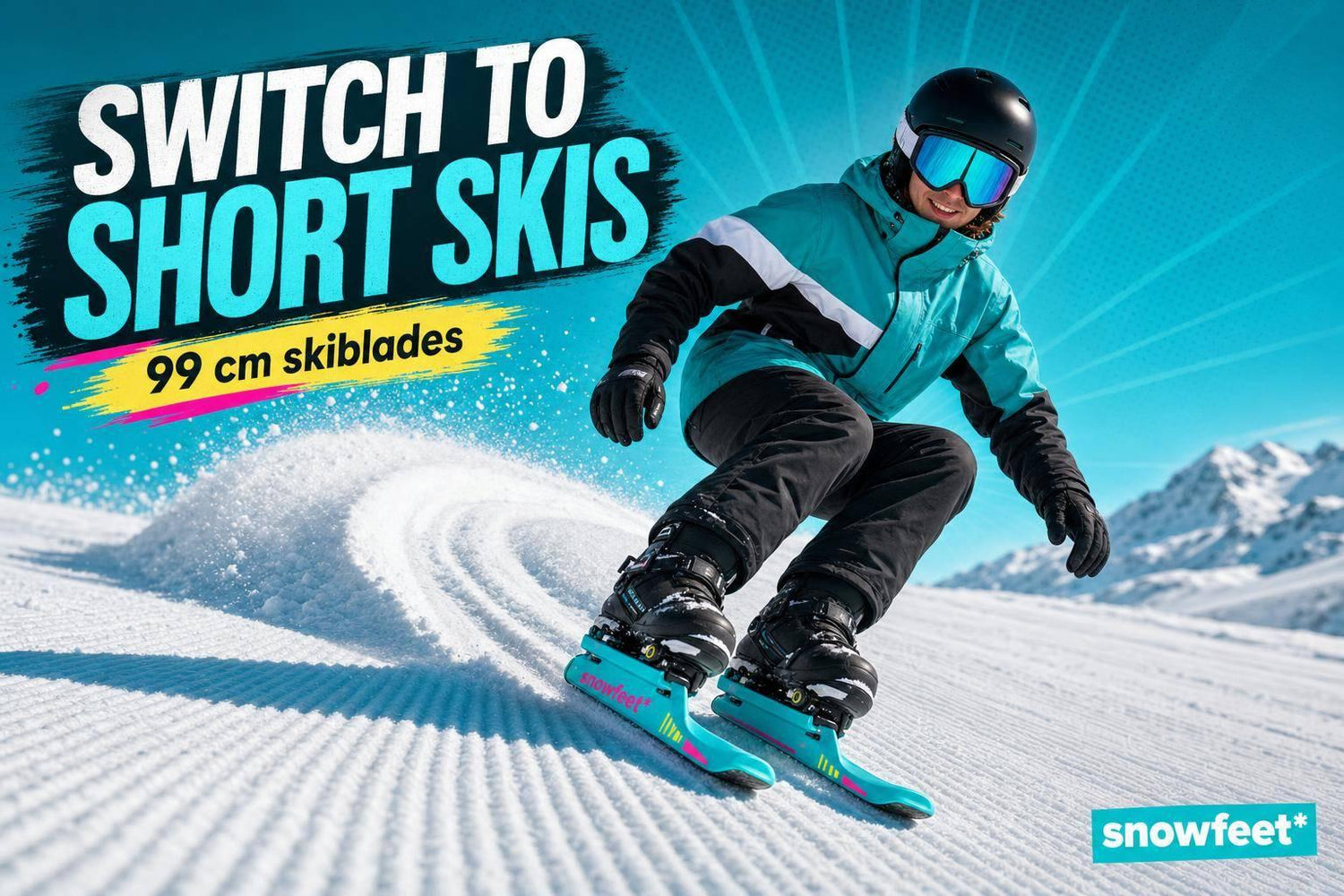
If I were switching from a snowboard today, I’d start with 99 cm skiblades. They give me the shortest path to a calm first run: more stable than 44 cm or 65 cm, less awkward than long skis, and often no new boots needed.
Here’s the short version:
- Snowboard: still best if I want zero change, but flats and lifts can be annoying
- 44 cm skiskates: smallest and most playful, but more twitchy underfoot
- 65 cm skiblades: fast-turning and fun, though less steady at speed
- 99 cm skiblades: best first switch for most riders
- 120 cm short skis: closer to ski technique, but I’ll need ski boots
- Long skis: best for speed, rough snow, and powder, but hardest first switch
- Other-brand snowblades: sit in the middle, though most use ski boots
The big change is simple: on a snowboard, both feet move as one. On short skis, each foot works on its own. If I already know edge control, balance, and speed control from snowboarding, I’m not starting at 0%. But I do need to get used to that split-leg feel.
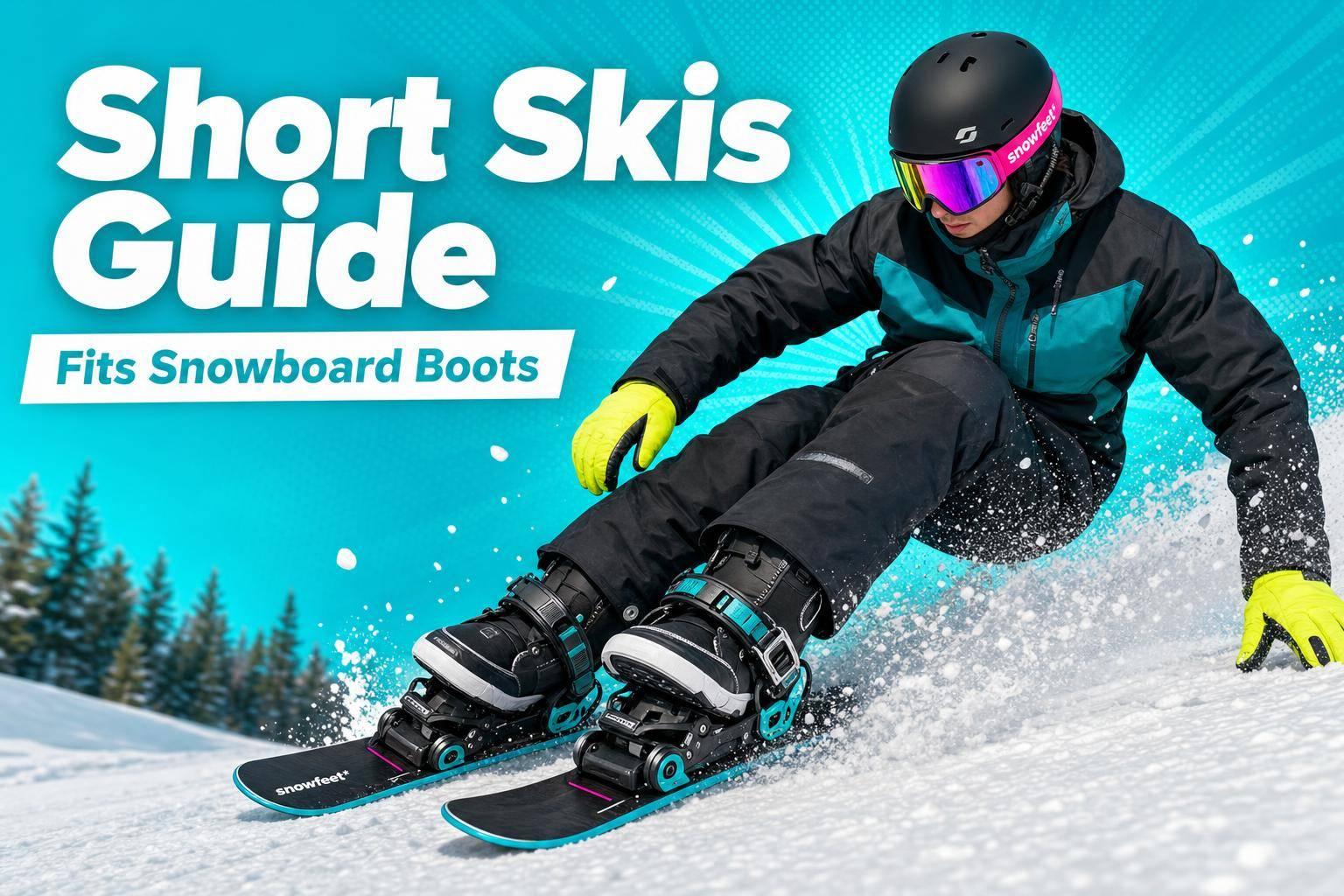
One boot fact matters a lot: Snowfeet* 44 cm, 65 cm, and 99 cm can work with snowboard boots, while 120 cm and most other ski-style setups use ski boots.
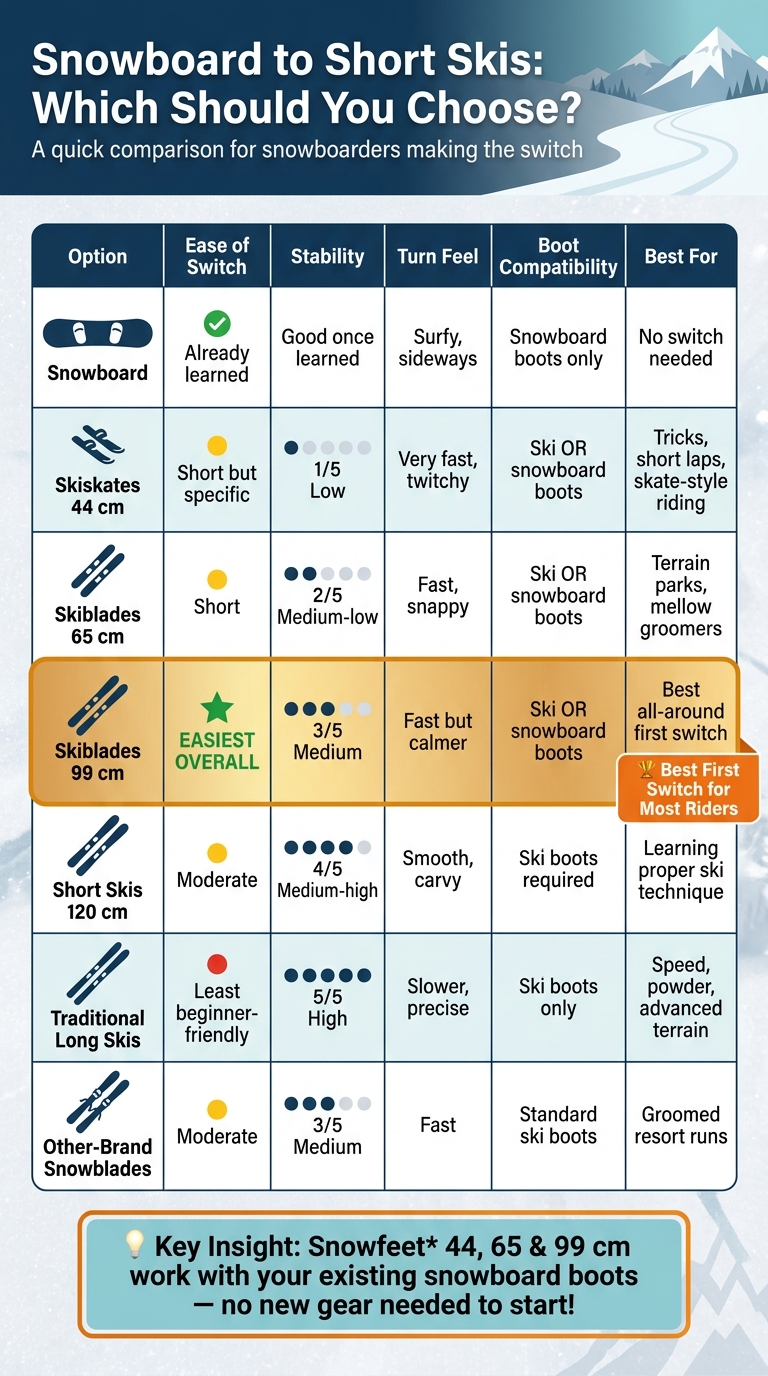
Snowboard vs Short Skis: Which Option Is Right for You?
Snowboarder tries Snowfeet* | Which Snowfeet* Short Ski is the Best? | Snowblades 44, 65, 99 Review
Quick Comparison
| Option | Learning feel | Stability | Turn feel | Boot setup | Best fit |
|---|---|---|---|---|---|
| Snowboard | Already known | Good once learned | Surfy, sideways | Snowboard boots | Staying put |
| Skiskates 44 cm | Short but odd at first | Low | Very fast | Ski or snowboard boots | Tricks, short laps |
| Skiblades 65 cm | Easy | Medium-low | Fast | Ski or snowboard boots | Park, mellow groomers |
| Skiblades 99 cm | Easiest for most | Medium | Fast but calmer | Ski or snowboard boots | First switch |
| Short Skis 120 cm | More ski-like | Medium-high | Smooth | Ski boots | Learning ski form |
| Long skis | Hardest first day | High | Slower | Ski boots | Speed, powder |
| Other-brand snowblades | Middle ground | Medium | Fast | Ski boots | Groomed runs |
A lot of riders don’t want a full reset. I get that. So, if I wanted the easiest first day, I’d pick 99 cm. If I wanted the wild little side quest version, I’d try 44 cm or 65 cm. If I wanted to move toward skiing full time, I’d go 120 cm or long skis.
A couple of helpful videos if you want to see the feel before you buy:
So, that’s the whole story up front: the easiest jump for most snowboarders is 99 cm short skis or skiblades, mainly because they turn fast, stop with less drama, and often let me keep my snowboard boots :)
1. Snowboard
Stance and Body Position
Snowboarders ride sideways with both feet locked to one board. That setup feels stable, but your legs can’t move on their own. And that’s the big thing short skis change.
Turning and Stopping
Snowboarding is all about edge control. You turn with heel-side and toe-side edges, and you stop by rotating the board across the slope and setting the uphill edge.
Short skis feel different right away. Each foot can pivot on its own, so stopping often feels more natural early on. For a lot of people, that’s a huge relief. Less “fight the board,” more “okay, I get this.”
Terrain and Speed Range
Beginners usually do best on wide, groomed green runs. That’s where snowboards feel most forgiving.
Once you move onto steeper blue or black runs, small mistakes can punish you fast. Flat connecting trails and traverses can also be a pain, since you can’t skate forward like you can on skis. If you’ve ever gotten stuck on a flat runout on a snowboard, you know the deal :)
Boots, Lifts, and Mobility
Chairlifts can be rough at first on a snowboard. Most riders keep one foot free, which makes loading and unloading feel less controlled. Early on, that awkward unload can lead to falls.
Getting up after a fall also takes more work, most of all on steeper terrain. You have to roll onto your knees and push yourself up while the board stays across the hill. That gets tiring fast.
That’s why short skis feel easier for many snowboarders, especially the smallest Snowfeet* options. They keep some of that familiar ride feel, but turning and moving around tends to feel simpler.
2. Snowfeet* Skiskates 44 cm
Stance and Body Position
For snowboarders who want the smallest jump into skiing, the 44 cm Skiskates are the most compact pick. At 44 cm (17 in), they feel very different from a snowboard. You’re no longer standing sideways on one board. You face forward, with one skiskate on each foot.
Start with a simple athletic stance: feet about shoulder-width apart, knees bent a bit, and your weight slightly forward. If things feel wobbly at first, that’s normal. Try putting one foot a little ahead of the other. That small tweak can help you settle in fast.
The big shift is this: each ski moves on its own. That means balance feels closer to skating than snowboarding. It’s less “locked in,” more quick-footed.
Turning and Stopping
Turning on Skiskates feels more like ice hockey or rollerblading than snowboarding. You turn by stepping into the carve and keeping your weight centered. Because of the shape, the edges bite fast, so turns feel quick and sharp.
Stopping takes a bit of rewiring. A lot of snowboarders twist their upper body too much at first. A better cue? Keep your chest facing more downhill and let your feet do the work. Practice small, controlled stops by adding edge angle and rotation little by little instead of trying to slam on the brakes all at once.
Terrain and Speed Range
Skiskates 44 cm work best on groomed runs, terrain parks, and moguls. They don’t float well in deep powder. On packed snow, they feel nimble and quick to react, but they’re still slower than standard skis.
Start on a gentle green run and get used to the skating motion first. Once that clicks, steeper terrain will feel a lot less sketchy.
Boots, Lifts, and Mobility
Skiskates 44 cm work with both ski boots and snowboard boots, based on the binding version you choose. Ski boots give you more precise edge control and more direct power transfer. Snowboard boots feel more comfortable and familiar for laid-back riding. The ski-boot version fits about US 4.5–14.5, and the snowboard-boot version fits about US 6–14.5.
On chairlifts, things are pretty simple. You load and unload facing forward with both feet on the skiskates, so you don’t need to unstrap a front foot. That alone feels nice if you’re used to the snowboard shuffle.
They’re also small enough to fit in a backpack, which makes them much easier to carry than a snowboard or full-length skis.
If you want a bit more stability but still want fast turns, the 65 cm Skiblades are the next step.
3. Snowfeet* Skiblades 65 cm
Stance and Body Position
If the 44 cm Skiskates feel a bit too twitchy, the 65 cm Skiblades are the next easy move. At 65 cm (26 in), they give you more stability but still keep that quick, snappy feel in turns. The main thing to get used to is the forward stance. After that, the longer platform tends to feel easier to manage.
Turning and Stopping
With a 4 m turning radius, these Skiblades turn fast and stay easy to control. The parabolic shape and metal edges help them hold well on snow, which makes controlled slowdowns feel smooth. Hockey stops work well too.
Compared to a snowboard, stopping can feel a little more hands-on at first. But it usually clicks fast, and the learning curve is short.
Terrain and Speed Range
They do well on groomers, moguls, and in snow parks. That said, they still work best on packed snow. These lean more toward control and agility than flat-out speed.
Boots, Lifts, and Mobility
Like the 44 cm model, this version can still work with snowboard boots. The snowboard-binding version fits US 6–14.5 / EU 38–49 boots, so a lot of riders can keep using the boots they already own.
On chairlifts, the short length feels simpler than a snowboard. And around the resort, the compact size is just way easier to deal with than hauling a full snowboard.
For more stability and speed, move up to the 99 cm Skiblades.
4. Snowfeet* Skiblades 99 cm
Stance and Body Position
If the 65 cm Skiblades feel a bit twitchy, the 99 cm version gives you more stability without giving up the short-ski feel. It’s the next step up from the 65 cm model: still short, still easy to handle, but more planted and more like a ski.
Your stance stays forward, with both feet pointed downhill. If you’re coming from snowboarding, the main shift is pretty simple: keep your upper body calm and let your legs do the work. Don’t twist with your shoulders. Steer from the hips down.
Turning and Stopping
At 99 cm, these Skiblades still turn fast. The short turning radius means edge-to-edge moves happen with little effort, and the strong sidecut helps the skis carve cleanly once you start linking turns.
A good way to start:
- Use a wedge first to manage speed
- Move into parallel turns as you get more comfortable
- Practice hockey stops by keeping both skiblades lined up
That last part matters. If you’ve snowboarded before, the stop will feel familiar, but you need both skiblades working together instead of one board sliding across the snow.
That makes the 99 cm model the best Snowfeet* step for riders who want control first and speed second.
Terrain and Speed Range
These work well on groomed runs and moguls. The 99 cm length lands in a sweet middle ground: more stable than the 65 cm Skiblades at moderate speed, but still quick enough for fast direction changes and small side hits.
In slush or chopped snow, keep your speed in check and stay active through your ankles and knees. That helps you keep the edges engaged instead of getting tossed around. Push them too fast, though, and you’ll notice the limit. They don’t feel as planted as long skis at higher speeds.
Boots, Lifts, and Mobility
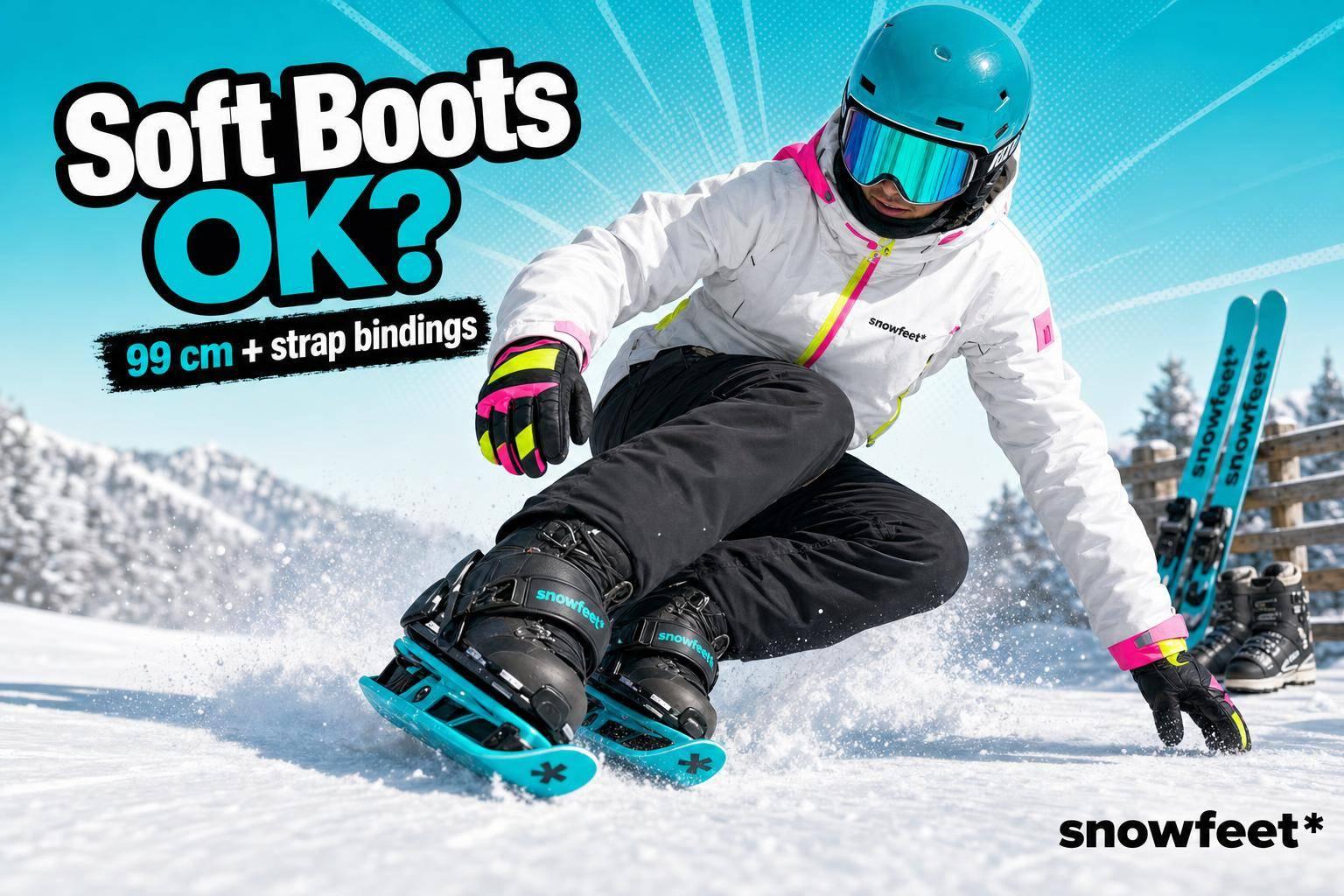
One nice perk here: you can still use snowboard boots. That makes the switch a lot easier if you don’t want to buy a whole new setup. The 99 cm Skiblades are available with snowboard boot bindings (US 6–14.5 / EU 38–49), so riders coming from a snowboard can keep using their current boots.
On chairlifts, the short length is easy to deal with. Load with the tips up, rest them on the footrest, and bring the safety bar down. The compact size also makes loading and unloading simpler than with long skis, with less chance of crossing tips.
So, you get more control than a snowboard, less bulk than long skis, and a boot setup that already feels familiar.
sbb-itb-17ade95
5. Snowfeet* Short Skis 120 cm
If 99 cm still feels a bit too playful, 120 cm gives you more stability without throwing you into the full long-ski world.
Stance and Body Position
At 120 cm (47 in), these feel the closest to regular skis in the Snowfeet* lineup - just without all that extra length to wrestle with. Keep your feet about shoulder-width apart, bend your knees a little, and stay centered over the bindings.
If you ride a snowboard, the biggest shift is simple: you’re now facing forward. That can feel odd at first. But your feel for edging and pressure control still helps a lot. Think of each ski like a small board under each foot. That’s a good mental shortcut.
This is the Snowfeet* pick for riders who want the closest thing to a ski feel while still skipping full-length skis.
Turning and Stopping
Turns feel quick and sharp, thanks to the 7.8 cm (3.1 in) waist and a parabolic sidecut made for carving. Start with a snowplow to keep speed in check. As you get more comfortable, move into parallel turns.
Because they’re shorter, wedge turns feel easier than they do on long skis. That’s one of those small wins you notice right away.
The big difference from the 99 cm model is the extra edge contact. In plain English: they feel more planted at moderate speed. That added contact makes the 120 cm version easier to trust once you start moving faster. The trade-off? At high speeds, longer skis still feel more settled. No magic trick there.
Terrain and Speed Range
The 120 cm model works well on:
- Green and blue groomed runs
- Gentle park features
- Moderate all-mountain terrain
The camber with tip-and-tail rocker helps with carving on groomers and smooths out uneven snow.
Compared with shorter Snowfeet* models, this one gives you the best mix of control and speed without the bulk of long skis. Keep them at moderate speeds where you can link turns with ease. These skis are great for cruising and carving, not for charging full blast down the hill like you’re late for lunch.
Boots, Lifts, and Mobility
The 120 cm Snowfeet* Short Skis use Pro Ski Boot Bindings and fit standard ski boots in 26 to 36.1 MP.
For snowboarders who want tighter edge control and better power transfer, ski boots are the better fit here. On chairlifts and gondolas, the shorter length makes loading and unloading much simpler, with a lot less chance of crossing tips than with full-length skis.
Off the snow, this size is still compact enough to toss into the backseat of a car.
Next, compare that feel with traditional long skis.
6. Traditional Long Skis
Stance and Body Position
If Snowfeet* still feels too short, traditional long skis are the full-length backup. This is the baseline for the whole guide: you face downhill, not sideways, and each leg moves on its own. In return, you lose some of Snowfeet*’s tight, snappy feel.
Keep your shins in light contact with the front of your boots. That helps you stay centered over the ski tips. If you lean back, the tips wash out. And yeah, the skis will let you know fast :)
Turning and Stopping
Start with a wedge to manage speed. Then shift pressure to the outside ski and work toward parallel turns. Long skis turn more slowly than short skis, so they ask for cleaner form instead of fast little pivots.
That slower reaction is the big trade-off compared with short skis.
Terrain and Speed Range
Traditional long skis do best at speed and in mixed snow. That’s the one spot where they beat every other option in this guide. For a snowboarder making the switch, the reward is better stability when you’re moving fast.
The catch? It usually takes more time to get there.
Boots, Lifts, and Mobility
Traditional long skis need hard-shell ski boots. They’re rigid and precise, but not much fun to walk in. On chairlifts, things are simple: sit facing forward, rest the skis on the footrest, and slide off at the top.
The downside is the bulk. Long skis are more of a hassle to carry around the resort and deal with in transit. That trade-off - more stability, less ease - is what sets long skis apart from the short-ski options in this guide.
7. Snowblades from Other Brands
Most snowblades from other brands, like Salomon snowblades or Elan Freelines, use a forward ski stance instead of a snowboard stance. They also tend to use standard ski boots and more old-school ski bindings than Snowfeet*. That’s the big shift here. The stance matters, sure, but the boot and binding setup matters even more.
If you’re a snowboarder, that’s the main thing to think about: do these feel easy enough to make ski boots worth the hassle?
They turn faster than long skis, which is nice. But each ski still moves on its own. So the learning path looks more like skiing than snowboarding. You’ll usually start with a wedge, then work up to hockey stops. That makes them easier than full-length skis, but not as easy as Snowfeet* for someone coming over from a snowboard.
Other-brand snowblades usually work best on groomed runs and mellow resort terrain. They’re a blast on blue runs and moderate slopes. But once the hill gets steeper, or the snow gets chopped up and uneven, they can start to feel a bit less sure under you. So, yeah, they sit in that middle zone: more playful than long skis, but not the easiest pick for snowboarders who want the most simple setup.
Most non-Snowfeet snowblades use standard alpine ski boots with release bindings. If you’ve only ridden a snowboard, that can feel like a pretty big change. Compared with Snowfeet*, these setups feel more like old-school skiing and less friendly for a first switch.
Here’s what you give up with that setup:
- The flex and comfort of snowboard boots
- Easier walking through the lodge or parking lot
- Less hassle carrying gear around the resort
- A more natural feel for first-time switchers
That side-by-side difference starts to matter fast, especially once you look past the ride and think about the whole day on the mountain.
Pros and Cons of Each Option for a First Switch
After the breakdowns above, it helps to put the trade-offs next to each other.
The biggest change with any ski setup is independent leg movement. On a snowboard, both feet move together as one unit. On skis, each foot does its own job. That’s the part most riders feel first. Shorter skis can also feel more freeing than a snowboard, which is part of the fun.
In general, shorter skis are easier to control than long skis. The catch? They give up some stability at higher speeds and can feel less sure in powder.
| Option | What Feels Familiar | Main Drawback | Ease of Switch | Boot Compatibility | Best For |
|---|---|---|---|---|---|
| Snowboard | Everything - home base | Flat traverses; feet locked together | Already learned | Snowboard boots | No switch needed |
| Skiskates 44 cm | Familiar for riders who like quick, playful movement | Sensitive fore-aft balance; skating motion | Short, but specific | Ski or snowboard boots | Best for skate-like movement and tricks |
| Skiblades 65 cm | Quick turns; compact feel | Twitchy at speed | Short | Ski or snowboard boots | Terrain parks, mellow groomed runs |
| Skiblades 99 cm | Edge pressure; speed control; pivot stops | Independent leg movement (at first) | Easiest overall | Ski or snowboard boots | Best all-around first switch |
| Short Skis 120 cm | Carving feel; stable on blues | Length shows in tight turns | Moderate | Ski boots | Closest to real ski technique |
| Traditional Long Skis | Edge concept carries over | Tips crossing; heavy; cumbersome length | Least beginner-friendly | Ski boots only | Advanced terrain, high speed, powder |
| Other-brand snowblades | Shorter than long skis; quicker turns | Usually ski boots; less compact than Snowfeet* | Moderate | Standard ski boots | Groomed resort runs |
So, what does this mean in plain English?
- If you want the easiest switch, Skiblades 99 cm make the most sense.
- If you want something super short and playful, Skiskates 44 cm or Skiblades 65 cm can feel like a fun left turn.
- If you want to move toward more standard ski technique, Short Skis 120 cm are a better fit.
- If your goal is full-on skiing for steep terrain, speed, or powder, Traditional Long Skis still lead the pack.
"Only trade-off is at higher speeds, where longer skis still feel more stable - but for overall fun and maneuverability, these are hard to beat." - Brad Tolin, Verified User
Next, match these trade-offs to your main goal: easiest switch, more control, or a setup that feels closer to standard skiing. Then use the table to narrow your pick based on how much ski technique you want to learn.
Which Option Is Right for You?
Pick based on terrain, speed, and how much ski technique you want to learn. The chart below helps you match your riding style to the shortest learning curve.
If you already know where you ride and how fast you like to go, the choice gets a lot easier.
| Rider Type | Terrain | Best Pick | Best Use |
|---|---|---|---|
| Nervous adult beginner | Green groomers | Snowfeet* Skiblades 99 cm | Short enough to turn with ease, stable enough to stop |
| Intermediate who wants to progress | Greens and easy blues | Snowfeet* Skiblades 99 cm or 65 cm | Fast turns and a natural step up from a snowboard |
| Park-focused snowboarder | Terrain park, side hits | Stay on snowboard or Snowfeet* Skiblades 65 cm | Best for fast turns and park-style riding |
| Parent riding with skiing kids | Mellow groomers | Snowfeet* Skiblades 99 cm or Short Skis 120 cm | Easy to match slow speeds and stop next to beginners |
| All-mountain beginner | Groomed blues | Snowfeet* Short Skis 120 cm | Closest to real ski technique without going all-in on long skis |
| Speed and powder seeker | All-mountain, off-piste | Traditional long skis | Best stability at high speed and in deep snow |
| Curious experimenter | Short laps, parks | Snowfeet* Skiskates 44 cm | Small, easy to carry, and very different from a snowboard |
One thing to note: Snowfeet* 44, 65, and 99 cm can work with snowboard boots. The 120 cm usually needs ski boots, which adds cost.
For snowboarders making the switch, the best setup is the one that changes the least while still giving you more control.
If you want the shortest path to a comfortable first run, start here:
Best first pick: For most snowboarders who want to try short skis, the Snowfeet* Skiblades 99 cm are the easiest and most fun first step. Want something more wild and experimental? Go with 65 cm or 44 cm. Want to lean into proper ski technique? Move up to the 120 cm. For most snowboarders, 99 cm is the easiest first switch.
FAQs
Do I need lessons to switch from a snowboard?
You usually don’t need formal lessons to move from a snowboard to short skis. Most riders pick up the basics in as little as five minutes to a few hours.
The big shift is simple: on a snowboard, you ride sideways. On short skis, you face forward with two separate skis. That can feel a little weird at first - like switching from a skateboard to rollerblades - but it clicks fast for most people.
A lot of what you already know still helps. Your edge control carries over. Your core strength helps too. But stopping is different. Instead of using heel-side braking, you’ll need to learn how to stop with a snowplow or parallel stop.
How long does it take to feel comfortable on 99 cm skiblades?
You can expect to feel comfortable on 99 cm skiblades within just a few runs.
They’re shorter, easier to turn, and more forgiving than long skis. So the learning curve feels smooth, even if you’re new to the sport. You still get solid stability and edge hold, but without that bulky, awkward feel that standard skis can have.
Which short skis are best if I want to keep using my snowboard boots?
If you want to keep using your snowboard boots, Snowfeet* has a few models with special bindings that lock them in place. So, no stiff ski boots needed.
Good picks include the 44 cm Skiskates, 50 cm PRO, and 65 cm Skiblades. If you want more stability and smoother carving on groomed runs, the 99 cm Skiblades work too.
For the best fit, make sure your boots sit snug and centered in the bindings.











ฝากความคิดเห็น
เว็บไซต์นี้ได้รับการคุ้มครองโดย hCaptcha และมีการนำนโยบายความเป็นส่วนตัวของ hCaptcha และข้อกำหนดในการใช้บริการมาใช้