



















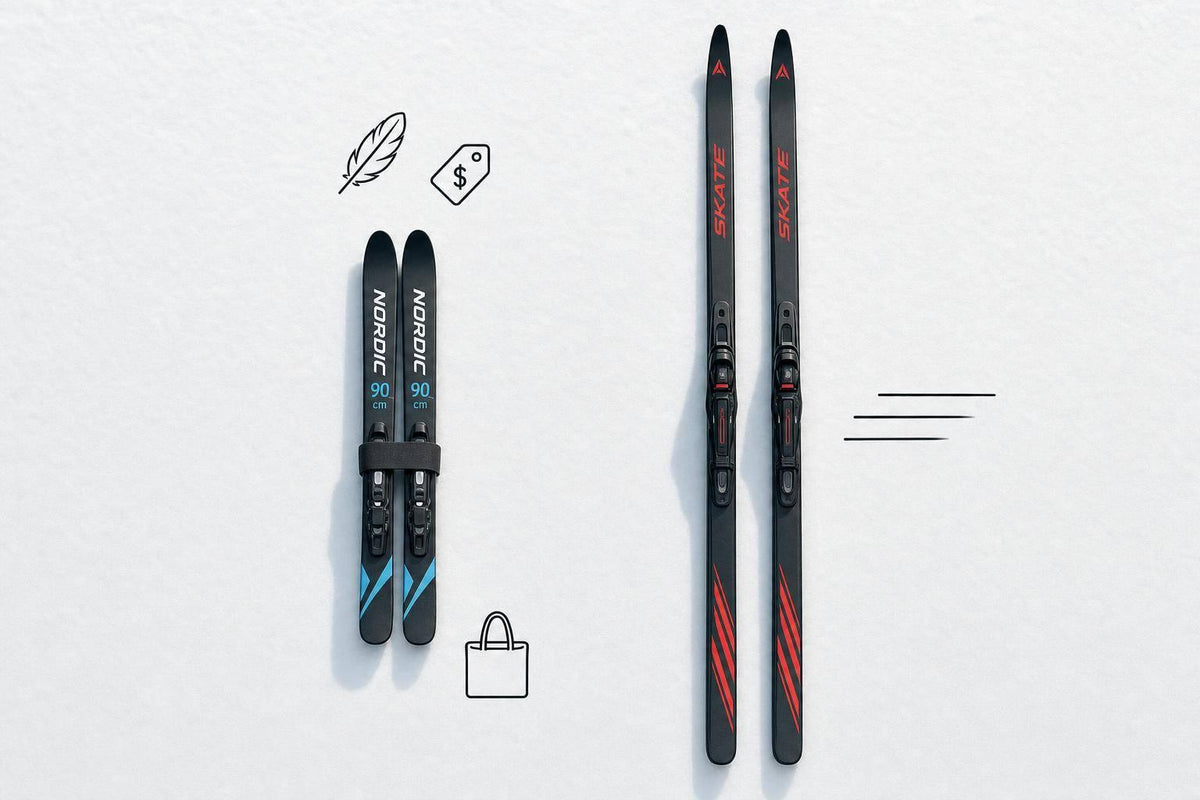
Yes - if you want the short answer, Snowfeet* NORDIC 90 cm is lighter, shorter, and often cheaper to own than standard skate skis. It starts at $450, weighs 3.84 lb. per pair, and works with regular winter shoes. Standard skate skis are usually 67–75 in. long (170–190 cm) and often cost more once you add boots, bindings, and poles.
Here’s the plain-English version:
- Buy NORDIC 90 cm if you want easy transport, simple storage, lower gear hassle, and fun short sessions.
- Buy skate skis if you want better glide, more speed, and longer training days.
- The trade-off is simple: short skis are easier to live with; long skis ski better.
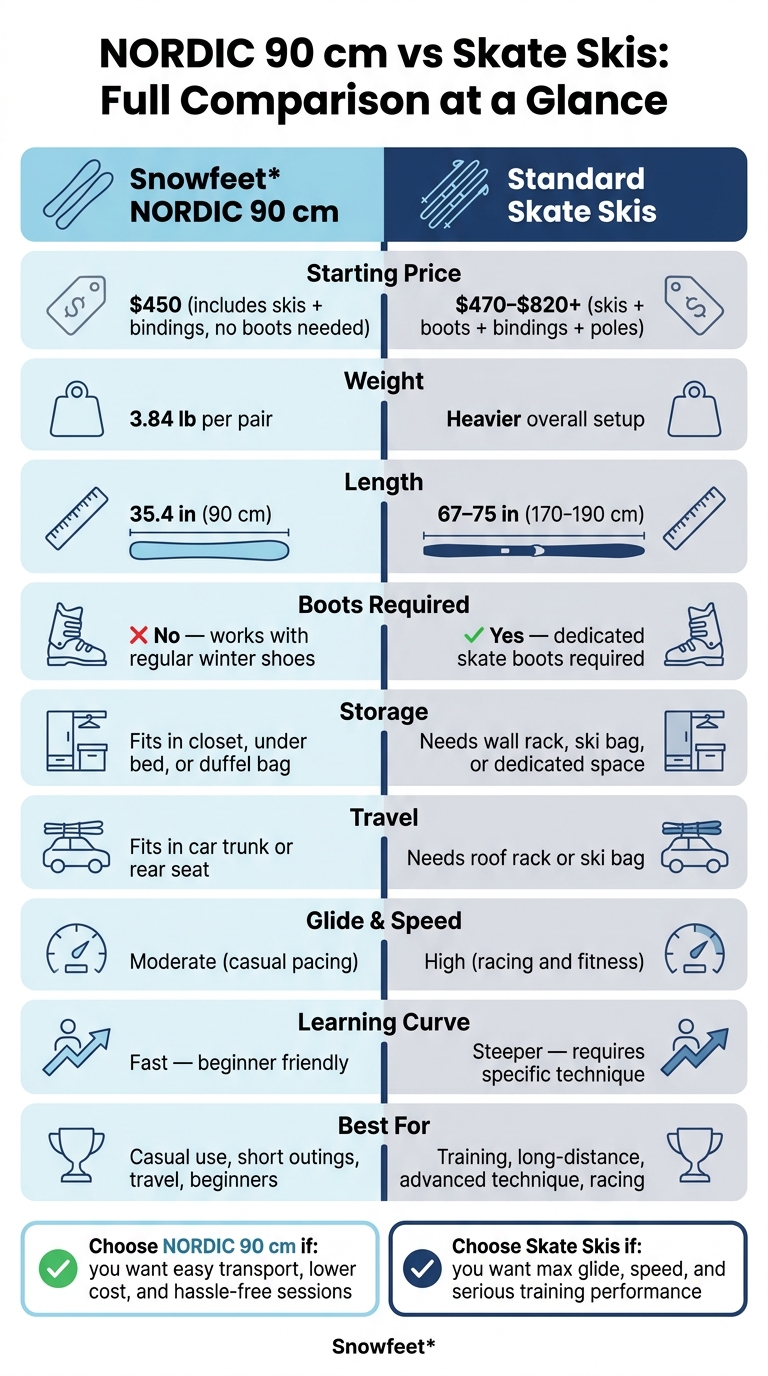
NORDIC 90 cm vs Skate Skis: Full Comparison at a Glance
This Nordic Ski Can Be Attached to Any Winter Shoes | Snowfeet Cross-country Skate Skis | 90 cm
Quick Comparison
| Criteria | Snowfeet* NORDIC 90 cm | Standard Skate Skis |
|---|---|---|
| Starting price | $450 | Usually $470–$820+ for a full setup |
| Weight | 3.84 lb. per pair | Often heavier overall setup |
| Length | 35.4 in. (90 cm) | 67–75 in. (170–190 cm) |
| Boots needed | No - works with winter shoes | Yes - skate boots needed |
| Storage | Fits in small spaces | Needs more room |
| Travel | Easy to pack in a car or duffel | Often needs ski bag or roof setup |
| Glide | Fair | Better |
| Speed | Moderate | Higher |
| Best for | Casual use, short outings, travel | Training, distance, technique |
So, if you’re asking, “What’s easier to own and use?” I’d point to NORDIC 90 cm. If you’re asking, “What skis better on groomed skate lanes?” I’d still point to full-length skate skis. That’s the whole story without the fluff :)
Weight and portability: How 90 cm changes the day-to-day experience
For skiing itself, the size gap matters less than it does in daily life. That’s where NORDIC feels much easier. It’s simpler to carry, pack, and store. And while the weight gap isn’t as big as the length gap, the smaller format still makes a clear difference.
That matters most if you ski now and then, travel a lot, or just don’t want to wrestle with full-length gear every time you head out.
Packing, carrying, and storing Snowfeet* NORDIC vs skate skis
At 90 cm, NORDIC is small enough to fit upright in a standard closet, under a bed, or along a wall. It also usually fits across a trunk or rear seat, so you can skip that awkward diagonal loading that full-length skis often need.
Standard skate skis are a different story. They usually need a roof rack, ski bag, or some dedicated storage setup at home. If you live in a small apartment or drive a compact car, yeah, the difference shows up fast.
Travel is another spot where the shorter format helps. NORDIC will usually fit in regular luggage or a duffel, while full-length skate skis often need a ski bag. And because NORDIC works with regular winter shoes, you have fewer things to bring in the first place.
| Factor | Snowfeet* NORDIC 90 cm | Standard Skate Skis |
|---|---|---|
| Length | 90 cm (35.4 in) | About 170–190 cm (67–75 in) |
| Transport burden | Fits across a trunk or rear seat; often fits in a duffel | Usually needs a ski bag, roof rack, or folded rear seats |
| Home storage | Fits in a standard closet, under a bed, or along a wall | Usually needs wall hooks, a rack, or dedicated space |
| Gear required | Regular winter shoes | Skate boots, bindings, poles, and a ski bag |
For casual users, this is the big practical edge.
"Also a big plus - they're lightweight and much easier to carry around than full-size skis." - Brad Tolin
Who benefits most from the smaller, easier-to-carry format
The biggest winners are people who already see gear logistics as a pain. Think casual riders who only ski a few weekends each season and don’t want a full ski setup taking over the closet. Or beginners who look at long race-style skis and think, nope, not today.
Parents dealing with gear for multiple kids get a clear perk too. Several pairs of NORDIC skis can stack in one trunk without a roof rack. That’s a lot less hassle on a busy winter morning.
The shoe-size range also helps. NORDIC fits US men's 6–13 / EU 38–47, so one pair can work for many users and cuts down on boot-fitting headaches.
So, the value here isn’t only about weight. It’s about making the whole process easier: packing, storing, sharing, and getting out the door with less fuss.
sbb-itb-17ade95
Price and buying value: Upfront cost and total ownership hassle
The sticker price doesn’t tell the whole story. With ski gear, the extras are where your wallet feels it.
How Snowfeet* NORDIC's $450 starting price stacks up
Snowfeet* NORDIC starts at $450, and that price includes the skis and bindings made for regular winter boots. So, you don’t need to buy separate XC boots, and the setup asks for less fuss and upkeep than many classic setups do.
A full skate-ski setup usually costs more once you add the rest of the gear. The ski-only price may look lower at first glance, but that’s not the full bill. You still need boots, bindings, and poles. When you add it all up, a basic entry-level setup usually lands around $470 to $820+.
Where casual users save money beyond the sticker price
For casual riders, the savings often come from the stuff around the skis, not just the skis themselves. You’re buying less gear, dealing with less tuning, and skipping XC boots.
That matters more than it sounds. If you just want to get out, slide around, and have fun without turning your garage into a ski workshop, NORDIC can be the lower-cost and lower-hassle pick.
Full skate skis still make sense for training-focused skiers who want better long-distance performance. But for most casual users, NORDIC keeps the total spend lower and the setup simpler.
Price matters. But glide and stability are what decide if a setup fits the way you want to ski.
Performance trade-offs: Glide, speed, stability, and technique
The lighter, lower-cost setup sounds great. But on snow, performance is what makes or breaks the deal.
With the Snowfeet* NORDIC 90 cm, the big trade-off is simple: you get more convenience, but less glide and less top-end speed. That’s not good or bad on its own. It just means you should know what you’re buying.
| Feature | Snowfeet* NORDIC 90 cm | Standard Skate Skis |
|---|---|---|
| Glide | Moderate; waxless fishscale base and shorter contact length | Superior; full-length base optimized for continuous glide |
| Speed | Moderate; better for casual pacing | High; designed for racing and fitness |
| Stability at speed | Lower; nimble, but feels less stable at higher speeds | Higher; tracks more smoothly at speed |
| Learning curve | Fast; easier to pick up than full-length skate skis | Steeper; requires specific technique and practice |
| Short outings | Excellent; easy to grab and go | Good; but more gear and prep involved |
| Long-distance training | Less efficient for endurance | Best pick for performance and distance |
Where standard skate skis still come out ahead
If glide and speed are your top goals, standard skate skis still win.
The reason is pretty plain. Full-length skate skis use a kick-zone-free base built for efficient glide. Each push carries farther, which matters a lot during long-distance training, race prep, and long, fast sessions on groomed skate lanes.
That extra length helps in another way too: speed feels smoother. Longer skis deal with small bumps and ruts better, stay on line more easily on firm snow, and feel steadier when you’re pushing hard. In other words, they’re less twitchy when things pick up.
"Only trade-off is at higher speeds, where longer skis still feel more stable - but for overall fun and maneuverability, these are hard to beat."
If you’re serious about V1 or V2 technique, or you’re training for ski marathons, you’ll spot the gap pretty fast. For that group, full-length skate skis aren’t just the faster option. They’re the right tool for the job.
Where Snowfeet* NORDIC feels easier and more practical
If ease and convenience matter more than max speed, NORDIC starts to look like the smart pick.
The 90 cm format cuts down on hassle. The shorter ski can feel a bit more like inline skating, so the basic skate motion often clicks faster. Turning, stopping, and moving through crowded or narrow trails also feel easier to manage. That’s a big deal for people who want to get out and ski without making it a whole production.
For casual sessions of 30–90 minutes, beginners, or anyone mixing light skating with other winter activities, that easier feel matters a lot more than top glide. You give up raw speed, sure, but you gain a setup that feels simpler and less demanding.
"It didn't take long to get used to these shorter skis, much easier than the original longer XC skis I used to own a long time ago!"
Conclusion: Who should buy Snowfeet* NORDIC 90 cm and who should stick with skate skis
If you want gear that’s lighter, lower in cost, and easier to use, go with Snowfeet NORDIC 90 cm*. If you want the best glide and better training performance, stick with skate skis. Once you see the trade-offs, the choice gets pretty clear.
Best pick for casual riders, travel, and short sessions
If you ski a few times each winter or just want something easy to toss in the car, Snowfeet NORDIC 90 cm is the better pick*. At 3.84 lb per pair and just 35 inches long, it fits where full-length skate skis simply don’t. That kind of grab-and-go setup also helps explain the price gap.
At $450, NORDIC comes in below the full cost of a skate ski setup once you add boots, bindings, and poles.
Best pick for training and long-distance performance
If your goal is training, long-distance skating, or sharpening advanced technique on groomed skate lanes, standard skate skis are still the right tool. The longer platform gives you better glide, smoother tracking at speed, and stronger energy transfer over distance. Price matters, sure, but performance is what tells you whether the ski matches your goal.
| Your situation | Better pick |
|---|---|
| Casual weekend outings, short sessions | Snowfeet* NORDIC 90 cm |
| Travel, limited storage, no dedicated boots | Snowfeet* NORDIC 90 cm |
| Structured training, long-distance endurance | Standard skate skis |
| Racing, advanced technique development | Standard skate skis |
For most casual riders, NORDIC is the practical buy.
FAQs
Can I use NORDIC 90 cm on groomed skate trails?
Yes - Snowfeet* NORDIC 90 cm works well on groomed skate trails, including groomed Nordic tracks, wide skate lanes, and snowmobile-packed surfaces.
Compared with old-school skate skis, they give you less glide and aren’t as efficient for long training sessions or racing. But they’re easier to control, quick to turn, and less likely to cross tips. That makes them a great fit for casual riders, families, and beginners.
Are NORDIC 90 cm good for complete beginners?
Yes. Snowfeet* NORDIC 90 cm are a great pick for complete beginners. At just 35 inches long, they feel way less intimidating than standard 67–75 inch skate skis.
That shorter length makes a big difference when you're starting out. Most beginners find them easier for:
- balance
- turning
- recovering from small mistakes
The learning curve is usually faster, too. And since you can use standard winter boots instead of specialized cross-country gear, the whole setup feels a lot more approachable. That’s one less hurdle when you’re just trying to get out there and have some fun :)
What extra gear do I need with NORDIC 90 cm?
Very little. Snowfeet NORDIC 90 cm* works with your current waterproof winter boots or snowboard boots, so you do not need special cross-country ski boots.
Poles are optional, more so for your first session. The waxless fishscale base means there’s no need for grip wax. If you’re heading out on dry, cold snow, cold-weather glide wax can help. A soft storage bag is also nice to have if you want to keep the bases clean.











ฝากความคิดเห็น
เว็บไซต์นี้ได้รับการคุ้มครองโดย hCaptcha และมีการนำนโยบายความเป็นส่วนตัวของ hCaptcha และข้อกำหนดในการใช้บริการมาใช้