




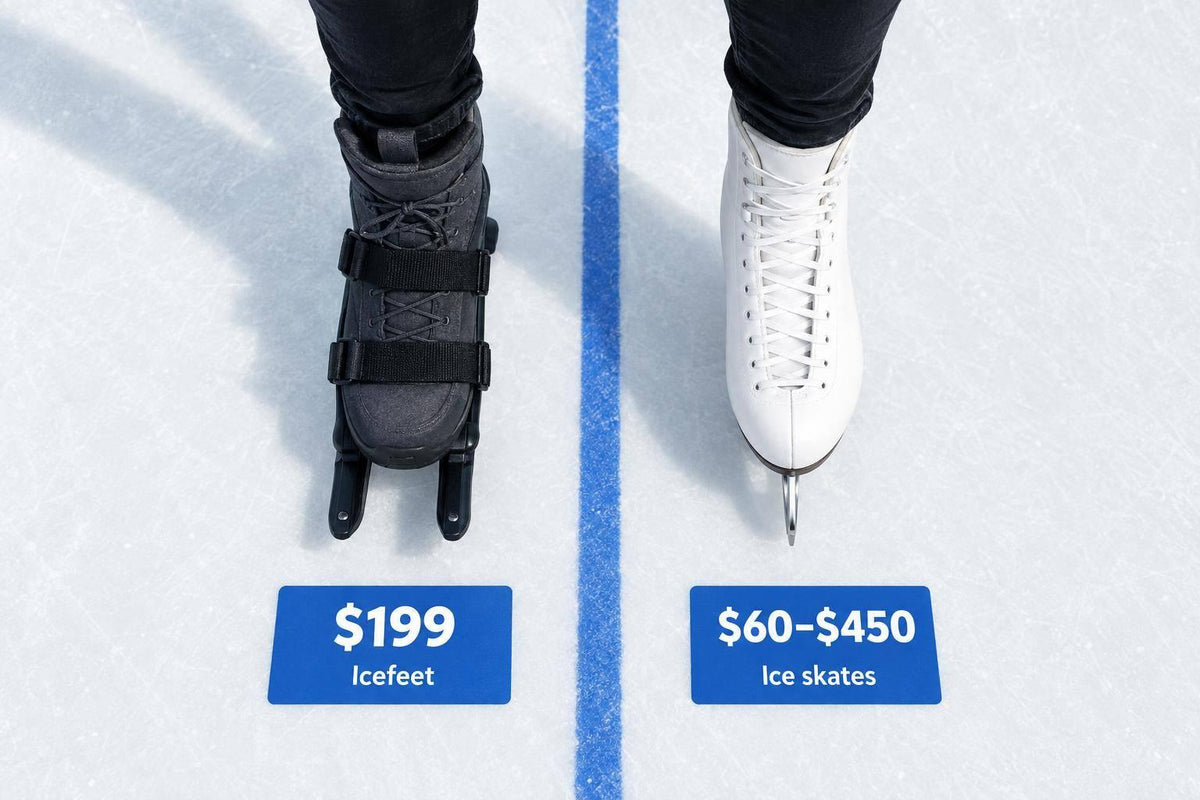
Icefeet list at $199 - more than entry-level ice skates at $60–$150. My advice: choose based on how you’ll skate, not just the price. Icefeet suit casual gliding with boots you already own; fitted skates offer more control for lessons and regular rink visits.
Here’s how I’d compare your options:
- Icefeet: Strap-on double blades for compatible winter boots. Add boot costs if you need a pair.
- Entry-level skates: A boot-and-blade setup for beginners and occasional rink trips.
- Mid-range skates: Usually $200–$450, with better support or fit, depending on the model.
Quick Comparison
| What I’d check | Icefeet | Entry-level skates | Mid-range skates |
|---|---|---|---|
| Price | $199 listed | $60–$150 | $200–$450 |
| Footwear | Your compatible boots | Skate boots usually included | Skate boots usually included |
| Best use | Casual gliding | Basic rink skating | Lessons and frequent use |
| Control | Limited edge control | Single-blade edge control | Single-blade edge control |
| Added costs | Boots if needed; parts and blade protection | Guards and sharpening | Guards and sharpening |
These are listed prices and comparison ranges, not live quotes. I’d check package contents, fit, tax, shipping, and return terms before buying. For Icefeet, I’d also confirm that your rink allows strap-on double blades.
My bottom line: <u>compare the total cost against how often you’ll skate</u>. At $199, Icefeet cost about $19.90 per outing over 10 outings, before extras. Their main draw is convenience - not the lowest price.
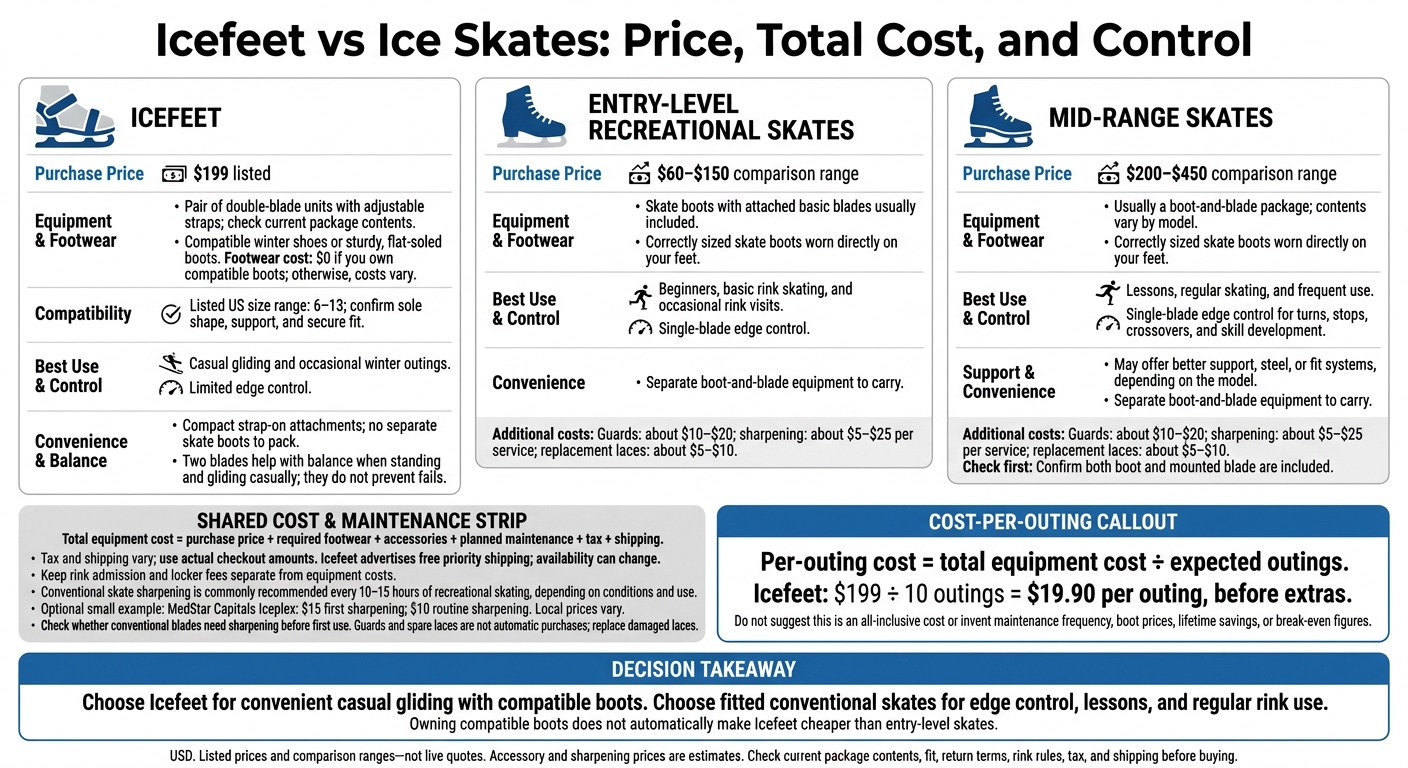
Icefeet vs Ice Skates: Price, Total Cost, and Control
Finally… Ice Skates Anyone Can Use!
Purchase Prices and Included Equipment
Here’s what you get for each price - and what you may need to buy separately.
| Option | US price | Included equipment | Footwear requirement | Best suited to |
|---|---|---|---|---|
| Snowfeet* Icefeet | $199 listed price | Pair of double-blade units with adjustable straps; check current package contents | Compatible winter shoes or sturdy, flat-soled boots | Casual gliding with winter boots |
| Entry-level recreational skates | $60–$150 comparison range | Usually skate boots with attached basic blades | Correctly sized skates worn directly on your feet | Beginners and occasional rink visits |
| Mid-range skates | $200–$450 comparison range | Usually a boot-and-blade package; contents vary by model | Correctly sized skates worn directly on your feet | Regular skating, lessons, and more support and control |
Icefeet: $199 for Strap-On Double-Blade Skates
Check the package contents before you buy. Don’t assume boots, a carrying bag, or protective gear come with it. Recommended footwear includes compatible winter shoes or boots in roughly US sizes 6–13. Check your footwear’s sole shape and boot support, too.
If you already own compatible boots, you can use them with Icefeet instead of buying separate skate boots.
Entry-Level Ice Skates: $60–$150
Entry-level recreational skates usually come with a boot and blade. Budget for guards, sharpening, tax, and shipping as well.
These skates suit beginners and casual rink visits - not advanced skating.
Mid-Range Ice Skates: $200–$450
Mid-range skates usually cost $200–$450. That extra spend may get you better support, steel, or fit systems. Confirm that both the boot and mounted blade are included.
If you skate often, the fit and control of dedicated skates may be worth the extra cost. For casual gliding, Icefeet are the simpler option if you already own compatible boots. Footwear, accessories, tax, and shipping also affect what you’ll pay beyond the sticker price.
Total Cost Beyond the Purchase Price
The sticker price is just the start. Footwear, upkeep, tax, and shipping all affect what you’ll pay.
| Cost category | Snowfeet* Icefeet | Entry-level skates | Mid-range skates |
|---|---|---|---|
| Footwear | $0 if you own compatible boots; otherwise, costs vary | Skate boot usually included | Skate boot usually included |
| Accessories | Blade protection: costs vary; check requirements | Guards: about $10–$20 | Guards: about $10–$20 |
| Maintenance: use-dependent | Follow manufacturer instructions; replacement-part costs vary | Sharpening: about $5–$25 per service; replacement laces: about $5–$10 | Sharpening: about $5–$25 per service; replacement laces: about $5–$10 |
| Tax and shipping | Costs vary; free priority shipping advertised | Costs vary | Costs vary |
Accessory and sharpening prices are estimates, not guaranteed charges.
Footwear Costs for Icefeet
Owning compatible boots doesn’t automatically make Icefeet cheaper than entry-level skates. If you need boots, add their actual cost to Icefeet’s $199 listed price.
Icefeet makes more sense on cost if you already own compatible winter boots. Without them, your total goes up.
Accessories, Maintenance, Tax, and Shipping
Conventional skates usually need sharpening. Icefeet care depends on Snowfeet*’s maintenance and strap instructions. Check whether conventional skate blades need sharpening before their first use.
MedStar Capitals Iceplex lists $15 for first sharpening and $10 for routine sharpening; local prices vary.
You don’t have to buy guards or spare laces by default, but you’ll need to replace damaged laces. For Icefeet, check the cost of replacement straps and other parts.
Add the actual sales tax and shipping shown at checkout. The advertised free shipping can change. Keep rink admission and locker fees separate from equipment costs. With those costs in hand, you can compare what each option costs per outing - not just what you pay at checkout.
Estimate Cost per Outing
Per-outing cost = total equipment cost ÷ expected outings. Count required footwear, accessories, planned maintenance, tax, and shipping in that total.
Use the number of outings you expect next winter, rather than assuming years of use. Casual gliders may prefer Icefeet because they’re easy to set up with familiar winter boots. Frequent skaters may get enough use from dedicated skates to justify the cost.
Sharpening is commonly recommended every 10–15 hours of recreational skating, depending on ice conditions and use. For casual outings, Icefeet’s ease of use is a stronger reason to choose them than any promise of the lowest cost per outing.
sbb-itb-17ade95
Convenience, Stability, and Skating Control
Price is only part of the choice. Compare how much gear you’ll carry and how much control you need on the ice.
| Factor | Snowfeet* Icefeet | Conventional skates |
|---|---|---|
| Gear to carry | Compact strap-on attachments; no separate skate boots to pack | Separate boot-and-blade equipment to carry |
| Footwear compatibility | Fits compatible winter boots | Requires a properly fitted skate boot |
| Balance and stability | Two blades help with balance when standing and gliding casually | Depends on fit, blade profile, and technique |
| Edge control | Limited; built for balance and simple gliding | Inside and outside edges support turns, stops, crossovers, and other skills |
| Intended activity | Casual gliding and occasional winter outings | Lessons, regular rink sessions, hockey, figure skating, and skill development |
| Best use frequency | Occasional use when convenience matters most | Regular use and continued skill development |
Icefeet for Casual Gliding in Winter Footwear
Icefeet mean less gear to buy, carry, and store. That makes them a good fit for occasional outings and family winter use. Check that they fit securely and that your boots have firm, fairly flat soles.
They don’t prevent falls. Starting, stopping, and turning still take practice. Before heading out, check whether your rink allows double-blade strap-on skates and requires protective gear.
Conventional Ice Skates for Lessons and Frequent Use
Single blades give you better edge control for turns, stops, crossovers, and skill practice. For lessons and structured training, that control can make the extra cost worth it.
Choose figure skates for figure-skating lessons and hockey skates for hockey. Check the class rules, too: some programs don’t allow double-blade skates.
For regular skating, fit, ankle support, and blade condition matter more than price alone. Conventional skates help you build technical skills. Icefeet put convenience first for casual gliding, provided they fit securely and your rink allows them.
Conclusion: Icefeet for Casual Skating
The lowest price tag isn’t always the best value. Your footwear and how often you skate matter, too. Snowfeet* Icefeet offer convenience and make the most sense for skaters who already own compatible winter boots.
Before buying, check the advertised price, shipping costs, return terms, and what’s in the package. For Icefeet, make sure your boots are sturdy, have flat soles, and fit the bindings. Check the listed US size range of 6–13, too. For conventional skates, confirm the fit and whether the blades come mounted and sharpened.
FAQs
How can I check whether Icefeet fit my boots?
Icefeet fit adult winter boots in U.S. sizes 4.5 to 14.5. Their adjustable click-lock strap bindings mean you don’t need special skate boots.
Choose waterproof winter boots with flat soles and firm ankle support. Skip soft, flexible footwear - it can shift in the bindings and reduce your control. Before you step onto the ice, tighten the straps until your boots feel locked in, then test the fit on dry ground.
Should I rent skates before buying Icefeet?
No. Icefeet strap onto the winter boots you already own. That means no rental lines, special skate boots, or the usual break-in period.
Their stable double-blade design tends to make them easier for beginners to use than standard skates. But standard skates are better for learning formal skating techniques, playing hockey, or figure skating.
Can my family share one pair of Icefeet?
Yes, your family can share one pair of Icefeet. The adjustable bindings strap onto winter boots you already own. Each person’s boots just need to fall within the supported range: US men’s and women’s sizes 6–13.
For family outings, that means you can skip buying and storing multiple pairs of ice skates in different sizes.











ฝากความคิดเห็น
เว็บไซต์นี้ได้รับการคุ้มครองโดย hCaptcha และมีการนำนโยบายความเป็นส่วนตัวของ hCaptcha และข้อกำหนดในการใช้บริการมาใช้