




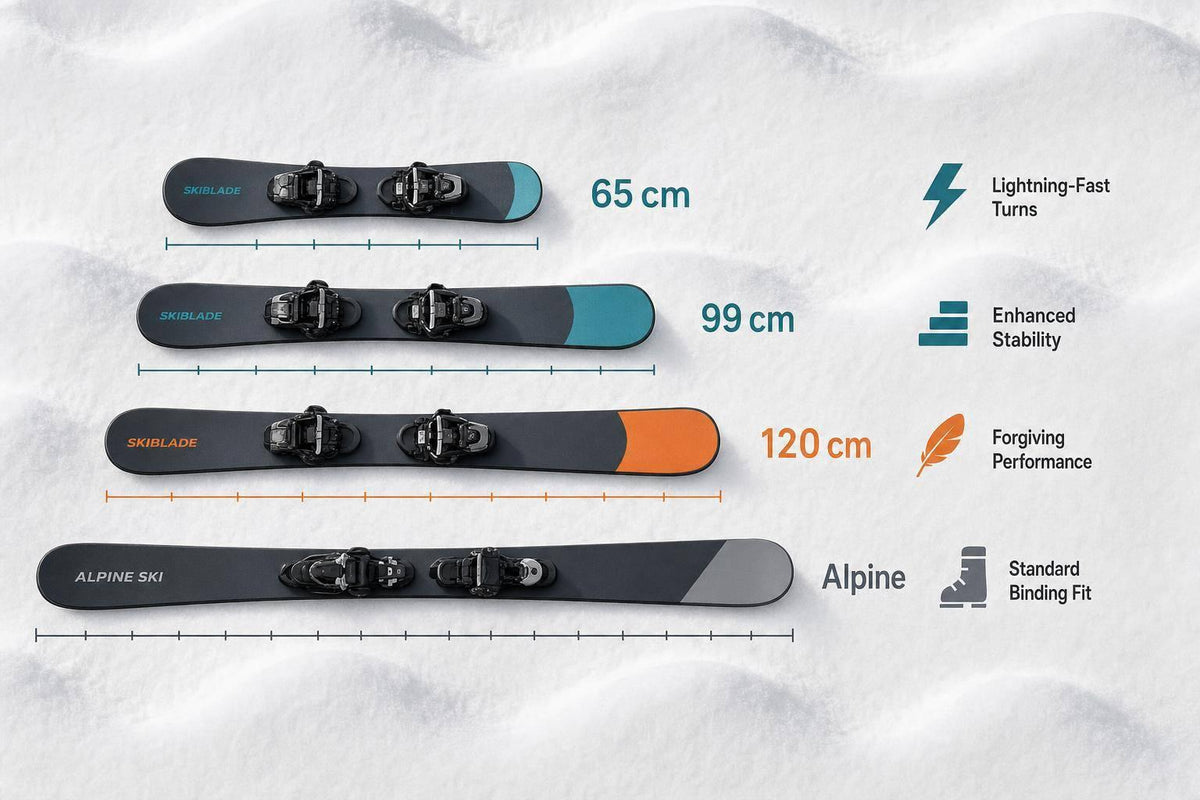
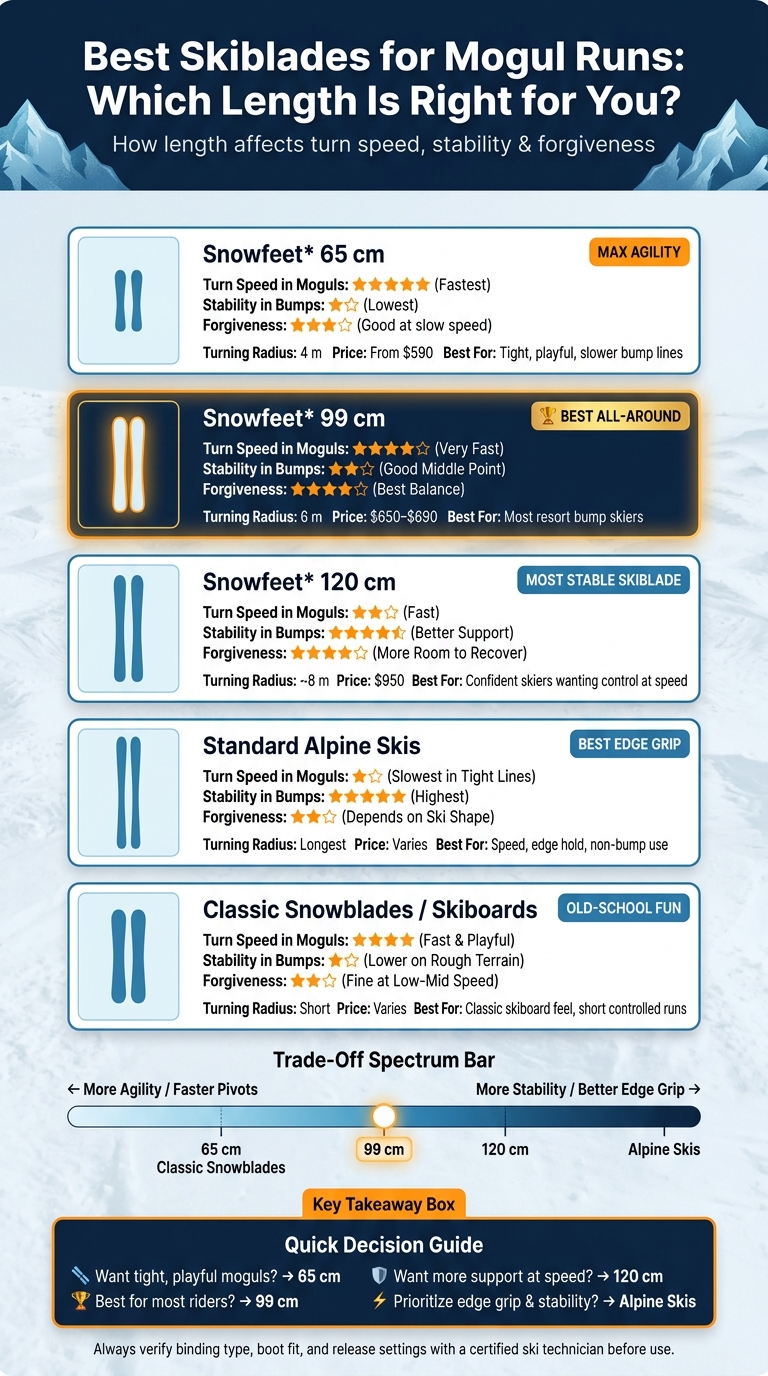
If you ski bumps, ski length changes everything. For most riders, the Snowfeet* 99 cm is the best middle ground. The 65 cm turns the fastest in tight moguls, the 120 cm feels calmer when the run gets steeper, and standard alpine skis still hold the lead for edge grip and support at higher speed.
Here’s the short version:
- Best for most resort bump skiers: Snowfeet* 99 cm
- Best for tight, slower mogul lines: Snowfeet* 65 cm
- Best for more support and a ski-like feel: Snowfeet* 120 cm
- Best for speed, edge hold, and non-bump use: Standard alpine skis
- Best for an old-school short-ski feel: Classic snowblades/skiboards
I looked at each option based on 4 simple points:
- Turn speed in tight bumps
- Stability over rough snow
- Recovery when you get off line
- Boot and binding fit
One big takeaway: short skis are often easier in moguls because they need less room to turn. But there’s a tradeoff. As length drops from 120 cm to 99 cm to 65 cm, turn speed goes up, while support at speed drops. That’s the whole game.
Skiblades vs Alpine Skis for Moguls: Which Length Wins?
Ultimate Short Skis 🎿 Snowfeet* Skiblades 99 CM
Quick Comparison
| Option | Turn feel in moguls | Stability in bumps | Forgiveness | Boot/binding notes |
|---|---|---|---|---|
| Snowfeet* 65 cm | Fastest | Lowest of the group | Good at slow speed, less calm when pace builds | Ski-boot or snowboard-boot versions |
| Snowfeet* 99 cm | Very fast | Good middle point | Best balance for most riders | Multiple binding setups |
| Snowfeet* 120 cm | Fast, but not as loose as shorter models | Better support | More room to fix mistakes | More ski-style binding choices |
| Standard alpine skis | Slowest in tight lines | Highest | Depends on ski shape and stance | Alpine boots/bindings |
| Classic snowblades/skiboards | Fast and playful | Lower once terrain gets rough | Fine at low to mid speed | Fit and release setup vary a lot |
So, if you want the simple answer: pick 99 cm for most mogul days, 65 cm for max slash-and-pivot fun, and 120 cm if you want more support underfoot. Pretty simple. Your knees may still complain, but your skis won’t :)
If you want a quick visual before you buy, these bump-ski videos can help:
- How to Ski Moguls - YouTube
- Short Skis vs Long Skis in Moguls - YouTube
- Skiblades Mogul Skiing - YouTube
1. Snowfeet* Skiblades 65 cm
At 65 cm (about 26 in.), this is the quickest, most nimble pick for tight moguls.
Mogul Agility
A 4 m turning radius and slim shape make these easy to pivot through tight troughs and around closely packed bumps. They suit beginners and playful riders who care more about fast direction changes than calm high-speed tracking.
Bump Stability
The 65 cm length helps you place the ski with care on bump shoulders and in troughs. That said, the trade-off is plain: you lose platform and shock absorption once speed climbs. On mellow to mid-speed moguls, they’re a blast. In steep, fast bump lines, their limits show up fast.
Forgiveness
The short length makes small corrections easier, which is great when you’re working on hockey stops, side slips, and pivot turns. If you get off balance, though, these react fast. So it’s smart to start on groomed blue runs, then move into smaller bumps before taking on steeper moguls.
Boot/Binding Fit
Snowfeet offers the 65 cm Skiblades with either ski-boot bindings or snowboard-boot bindings. The published ski-boot size range is US 4.5–14.5 (EU 36–49), and the snowboard-boot range is US 6–14.5 (EU 38–49).
One thing to watch: the snowboard-boot version uses a different binding system. Before you take it into moguls, double-check the setup and follow the safety guidance.
| Spec | Detail |
|---|---|
| Length | 65 cm / 26 in. |
| Turning radius | 4 m. |
| Tip / waist / tail | 11 / 9.5 / 11 cm. |
| Ski-boot size range | US 4.5–14.5 / EU 36–49. |
| Snowboard-boot size range | US 6–14.5 / EU 38–49. |
| Price | From $590 |
If you want a bit more calm once the pace picks up, the 99 cm model is the next step. You still get that quick, fun feel - just with a touch more support.
2. Snowfeet* Skiblades 99 cm
At 99 cm (about 39 in.), this is the best all-around pick for moguls. It’s quick enough for tight bumps, but it also feels more settled than the 65 cm. That mix makes it a strong choice for bump skiers who want fast turns without that super twitchy ride.
Mogul Agility
The 6 m turning radius and 99 cm length give you enough ski to feel planted, while still letting you pivot fast between bumps. In a tight mogul corridor, you can redirect the skiblades around bump shoulders without needing a big arc. The compact 15/12/15 cm shape also stays easy to move in narrow troughs.
Bump Stability
This is where the 99 cm hits the sweet spot. It tracks calmer than the 65 cm model, with more snow contact underfoot to help when you land a bit off balance. It works better in moderate, groomed resort bumps than in fast, hard-charging zipper lines. So if you get a little out of rhythm, it’s easier to pull things back together.
Forgiveness
For most riders, this is the best balance. It’s easier to recover on than the 65 cm, but it doesn’t ask as much from you as a full-length ski. One thing to watch, though: if you lean back in bumps, the short tails lose support fast. Stay centered and use short pivot turns.
Boot/Binding Fit
Snowfeet offers the 99 cm in three binding setups, with the boot ranges below.
| Binding option | Boot range |
|---|---|
| Simple ski-boot bindings | US 4.5–14.5 / EU 36–49 |
| Pro ski bindings | Mondo 26–36.5 |
| Snowboard-boot bindings | US 6–14.5 / EU 38–49 |
Before you order, double-check which boot type you use and confirm the exact binding specs. Price is about $650–$690, based on the binding package.
If you want more calm at speed and a more planted feel, the 120 cm model is the next step.
3. Snowfeet* Short Skis 120 cm
At 120 cm (47 in.), this model lands right between compact skiblades and standard alpine skis. You get a nice middle ground here: more stability than the shorter Snowfeet* options, but still plenty of snap for fast turns.
Mogul Agility
With an about 8 m turning radius plus camber and tip-and-tail rocker, these skis make tight turns and quick line fixes much easier in moguls. In a narrow bump line, you can pivot around the shoulders of each mogul without needing a big sweeping arc.
Bump Stability
The 10.9 cm tip / 7.8 cm waist / 9.9 cm tail gives you more platform underfoot than the shorter Snowfeet* models. That extra surface helps the ski feel steadier on top of bumps and down in the troughs.
That said, if you're charging straight through big moguls or skiing icy bump lines, longer skis still tend to feel more planted.
Forgiveness
The added length gives you a bit more space to recover from quick mistakes. That helps. But these skis still like a centered stance and smooth, controlled input. If you get too far back, they'll let you know. Fast :)
Boot/Binding Fit
Make sure the binding matches your boot type. The product listing shows these fit ranges:
| Binding type | Boot size range |
|---|---|
| Pro ski boot bindings | Mondo 26–36.1 |
| Ski-boot bindings | US 4.5–14.5 / EU 36–49 / Mondo 22.5–32.5 |
| Snowboard-boot bindings | US 6–14.5 / EU 38–49 |
| Price | $950 |
Before taking them into moguls, have a ski tech check boot fit and release settings. That's one of those small shop steps that can save you from a bad day on the hill.
Next, compare it with standard alpine skis for the most planted option.
sbb-itb-17ade95
4. Standard Alpine Skis
Compared with Snowfeet* 120 cm, standard alpine skis give up some quick pivoting in exchange for more stability. In moguls, they’re the most stable choice of the bunch. But there’s no free lunch here: the added length makes tight bump turns slower and a bit more work than on Snowfeet*.
Mogul Agility
Longer skis need more space to finish each turn. That’s why they feel slower in zipper lines. A narrower waist can help them move edge to edge with less effort, but even then, they won’t pivot as fast as Snowfeet* 65 cm or 99 cm. If you like fast, snappy direction changes, that difference shows up right away.
Bump Stability
This is where standard alpine skis shine. More edge contact gives you better grip on firm snow and in rutted-out bumps. If you’re carrying speed through bigger moguls or skiing a steep bump run, a longer ski feels more planted and more controlled than shorter skiblades.
The trade-off is simple: you get more stability at speed, but you lose some of that easy, quick-pivot feel. Kind of like driving a longer truck instead of a go-kart. More calm, less snap.
Forgiveness
Forgiveness comes down to the ski and your stance. Softer, rockered models are easier in smaller bumps. Stiffer, longer skis can punish a back-seat stance fast. Stay centered, keep your balance over the middle of the ski, and absorb the bumps with your legs. That part matters a lot.
Boot/Binding Fit
Standard alpine skis use alpine boots and bindings. If you have GripWalk boots, make sure the bindings are GripWalk-compatible. And before you head into moguls, have a certified tech set the release values.
Next: classic snowblades and skiboards.
5. Classic Snowblades and Skiboards
Classic snowblades and skiboards feel quick and playful in moguls. But as speed picks up and the pitch gets steeper, they give you less stability and less room to recover from mistakes. Compared with Snowfeet* 65 cm, 99 cm, and 120 cm, they land much closer to the old-school side of the short-ski range.
Mogul Agility
Classic skiboards turn fast in bumps, and their low swing weight helps your feet move fast through controlled mogul lines at moderate speeds. That part is fun. You can flick them around with very little effort.
The tradeoff shows up in precision. Their wider platform makes edge-to-edge moves feel less exact than on Snowfeet* 99 cm or 120 cm. And when the bump line gets rougher or faster, that quick feel can start to feel a bit twitchy.
Bump Stability
At low to moderate speeds, they feel stable enough. Once you move into steep, uneven bumps, the short length gives you less support than Snowfeet* 99 cm or 120 cm.
Forgiveness
Classic snowblades rotate with ease, which helps in tight lines. But they don’t give you much grace if you get lazy with stance. Drift into the backseat, and they’ll remind you fast. Stay centered and keep your speed under control.
Boot/Binding Fit
Before you buy, check a few key things:
- Binding type
- Boot-sole-length range
- DIN
- Release certification
Have release bindings set by a qualified technician.
Next: a side-by-side look at the strengths and drawbacks of each option.
Strengths and Drawbacks of Each Option
Here’s the trade-off in plain English: binding type can change both safety and boot fit.
And yeah, that matters more than a lot of people think.
After looking at each option side by side, this is the short version of what you gain and what you give up.
| Item | Main pros | Main cons | Mogul fit | Skip if |
|---|---|---|---|---|
| Snowfeet* Skiblades 65 cm | Fastest pivots; highly maneuverable; compact; most forgiving in tight bump lines | Least stable at speed; limited flotation; non-release binding setup needs careful review | Best for tight, playful, slower bump lines | You prioritize fast open terrain or a conventional release-binding setup |
| Snowfeet* Skiblades 99 cm | Best balance of agility and stability; works on mixed resort terrain; multiple binding options | Less nimble than 65 cm in very tight troughs; weaker than alpine skis in deep snow | Best all-around skiblade choice for most resort bump skiers | Riders seeking maximum trick agility or full-size ski performance |
| Snowfeet* Short Skis 120 cm | More stable; better tracking; release ski bindings; closest to a conventional ski feel | Less effortless to pivot in tight, closely spaced moguls | Best for confident skiers who want control at moderate-to-high speed | Beginners wanting the simplest setup, unless snowboard-boot compatibility is confirmed |
| Standard alpine skis | Best edge grip, high-speed stability, and all-mountain range | Longer turning radius; slower and more demanding in tight moguls | Strong - especially for fast or technical mogul skiing | Riders who want a compact, skate-like feel or easier portability |
| Classic snowblades/skiboards | Quick edge changes; compact; easy to transport | Binding and boot compatibility varies; non-release models behave differently in falls | Fine for short, controlled bump runs | Anyone unwilling to verify binding type, boot fit, and safety setup |
Classic snowblades vary a lot. Most feel playful at low speed, then start to feel less steady once the pace picks up.
The big thing to watch is binding type. Release bindings can come off in a fall, but they need compatible alpine boots and a proper shop setup. Non-release systems and snowboard-boot setups play by different rules, so don’t treat them like the same thing.
If you want one simple buying rule, use this:
Standard alpine skis still come out on top for edge grip and calm at speed. Snowfeet* feel quicker and easier in tight bumps. Before you buy, check the binding type, make sure your boots fit, and confirm whether the bindings are included.
Final Recommendation
After looking at speed, stability, and forgiveness, the pick mostly depends on how hard you like to charge through bumps.
For most resort skiers who want strong bump performance without going all the way to full-length skis, the Snowfeet* Skiblades 99 cm is the best all-around choice. It turns fast, feels calmer than the 65 cm, and handles mixed resort terrain well. That’s why the 99 cm is the main reference point here. The other two lengths fit more specific jobs.
Go with the 65 cm if you want tight, slow moguls and max agility. Go with the 120 cm if you want more support in larger, faster bump lines.
Before you buy, check these four things:
- Rider profile: Think about your height, weight, skill level, and how fast you like to ski bumps.
- Terrain expectations: Tight, closely spaced moguls lean shorter. Bigger, faster bump fields lean toward the 120 cm.
- Control priorities: Shorter lengths feel easier to pivot and more playful. Longer lengths give more support and feel closer to a standard ski.
- Safety and instruction: Check manufacturer limits before you buy, and start on easier terrain if you’re new to very short skis.
Here’s the simplest way to choose.
| Rider need | Best choice | Why |
|---|---|---|
| Best overall option for most resort riders | Snowfeet* Skiblades 99 cm | Balances quick turning, bump maneuverability, stability, and use across typical resort terrain |
| Maximum agility and playful bump skiing | Snowfeet* Skiblades 65 cm | Easiest to pivot and redirect in tight moguls; best for riders who want fast pivots and playful turns more than speed stability |
| More stability and a more conventional ski feel | Snowfeet* Short Skis 120 cm | Gives more stability and support for experienced skiers, faster runs, and larger or tougher bumps |
| Best for non-mogul skiing and maximum stability outside bumps | Standard alpine skis | Longer effective edges and more flotation give more predictable performance outside the short-ski use case |
| Classic skiboard feel | Classic snowblades or skiboards | Best for riders who want a classic skiboard feel |
FAQs
Which skiblade length is easiest for beginners in moguls?
For beginners learning moguls, the 65 cm Snowfeet Skiblades* are the easiest place to start. Their short length makes turns easier to begin, helps with quick pivots through tight bump lines, and gives you a little more room for error when your timing is off.
The 99 cm models give you more stability as your skills grow. But for learning the basics in bumpy terrain, the 65 cm version feels more nimble and forgiving, which can help you build confidence faster.
Can I use snowboard boots with Snowfeet* skiblades for bumps?
Yes. Snowfeet* skiblades - including the 65 cm, 99 cm, and 120 cm models - come with adjustable bindings that fit most snowboard boots.
That’s a big plus if you care about comfort. Snowboard boots tend to feel softer and easier on your feet than ski boots, which makes them a nice pick for casual riding in bumps. They also pair well with Snowfeet*’s quick, playful feel.
Ski boots, on the other hand, give you more precision and better ankle support. So if you want a tighter, more locked-in ride, they still have an edge.
But for plenty of riders, snowboard boots are the easy, comfy option. Less stiff. Less fuss. More fun :)
Are skiblades or alpine skis better for steep mogul runs?
For most recreational skiers, skiblades are a great pick for mogul runs. Their short length makes quick pivots in tight troughs much easier. They also make speed control feel more natural than it does on longer alpine skis.
Longer skis can feel more stable in fast, aggressive zipper lines. But Snowfeet Skiblades* feel more agile and more forgiving in bumps. For most riders, 65 cm feels the nimblest, while 99 cm gives you a bit more stability.











ฝากความคิดเห็น
เว็บไซต์นี้ได้รับการคุ้มครองโดย hCaptcha และมีการนำนโยบายความเป็นส่วนตัวของ hCaptcha และข้อกำหนดในการใช้บริการมาใช้