





If you’re a heavier beginner, don’t go ultra-short just because it looks less scary. For most skiers around 220 lb, I’d put the Snowfeet* 99 cm at the top for short-ski learning, the 120 cm first if you want more calm underfoot, and standard beginner carving skis first if your main goal is clean carving over time.
Here’s the short version:
- Best overall short ski: Snowfeet* Skiblades 99 cm
- Best for more support and a calmer ride: Snowfeet* Short Skis 120 cm
- Best for long-term carving progress: Standard beginner carving skis
- Least suited to heavier beginners learning to carve: 65 cm skiblades and mini ski skates
Why? Because when ski length drops from 120 cm to 99 cm to 65 cm, turn entry gets easier, but support and edge grip drop too. And at 220 lb, that trade-off shows up fast.
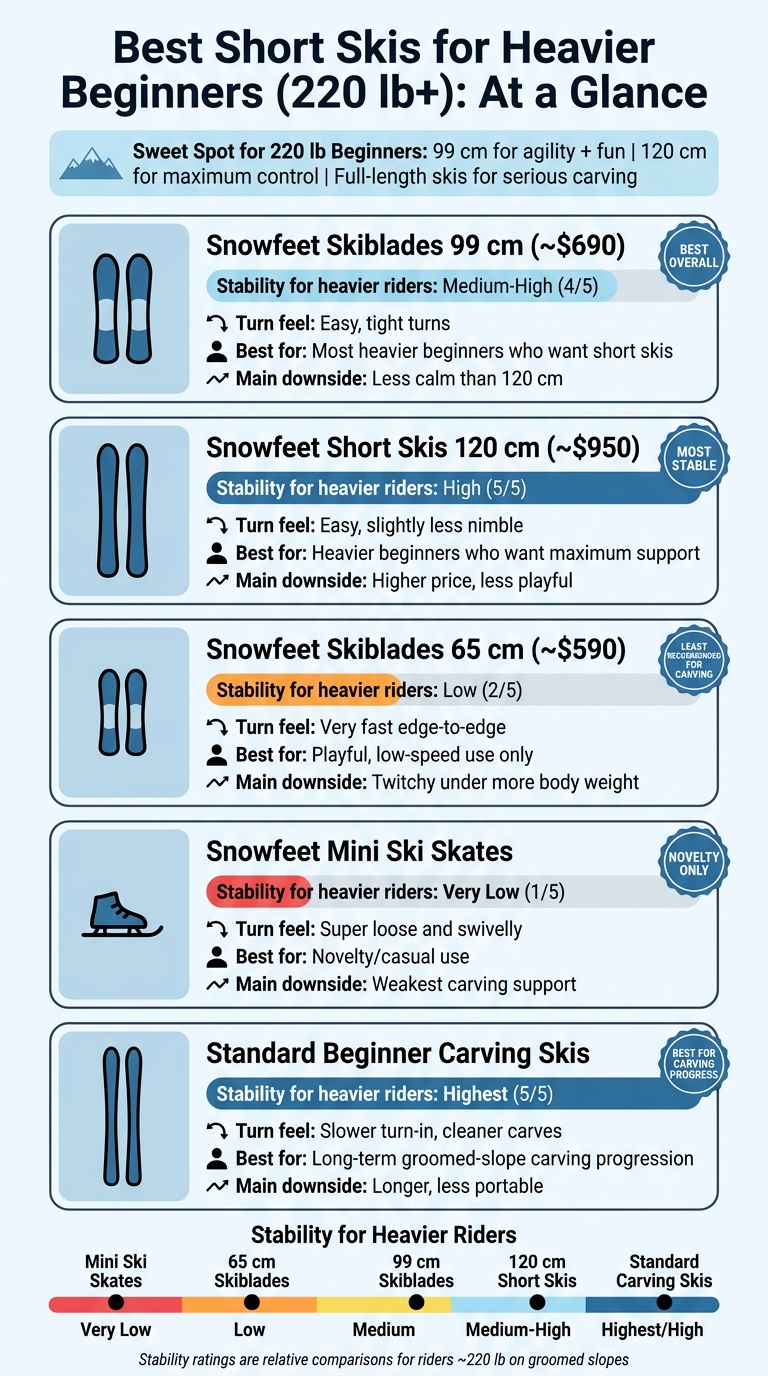
Best Short Skis for Heavier Beginners: Side-by-Side Comparison
Ultimate Short Skis 🎿 Snowfeet* Skiblades 99 CM
Quick Comparison
| Option | Best for | Stability for heavier beginners | Turn feel | Main downside |
|---|---|---|---|---|
| Snowfeet* Skiblades 99 cm | Most heavier beginners who want short skis | Medium-high | Easy, tight turns | Less calm than 120 cm |
| Snowfeet* Short Skis 120 cm | Heavier beginners who want more support | High | Easy, slightly less nimble | Costs more, less playful |
| Snowfeet* Skiblades 65 cm | Playful, low-speed use | Low | Very fast edge-to-edge | Can feel twitchy |
| Snowfeet* Mini Ski Skates | Casual novelty use | Very low | Super loose and swivelly | Weak carving support |
| Standard beginner carving skis | Groomer carving progression | Highest | Slower turn-in | Longer, less portable |
| Other snowblades | Used-market shoppers who check setup well | Varies | Varies | Binding/setup risk |
A few things matter more than the sales pitch:
- Length
- Flex
- Boot fit
- Binding type
- Edge tune
So, if you want a short answer: 99 cm is the sweet spot for many heavier beginners, 120 cm is the safer call if you want more control, and full-length beginner skis still win for pure carving progress. Think of it like this: short skis can be fun, but too short can feel like your skis drank three espressos :)
If you want a simple visual on skiblades vs short skis, these videos can help:
- Stomp It Tutorials – Short Skis / Skiboards basics
- Elate Media – How to carve on skis
- Ski School by Elate Media – Beginner carving tips
1. Snowfeet* Skiblades 99 cm
Stability and Support
At 99 cm (39 inches), these Skiblades give heavier beginners more support than the 65 cm models, but without the bulk of full-length skis. The 11.5–8.5–11 cm tip/waist/tail shape also gives you a larger platform under your boot than the 65 cm version.
That matters a lot when you're starting to link turns. The 99 cm model is the shortest Snowfeet* option that still feels manageable for learning carved turns on groomed runs if you're on the heavier side. It’s short enough to feel less intimidating, but long enough to avoid that twitchy, squirrelly feel shorter skis can have. Before you buy, check the company’s weight and binding specs.
That extra support starts to pay off once you move from single turns to smooth turn-to-turn skiing. That’s where the 6-meter radius comes into play.
Turn Initiation
The 6-meter turning radius helps the ski make quick, tight turns, which is handy for beginners learning to link carved turns on groomed slopes. In plain terms: the ski wants to turn. That can be a big plus when you're still figuring things out.
There is a catch, though. That same quick response can make the ski hook harder than you expect if you lean too hard or twist fast. So don’t muscle it. Add pressure bit by bit and let the edge do the work.
Quick turn entry is nice, but it only helps if the ski can also hold its line when tipped over.
Edge Hold
The camber is meant to keep the ski under control on groomed snow, but edge hold still comes down to two simple things: sharp edges and even pressure. If the edges are dull or your weight gets thrown around, the ski won’t save you. No magic trick here.
It’s best to think of the 99 cm model as a confidence-first groomer ski, not a high-speed stand-in for a longer carving ski. It’s easy to bend, easy to steer, and best on green and easy blue runs. That’s its lane, and honestly, it’s a fun lane.
Boot and Binding Setup
The 99 cm model comes in three setup options:
- Fixed ski-boot bindings: about U.S. men’s 4.5–14.5
- Release ski bindings: about mondo 26–36.5
- Snowboard-boot bindings: about U.S. 6–14.5
Standard release bindings are offered on the 99 cm and 120 cm models, but not on the shorter Skiblades.
For heavier beginners, the goal isn’t just comfort. You need a setup that stays precise when pressure builds. If you're learning to carve, release bindings with alpine ski boots give the best precision and control. Snowboard-boot bindings feel more relaxed, but you give up some accuracy in return.
If you want more stability and a calmer ride, the 120 cm model is the next step up.
2. Snowfeet* Short Skis 120 cm
Stability and Support
At 120 cm, this is the most confidence-inspiring Snowfeet* pick for heavier beginners on groomed slopes. The extra length gives you a calmer, more planted feel at low to moderate speeds. Compared with the 99 cm Skiblades, the 120 cm gives up a bit of quickness, but you get more support underfoot.
It works best on wide, groomed runs while you build your technique.
Turn Initiation
The 8-meter turn radius helps with quick, short turns. That makes it easier for heavier beginners to move from a wedge to parallel turns without feeling like they have to wrestle the ski. The rocker helps the ski enter and exit turns with less effort, while the camber keeps it engaged when you put pressure into it.
That said, this ski can still feel a bit nervous if you stand too upright or move your weight too fast. A centered stance and smooth pressure through the outside ski make a big difference.
Edge Hold
You can expect solid grip on groomers at moderate speed, but not the hard-snow bite you’d get from a full-length carving ski. There’s no independent ice-grip data available, so it’s smart to keep your expectations focused on groomed snow.
For heavier beginners, sharp edges and smooth pressure transfer matter most. On firm snow, clean edge engagement is a big deal.
Boot and Binding Setup
Snowfeet* sells the 120 cm with ski bindings or snowboard bindings. The listed ski-boot fit is about U.S. 4.5–14.5, and the snowboard-boot fit is about U.S. 6–14.5.
Here’s the simple version:
- Ski boots give you the best precision.
- Snowboard boots give you less ankle support and less precision.
- Soft winter boots are the least precise option.
Have a ski shop set the DIN for you. Don’t bump it up on your own just because you weigh more. That’s one of those “looks easy, goes bad fast” ski-shop mistakes.
If you want faster handling and less ski underfoot, the next step down is the 65 cm Skiblades.
| Spec | Detail |
|---|---|
| Length | 120 cm / 47 in |
| Dimensions (tip/waist/tail) | 10.9 / 7.8 / 9.9 cm |
| Turn radius | 8 m |
| Ski-boot binding range | ~US 4.5–14.5 |
| Snowboard-boot binding range | ~US 6–14.5 |
| Listed price | Check current U.S. product page |
3. Snowfeet* Skiblades 65 cm
After the steadier 99 cm and 120 cm models, the 65 cm version is the agility-first outlier.
Stability and Support
At 65 cm, this is the smallest option here. That means less ski on the snow, which gives heavier beginners a much quicker and less stable ride. If you're learning to carve, this is the least forgiving Snowfeet* model in this guide.
It works best on wide, freshly groomed beginner slopes. Think of it as a balance-and-edging trainer, not your main carving ski. It is not a direct substitute for properly sized beginner carving skis.
Turn Initiation
The 4-meter turning radius makes the 65 cm model very quick from edge to edge. That helps with turn entry, but it also means sloppy stance or sudden inputs can bite back. Compared with the 99 cm and 120 cm options, this one turns faster but feels less calm.
The raised tip and tail help it pivot, and the tight radius makes initiation quick. For a heavier beginner, even small movements can lead to fast direction changes. So, smooth pressure matters here. Jerky inputs? Yeah, this ski will notice.
Edge Hold
The 65 cm Skiblades have metal edges, which help on firm groomers. But the short edge length means less contact with the snow than a longer ski, so edge hold has limits, most of all on ice or tracked-up snow. These skis do best on freshly groomed slopes where the surface stays even.
Use smooth, progressive pressure.
Boot and Binding Setup
The 65 cm model comes with ski-boot or snowboard-boot bindings and commonly uses fixed, non-release bindings. That means the boot stays locked in during a fall instead of releasing like a standard alpine binding.
For heavier beginners, the bigger issue isn't just the binding option. It's that this model feels more reactive and less forgiving than the longer Snowfeet* versions. Snowfeet* does not publish a rider-weight limit for this model, so confirm the current weight limit before buying.
Fast and fun, but the least stable choice for heavier beginners learning to carve.
| Spec | Detail |
|---|---|
| Length | 65 cm / ~26 in |
| Dimensions (tip/waist/tail) | 11 / 9.5 / 11 cm |
| Turning radius | 4 m |
| Tip / tail height | ~4.2 cm / ~3.2 cm |
| Ski-boot binding range | ~US 4.5–14.5 |
| Snowboard-boot binding range | ~US 6–14.5 |
| Binding type | Fixed, non-release |
| Price | $490 (confirm current pricing on Snowfeet* product page) |
If 65 cm still feels too supportive for your goals, the next option goes even shorter, with more agility and even less stability.
4. Snowfeet* Mini Ski Skates
If the 65 cm Skiblades already feel a bit nervous, the Mini Ski Skates push even more in that same direction. They’re the shortest and easiest pair to toss in a bag, which is fun. But that tiny platform isn’t a great match for heavier beginners who are trying to learn carving.
Stability and Support
On smooth beginner runs, they’re still usable. Once the snow gets bumpy or chatters under you, though, they give you less support than the 99 cm or 120 cm models.
The longer Snowfeet* options smooth out small changes in the snow and help keep you centered. The Mini Ski Skates don’t do much of that. They pass those little hits right up to your feet. For a heavier rider, that usually means less confidence and weaker edge control.
Turn Initiation
These turn FAST. That’s nice for playful skids and quick direction changes. But for heavier riders trying to build calm, controlled carving skills, that speed can be a headache.
Small weight shifts feel more sudden here. So your room for error is tighter than on any other model in this guide.
Edge Hold
They can hold a short edge on smooth snow. That said, they’re not a steady carving pick for heavier beginners, above all on firm snow, chopped-up runs, or steeper terrain.
This model trades carving support for convenience and novelty. For a heavier rider, that trade usually hurts confidence and edge control more than it helps.
Boot and Binding Setup
The adult model fits about US men's sizes 6–13 / EU 38–47. Use snug snowboard boots or firm winter footwear, and treat the binding as a fit-first setup. Snowfeet* does not publish a clear weight limit, so this model should only be used if the boot fit feels secure.
| Spec | Detail |
|---|---|
| Adult fit | US 6–13 / EU 38–47 |
| Binding type | Adjustable universal (winter shoes or snowboard boots) |
| Kids model | Mini Kids: US kids' 10 to adult US 6 / EU 27–38 |
| Price | See current pricing on the Snowfeet* product page |
| Verified buyer rating | 4.9/5 from 5,799 reviews (Snowfeet*-affiliated review page) |
For heavier beginners, this is a portability-first option, not a carving-first one. If you want solid carving progress, you’ll likely do better with standard beginner carving skis that give you more length, more damping, and better edge hold.
sbb-itb-17ade95
5. Standard Beginner Carving Skis
Compared with the 99 cm and 120 cm Snowfeet options, standard beginner carving skis feel calmer once you pick up speed, but they’re not as quick to turn. They’re the stability benchmark for carving lessons. So, if you want a clean control point, this is it: standard skis are steadier than short skis, but they don’t give you that same easy, instant turn entry.
Stability and Support
A longer ski spreads pressure over more snow, smooths out the ride, and stays more planted as speed climbs. That gives heavier beginners more support than the 99 cm and 120 cm Snowfeet options, though you give up some quickness in return.
A good starting point is a ski in the chin-to-nose range. If you’re on the heavier side, lean a bit longer. For flex, skip both extremes. You don’t want a noodle, and you don’t want something race-stiff either. A supportive but forgiving flex usually hits the sweet spot.
Turn Initiation
Standard carving skis don’t pivot as fast as short skis. Instead of twisting the ski around, you roll your knees and ankles toward the new edge and let the sidecut do the work. That’s the basic carving feel, and on groomers, it’s what helps turns come out cleaner.
For groomed runs, look for:
- A waist width under 85 mm
- A turn radius around 12–18 m
A narrower frontside shape usually rolls onto edge more easily than a wide all-mountain ski, which gives you cleaner feedback on groomed snow. That slower turn-in is the trade-off for a calmer ride, especially for heavier riders.
Edge Hold
On firm groomed snow, standard beginner carving skis usually hold an edge better than short skis. The main reason is simple: they have a longer effective edge and a more standard sidecut. That said, edge hold still comes down to ski shape and tune. Even a good ski won’t feel great if the edges are dull.
Boot and Binding Setup
You’ll need standard alpine boots that fit snugly, with your heel locked in place. That part matters a lot. If your heel lifts, the whole setup gets sloppy fast. Heavier beginners should also avoid boots that are so soft they fold under forward pressure. A comfortable but supportive flex is the right call.
Bindings need to be mounted and adjusted by a pro. Release settings are based on your full skier profile, including weight, height, age, boot-sole length, and ability level, not weight alone. Beginner-to-intermediate alpine bindings often fall in a DIN range of about 3–10, but heavier skiers may need ranges that go to 3–12 or more, depending on their full profile. A certified technician should set and test the release before you ski.
| Factor | What to look for |
|---|---|
| Length | Chin-to-nose height; lean toward the longer end if you're heavier |
| Waist width | Under 85 mm for groomed-slope carving |
| Turn radius | ~12–18 m for manageable short-to-medium turns |
| Flex | Supportive but forgiving - not the softest, not race-stiff |
| Bindings | Professionally mounted; DIN set by full skier profile |
If standard skis feel too long or too locked-in, the next step is to compare them with the other snowblade-style short-ski options.
6. Other Snowblades and Short-Ski Options (e.g., Salomon Snowblades, ODR, Bigfoot-style models)
Compared with Snowfeet* 99 cm and 120 cm models, most non-Snowfeet short skis give something up. In most cases, that means less stability, a trickier binding setup, or both. So the side-by-side is pretty simple: current Snowfeet* models come with clearer specs and less setup guesswork.
Stability and Support
For heavier beginners, the more usable Salomon picks are the longer 99 cm models. The 83–84 cm versions tend to feel too short. Bigfoot-style skis sit at the other end of the spectrum. They’re short and wide, which makes them easy to swivel at slow speeds. But once speed picks up, or you start putting more force into a turn, that tiny platform gives you less support.
ODR is one current short-ski option, with pricing around $449.99 to $499.99. The catch? The listed specs don’t give enough detail to judge stiffness or weight support.
Turn Initiation
This is where length starts to matter. A ski can turn in fast, sure, but if it doesn’t give enough support, a heavier rider may feel like it wants to dart around.
A 99 cm Salomon model usually has enough running length to let the turn build in a more natural way. Bigfoot-style skis, on the other hand, can feel twitchy once speed or pressure goes up. For learning linked carved turns, a bit more length is often the steadier, more confidence-friendly call.
Edge Hold
For heavier beginners, very short or flat models tend to lose edge contact sooner on firm groomers. Narrower, more ski-like shapes with camber and a clear sidecut usually hold on groomed snow in a more predictable way than very short or heavily rockered mini skis.
Boot and Binding Setup
If you’re buying used, slow down and check the details. Verify the binding type, confirm boot sole length, and have a ski tech inspect the setup.
Resale listings for 99 cm Salomon sets with adjustable bindings have shown up around $140, while 82 cm pairs have appeared around $119.99. That extra setup risk is why stability and flex matter more than the brand name by itself. A cheap used pair can look like a steal, but if the bindings are wrong, it’s more headache than bargain.
| Alternative | Best for heavier beginners? | Typical length | Approx. price |
|---|---|---|---|
| Salomon SB10 / MiniMax | More usable than shorter Salomon models; check binding type | ~99 cm | Around $140 in resale examples |
| Salomon SB9 / Propellor | Less ideal; shorter platform, less support front to back | 83–84 cm | Around $120 in resale examples |
| ODR short skis | Possible modern option; specs unverified | Not verified in available specs | About $449.99–$499.99 |
| Bigfoot-style skis | Fun at low speed; not ideal for carving progression | 60–80 cm | Varies |
Used options can work, but they bring setup risk that many heavier beginners just don’t need. The next piece is how these choices handle a heavier beginner’s weight and pressure on snow.
Stability, Carving Progression, and Setup: What Heavier Beginners Need to Know
For heavier beginners, ski length isn't the main thing. Stability, edge grip, and boot/binding fit matter more.
The big trade-off is simple: calmness vs. quickness.
With Snowfeet*, the main choice comes down to the 99 cm and 120 cm models. The 99 cm gives you a nice middle ground. It feels supportive, but it still stays easy to move around. The 120 cm is the calmer option of the two. It feels more planted on groomed runs and makes sense if you want a steadier platform as your turns get stronger.
The 65 cm Skiblades and Mini Ski Skates can be fun, no doubt. But for most heavier beginners who want to learn carving, they can feel a bit twitchy. So it’s better to think of them as side options, not equal choices for this job. After that, the next big factor is boot fit. If the boot fit is off, you won’t feel much of the ski’s stability anyway.
| Model | Best rider profile | Stability | Turning ease | Best terrain |
|---|---|---|---|---|
| Snowfeet* Skiblades 99 cm | Heavier beginner wanting support and agility | Moderate to high; wood core marketed as stiffer and more stable | Easy; short length helps initiate turns | Groomed blue and green runs, controlled carving practice, moderate-speed cruising |
| Snowfeet* Short Skis 120 cm | Heavier beginner who values the calmest platform and longer-term progression | Highest of these four, subject to correct binding setup and technique | Easy, but less instantly pivotable than shorter models | Groomed beginner terrain, wider runs, linking progressively stronger turns |
| Snowfeet* Skiblades 65 cm | Smaller or highly playful rider, or experienced skier seeking maximum maneuverability | Lower for a heavier beginner; very short platform | Very easy to pivot, but twitchy at speed | Slow-to-moderate-speed groomers, compact turns, recreational skiboarding |
| Snowfeet* Mini Ski Skates | Casual user prioritizing portability and novelty | Lowest for linked carved turns, especially for a heavier rider | Extremely easy to swivel at low speed | Short, gentle groomed sections and casual snow play |
What you want is easy turn entry with steady edge grip. Not that jumpy, sudden pivot that makes you feel like the skis have had too much coffee. Start on gentle groomers. Stay centered. Then add smooth pressure into the outside ski as the turn builds.
Once you pick the ski length, boots become your main control lever. A poor boot fit can make even a decent short ski feel shaky. So, yeah, fit quality matters more than the size number on the label.
| Boot type | Best use | Support for heavier rider |
|---|---|---|
| Proper alpine ski boots | Technical carving and maximum edge control | Highest when correctly fitted and compatible with the binding |
| Snowboard boots | Recreational skiblading and a more comfortable stance | Moderate to high, depending on boot stiffness and binding security |
| Supportive winter boots | Casual use on compatible mini-ski products | Low to moderate; sole stiffness and fit matter greatly |
| Soft, loose, or oversized footwear | Convenience only | Low and potentially unsafe; foot movement undermines edge control |
These setup differences shape the pros and cons in the next section. Heavier riders put more load into the binding, so follow the maker’s setup rules and have a ski tech check it.
Pros and Cons for Heavier Beginners
Here’s the quick breakdown for heavier beginners learning to carve. The table below makes it easy to compare stability, carving ease, and fit at a glance.
| Option | Major Pros | Major Cons | Best Fit |
|---|---|---|---|
| Snowfeet* Skiblades 99 cm (~$690) | Good balance of support and agility; easier to transport than full-length skis; works with ski or snowboard boots | Less stable at higher speeds than the 120 cm model | Heavier beginner who wants a versatile, manageable ski that carves well on groomed runs |
| Snowfeet* Short Skis 120 cm (~$950) | Most stable short ski in the lineup; calmer, more planted feel for heavier riders | Less nimble than shorter models; higher price point | Heavier beginner whose top priority is a calm, planted feel in a short ski |
| Snowfeet* Skiblades 65 cm (~$590) | Very easy to pivot; compact and portable | Twitchy under more body weight; less edge grip on firmer snow | Casual use at slow speeds; not the best choice for a heavier beginner focused on carving |
| Snowfeet* Mini Ski Skates | Extremely portable; easy to use | Least stable for linked carved turns; limited edge control for heavier riders | Novelty use, not carving progression |
| Standard Beginner Carving Skis | Strongest edge engagement; most stable at moderate speed; best platform for long-term carving progress | Longer and harder to transport | Heavier beginner whose main goal is groomed-slope carving over the long term |
| Other Snowblades / Short-Ski Brands (e.g., Salomon Snowblades, ODR, Bigfoot-style) | Compact; playful feel on groomed runs | Inconsistent edge hold; unclear weight support and setup guidance; weaker carve progression | Buyers who verify length, binding type, boot compatibility, and weight rating before purchasing |
For heavier beginners, the 120 cm Snowfeet* is the safest short-ski pick when stability matters most. It gives you a calmer, more planted ride, which is a big deal when you're still building confidence.
That said, short skis still turn faster, and that quickness comes with a trade-off. Less length usually means less stability and less edge grip than longer carving skis. So if your main goal is clean carving on groomed runs, that’s the big thing to keep in mind.
Final Verdict: Which Short Ski Should You Buy?
After looking at stability, how easy each ski is to turn, and the full setup, the pecking order is pretty clear. For heavier beginners, the best short-ski pick comes down to three things: stability, edge hold, and smooth turn entry.
The Snowfeet* Skiblades 99 cm (from $690) is the best all-around choice. It gives you quick turns without feeling too twitchy, and it still has enough stability to help you learn on groomed runs.
Go with the Snowfeet* Short Skis 120 cm ($950) if stability matters most to you. They feel calmer and more planted, which makes them the safer bet for heavier riders who want more control before picking up speed.
| Rider need | Best choice | Why |
|---|---|---|
| Best overall short ski for heavier beginners | Snowfeet* Skiblades 99 cm | Best mix of stability and easy turn initiation |
| Tallest or heaviest beginners, stability first | Snowfeet* Short Skis 120 cm | Most stable short-ski option |
| Playful short turns on gentle groomed terrain | Snowfeet* Skiblades 65 cm | Very quick turns |
| Casual experimentation or novelty use | Snowfeet* Mini Ski Skates | Most compact, least stable for carving |
| High-speed groomer carving, long-term progression | Standard beginner carving skis | Longer effective edges and greater stability at speed |
The 65 cm Skiblades are fun and super quick to redirect. But for a heavier skier, that short platform can start to feel a bit nervous once speed builds. So, yeah, it’s more of a niche pick than a main ski for learning to carve.
If your main goal is long-term carving progress on groomed snow, standard beginner carving skis still come out on top for stability and edge hold. But if you want a shorter setup that feels less intimidating and easier to handle, Snowfeet* makes a lot of sense. Just make sure your boots fit well and your bindings are set correctly.
FAQs
Are 99 cm or 120 cm short skis better for my weight?
For heavier riders, the 120 cm Short Skis are usually the better pick for stability, support, and control.
The 99 cm Skiblades can still be a lot of fun for playful, moderate-speed groomer laps. But the 120 cm model gives you more surface area underfoot, which helps spread out your weight, keeps the tips from diving as much in soft snow, and feels less twitchy when you pick up speed.
If you weigh 220 lb or more, go with 120 cm. It’s the safer bet.
Can I really learn to carve on short skis?
Yes. A lot of beginners pick up carving on short skis faster than they do on long, old-school skis. Snowfeet short skis are light and quick to respond, so it takes less work to start a turn. Edge control also tends to feel easier to learn, which is a big deal when you’re still getting your ski legs :)
For heavier beginners, the 120 cm Short Skis are the better fit. They give you more stability, better edge hold, and more support underfoot. The 99 cm models are more playful and fun, but the 120 cm length usually feels more secure and builds more confidence on groomed runs.
What boots and bindings should I choose?
For most Snowfeet models, you can ride with either ski boots or snowboard boots. But they don’t feel the same on snow.
Ski boots are the better pick for carving. They give you more precise control, stronger ankle support, and better power transfer. In plain English: when you tip into a turn, the response feels tighter and more direct.
Snowboard boots feel softer and more comfortable. That makes them a nice fit for casual riding or park laps, where a looser feel can be more fun.
The 120 cm model is the one exception. It requires standard alpine ski boots with release bindings. That setup gives you the safety and support needed for faster, more aggressive carving.












ฝากความคิดเห็น
เว็บไซต์นี้ได้รับการคุ้มครองโดย hCaptcha และมีการนำนโยบายความเป็นส่วนตัวของ hCaptcha และข้อกำหนดในการใช้บริการมาใช้