



















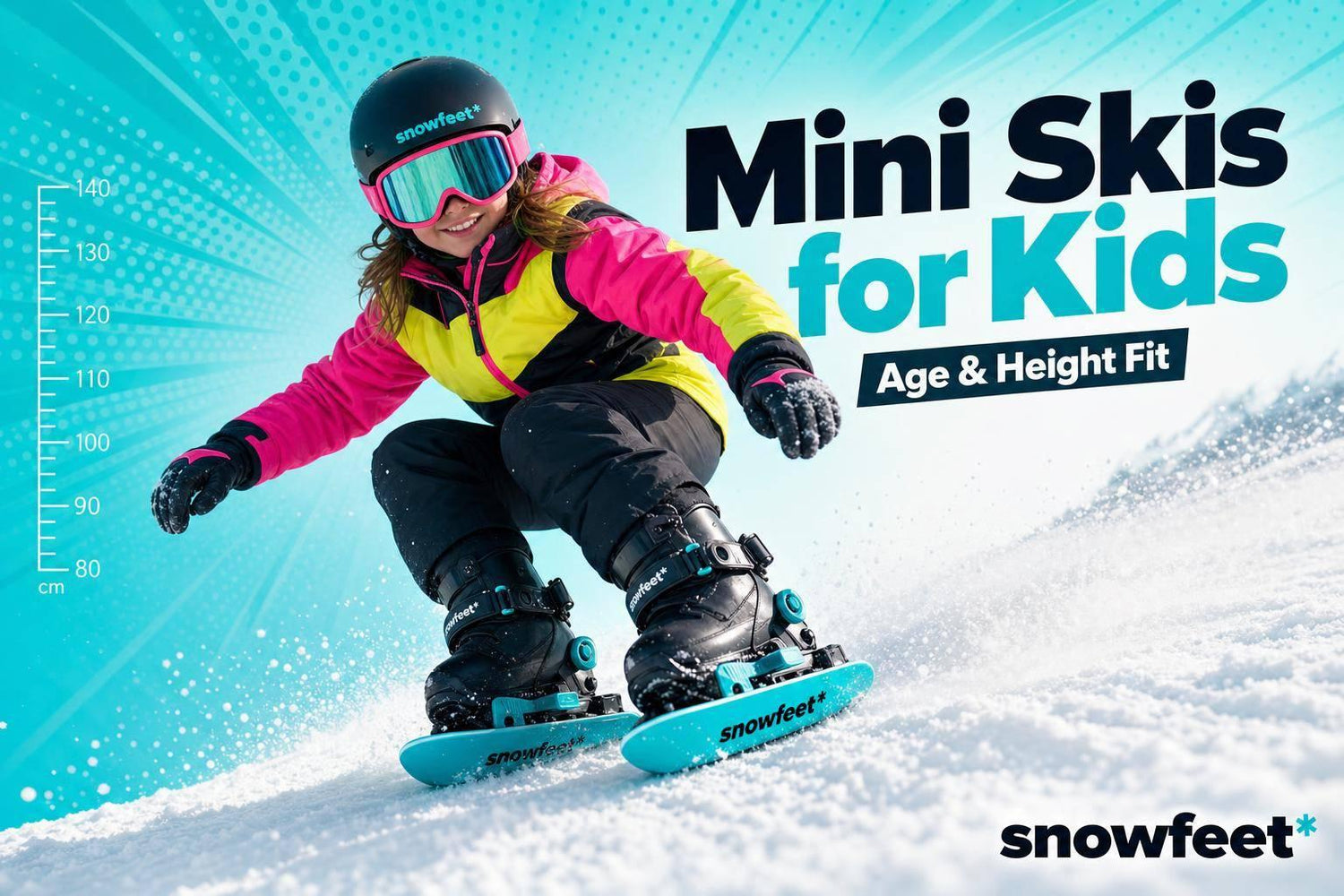
Most kids do better when you start shorter. For mini skis, that usually means 15 to 26 in. long, with the shortest options best for first-timers and the longer ones better for kids who can already stop, steer, and link turns.
If I had to boil the whole guide down fast, here’s how I’d call it:
- Best for tiny beginners: Snowfeet* MINI KIDS
- Best for cautious young kids: Snowfeet* 38 cm
- Best middle step: Snowfeet* 50 cm
- Best for playful, fast-turning riders: Snowfeet* Skiskates 44 cm
- Best for older kids who want more ski feel: Snowfeet* Skiblades 65 cm
A few numbers matter most:
- Mini skis in this guide run from 15 in. to 26 in.
- The shortest models fit many kids from about age 3 to 8
- The longer models fit many kids from about age 8 to 14
- Some models work with regular winter boots
- Others need ski boots or snowboard boots
So, I’d pick based on height, boot size, and control first. Age helps, sure. But a calm 9-year-old and a bold 6-year-old can need very different setups :)
How to Choose the Best Skis for Kids
Quick comparison
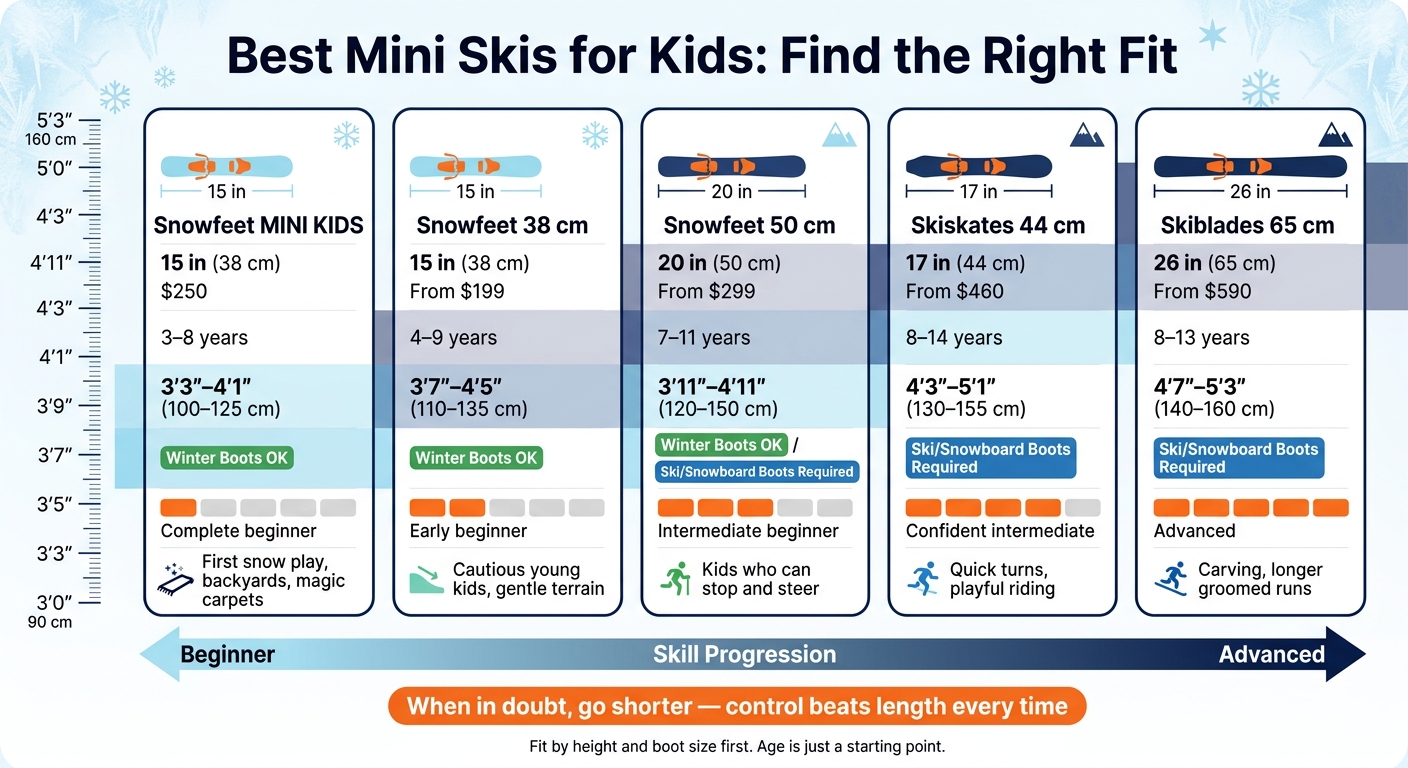
Mini Skis for Kids: Age, Height & Skill Level Comparison Chart
| Model | Length | Best match | Boot type |
|---|---|---|---|
| Snowfeet* MINI KIDS | 15 in. (38 cm) | Small first-timers | Winter boots |
| Snowfeet* 38 cm | 15 in. (38 cm) | Young, cautious beginners | Winter boots |
| Snowfeet* 50 cm | 20 in. (50 cm) | Kids who can stop and steer | Winter boots / snowboard boots |
| Skiskates 44 cm | 17 in. (44 cm) | Confident kids who want tight turns | Ski boots / snowboard boots |
| Skiblades 65 cm | 26 in. (65 cm) | Older kids who want more glide | Ski boots / snowboard boots |
Here’s the short version: go shorter if your child is unsure, small, or just starting. Go longer only when control is already there. That one rule will save you a lot of hassle, and maybe a few snow-angel wipeouts too.
If you want the safest bet, I’d start with the model that feels a little easier today instead of a little bigger for next season.
1. Snowfeet* MINI KIDS
The Snowfeet* MINI KIDS ($250) are super short mini skis made for young first-timers. At 15 in (38 cm), they’re easy for small kids to move, steer, and stop. For the littlest beginners, this is the safest and simplest place to start.
Age and Height Fit
These are a strong fit for kids around ages 3–8 and about 3'6" to 5'0" tall, with shoe sizes from US 10 kids to US 6 adult. If control matters more than speed, MINI KIDS make a lot of sense.
Kids who are moving into US kids' size 10–12 can often use them for a couple of seasons. That’s nice for parents who don’t want gear that gets outgrown in five minutes :)
Boot Compatibility
MINI KIDS work with most insulated winter boots sold in U.S. stores. That includes kids' snow boots and light winter hiking boots, as long as the sole isn’t too soft.
Before heading out, make sure the boots are laced or buckled tight so the foot doesn’t slide around inside. Simple fix, big difference.
Terrain and Speed
MINI KIDS are best for:
- first slides
- first turns
- short, slow runs on bunny hills
- magic carpets
- short resort runs
Their short length helps keep turning easy and speed low. That’s a big win when a kid is still getting used to the whole “I’m gliding on snow now” thing.
Skill Progression
Start small. Think side-stepping, little hops, and gentle gliding on flat snow or a light slope. That gives kids time to get their balance without feeling rushed.
Once a child can balance, steer, and shift weight on flat snow, they’re ready for more. And when control starts to feel easy, the 38 cm model gives them a bit more glide while still keeping turns easy.
2. Snowfeet* 38 cm
The Snowfeet* 38 cm is a natural next step for kids who’ve outgrown the MINI KIDS. It’s made for children who want a bit more glide but still need gear that feels easy to handle.
Age and Height Fit
This 38 cm model fits kids around 4–8 years old and about 40–52 in tall, with foot sizes around US kids' 10 to US adult 6 (EU 27–38).
If your child is on the smaller side, or speed makes them nervous, MINI KIDS is still the safer pick.
Boot Compatibility
The 38 cm model works with insulated winter boots that have firm soles and good ankle support. One thing to watch: very bulky boots above EU 33 may not clip in with a secure fit.
Terrain and Speed
At 15 in (38 cm), these lean toward control, not speed. That’s a good thing for most kids.
They work best on:
- Groomed slopes
- Light powder up to about 4 in
They’re not a good match for steep runs, icy patches, or crowded slopes. In plain English: keep it mellow and fun.
Skill Progression
The 38 cm model is a good tool for building balance and steering. Parents can stay next to their child on flat snow and gentle slopes while they get the hang of it.
When your child starts asking for more glide and a steadier ride, that’s usually the time to move up to the 50 cm.
3. Snowfeet* 50 cm
Age and Height Fit
The Snowfeet* 50 cm works well for kids who are past the first "slide and hope for the best" stage and want a bit more stability without losing easy control. It’s a good match for children about 7–12 years old and 48–58 in. tall (around 4'0"–4'10"), with a weight range of roughly 50–90 lb.
A kid who’s about 54 in. tall will often fit this size nicely. If the 38 cm starts to feel a little twitchy, the 50 cm brings more calm and smoother glide.
Boot Compatibility
The adjustable bindings fit most winter boots and snowboard boots. Skip soft fashion boots. Before riding, do a pull test to make sure the boot stays set in the binding.
Terrain and Speed
Compared with the 38 cm, the 50 cm feels steadier but still doesn’t feel long or awkward. It’s best for:
- Groomed beginner runs
- Magic carpets
- Open practice areas
Keep speeds low to moderate. This model is not a good pick for steep icy runs, deep powder, or terrain parks with big jumps. Green runs and flat practice zones are the sweet spot here.
Skill Progression
The 50 cm sits in that nice middle zone between early balance drills and more controlled riding. It gives kids room to work on linked turns, side-slips, and edge control without feeling like they’ve jumped straight to a full ski setup.
Once that starts to feel easy, the next move depends on what the kid wants. If they want quicker turns and faster edge-to-edge movement, look at the 44 cm Skiskates. If they want more glide and a more ski-like feel, compare it with the 65 cm Skiblades.
sbb-itb-17ade95
4. Snowfeet* Skiskates 44 cm
If the 50 cm model feels steady but a bit slow, the 44 cm Skiskates bring a snappier, faster feel from edge to edge. For kids who already ride with confidence, that can be a lot more fun.
Age and Height Fit
Snowfeet* Skiskates 44 cm are a good match for confident kids around 8–14 years old and about 4 ft tall or more. At this size, boot fit matters more than height.
The bindings fit:
- Ski boots from US 4.5 to 14.5
- Snowboard boots from US 6 to 14.5
So, if a younger child is still in a US size 3 kids' boot, this model will be too big. In that case, the shorter mini ski options make more sense.
Boot Compatibility
Use ski or snowboard boots that fall within the binding range, and make sure the fit is snug. You don’t want side-to-side movement. A loose fit can make these feel twitchy in all the wrong ways.
Terrain and Speed
The 44 cm Skiskates are quick, nimble, and easy to flick from one edge to the other. That makes them a blast for weaving through easy terrain and making short-radius turns.
They’re not the best tool for:
- Steep icy black runs
- Deep powder
- Rough, ungroomed snow
On bumps, keep your weight centered and your toes light so you don’t catch an edge. That little cue helps a lot. For speed control, linked turns are the habit to build early. Straight-lining might look cool for about two seconds, then things get sketchy fast :)
Skill Progression
When the 50 cm starts to feel almost too mellow, the 44 cm Skiskates are a natural next step. They fit kids who can already link parallel turns and want faster turns, a more playful ride, and maybe a few small tricks.
Snowfeet's comparison chart puts the 44 cm Skiskates in the more advanced, trick-focused group, while the 65 cm Skiblades are the better choice for beginners who want more stability.
If your child wants more glide and a calmer ride, compare this model with the 65 cm Skiblades.
5. Snowfeet* Skiblades 65 cm
If the 44 cm Skiskates feel a bit too twitchy, the 65 cm Skiblades are the next move. They’re the longest model in this group, and that added length gives kids more stability and a ride that feels closer to regular skis.
Age and Height Fit
These work best for kids around 8–13 years old, starting at about 4'3" (130 cm) and up to roughly 5'0"–5'2" (152–158 cm).
Here’s a simple gut-check: can your child control speed with turns and stop when asked? If the answer is yes, they may be ready. A confident 9-year-old who can already link parallel turns on blue runs could step into 65 cm right now.
Boot Compatibility
These skis fit ski boots from US 4.5 to 14.5 and snowboard boots from US 6 to 14.5. Since the 65 cm model is longer and faster than the shorter Snowfeet options, boot fit matters more here. A loose boot can make edge control feel shaky once speed picks up.
Before you head to the mountain, do a quick check at home:
- Have your child clip in
- Ask them to flex forward
- Have them push side to side
If the boot moves inside the binding, adjust it again or have a ski shop check the setup.
Terrain and Speed
The 65 cm length gives kids better edge grip on packed snow and a straighter, steadier ride at moderate speeds. They do best on groomed green runs and easy blue runs at a typical U.S. resort.
They’re not as quick in tight spaces as the 38 or 50 cm models, but that’s the trade. You give up some snap and gain more stability. Deep, heavy snow and rough, bumpy terrain are still not where these shine.
Use those differences in the next section to compare control, terrain, and how each model supports progression.
Skill Progression
This is the point where kids start building carved turns and front-to-back balance. Those skills carry over well to full-length skis later, which is a big plus.
If your child is starting to tip the skis onto their edges, trying small bumps, or asking for longer runs, these skis line up well with that stage. They help kids move from short-ski control into carved turns before making the jump to a full ski setup, with more glide and more room to grow.
Fit, Control, Terrain, and Progression: How the Models Stack Up
Here’s the side-by-side view. All five work best on groomed or packed snow. In deep powder or on ice, they lose grip and get harder to control. So, the main job here is simple: match the model to where your child is right now, not where you hope they’ll be next winter.
| Criteria | MINI KIDS | 38 cm | 50 cm | Skiskates 44 cm | Skiblades 65 cm |
|---|---|---|---|---|---|
| Best height | 3'3"–4'1" (100–125 cm) | 3'7"–4'5" (110–135 cm) | 3'11"–4'11" (120–150 cm) | 4'3"–5'1" (130–155 cm) | 4'7"–5'3" (140–160 cm) |
| Best age | 4–7 | 5–9 | 7–11 | 8–14 | 8–13 |
| Fit | Most forgiving; ideal for small kids | Compact, easy stance | Balanced; more ski-like feel | Tighter fit for better control | Most ski-like feel |
| Control | Easiest - beginner-friendly | Still very maneuverable | Better for kids who can already stop and steer | Quick, agile turns; needs balance | Stable at speed; requires technique |
| Best terrain | Magic carpets, beginner areas, backyard hills | Resort greens, neighborhood hills | Resort greens, soft groomers | Groomed laps, playful side terrain | Easy blues, longer groomed runs |
| Progression | First step on snow; great for the first 1–2 seasons | Bridge to longer gear | Good for more than one season, green to blue | Good for more than one season, agility builder | Best for older kids who want more real-ski performance |
A few patterns jump out fast:
- MINI KIDS is the soft landing. It’s the easiest pick for very small kids or kids who feel unsure on snow.
- 38 cm keeps things simple but gives a bit more room to grow.
- 50 cm starts to feel more like a ski, which makes it a nice step for kids who can already stop and turn.
- Skiskates 44 cm suit kids with decent balance who like quick turns and a playful feel.
- Skiblades 65 cm give the most ski-like ride of the bunch, but they ask more from the rider too.
Fit and control matter most for younger kids and for kids who are still building trust in their gear. As kids get older, terrain range and skill growth start to matter more. That’s why a nervous 5-year-old on a backyard hill will have a much better time on the MINI KIDS. Meanwhile, a confident 10-year-old who already knows how to stop and steer can step into the 50 cm or Skiskates 44 cm without getting in over their head.
Use this chart to narrow your pick, then compare the quick pros and cons below.
Pros, Cons, and Quick Picks for U.S. Parents
Use this summary to turn the comparison chart into a fast buy decision.
| Model | Pros | Cons | Best For | Not Ideal For |
|---|---|---|---|---|
| MINI KIDS | Works with regular winter boots. Very light and short. Easiest to control. Great for backyards, parks, and magic carpet areas. | Limited edge hold. Not built for speed or steep terrain. | First-time riders, flat snow, winter boots. | Kids already comfortable on green runs. |
| 38 cm | Still very compact. Easy to put on and take off, even with gloves. Good bridge from MINI KIDS. Works on neighborhood hills and resort greens. | Less stable at higher speeds. Not a long-term option as kids grow. | Cautious young kids, gentle terrain. | Kids who want more speed. |
| 50 cm | More ski-like feel. Handles green runs well. Builds real turning skills. | Requires basic stopping and steering ability. Less forgiving than shorter models. | Kids who can already stop and steer. | True beginners. |
| Skiskates 44 cm | Agile and fun. Rewards good balance. Works well on groomed runs and easy side terrain. | Steeper learning curve. Needs decent balance from the start. | Confident riders who like quick turns. | Nervous beginners. |
| Skiblades 65 cm | Most ski-like feel of the group. Stable at speed. Great for tweens who want real carving. | Asks the most from the rider. Not beginner-friendly. | Older kids ready for easy blue runs. | First-timers. |
Quick Picks
For the fastest choice, scan the picks below.
- Best for first snow play: Go with the MINI KIDS at $250. It works with regular winter boots, which is a big win for parents who don't want to buy ski boots yet.
- Best for a cautious beginner: The 38 cm model, from $199, keeps things simple. It's small, easy to manage, and gives a child a bit more room to grow than the MINI KIDS without feeling like too much, too soon.
- Best for a confident intermediate: The 50 cm model, from $299, is the sweet spot. If your child can already stop and steer on a bunny hill, this is a solid next step. More ski-like, but not too much ski. That's the idea.
- Best for carving: Pick Skiskates 44 cm (from $460) or Skiblades 65 cm (from $590). Skiskates fit kids who like quick turns and a more nimble feel. Skiblades fit kids who want something closer to a standard ski feel on longer groomed runs.
Use stopping and steering ability as the cutoff for moving up a size.
The conclusion below turns these picks into one final choice.
Conclusion
Picking the right mini skis for your child comes down to four things: height in feet and inches, U.S. shoe size, terrain, and how comfortable they feel on snow. Age can help as a starting point, but that’s it. Two kids who are the same age can be totally different in height, balance, and comfort on snow.
Use the chart above as your last check:
- Under 3 ft 6 in: go with MINI KIDS or 38 cm
- Around 3 ft 6 in to 4 ft: go with 50 cm
- At 4 ft and up: look at Skiskates 44 cm or Skiblades 65 cm
Before you buy, make sure the boot size matches the binding. Fit matters for safety.
If your child falls between sizes, go shorter. Control beats extra length every time.
Buy for right now, not for “maybe next season.” Kids can move up in size once their control is solid.
FAQs
How do I know if my child is ready to size up?
Size up once your child looks calm, in control, and at ease on the slopes. If they can stop and turn with no drama on their current Snowfeet* model and now want a bit more speed or a steadier ride, that’s a good sign they’re ready.
For example, a child may move from the 38 cm MINI KIDS or 44 cm Skiskates to the 65 cm Skiblades for more stability and better performance.
Can my child use mini skis with regular snow boots?
Yes. Most Snowfeet* mini skis and skiskates work with regular winter boots or snowboard boots, so your child usually won’t need ski boots.
For the best ride, go with sturdy, waterproof winter boots that have firm ankle support. Some larger models can also fit ski boots if you want a bit more stability.
Which mini skis are best for a nervous beginner?
For a nervous beginner, Snowfeet* MINI KIDS (38 cm) are the best pick. They’re short and light, so they don’t feel as scary as long, bulky skis from brands like Atomic or Salomon.
They clip onto regular winter boots, which keeps things simple and lets kids focus on balance and control instead of fighting with gear. The built-in heel brakes and metal edges help them stay in control, and the small size works well for easy practice in the backyard or on small hills.











ฝากความคิดเห็น
เว็บไซต์นี้ได้รับการคุ้มครองโดย hCaptcha และมีการนำนโยบายความเป็นส่วนตัวของ hCaptcha และข้อกำหนดในการใช้บริการมาใช้