




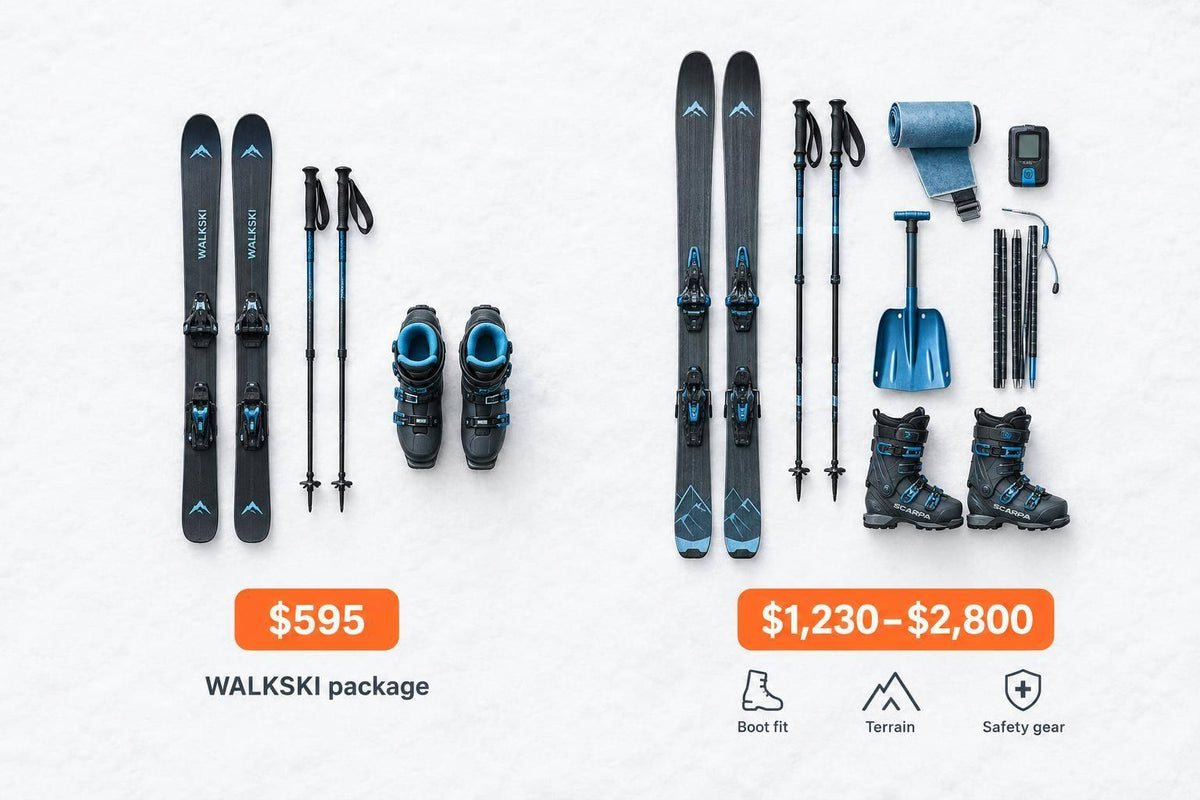
WALKSKI starts at $595, compared with $1,230–$2,800 for a full-length touring setup. My advice: check your boot fit first. If you already own boots that fit WALKSKI, its package costs about 52%–79% less than buying a full touring kit.
Here’s how I’d weigh the cost against your plans:
- What’s included: WALKSKI bundles 100 cm (39.4-inch) skis, bindings, and removable skins. Boots cost extra if yours don’t fit.
- Gear you already own: With compatible touring boots on hand, a full-length setup drops to $830–$1,900.
- Trail use: I’d lean toward WALKSKI for short outings, tight turns, and easy storage. For long tours, deep snow, and harder descents, I’d favor full-length skis.
- Shared costs: Budget roughly $500–$800 for avalanche gear and education, plus any poles, helmet, pack, or clothing you need.
Quick Comparison
| Factor | WALKSKI | Full-length touring setup |
|---|---|---|
| Core price | $595, plus boots if needed | $1,230–$2,800 with boots |
| Boot needs | Compatible winter, snowboard, or ski boots | Boots that match the touring bindings |
| Carrying and storage | Short, compact skis | Longer skis need more space |
| Best fit | Short, casual outings | Long tours and demanding descents |
The lower price isn’t the whole story. Before buying, I’d <u>confirm the package contents, boot fit, and terrain suitability</u> - then check tax and shipping. Pick the setup for the skiing you’ll do, not just the bill. :)
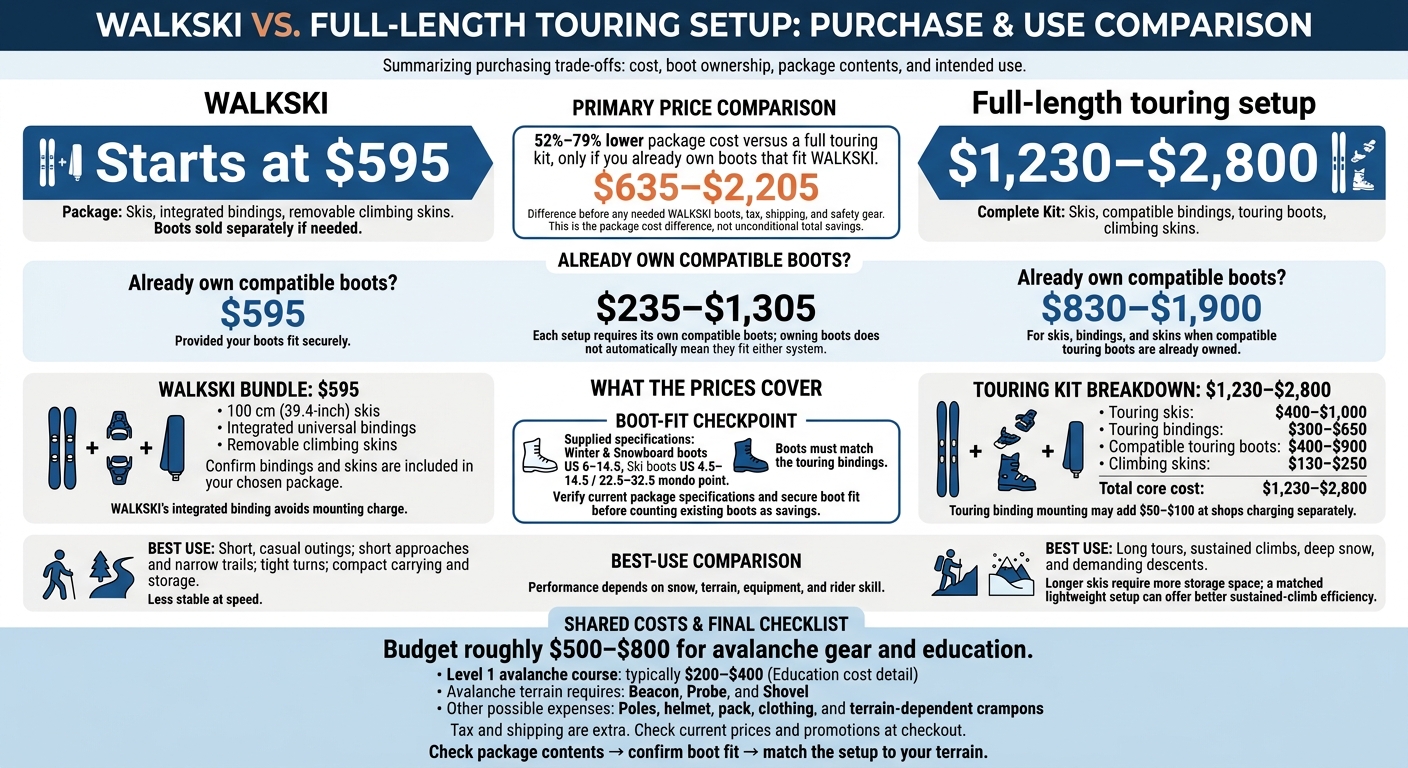
WALKSKI vs. Touring Setup: Costs and Best Uses
Snowfeet WALKSKI | Backcountry Skiing in Georgia
WALKSKI Starting Price and Package Contents
Use the supplied $595 starting price for this comparison. Check final tax, shipping, and promotions at checkout.
To judge that price, you’ll need to know what comes in the box - and what you’ll have to buy.
What's Included and What Costs Extra
The supplied package lists skis, universal bindings, and removable climbing skins. Confirm that both bindings and skins come with your chosen package before using the kit for uphill and downhill travel.
| Item | Included status | Buy separately |
|---|---|---|
| WALKSKI 100 cm skis (about 39.4 inches) | Included | No |
| Universal bindings | Included | No |
| Boots | Not included | Yes, unless you own compatible boots |
| Removable climbing skins | Included; confirm chosen package | No |
| Avalanche gear | Not included | Beacon, probe, and shovel for backcountry terrain |
The integrated binding has four settings. Walk frees your heel, while Ski locks it for descents. Climb 1 and Climb 2 offer low and high heel risers. Remove the climbing skins before skiing downhill.
Compatible Boots and Required Accessories
The supplied specs list winter and snowboard boots in US sizes 6–14.5, plus ski boots in US sizes 4.5–14.5 / 22.5–32.5 mondo point.
Check those ranges for your chosen package on snowfeetstore.com, then make sure your boots fit securely. Count boots you already own as a savings only after you’ve checked the fit.
Next, compare the bundle’s price with the cost of buying a separate ski touring setup.
Full-Length Touring Setup: Component Costs
Skis, Bindings, Boots, and Skins: $1,230–$2,800
Here’s how a full-length touring setup breaks down for a like-for-like cost comparison.
| Component | Estimated U.S. price | WALKSKI status |
|---|---|---|
| Touring skis | $400–$1,000 | Included |
| Touring bindings | $300–$650 | Included; integrated universal binding |
| Compatible touring boots | $400–$900 | Use compatible boots you already own |
| Climbing skins | $130–$250 | Included |
| Total core cost | $1,230–$2,800 | $595 package; boots sold separately |
WALKSKI packs skis, bindings, and skins into one $595 package. The main savings come from skipping separate touring boot and binding purchases - if you already own compatible boots.
Most touring bindings need compatible boots. Ordinary winter boots or ski boots usually won’t fit. Shops that charge separately for binding mounting add $50–$100 to the bill. WALKSKI’s integrated binding skips that mounting cost.
Safety Gear, Accessories, and Other Expenses
Both setups come with other backcountry costs. Budget for poles, a helmet, a pack, and clothing suited to the weather. For avalanche terrain, you’ll also need avalanche gear: a beacon, shovel, and probe. Depending on the terrain, you may need crampons, too.
sbb-itb-17ade95
Total Costs With and Without Existing Gear
Your total cost depends on whether you’re starting from scratch or using boots you already own.
Buying All Your Gear
WALKSKI includes skis, bindings, and removable climbing skins in one package. A conventional touring setup requires separate purchases.
| Purchase scenario | WALKSKI | Conventional touring setup |
|---|---|---|
| Buying everything new | Starts at $595; boots sold separately | $1,230–$2,800 for skis, bindings, boots, and skins |
| You already own compatible boots | No new boots needed if your winter, snowboard, or ski boots fit the bindings | $830–$1,900 if you own compatible touring boots |
| Core setup before safety gear | Package price plus any needed boots, tax, and shipping | Full setup or boots-owned price plus tax and shipping |
| Total with avalanche gear | Add avalanche gear and education | Add avalanche gear and education |
The upfront price gap is $635–$2,205, before tax, shipping, and safety gear. Boot compatibility accounts for most of that difference. If you need boots for WALKSKI, add their cost to its starting price.
A Level 1 avalanche course typically costs $200–$400.
Reusing Compatible Gear
If you already own compatible boots, the price gap drops to $235–$1,305. WALKSKI needs no extra boot purchase, while a conventional setup costs $830–$1,900 for skis, bindings, and skins.
The next section compares portability with performance on long tours.
Conclusion: Which Setup Is Worth the Cost?
With the totals clear, your choice comes down to terrain, distance, and ease of carrying.
| Factor | Snowfeet* WALKSKI | Full-Length Touring Setup |
|---|---|---|
| Price | Lower upfront cost and simpler setup | Higher cost; better suited to long tours |
| Carrying and storage | Compact at 100 cm (about 39 inches) | Longer skis need more space |
| Uphill efficiency | Best for short approaches and narrow trails | A matched lightweight setup can work better on sustained climbs |
| Downhill capability | Easy to turn in tight spaces; less stable at speed | Better for fast descents, deep snow, and changing conditions |
How either setup performs still depends on the snow, terrain, and your skill. For shorter outings, the simpler setup offers more convenience for less money.
WALKSKI for Short Outings and Easy Storage
WALKSKI is the better value for most casual riders. It bundles skis, bindings, and skins to keep the setup compact and the starting cost low.
Its universal binding fits compatible winter and snowboard boots in US sizes 6–14.5, plus ski boots in MP 22.5–32.5. That makes WALKSKI a good fit for short, casual outings without much storage space.
Longer tours call for more glide and stability, which helps explain the price gap.
Full-Length Skis for Long Tours and Tough Descents
A full-length setup is worth the extra cost for long climbs, deep snow, and technical descents. You’ll pay more because you’re buying skis, bindings, boots, and skins separately. That added cost buys better efficiency and control, though tough terrain also calls for more skill.
If you’re a casual rider shopping for Snowfeet* WALKSKI, check the current model price, package contents, boot fit, and terrain suitability before checkout.
FAQs
How can I check whether my boots fit WALKSKI securely?
Check that your boots fit WALKSKI’s adjustable universal free-heel binding. It fits winter boots, snowboard boots, and ski boots in US sizes 6–14.5, so you can use footwear you already own.
For the best performance and control, Snowfeet recommends waterproof boots with solid ankle support. Boots that feel stable help you get a smoother, more controlled ride.
What should I budget for my first WALKSKI outing?
Budget $690–$750 for WALKSKI Backcountry Touring 100 cm. That includes skis, integrated climbing skins, and universal bindings that fit winter, snowboard, or hiking boots you may already own. Adjustable poles cost another $60–$150.
Avalanche safety gear - a beacon, probe, and shovel - adds $330–$560, bringing the complete kit above $900. Using compatible boots you already own saves you the cost of specialized boots. That makes WALKSKI a lower-cost option than a standard touring setup, which runs $2,000–$4,500.
How do I know if my route suits WALKSKI?
Snowfeet* WALKSKI is a good fit for short tours, local hills, and sidecountry laps lasting one to three hours. At about 39 inches (100 cm) long, it’s easy to steer on narrow trails, through tight trees, and across rolling terrain. It’s also light and easy to carry when you’re switching modes often or hiking uphill in your boots.
It handles up to 4 inches of powder well. For deep alpine powder or long, high-speed descents, go with a standard ski setup.











Lämna en kommentar
Denna webbplats är skyddad av hCaptcha och hCaptchas integritetspolicy . Användarvillkor gäller.