



















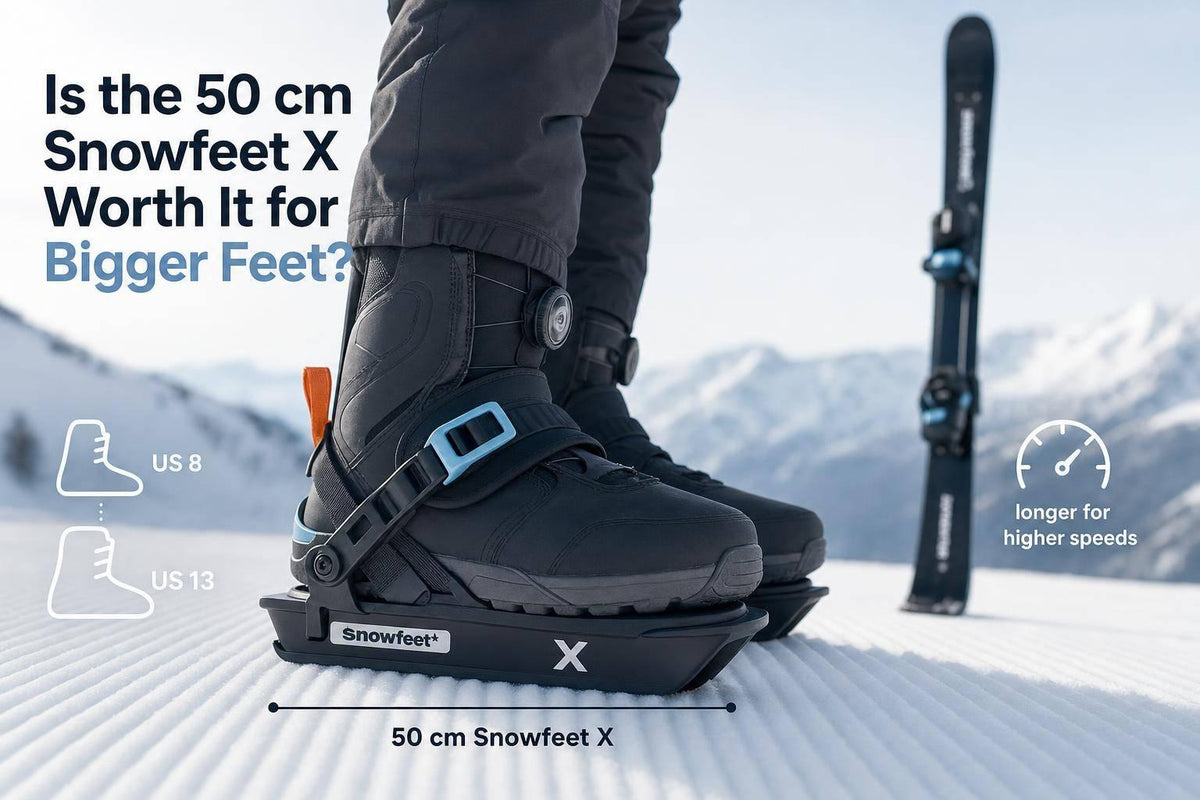
Yes - if your boots are in the stated range and you want a short, playful ride more than a calm ride at speed. I’d put the Snowfeet* X 50 cm in the good-fit zone for most riders with men’s U.S. sizes 8–13. But once you get near the top end, boot bulk matters a lot more than the number on the tag.
Here’s the simple version:
- Boot fit range: men’s US 6–13 / EU 38–47
- Best for: groomers, small turns, park laps, travel, short sessions
- Less ideal for: rough snow, icy chatter, steep fast runs, deep powder
- Best boot match: low-profile snowboard boots or slim winter boots
- If you wear US 14+ or use bulky boots: look at Skiskates 44 cm or Skiblades 65 cm
- If you want more stability: skip the 50 cm and go to 65 cm
I’d sum it up like this: bigger feet can work fine on the X 50 cm, but bigger feet plus bigger body size plus higher speed is where the limits show up. A short ski is fun. It’s also honest. It won’t pretend to be a 68-inch all-mountain setup :)
Snowfeet* & Skiskates Complete Guide | All you need to know about Skiskating
Quick Comparison
| Model | Length | Boot Range | Best For | Feel for Bigger Riders |
|---|---|---|---|---|
| Snowfeet* X | 50 cm / 20 in | US 6–13 | Casual resort laps, parks, travel | Agile, less calm at speed |
| Snowfeet* PRO | 50 cm / 20 in | US 6–13 | More frequent use on groomers | Similar fit, slightly more locked-in feel |
| Skiskates | 44 cm / 17 in | Up to US 14.5 | Large boots, snug boot hold | Short but more boot-room options |
| Skiblades | 65 cm / 26 in | Up to about US 14.5 | Carving, rougher snow, more speed | More planted and easier to trust |
My bottom line: if you have bigger feet but still fall inside US 13, the X 50 cm is worth a look for groomed runs and moderate speeds. If your feet are US 14–14.5, or you want more support under a larger frame, I’d steer you to the longer options first.
Boot Size Compatibility: Will the Snowfeet* X 50 cm Fit Bigger Feet?
This is the part that matters most: can bigger boots fit without turning the ride into a wobbly mess? Fit is the first checkpoint. After that, it comes down to how much boot you're putting on a short 50 cm platform.
Which U.S. boot sizes fit and where the limit is
Men's US 11 fits with no drama, and there's still room in the binding adjustment.
Men's US 13 is the upper end of the range, and at that point, boot shape matters just as much as the number on the label. A lower-profile boot tends to sit better and lock in more cleanly. A thick, bulky winter boot can make strap closure harder and leave the fit a bit loose.
If you're in US 14 to 15, it's smart to start with the Skiblades 65 cm, which fits up to US 14.5.
And yeah, this part isn't just about getting your boot in. When you're near the limit, fit changes how the X turns, how well it holds an edge, and how planted it feels under you.
Best boot types for a secure, comfortable fit
For bigger feet, these boot styles tend to work best:
- Low-profile snowboard boots
- Streamlined winter boots
The main issue at the top end is bulk. Thick, puffy, heavily insulated boots can stop the strap from closing all the way and can add unwanted movement inside the binding.
That boot choice has a direct effect on comfort, edge pressure, and stability once you're on snow. Once the fit is dialed in, the next thing to look at is how that short 50 cm platform rides.
sbb-itb-17ade95
How the 50 cm Length Rides for Bigger Feet: Comfort, Control, and Stability
Once the fit is set, the real test starts on snow. And for bigger riders, that’s where the X feels fun fast - but also a bit more demanding.
Why bigger riders may enjoy the agility but feel more sensitive steering
The Snowfeet X is built for quick turns, quick stops, and a skating-style flow down the mountain - not the locked-in feel of a longer all-mountain ski. On groomed resort runs at low to moderate speeds, that trade can be a blast. The short length makes step-turns and fast pivots easy. Its sweet spot is groomed runs, parks, and low-speed sessions where agility matters more than top-end stability.
But there’s no magic here. Riders over about 6'0" or 200 lb will notice more movement on rough or icy snow, especially as speed goes up. A typical all-mountain ski for a 5'10"–6'1" rider in the 165–209 lb range is usually about 172–182 cm long, and that extra length is there for a reason: more stability at speed and better float in deeper snow. So, that’s the deal - you get compact, playful handling instead of a planted, high-speed ride.
And that fast, playful feel depends a lot on one thing: how well your boot sits in the binding and how snugly it’s strapped down.
How larger boots affect edge pressure, stance, and comfort
This is one spot where bigger boots can help. When a large boot fills more of the binding, there’s less empty space between the boot and the binding. That usually means faster, more direct response. On groomed runs, heavier riders can use that to get cleaner edge control in turns without muscling it.
The catch is strap tension. Too loose, and a heavy boot can twist in the binding. That can lead to delayed response or slippage. Too tight, and you’ll start to feel hot spots across the instep after a few runs. The fix is pretty simple:
- Center the boot in the binding
- Tighten until heel lift and side-to-side movement are gone
- Stop before the straps create pressure points
A neutral stance helps too - hips over feet, knees soft, weight centered. On a 50 cm platform, that matters more because there’s less front-to-back support. And if your boot has a stiffer shell, even better. It passes edge pressure into the ski more cleanly on a short setup like this.
Snowfeet* X 50 cm vs PRO 50 cm vs Skiskates 44 cm vs Skiblades 65 cm
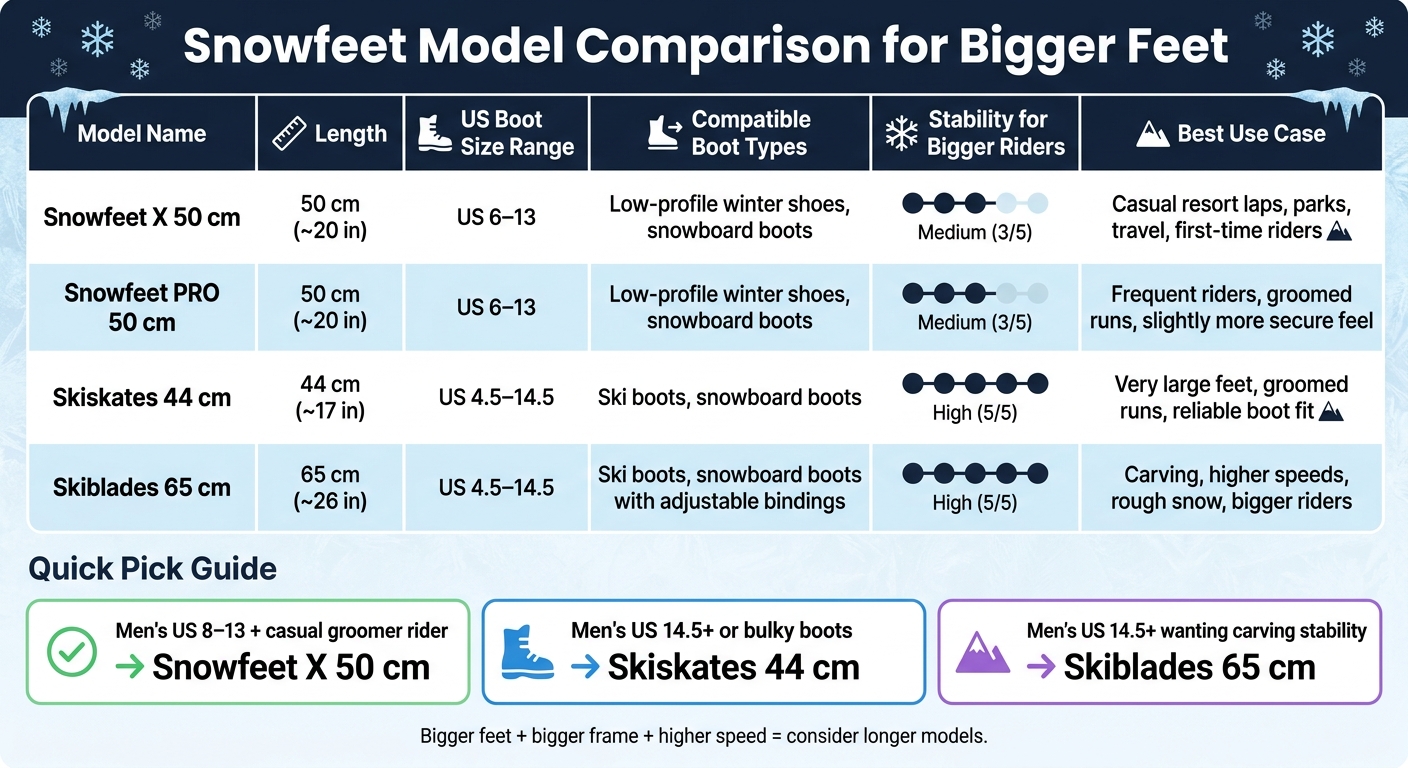
Snowfeet Model Comparison for Bigger Feet: Which One Is Right for You?
Once you know how these ride, the next step is simple: pick the Snowfeet* model that matches your boots and what you want to do on the mountain. Here’s how the four main options compare.
Comparison table: fit, boot type, stability, and best use
| Model | Length | U.S. Boot Size Range | Compatible Boot Types | Stability for Bigger Riders | Best Use Case |
|---|---|---|---|---|---|
| Snowfeet* X 50 cm | 50 cm (~20 in) | US 6–13 | Low-profile winter shoes, snowboard boots | Medium | Casual resort laps, parks, travel, first-time riders |
| Snowfeet* PRO 50 cm | 50 cm (~20 in) | US 6–13 | Low-profile winter shoes, snowboard boots | Medium | Frequent riders, slightly more secure feel, groomed runs. Some bulky US 12–13 snowboard boots may be tight. |
| Skiskates 44 cm | 44 cm (~17 in) | US 4.5–14.5 (ski boots); US 6–14.5 (snowboard boots) | Ski boots, snowboard boots | High | Very large feet, groomed runs, reliable boot fit |
| Skiblades 65 cm | 65 cm (~26 in) | Roughly US 4.5–14.5 depending on binding | Ski boots, snowboard boots with adjustable bindings | High | Carving, higher speeds, rough snow, bigger riders |
US 11–13 riders can still make the X or PRO work. Once you get past that, Skiskates or Skiblades start to make more sense.
When the Snowfeet* X beats the other Snowfeet* models
The X 50 cm is the most straightforward Snowfeet option for bigger feet. If your fit looks close on paper, the choice usually comes down to three things: convenience, stability, and how much you ride.
- X is the easiest pick - it works with boots you already own, fits in a backpack, and keeps the learning curve short. That makes it a smart match for US 11–13 riders doing weekend resort trips, backyard laps, or travel.
- PRO feels a bit more locked in - same 50 cm length, but a better pick for people who ride more often and want a touch more security.
- Skiskates and Skiblades give you more room and more support - Skiskates 44 cm are the better option once your feet go past US 13 or your snowboard boots get too bulky for the X or PRO straps. Skiblades 65 cm are the move if you want stronger carving and better control at speed.
How Snowfeet* compares to standard skis and snowboards
Full-length skis and snowboards still do a better job at high speed, in deep powder, and on icy or chopped-up snow. That’s the trade-off in plain English: longer gear handles speed and rough conditions better, while Snowfeet* is easier to carry and easier to use.
For a lot of casual U.S. riders, that trade-off is worth it. Think weekend resort skiers, people who get out a few times each winter, or anyone who wants to try something new without dragging around a full ski setup. The X and PRO work with boots you already own, fit in a backpack, and don’t take forever to learn. That matters on groomers, in terrain parks, off side hits, and during short sessions.
So, for bigger-footed riders, the usual split is pretty simple: pick Snowfeet for convenience first, and pick longer skis if speed is the main goal.
Final Verdict: Is the 50 cm Snowfeet* X Worth It for Bigger Feet?
After fit and ride feel, the call is pretty simple: the Snowfeet X 50 cm makes sense for bigger feet when nimble handling matters more than top-end speed* - as long as your boots fit the binding range.
Who should buy the X 50 cm and who should go with a different model
For most riders in Men's US 8–13, the X 50 cm hits the sweet spot. The binding sits cleanly under the foot, and the ride stays easy to handle on groomers.
If you're at Men's US 14.5 or above, you're better off with the Snowfeet Skiskates 44 cm* or Snowfeet Skiblades 65 cm*. Their adjustable bindings are rated up to US 14.5. And yeah, riding style matters too. If you want a short, snappy ride, go with the X. If you need room for larger boots, pick Skiskates. If you want more support and a steadier feel, Skiblades are the better call.
Here’s the quick match-up:
| Your Situation | Best Pick |
|---|---|
| Men's US 8–13, casual groomer rider, low-profile winter boots or snowboard boots | Snowfeet* X 50 cm |
| Men's US 14.5+, bulky ski boots, or wants a more planted feel | Snowfeet* Skiskates 44 cm |
| Men's US 14.5+, wants more stability for carving and steeper runs | Snowfeet* Skiblades 65 cm |
FAQs
Will my boot width matter more than my labeled size?
Yes. Your boot’s outer bulk and shape can matter just as much as, or even more than, the labeled size.
A size 12 or 13 boot may fall within the range for the Snowfeet PRO 50 cm. But if the shell is bulky or the padding is thick, the straps can max out before the boot feels locked in.
That’s the key point: two boots with the same labeled size can fit very differently.
So when you check fit, don’t focus on the number alone. Aim for a snug, centered fit inside the binding.
Can a heavier rider still feel stable on the 50 cm X?
Yes - the 50 cm Snowfeet X is a smart pick for riders in the 170–220 lb range.
Why? The added length spreads your weight more evenly over the snow. That gives you a smoother, more balanced ride, with less leg strain and less vibration on hardpack.
If you’re over 220 lbs, it’s the better option. You’ll get more control, and the extra length helps keep the tips from sinking in softer snow.
When should I choose the 65 cm Snowfeet* instead?
Choose the 65 cm Snowfeet* Skiblades if you want more stability than the 44 cm or 50 cm models.
The shorter versions are better if you want tight turns and easy carry. The 65 cm model feels more planted and steady, with better support and cleaner carving when you pick up speed. It’s a solid next step if you’ve outgrown the shorter sizes but still want something playful that works well in the park.











Lämna en kommentar
Denna webbplats är skyddad av hCaptcha och hCaptchas integritetspolicy . Användarvillkor gäller.