



















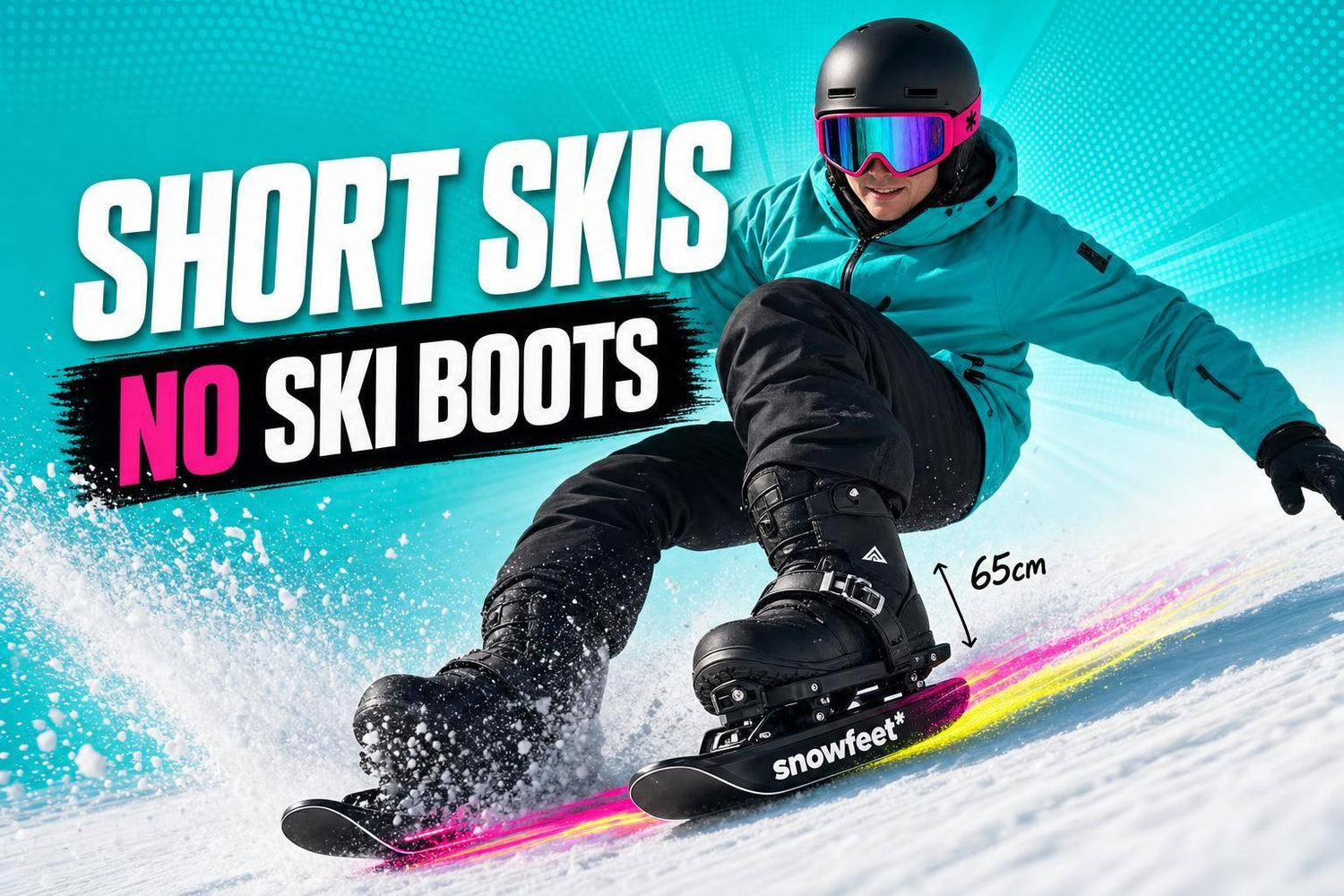
You can try skiing in your snowboard boots and skip a second boot setup. That’s the big win here. Ski boots can cost $150 to $800+, and rentals often add $25 to $35 a day. So if I just want to test the waters, short skis that fit snowboard boots make a lot of sense.
Here’s the short version:
- 44 cm Skiskates: best for park laps, spins, and tiny packed gear
- 50 cm PRO: best low-cost starting point at $299
- 65 cm Skiblades: best all-around pick for most snowboarders
- 99 cm Skiblades: closest feel to skis without changing boots
- Long skis: still best for high speed, steep runs, and deep powder
The trade-off is simple. Shorter skis are easier to turn, pack, and learn on. Longer skis feel steadier when the hill gets steep or the speed climbs. If I were helping a snowboarder pick one fast, I’d point them to the 65 cm Skiblades for the best mix of control and fun, or the 44 cm Skiskates if park and travel come first.
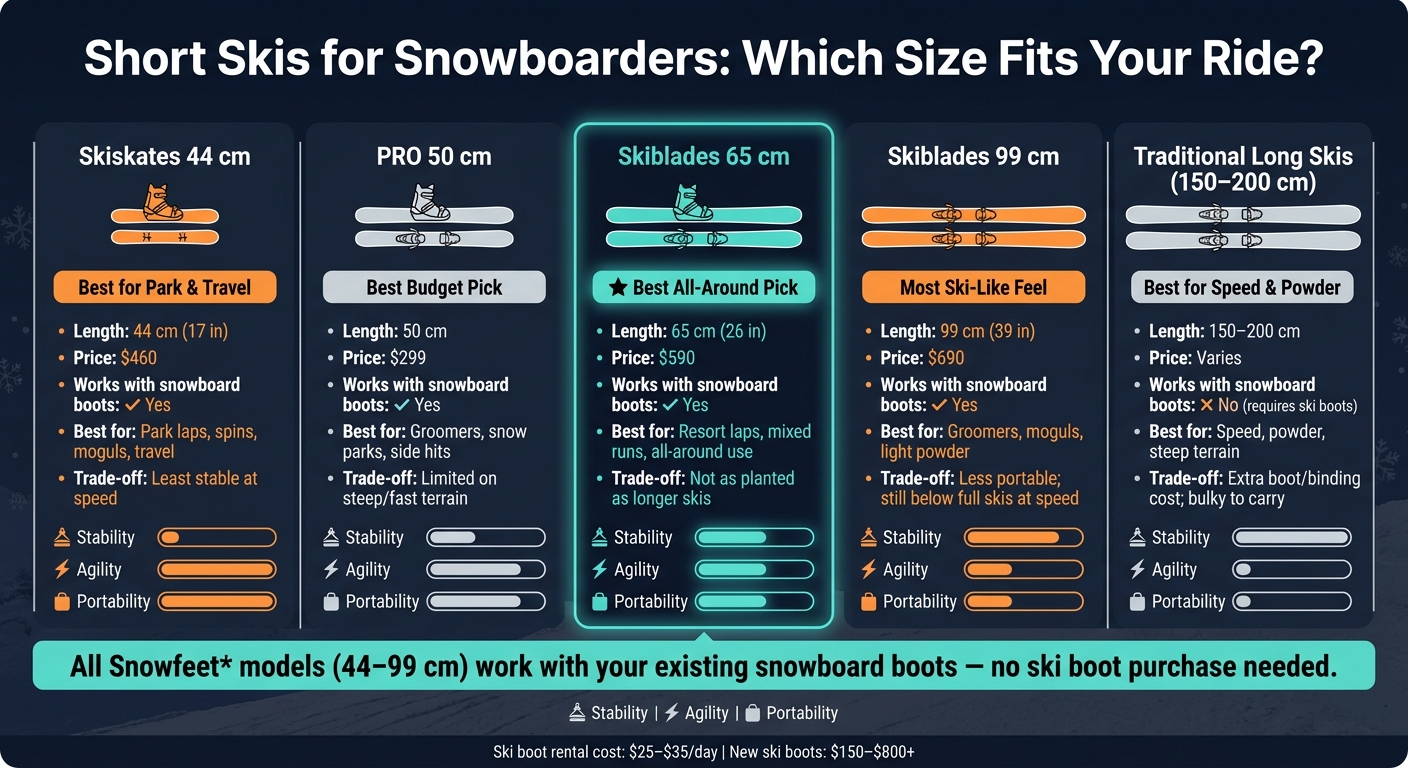
Short Skis for Snowboarders: Which Size Fits Your Ride?
Snowboarder tries Snowfeet* | Which Snowfeet* Short Ski is the Best? | Snowblades 44, 65, 99 Review
Quick Comparison
| Option | Works with snowboard boots | Best use | Main trade-off | Price |
|---|---|---|---|---|
| Skiskates 44 cm | Yes | Park, spins, moguls, travel | Least steady at speed | $460 |
| PRO 50 cm | Yes | First try, groomers, side hits | Limited on steep, fast terrain | $299 |
| Skiblades 65 cm | Yes | Resort laps, mixed runs, all-around use | Not as planted as longer skis | $590 |
| Skiblades 99 cm | Yes | Groomers, moguls, light powder | Costs more; still below long skis at speed | $690 |
| Long skis | No | Speed, powder, steep terrain | Need ski boots; harder to carry | Varies |
So, if I want the no-fuss path from snowboard to skis, I’d keep it simple: go short first, then go longer only if I want more speed and edge hold :)
Useful watch:
1. Snowfeet* Skiskates 44 cm
At just 17 inches (44 cm), these Skiskates feel more like ice skates for snow than full-on skis.
The Snowfeet* Snowboard Boots Model comes with adjustable, tool-free bindings that fit snowboard boot sizes 6 to 14.5 US (38–49 EU). So, yeah, you can use the boots you already have instead of buying a whole new setup.
That tiny size changes how they ride. You get less stability, but way more agility. That makes them a blast for:
- quick turns
- spins
- moguls
- park laps
They’re not built for high-speed carving or deep powder. That’s the trade-off.
At 17 inches, they can fit inside a standard backpack, which is a huge plus if you’re walking to the lift, hopping on a flight, or just hate lugging around long gear.
At $460, they’re near the top end of the short-ski price range. But if you want the most compact, trick-focused option in the lineup, this is it.
If you want a bit more stability and still want to use snowboard boots, the 50 cm PRO is the next move.
2. Snowfeet* PRO 50 cm
At 50 cm, the PRO sits right in the middle. It’s a smart pick for snowboarders who want to use snowboard boots but want more stability than the 44 cm Skiskates.
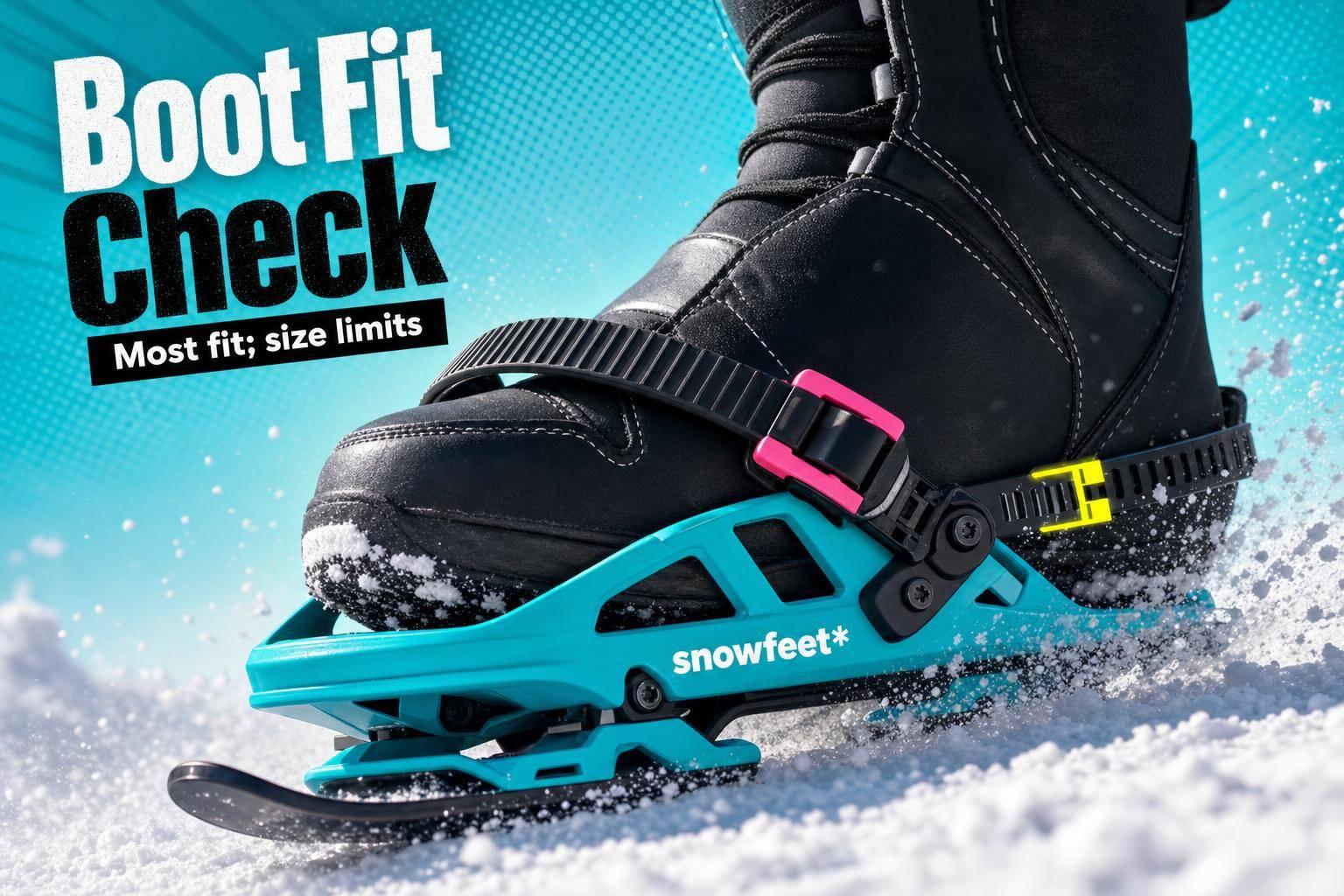
The PRO comes with adjustable bindings that fit standard snowboard boots in US sizes 6–13 (EU 38–47). For most people, setup is easy. If your freeride boots are extra bulky, you may need a quick strap check.
That extra length helps a lot. The PRO feels more stable, gives you smoother edge control, makes turning easier, and helps with stopping. At the same time, it still stays light on its feet. So you can make fast direction changes without feeling like you’re dragging around long skis.
On groomed blue runs, the PRO feels stable enough for controlled carving and still loose enough for playful turns. It works best on:
- Groomed slopes
- Snow parks
- Side hits
- Packed snow
It can also handle light powder up to about 4 inches (10 cm). Once the terrain gets steep, icy, or very fast, long skis still have the edge. But for most snowboarders, the PRO is easier to learn, easier to carry, and just more fun to hop on without a whole ski-boot setup. That’s the sweet spot here: more control than the 44 cm Skiskates, without jumping to longer skis that feel less nimble.
At 0.9 lb per pair, the PRO is easy to toss into a backpack or suitcase. And at $299, it’s a low-cost way to try ski-like handling without buying ski boots.
If you want more stability and a bit more room for error, the 65 cm Skiblades are the next move.
3. Snowfeet* Skiblades 65 cm
If you're moving up from the 50 cm PRO, the 65 cm Skiblades give you more edge hold and a steadier feel without losing the big perk here: you can still ride in snowboard boots. For snowboarders who want a smart middle ground, this is the sweet spot. They feel more planted than the 44–50 cm models, but they still stay quick, loose, and fun.
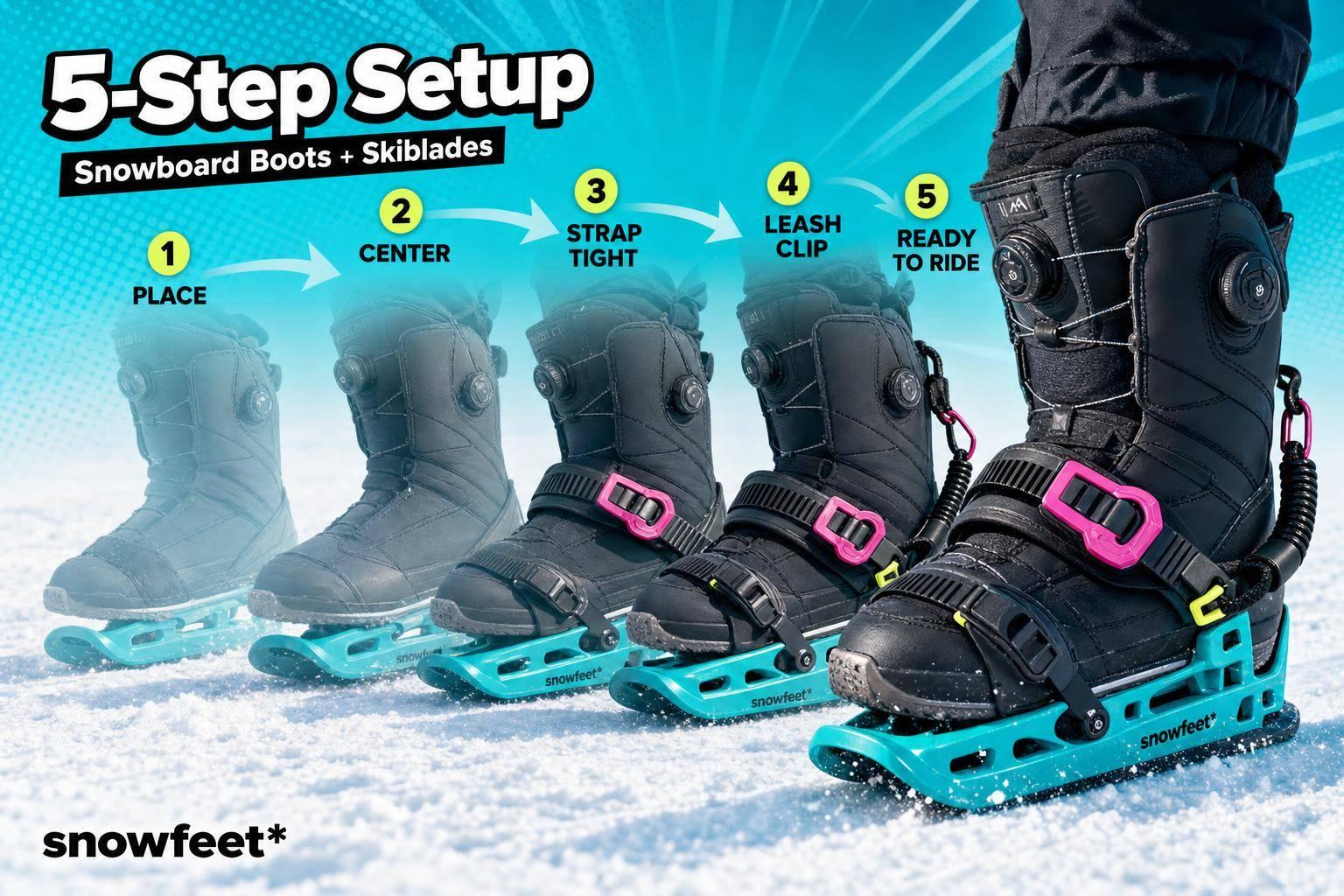
The snowboard-binding version works with your snowboard boots, which is a huge plus if you don't want to mess with ski boots. The adjustable, tool-free bindings fit a broad range of adult sizes, about US 6–14.5 (EU 38–49), and the setup feels familiar if you've spent time on a snowboard.
Verified user Mike E said after using the snowboard-binding setup:
"I was nervous about the boots not being stiff enough for skis but it was not an issue at all. SUPER comfortable, easy to control, very agile, easy on the knees and ankles because they are so light."
On snow, that 65 cm length gives you more grip and more confidence than the shorter Snowfeet* models. The 4 m turning radius keeps them quick edge to edge, so turning feels easy and snappy. That makes them a strong pick for:
- groomed runs
- short resort laps
- small to medium terrain-park features
- side hits
- mixed snow, like chopped-up afternoon runs
The tradeoff is pretty simple. In deep powder or on fast, steep lines, the 99 cm Skiblades have the edge. They feel steadier at speed and float better. But for normal resort days, the 65 cm model is the most balanced option.
They're easy to travel with too. At 26 inches long and about 5.89 lb per pair with snowboard bindings, they slide into a car trunk or a larger gear bag without much fuss. Prices start at $590. That's more than the PRO 50 cm, but you're getting a wood core, metal edges, and a graphite base while still keeping the ease of snowboard boots. If you want more speed and a straighter, more planted ride, the 99 cm Skiblades are the next move.
sbb-itb-17ade95
4. Snowfeet* Skiblades 99 cm
For snowboarders who want the feel of skis without giving up their snowboard boots, the Snowfeet Skiblades 99 cm* are the next move. They’re the most ski-like option in the Snowfeet* lineup, but they still use adjustable bindings that fit snowboard boots in US 6–14.5 (EU 38–49).
At 99 cm (39 in), these skiblades hit a sweet spot. You get a 6 m turn radius and a deep sidecut, which gives them the best mix of stability and agility in the Snowfeet* range. Snowfeet* also says they use a wood core and camber, which helps with control and makes carving easier.
That added length helps a lot on:
- Groomed runs
- Moguls
- Light powder
On snow, they’re often described as easy to control, quick to turn, and less bulky than full-length skis. That’s a big part of the appeal. You get more of that ski feel, but without lugging around long planks like you’re heading into a 1990s ski movie.
At $690, they’re the most expensive model in the Snowfeet* range. Full-length skis still have the edge at high speed, and that’s where the comparison starts to matter more in the next section. The trade-off shows up fast once you put them side by side with standard skis.
5. Traditional Long Skis
Compare Snowfeet* 99 cm skiblades with full-length skis, and the trade-off is pretty clear: control and easy transport vs. top downhill performance.
Traditional long skis still set the bar for speed, stability, and powder riding. As a rule of thumb, 150–170 cm works well on groomers, while 180–200 cm is a better fit for powder and fast, sweeping turns.
There’s also the gear issue. Traditional skis need ski boots and alpine bindings, which means snowboarders can’t use the boots they already own. That adds extra cost and, frankly, a bit of hassle. Snowfeet* skips that part.
Long skis are also tougher to pack, carry, and stash than compact Snowfeet* gear. And that setup headache is a big reason many snowboarders stick with Snowfeet* instead.
For snowboarders who want to try skiing without buying ski boots or dragging around extra gear, Snowfeet* is the easier and more practical pick.
Which Option Works Best for Each Situation on the Mountain
Now that the lineup is clear, let’s match each model to the way you ride. Since all four Snowfeet* models work with snowboard boots, the main call comes down to three things: stability, agility, and portability.
Here’s the quick pick chart.
| Use Case | Best-Fit Product | Reasoning |
|---|---|---|
| Groomed resort runs | Skiblades 99 cm | Extra length gives you more stability and a feel that’s closer to skiing. |
| Terrain park laps | Skiskates 44 cm | Ultra-short and light, which makes spins and tricks easier. |
| Travel & limited storage | Skiskates 44 cm | Very easy to pack and fully compatible with snowboard boots. |
| First-time ski experiments | Skiblades 65 cm | A balanced length that feels easier to learn on. |
| Most ski-like feel | Skiblades 99 cm | Extra length helps with carving and edge hold. |
A simple way to think about it: the 44 cm model is the fun-size option, the 65 cm model sits in the middle, and the 99 cm model gets closest to a ski feel without turning into a full ski.
All four models do best on smooth, packed snow. In this lineup, the 99 cm handles firm, steep terrain best. But when speed climbs, long skis still have the edge.
Next, it helps to stack those picks against the trade-offs.
Pros and Cons of Each Option
Use this table when you want the trade-offs fast. Since all Snowfeet* models work with snowboard boots, the main thing to compare is how each model rides. A simple rule helps here: pick the shortest model that still fits your style.
Here’s the quick side-by-side.
| Item | Biggest Pros | Biggest Cons | Best For |
|---|---|---|---|
| Skiskates 44 cm | Fits in a backpack; ultra-agile for spins and park tricks; very short learning curve for snowboarders | Least stable at speed; short edge means less grip on firm or steep snow; not for long groomer runs | Park-focused riders who want quick laps or short fun sessions |
| PRO 50 cm | More stable than 44 cm; quick-turning and playful; reinforced for frequent use; heel brake adds speed control | Still limited on steep or fast terrain; not ideal for long, fast descents | Casual riders and beginners who want the most versatile entry point |
| Skiblades 65 cm | More ski-like feel than shorter models; better carving potential and edge grip; good for varied resort runs | Less portable than the 44/50 cm options; still compromised in deep powder and at high speeds versus full-size skis | Snowboarders who want a clear ski-like feel without committing to full-size gear |
| Skiblades 99 cm | Closest to a real ski feel; better directional stability; confident carving on longer groomers; still shorter and more playful than traditional skis | Less portable than shorter Snowfeet* models; less stable than full-size skis at high speeds; not as strong in deep powder or race-style carving | Adventurous riders who want to explore more of the mountain on something ski-like |
| Traditional Long Skis | Best high-speed stability; strongest edge hold on steep, icy terrain; best float in deep powder | Requires a separate boot-and-binding setup; bulky to travel with; higher total cost to get started | Riders ready to commit to alpine skiing with lessons and dedicated gear |
The pattern is pretty simple. Longer models bring more stability and less agility. So, 44 cm feels the most playful, while 99 cm feels the most like a ski.
Traditional long skis still do best when the day is all about speed, steep terrain, or deep powder. Snowfeet*, though, keeps one big perk: you can use snowboard boots and skip the extra boot-and-binding setup. That makes them easier to pack, carry, and test out without turning your whole trip into a gear haul :)
If you wear a US men’s 12–13, check PRO 50 binding clearance before ordering.
Conclusion
The bottom line is pretty simple: Snowfeet* Skiblades 65 cm are the best all-around pick.
They hit a nice balance between stability and playfulness. And for snowboarders, that matters a lot. You get an easy, fun ride without needing ski boots, which is a huge plus.
If you want something best for park laps and travel, go with Skiskates 44 cm. If you want a compact option that sits in the middle, pick PRO 50 cm.
If you want the closest thing to a ski-like feel, but still don’t want ski boots, Skiblades 99 cm are your best bet.
Long skis still have their place. They make sense for high-speed carving, deep powder, and steep off-piste terrain. But for most resort days, short skis are the easier and more practical pick. That’s where Snowfeet* stands out: it lets snowboarders try skiing without buying a second boot setup.
FAQs
Can I really use my snowboard boots with these short skis?
Yes - if you pick the right Snowfeet* model.
Most Snowfeet* short skis come with adjustable bindings that work with snowboard boots. That’s a big shift from standard skis, which need ski boots.
You can use snowboard boots with:
- Skiskates (44 cm)
- Snowfeet PRO (50 cm)
- Skiblades (65 cm and 99 cm)
- Mini Ski Skates (38 cm)
For the best fit, make sure your boots feel snug and fall within the model’s size range.
Which short ski size is best for a first try?
For a first try, the 65 cm Snowfeet Skiblades* are the best place to start. They’re the most forgiving and stable option, so it’s easier to find your balance and link turns on groomed resort runs without feeling like the skis are trying to prank you.
If you want a bit more stability and more room to grow, the 99 cm Skiblades are also a strong pick. The 44 cm Skiskates are more playful and easy to carry around, but they come with a steeper learning curve and ask for better balance right from day one.
Are short skis good enough for steep runs or powder?
Usually, no.
Snowfeet* models are a lot of fun on groomers, in terrain parks, and for laid-back resort laps. But they’re not built for deep powder or steep, icy runs.
Most of them work best when the snow is under 4 inches deep. The short length gives you less float in powder and less edge control at high speeds on hard, steep ice.
So if you want better control, more stability, and a safer ride in those conditions, long skis with stiff alpine ski boots are still the better pick.











Lämna en kommentar
Denna webbplats är skyddad av hCaptcha och hCaptchas integritetspolicy . Användarvillkor gäller.