



















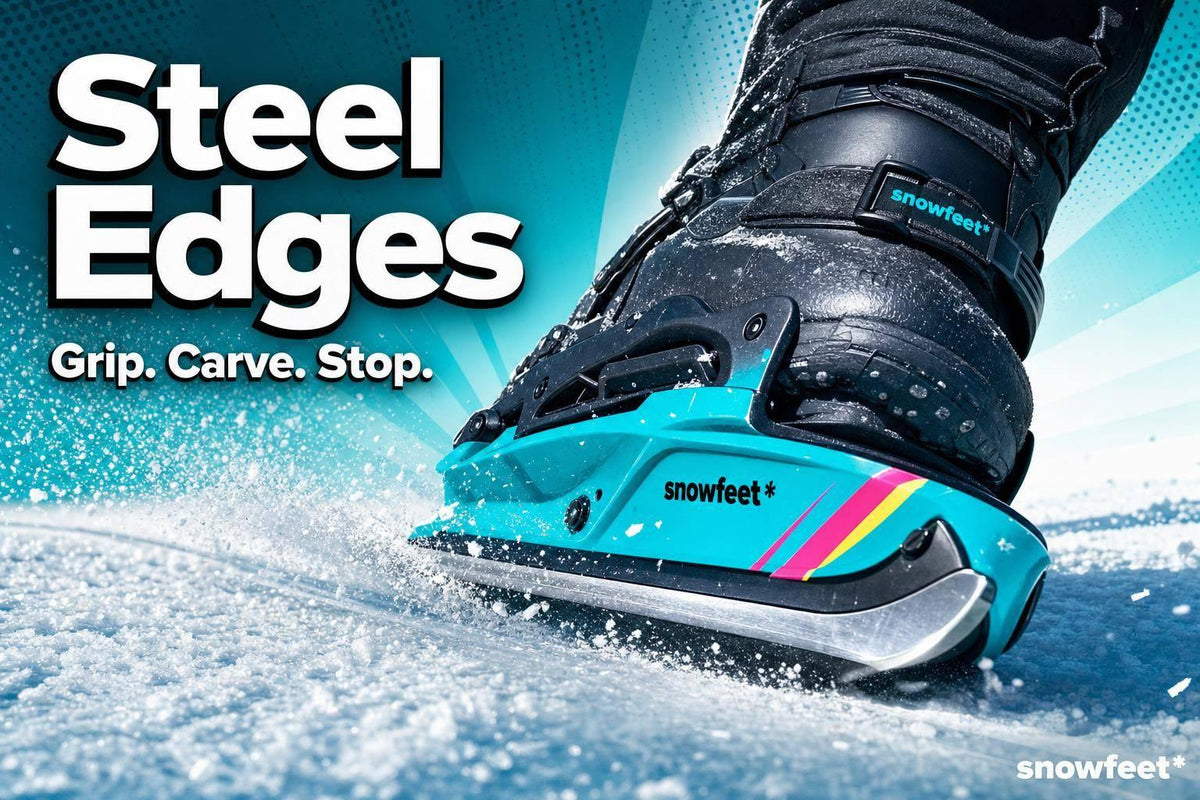
Yes - most skiblades made for ski resorts have metal edges. If you plan to ride groomers, hardpack, or icy runs, that’s what you want under your feet.
Here’s the short version:
- Metal edges help you grip, turn, and stop
- Plastic edge-free mini skis are not the same thing
- Many U.S. resorts may not allow edge-free gear
- Snowfeet* 65 cm, 99 cm, and 120 cm models all use full steel edges
- Length changes the feel: shorter = more agile, longer = more stable
So, if you’re asking whether skiblades work like skis on resort snow, the answer is simple: they do when they have steel edges. Without them, things can get sketchy fast. Think less “carving turns,” more “shopping cart on a frozen driveway” :)
Quick Comparison
| Model | Metal Edges | Best For | Main Feel |
|---|---|---|---|
| Snowfeet* 65 cm | Yes | Beginners, park laps, tight turns | Very agile |
| Snowfeet* 99 cm | Yes | All-around resort use | Balanced |
| Snowfeet* 120 cm | Yes | More speed, rougher snow | More stable |
| Plastic mini skis | No | Small backyard hills | Low control |
What I’d tell a customer in my shop is this: if you ride lift-served terrain, get skiblades with steel edges. That one feature does a lot of the heavy lifting.
All you need to know - Snowfeet* | Skiskates | Skiboards | Snowblades | Skiblades FAQ
What metal edges do on skiblades
Metal edges are the steel strips that run along the sides of the ski. When you tip the ski on edge, those strips bite into the snow and help you stay in control. That grip is a big reason short skiblades feel stable instead of loose and slippery.
Grip, carving, and control on groomed snow
On groomed snow, metal edges help you carve clean, sharp turns instead of washing sideways in a skid. That matters a lot on short skiblades. Since they turn fast, you want the ski to feel precise, not twitchy.
Steel edges also help with quick edge-to-edge response. So when you roll from one turn to the next, the skis react fast and in a way that feels predictable. That’s a big deal on groomed runs and icy patches, where short skiblades need solid edge hold to carve and stop with confidence. The same thing shows up in the park too, especially when you land tricks or ride switch.
Stopping and speed control
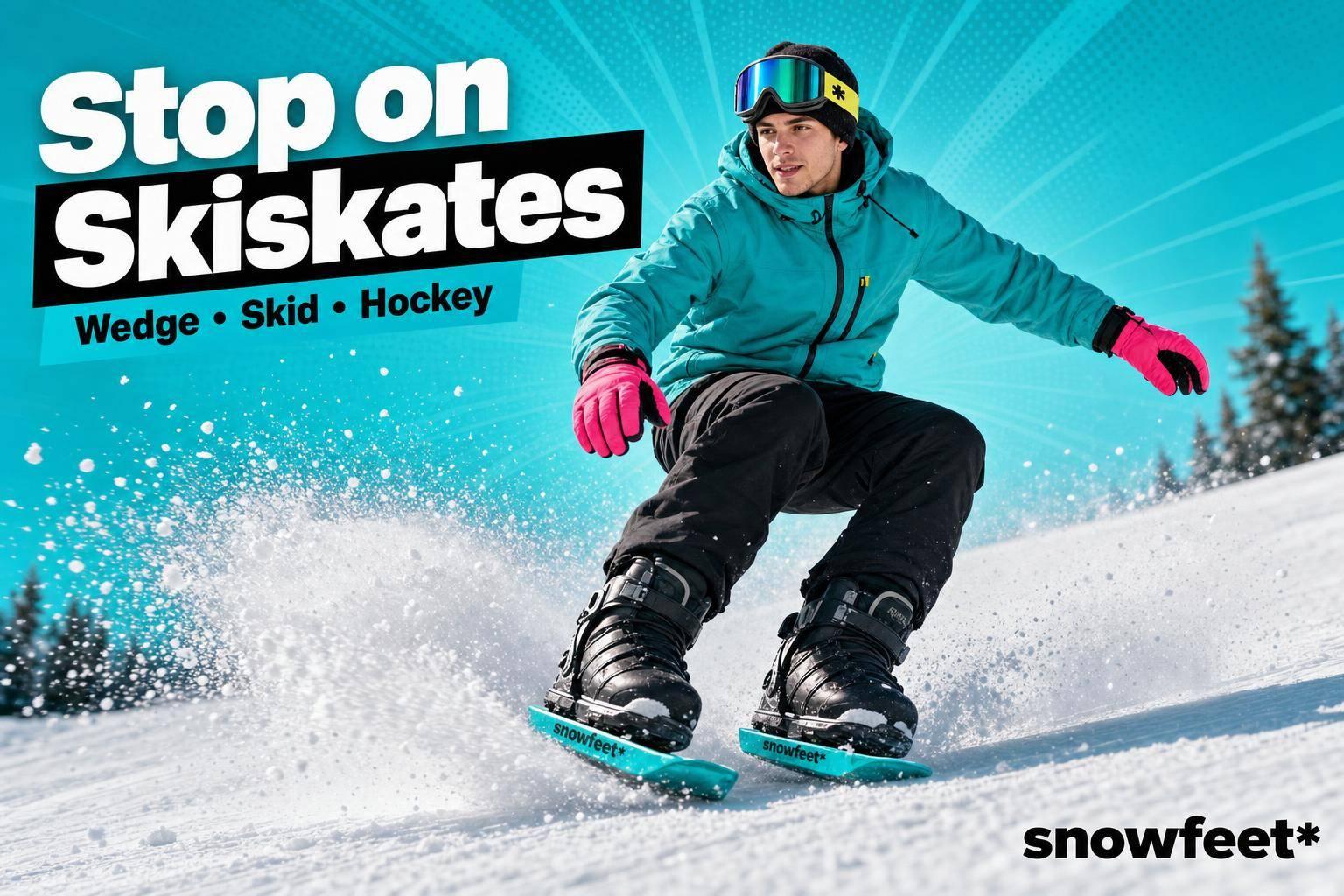
Stopping on skiblades works the same way it does on regular skis: the edges create friction against the snow. Snowplows, skidded stops, and hockey stops all depend on that edge hold.
Because skiblades are shorter, they’re usually easier to pivot than full-length skis. In plain English, that means controlled stops often feel simpler and take less effort. A well-kept edge also gives you more steady braking on groomed slopes and icy spots. If the edges are dull, you’ll feel it fast - kind of like trying to stop a shopping cart with bald tires.
Park riding, detuning, and edge upkeep
Metal edges matter in the park too. They help with landings, approach control, spins, and riding switch. Put simply, that steel edge hold helps you stay dialed in when you come into a feature, land, or ski backward.
Some riders detune parts of the edge for park use so the skis feel less catchy on rails and boxes. But even then, edge upkeep still matters. You want enough bite where you need it, without making the ski hook when you don’t.
Next: which skiblades use full metal edges, and which ones do not.
Which skiblades have metal edges and which do not
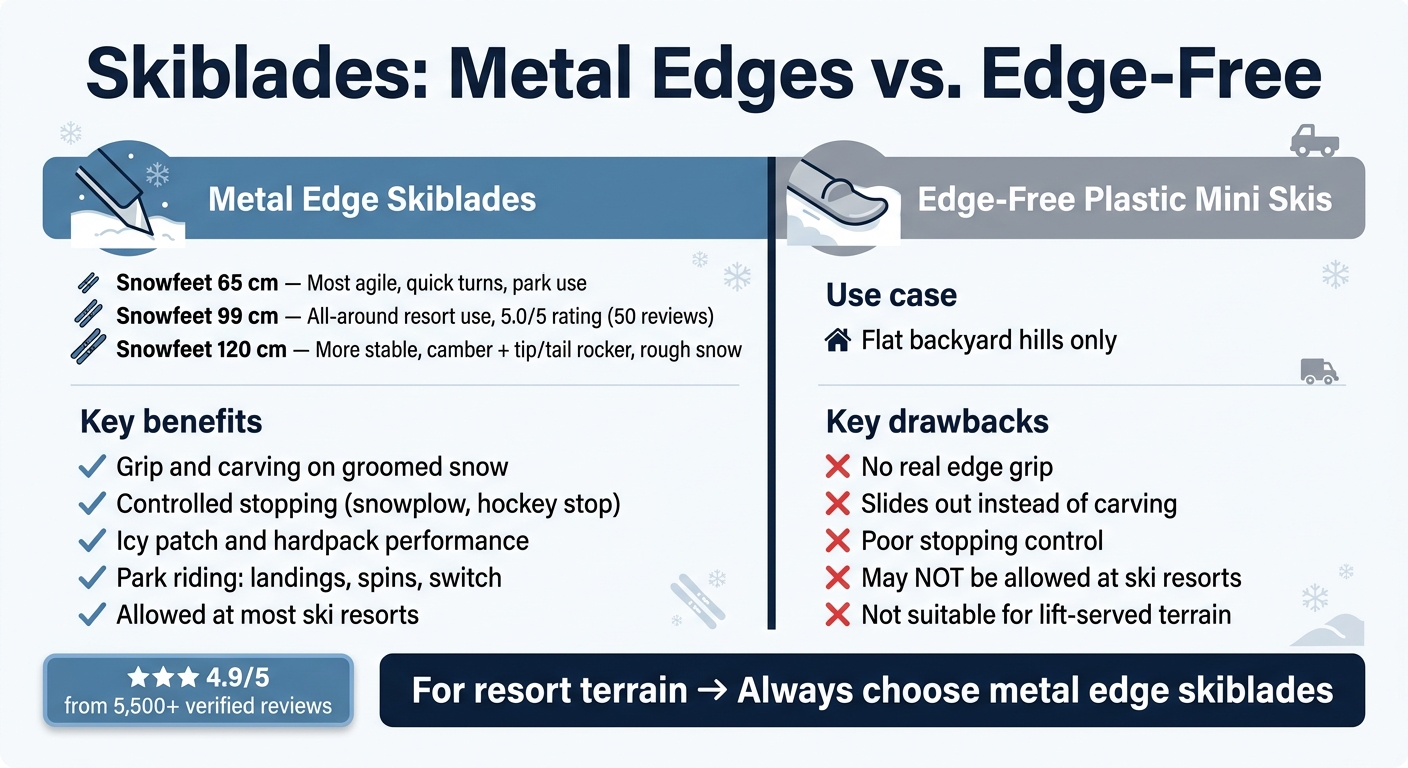
Skiblades with Metal Edges vs. Edge-Free: Which Should You Choose?
Here’s the simple version: some skiblades have full steel edges, and some don’t. That one detail makes a huge difference once you’re on snow.
Snowfeet* skiblades and short skis with full metal edges
Snowfeet* Skiblades 65 cm and 99 cm, plus the 120 cm short ski, all come with full steel edges and are made for resort riding.
The 65 cm model is the most agile. It feels quick and easy in tight spaces, which is a big plus if you like short turns or just want something that doesn’t fight you.
The 99 cm model hits a nice middle ground between maneuverability and stability. It also has a 5.0/5 rating from 50 reviews, which gives you a pretty clear sense of how riders feel about it.
The 120 cm short ski adds camber with tip and tail rocker, which helps when snow gets less than perfect, like on ungroomed terrain.
Other metal-edge skiblades compared to Snowfeet*
Other good skiboards use steel edges too, and they do well on groomed runs. So, metal edges aren’t rare. But Snowfeet* stands out for one simple reason: they’re easy to learn. Most riders get comfortable in about 5 minutes.
That’s a big deal. Some steel-edge skiboards are geared more toward enthusiasts and freestyle riders. They can work great, but they may take more time to get used to.
By contrast, edge-free plastic mini skis don’t have real metal edges at all. They’re fine for flat backyard hills, but not for lift-served terrain.
Edge-free plastic skis and other low-control options
Plastic snow sliders and toy mini skis do not have real metal edges. On groomed snow, they tend to slide out instead of carve. Stopping also feels much less controlled.
That makes them a poor swap for real skiblades at a ski resort. If you plan to ride lift-served terrain, this is the part you don’t want to gloss over: metal edges give you the control that plastic edge-free options just can’t match.
sbb-itb-17ade95
How to pick the right edged skiblades for your riding style
With metal edges, grip isn’t the main thing you’re choosing. That part is already built in. What you’re actually picking is the feel: do you want a setup that turns in a blink, or one that feels calmer when you start moving faster?
So, with steel edges, length mostly comes down to agility vs. stability.
Beginners and occasional resort riders
If you’re new or you just ride now and then, the 65 cm is the easiest place to start. It makes quick turns simple, and edge control feels less intimidating.
That said, longer skis are still more stable at top speed. So if you think you’ll ski a bit faster and want more support under you, the 99 cm is the smarter first pick.
If your plan is more speed and better all-around resort use, step up to the 99 cm or 120 cm.
Casual all-mountain riders
The 99 cm works well on groomers and in moguls. The 120 cm feels calmer when the snow gets rougher. Both give you solid edge grip across mixed resort terrain.
For a lot of riders, this is the sweet spot. You still get easy handling, but you’re not giving up as much composure when conditions get choppy.
For park laps, quick turns matter more than flat-out speed.
Terrain-park and freestyle riders
For park laps, spins, and switch riding, the 65 cm and 99 cm are the main picks.
- 65 cm: best for quick spins and fast edge changes
- 99 cm: gives you more surface area for landings while still staying very maneuverable
There’s a trade-off here. The 65 cm is faster and snappier, but it gives up landing support on bigger jumps. If you’re eyeing larger features, the 99 cm is the safer call.
Conclusion: metal edges are what make skiblades work on real slopes
Yes - good skiblades have metal edges.
That’s the part that gives you grip, clean carving, and controlled stopping on actual snow. Steel edges bite into the surface. Edge-free plastic gear doesn’t. Simple as that.
On groomed runs, icy spots, and busy resort slopes, control is everything. That’s also why many resorts may not allow edge-free equipment. If you can’t stop well, things get sketchy fast.
For most riders, Snowfeet* covers the main use cases with full metal edges:
- 65 cm for agility
- 99 cm for all-around use
- 120 cm for a more stable, longer-ski feel
Snowfeet* also has a 4.9/5 rating from 5,500+ verified reviews.
If you ride resort terrain, edged skiblades are the practical pick. And for most casual riders, Snowfeet* is the best fit.
FAQs
Are metal edges required at ski resorts?
Policies vary by resort, but metal edges are usually a must for safe, solid riding. On groomed runs, packed snow, or icy patches, they help you hold an edge, steer with control, and stop without that sketchy "uh-oh" slide.
Snowfeet* Skiblades come with high-quality, full metal edges for exactly that reason. Edge-free options can cut down your control in a big way, and that can make resort riding a lot less safe.
How do I know if skiblades have full steel edges?
Check the build and specs. Snowfeet* skiblades in 65 cm, 99 cm, 100 cm, and 120 cm use full metal edges, just like regular skis and snowboards. That gives you grip, cleaner carving, and more control when you need to stop.
If a product is made from light, unreinforced plastic, it usually won’t have those edges. It also helps to check for a wood or fiberglass core and a clear note in the specs that says the product has metal edges.
Which Snowfeet* length is best for me?
Choose based on your goal and experience level:
- 65 cm Skiblades: best for beginners, casual resort laps, moguls, and terrain parks
- 99 cm and 100 cm: a nice middle ground for carving, light powder, and all-mountain use
- 120 cm Short Skis: best if you want something closer to regular skis, with more stability at higher speeds











Lämna en kommentar
Denna webbplats är skyddad av hCaptcha och hCaptchas integritetspolicy . Användarvillkor gäller.