



















If you want the short answer: classic skis are easiest to learn, skate skis are fastest on groomed snow, and short Snowfeet* models work best when you want less gear hassle.
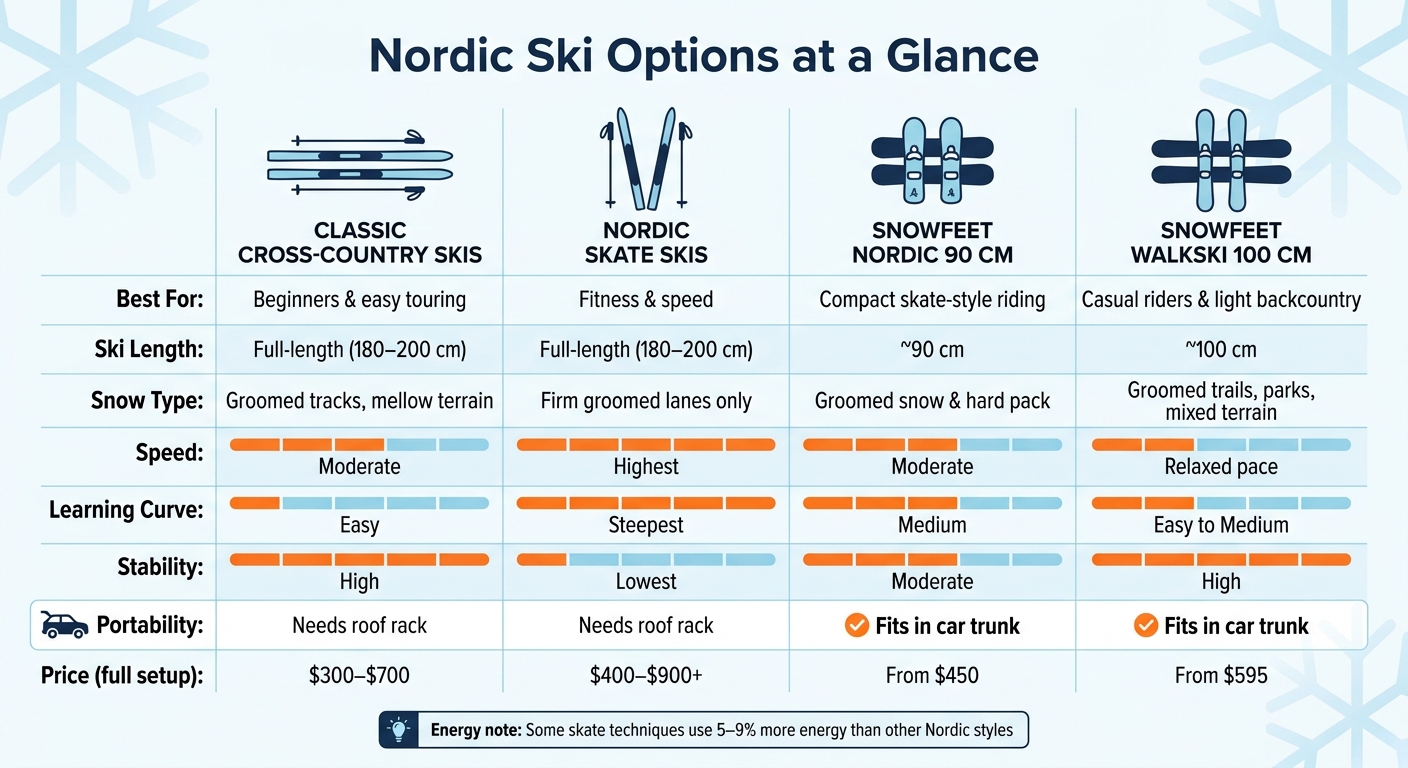
I’d pick classic skis for first-timers, skate skis for fitness laps, Snowfeet* NORDIC 90 cm for a short skate-style ride, and WALKSKI 100 cm for casual touring or light backcountry. Full-length Nordic skis often run 180–200 cm, while Snowfeet* options are just 90–100 cm. That changes storage, control, and how much ski you have to deal with.
Here’s the plain-English breakdown:
-
Classic cross-country skis
- Best for groomed tracks and mellow trails
- More stable for most beginners
- Moderate pace
- Typical full setup: $300–$700
-
Skate skis
- Best for firm, wide groomed lanes
- Faster, but harder to learn
- Some skate methods can use 5%–9% more energy
- Typical full setup: $400–$900+
-
Snowfeet* NORDIC 90 cm
- Short skate-style option
- Easier to store in a car trunk
- Better for short outings and hard-packed snow
- Starts at $450
-
Snowfeet* WALKSKI 100 cm
- Short touring option
- Good for parks, mixed terrain, and light backcountry
- More beginner-friendly than skate skis
- Starts at $595
Nordic Skate Skis vs Classic Cross-Country Skis: Full Comparison
This Nordic Ski Can Be Attached to Any Winter Shoes | Snowfeet Cross-country Skate Skis | 90 cm
Quick Comparison
| Option | Best for | Snow type | Learning curve | Feel | Price |
|---|---|---|---|---|---|
| Classic skis | Beginners, easy touring | Groomed tracks, mellow terrain | Easy | Steady, smooth | $300–$700 |
| Skate skis | Fitness, speed | Firm groomed lanes | Harder | Fast, athletic | $400–$900+ |
| Snowfeet* NORDIC 90 cm | Short skate-style riding | Groomed snow, hard pack | Medium | Lively, short, easy to carry | From $450 |
| Snowfeet* WALKSKI 100 cm | Casual riders, light backcountry | Groomed trails, parks, mixed terrain | Easy to medium | Stable, relaxed | From $595 |
So, if you’re stuck between them, I’d keep it simple: classic for ease, skate for speed, NORDIC 90 for compact skate feel, WALKSKI 100 for short touring with less fuss. It’s less about what sounds cool and more about what you’ll use on a cold Saturday morning :)
Technique and Ski Design: How Each Style Feels on Snow
Classic technique and classic ski setup
Classic skiing uses parallel skis and a diagonal stride. You push with one ski while the opposite arm swings forward, then you glide on the other side. It’s a simple, steady rhythm, which is a big reason classic tends to feel natural for beginners.
The ski itself is built around that motion. A grip zone sits under your foot, right in the middle of the ski. When you press down to kick, the camber flattens and that grip zone grabs the snow. When you move your weight forward to glide, the camber lifts the grip zone off the snow so it won’t drag.
Classic poles are shorter than skate poles, usually about 83–86% of your height. That keeps your arm swing smooth and comfortable instead of making every push feel like you’re reaching for the moon.
Skate skiing is a different animal. It trades that easy rhythm for more speed and a much bigger balance test.
Skate technique and skate ski setup
Skate skiing looks a lot like ice skating. You push off the inside edges of each ski in a V-shape, side to side, while your poles help drive you forward. There’s no grip zone here. The base is smooth, so movement comes from edging, timing, and body control.
Skate skis are shorter and stiffer than classic skis, and they’re made for firm groomed snow. The poles are longer too, which gives you more leverage for strong double-poling between each V-push. That said, skate skiing asks more from you. Gliding on one ski while pushing off the other takes solid coordination, and even small timing mistakes show up fast.
If long skis feel like a lot to deal with, shorter Snowfeet* gear can make that first step feel less awkward.
Short Nordic options: Snowfeet* NORDIC 90 cm and WALKSKI 100 cm
This is where short Nordic skis start to make a lot of sense. Full-length Nordic skis for adults often run about 180–200 cm, so the Snowfeet NORDIC Cross-country 90 cm* and Snowfeet WALKSKI Backcountry Touring 100 cm* come in at about half that length.
The NORDIC Cross-country 90 cm uses a skate-style, edge-driven motion in a compact shape. It turns fast and reacts quickly when you shift your weight. For many skiers, that shorter running surface feels less intimidating and more playful than a full-length skate ski. Each move feels faster and a bit less draining.
The WALKSKI Backcountry Touring 100 cm leans more toward a short-stride glide that works well for backcountry travel. It feels more stable and easier to steer on forest trails and rolling terrain than a standard touring ski, without that long, locked-in feeling under your feet. Both are also easy to store and easy to toss in the car.
sbb-itb-17ade95
Terrain, Speed, Stability, and Learning Curve
Best terrain for each ski style
These setup differences show up fast once you're on snow. Classic skis work best in groomed tracks and on mellow, rolling terrain. They’re the easygoing option for trails that are set up for a smooth, straight glide.
Skate skis need firm, wide groomed snow. Put them on soft snow or a narrow trail, and they lose speed and efficiency in a hurry. It’s a bit like taking a road bike onto a sandy path. You can try it, but it won’t feel great.
That trail match also shapes how fast each style feels and how much work it takes.
Speed, workout intensity, and overall feel
On the same snow, skate skiing is faster, but it also asks more from your body. In similar conditions, it usually holds a small but clear speed edge over classic skiing.
That extra pace comes with extra effort. Some skate technique variations use 5% to 9% more energy than other Nordic styles. So if you want more speed and a harder workout, skate has that punch.
Classic skiing feels steadier and easier to pace. You can settle into a rhythm, cruise, and keep things under control without fighting for every bit of momentum.
Stability and how hard each style is to learn
For beginners, classic skis are the more stable choice. The track grooves help guide the skis, so the motion feels more natural right away. That built-in guidance can take a lot of stress out of your first few outings.
Skate skiing is a different beast. It needs more side-to-side balance and better edge control, so it doesn’t feel automatic at first. There’s a learning curve, and yep, most people feel a little wobbly early on.
Snowfeet*'s shorter NORDIC 90 cm and WALKSKI 100 cm models are shorter and easier to control, which makes them simpler to handle for beginners and casual riders.
Which Option Fits Your Goals: A Direct Comparison
Comparison table: classic vs skate vs Snowfeet* short Nordic options
Now that the technique and terrain differences are clear, here’s the fast way to sort it out. When you line these options up side by side, the feel of each one starts to make a lot more sense.
| Feature | Classic Cross-Country | Nordic Skate Skis | Snowfeet* NORDIC 90 cm | Snowfeet* WALKSKI 100 cm |
|---|---|---|---|---|
| Technique | Kick-and-glide | V-step lateral push | Compact skate-style | Walking-style glide touring |
| Ski length | Full-length | Full-length | About 90 cm | About 100 cm |
| Terrain | Groomed classic tracks, gentle ungroomed terrain | Groomed skate lanes only | Groomed snow, hard pack, light mixed terrain | Groomed trails, parks, mixed terrain, light backcountry |
| Speed | Moderate | Highest | Moderate | Relaxed pace |
| Stability | High, but track-dependent | Lowest - most balance demand | Moderate | High |
| Learning curve | Easy to start | Steepest - needs athletic base | Moderate | Beginner-friendly |
| Portability | Bulky, needs roof rack or long vehicle | Bulky, needs roof rack or long vehicle | Fits in most car trunks | Fits in most car trunks |
| Best for | Relaxed touring, beginners | Fitness and speed-focused skiers | Skate feel in a compact package | Casual riders and backcountry users |
Best match by rider type: beginners, fitness skiers, casual riders, and backcountry users
The best pick has less to do with the name of the ski and more to do with how you want to move on snow.
Beginners usually do best on classic skis or the WALKSKI 100 cm. Both feel steady and easy to figure out. Classic is the safer default, but if you want something shorter and more walking-like, the WALKSKI is a nice fit.
Fitness-focused skiers should look at skate skis first if they want a hard cardio session. Once the technique clicks, skate skiing turns into a high-effort, full-body workout. If your car, storage space, or patience for long gear is limited, the NORDIC 90 cm gives you that skate-style feel in a much smaller setup.
For many people, though, speed isn’t the main thing. Ease of use wins.
Casual riders who want mellow snow days, short outings, and a bit of trail wandering will likely feel most at home on classic skis or the WALKSKI 100 cm. The WALKSKI works well for mixed-use days when a full-length ski feels like a bit much.
Backcountry users heading onto forest roads or ungroomed terrain should lean toward the WALKSKI 100 cm. The shorter length makes it easier to turn, step around trees, and deal with rolling ground. Full-length skate skis are a poor match off groomed lanes, and even classic skis can feel awkward in tight spots.
Budget and value: when Snowfeet* makes more sense
Once you know the ski style, price and day-to-day convenience tend to settle the debate.
Typical full setups - skis, bindings, boots, and poles - cost about $300–$700 for entry-to-midrange classic packages and about $400–$900+ for skate setups at U.S. retailers. The Snowfeet* NORDIC starts at $450, while the WALKSKI starts at $595. That puts both right in the midrange.
If you race or ski long distances a lot, full-length gear will give you more performance for the money. But for plenty of riders, that’s not the whole story. Snowfeet* options do something long skis can’t: they fit in a standard trunk and store in a coat closet. That’s a big deal. Gear that’s easy to grab tends to get used more, and more days on snow usually beat tiny gains in speed.
For groomed trails, parks, mixed terrain, and casual touring, the Snowfeet* format makes a strong practical case.
Conclusion: Choose Based on Where and How You Ski
After looking at technique, terrain, and the learning curve, the pick comes down to three simple things: where you ski, how much effort you want to put in, and how much gear hassle you can live with.
So, the best ski depends less on the label and more on where you actually ski. Classic works well on groomed tracks. Skate works well for performance on wide groomed lanes. And Snowfeet* makes sense for short outings and mixed conditions. For parks, mixed terrain, or laid-back days outside, Snowfeet* NORDIC 90 cm ($450) and WALKSKI 100 cm ($595) are the better match.
Snowfeet* stands out for practicality, not top speed. That short, compact shape makes it easier to bring along, put on, and use more often. For most casual riders, that kind of easy use matters more than going all-out for speed.
Pick the option that matches your trails and your current skill level. You don’t need the perfect long-term setup on day one. Pick the ski you’ll use the most. :)
FAQs
Which ski is best for absolute beginners?
For absolute beginners, Snowfeet products are the best place to start. Traditional cross-country skis can feel a bit intimidating. They’re long, awkward at first, and they need special boots.
Snowfeet skis keep things much simpler. They’re compact, lightweight, and easier to learn on. In many cases, people can get the basics down in just one day.
The 38 cm and 44 cm Mini Ski Skates are an especially easy entry point. They fit over regular winter boots, so you don’t need extra gear, and they’re easy to carry around. That means less fuss, less setup, and more time actually having fun on the snow :)
Can I use skate skis on ungroomed snow?
Standard skate skis are built for groomed trails. That’s where they shine.
Take them into deep snow or rough, ungroomed terrain, and things get sketchy fast. They don’t have the width, float, or stability you need, so control drops off in a hurry.
For off-trail use, backcountry skis or other purpose-built gear make more sense.
Snowfeet NORDIC skis are a smart option here. Their compact shape makes them easier to handle, and the integrated metal edges give you better control on uneven, unpredictable snow.
Are short Snowfeet* skis better for casual riders?
Yes - short Snowfeet* skis are often a better pick for casual riders.
Why? They’re easier to learn on and easier to control than standard skis, which usually run from 150 cm to 195 cm. That shorter learning curve can make a big difference if you just want to get out there and have fun instead of spending half the day figuring things out.
Their small, lightweight build also makes life simpler. They’re easier to carry, work with your existing winter footwear, and give you a handy, lower-cost, flexible way to enjoy groomed trails and local hills.











Lämna en kommentar
Denna webbplats är skyddad av hCaptcha och hCaptchas integritetspolicy . Användarvillkor gäller.