



















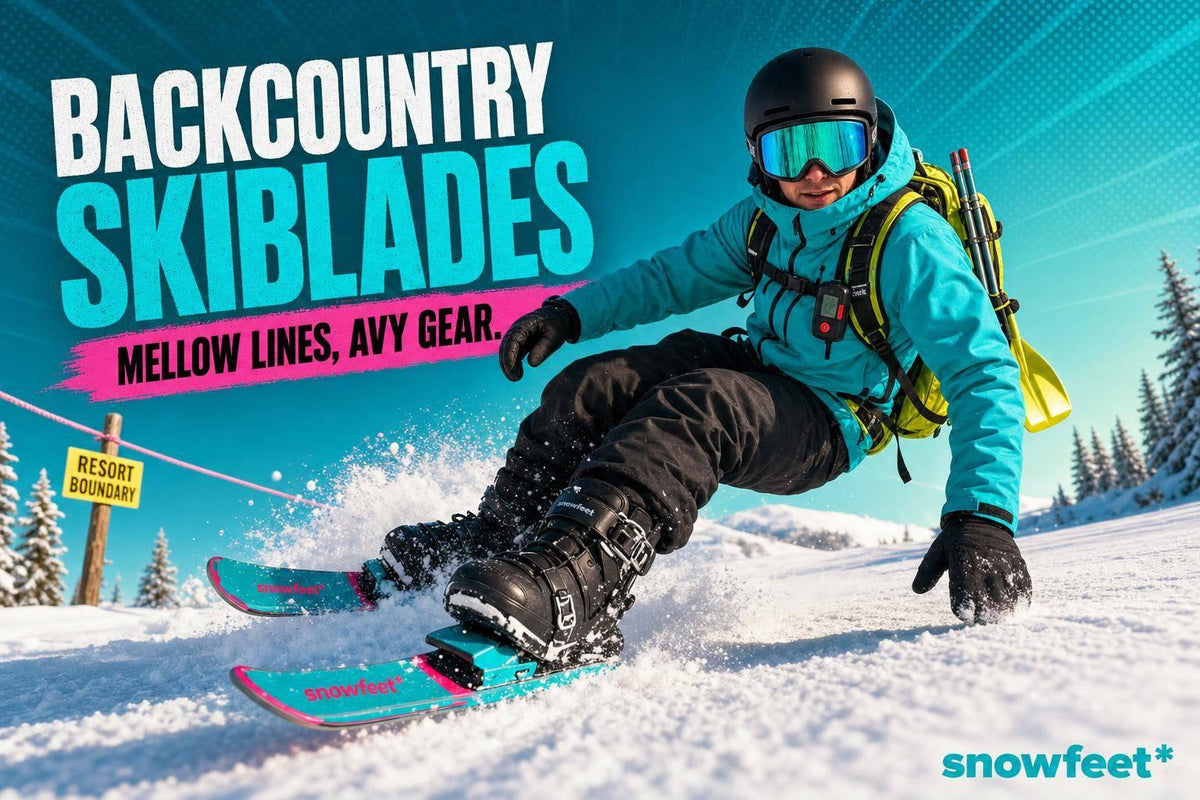
Yes - but only for the right day and the right terrain.
If I had to give you the short answer fast, it’d be this:
- 99–100 cm skiblades can work for short tours, sidecountry laps, mellow glades, and boot-top powder
- 65 cm skiblades are best kept inbounds
- For deep powder, long climbs, or steep lines over 35°, longer touring skis still make more sense
- If you go out of bounds, you need avalanche gear, training, a partner, and a plan - no shortcuts
Here’s the part many people miss: sidecountry and backcountry are not the same thing. Sidecountry often means lift access plus a short hike. Backcountry usually means a trailhead start, no patrol, and more exposure. That one difference changes what setup I’d trust.
A few simple takeaways:
- Best short-ski length for off-piste use: 99–100 cm
- Poor choice for powder and mixed snow: 65 cm
- Best snow for skiblades: packed powder, soft tracked snow, boot-top powder
- Bad snow for skiblades: knee-deep powder, breakable crust, wet heavy snow
- Best use case: short, playful runs where turning fast matters more than float and top-end stability
My bottom line? If your day looks like a short walk, a mellow tree run, and a lap back toward the resort, skiblades can be a fun tool. If it looks like a big mission, bring longer skis. No shame in using the right tool - your legs will thank you later :)
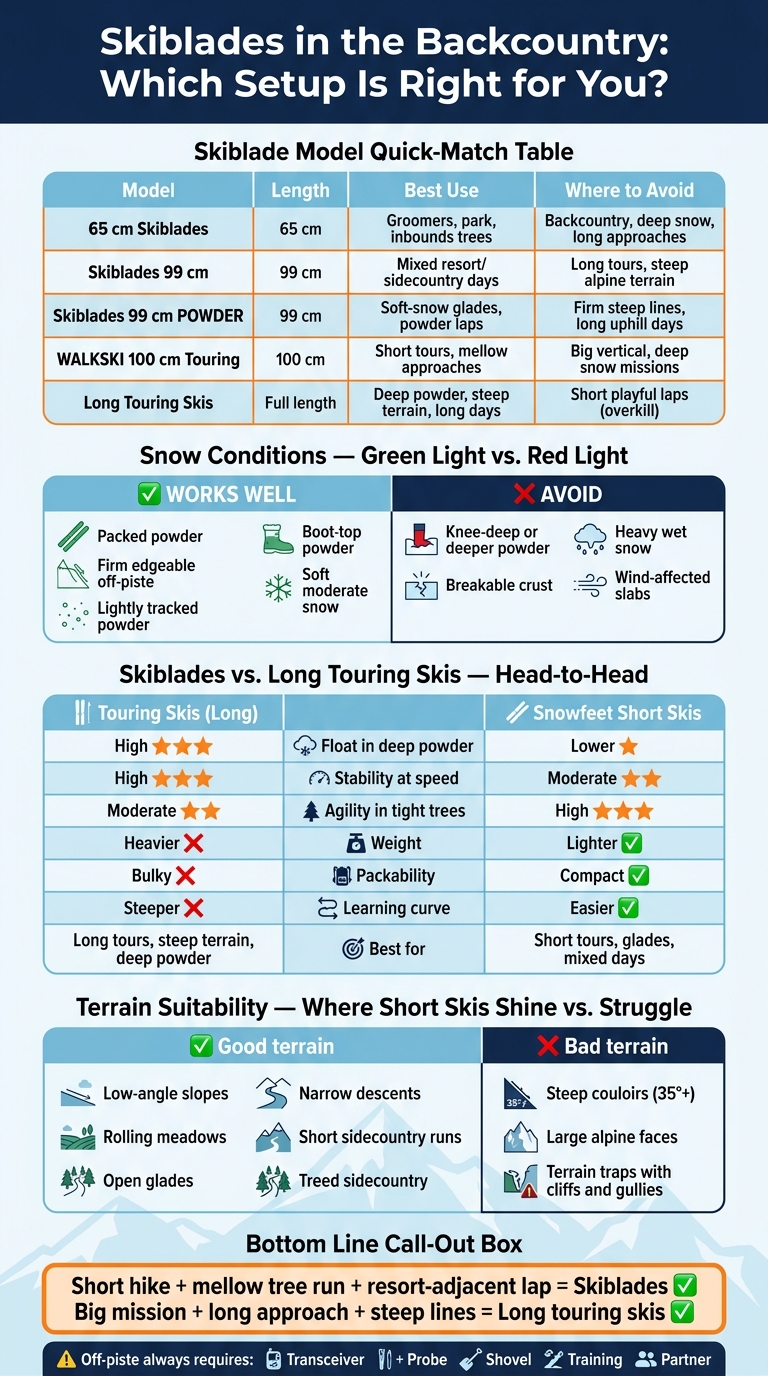
| Setup | Where I’d Use It | Where I Wouldn’t |
|---|---|---|
| 65 cm skiblades | Groomers, park, inbounds trees | Backcountry, deep snow, long approaches |
| 99 cm skiblades | Sidecountry laps, mixed resort/off-piste days | Long tours, steep alpine terrain |
| 99 cm powder skiblades | Soft-snow glades, powder laps | Firm steep lines, long uphill days |
| 100 cm touring short skis | Short tours, mellow approaches | Big vertical, deep snow missions |
| Long touring skis | Deep powder, steep terrain, long days | Overkill for short playful laps |
So, if you want the simple version: skiblades can work out of bounds, but only in a narrow lane. Pick the wrong snow or terrain, and they go from fun to a lot of work, fast.
Skiblades vs. Backcountry Skis: Which Setup Is Right for You?
Snowfeet* WALKSKI Backcountry Touring Skis | 100 CM
When Skiblades Work Off-Piste
Once you step past the resort boundary, ski length stops being the whole story. Terrain and snow call the shots. That’s where skiblades either feel fun and easy... or start to feel out of their depth.
Terrain Where Short Skis and Skiblades Perform Well
Short skis shine on low-angle slopes, rolling meadows, open glades, narrow descents, and short sidecountry runs. In spots like these, quick turns matter more than top speed or long-ski stability.
On mellow terrain, you don’t need a long touring setup. You need skis that pivot fast, scrub speed with ease, and slip through tight gaps without a fight.
Glades and treed sidecountry runs are a strong match for skiblades. They turn fast in tight spaces. For a short hike from a lift to a nearby powder stash, or a low-angle bowl just outside the resort boundary, skiblades can be a smart pick. That’s where 99–100 cm Snowfeet* models fit well.
What they don’t suit:
- Steep couloirs
- Large alpine faces
- Terrain traps with cliffs and gullies
Terrain sets the ceiling; snow sets the limit.
Snow Conditions That Work - and Conditions That Don't
The sweet spot for skiblades off-piste is packed snow, firm but edgeable off-piste surfaces, lightly tracked powder, and boot-top powder. In soft, moderate snow, these skis stay easier to handle. That helps Snowfeet* short skis keep that playful feel without giving up too much control.
Once the snow gets knee-deep or deeper, things change fast. Short skis sink more. That can shove you into a backseat stance, which gets tiring and shaky in a hurry.
Then there’s the ugly stuff: breakable crust, heavy wet snow, and wind-affected slabs. Those conditions send every bump and change straight into your legs. You also get less margin for error. A good rule here is simple: use skiblades for soft snow, and switch to longer skis for deeper or mixed conditions.
What Gear You Need Before Leaving the Resort
If you’re heading out of bounds, the gear matters just as much as the slope.
Every person needs:
- An avalanche transceiver
- A probe
- A shovel
- Training to use them
- A helmet
- Layers
- Food
- Water
- A charged phone
For more exposed routes, bring an avalanche airbag pack and a communication device.
On the climb, climbing skins cut to fit your 99–100 cm skiblades give you traction on low-angle approaches. For Snowfeet* WALKSKI and 99 cm POWDER setups, skins and touring bindings can turn short skis into a legit short-tour option. You’ll also want touring bindings with walk mode and AT boots that match your binding.
Forecast, gear, and training are non-negotiable before any sidecountry trip.
That’s why the next question is which Snowfeet* setup fits the trip.
Snowfeet* Models for Backcountry Use
Only a few Snowfeet* models make sense off-piste. Most are still built more for the resort. So if you want the short version, here it is: match the model to the kind of terrain and trip length you’ll actually do.
| Model | Length | Best Use | Boot Compatibility | Skin-compatible |
|---|---|---|---|---|
| WALKSKI Backcountry Touring | 100 cm | Short tours, approaches, winter trails | Winter boots, snowboard boots, ski boots | Yes |
| Skiblades 99 cm POWDER | 99 cm | Soft-snow glades, powder laps, sidecountry | Ski boots | No |
| Skiblades 99 cm | 99 cm | Mixed resort/sidecountry days | Ski boots | No |
| Skiblades 65 cm | 65 cm | Groomers, parks, casual sidecountry | Ski boots | No |
Snowfeet* WALKSKI Backcountry Touring 100 cm: Best for Short Tours and Approaches
WALKSKI is Snowfeet*’s best pick for short backcountry approaches. Put skins on, and it works well for short uphill travel on forest roads, ridgelines, and winter trails. That makes it a good match for quick approaches to powder terrain, not long haul missions.
One thing that helps a lot is the multi-boot binding system. It works with insulated winter boots and snowboard boots, not just ski boots. That opens the door for hikers, ice climbers, and anyone who wants a warmer setup that’s easier to walk in. That’s a nice touch, because clomping around in ski boots all day isn’t most people’s idea of fun :)
If your main goal is the downhill after a short hike, though, the 99 cm models make more sense.
Snowfeet* Skiblades 99 cm and 99 cm POWDER: Best for Playful Off-Piste Descents
These two are better for the fun part: short off-piste descents.
The 99 cm POWDER gives you more float. Its extra width and rocker help in glades and lightly tracked powder, where the standard 99 cm can feel less floaty and take more effort. You’ll notice that when the snow gets soft and you want the skis to stay up instead of making you work for every turn.
The standard 99 cm is still the better all-around option. It handles groomers, sidecountry laps, bumps, and mixed conditions without feeling too niche. So if your day might include a lift, a traverse, a dip into soft snow, and then back to firmer runs, this one has the broader range.
Both models need ski boots. That means they’re best for riders who already use a ski-boot setup and want short off-piste laps, not long tours or full backcountry days.
Why 65 cm Skiblades Are Best Kept to the Resort
The 65 cm version is the clearest limit case. They’re quick to turn on groomers and in parks, which is fun, no doubt. But once you leave the resort, the weak spots show up fast.
They don’t have the float, stability, or skin compatibility you need for actual backcountry use. In other words, they’re fine for messing around in bounds, but they’re not the tool for snowfields, approaches, or deeper off-piste terrain.
For riders comparing short skis with full touring setups, the next question is where longer backcountry skis still win.
sbb-itb-17ade95
Skiblades vs. Backcountry Skis: An Honest Comparison
Once you’ve got the right terrain and snow, the next call is pretty simple: do you want long touring skis or short Snowfeet* skis?
These two setups do different jobs. Long touring skis are built for distance, deep snow, and steeper terrain. Snowfeet* short skis lean toward lighter, simpler days with less gear to haul around. For most casual riders, the better pick comes down to terrain, tour length, and how much stuff you want to carry.
| Factor | Touring Skis (Long) | Snowfeet* Short Skis |
|---|---|---|
| Float in deep powder | High | Lower |
| Stability at speed | High | Moderate |
| Agility in tight trees | Moderate | High |
| Weight | Heavier | Lighter |
| Packability | Bulky | Compact |
| Learning curve | Steeper | Easier |
| Best for | Long tours, steep terrain, deep powder | Short tours, glades, mixed days |
So the real question isn’t which one is “better” across the board. It’s this: where do long skis still beat short ones?
Where Long Touring Skis Still Have the Edge
Full-length touring skis are the better tool for long tours, steep lines, and deep powder days. They float better, hold an edge better on firm snow, and feel steadier on steep pitches. Over long climbs and long descents, they also deal with sustained vertical with less fatigue.
If you’re heading into lines above 35° or planning big alpine days, a full-length setup gives you more margin for error. At that point, it’s not just personal taste. It’s the right tool for the job.
Where Snowfeet* Short Skis Win for Casual Riders
For shorter missions, things flip. This is where Snowfeet* starts to make a lot of sense.
The WALKSKI 100 cm weighs about 8.8 lb per pair, so it’s much easier to carry on bootpacks or short approaches. That lighter setup can feel like a gift when you’re hiking uphill and trying not to feel like a pack mule by mile two.
Snowfeet* short skis also make kick turns easier, and the setup is less intimidating for riders trying off-piste terrain for the first time. That lower barrier matters. Less fuss usually means more fun, and for casual riders, that counts for a lot.
That’s why Snowfeet* works best for riders who want a lighter, simpler setup for short approaches and playful descents. That leads straight to the next step: which Snowfeet* model matches your touring style.
Conclusion: Choosing the Right Setup for Your Backcountry Goals
Skiblades can work in the backcountry, but ONLY when the day lines up with the gear. Terrain, snowpack, and avalanche gear all need to match your plan. So the main call isn’t “Can skiblades go off-piste?” It’s this: Do they fit the terrain, snow, and distance you have in mind?
For casual riders doing short hikes, tree runs, and resort-adjacent laps, Snowfeet* short skis make a lot of sense. They’re a smart pick for playful off-piste days. For big objectives, long approaches, and serious missions, long touring skis are still the better tool.
Which Snowfeet* Model Fits Your Riding Style
Here’s the fastest way to match your Snowfeet* setup to the way you ride.
| Your Typical Day | Best Snowfeet* Pick |
|---|---|
| In-bounds laps, not backcountry | 65 cm Skiblades |
| Local tree runs, short bootpacks, resort-adjacent powder | Skiblades 99 cm |
| Weekend powder days, soft snow, sidecountry glades | Skiblades 99 cm POWDER |
| Short tours, trailhead hikes, mellow ridgeline approaches | WALKSKI Backcountry Touring 100 cm |
| Long tours, steep couloirs, deep backcountry missions | Traditional long touring skis |
If your day is mostly downhill, go with the 99 cm models. If your plan includes real uphill travel, pick the WALKSKI 100 cm.
Whatever ski you choose, check the forecast and travel with a partner. For casual off-piste use, Snowfeet* is the smarter, simpler choice.
FAQs
Are skiblades good for beginners in the backcountry?
Yes. Skiblades can be a great pick for backcountry beginners because they’re easier to learn, easier to control, and easier to carry than full-length skis. Their shorter, lighter shape feels less intimidating, which helps new riders build confidence fast.
If you want a more stable, casual setup, Snowfeet* models like the PRO (50 cm) or Skiblades (65 cm and 99 cm) give you a wider platform. That makes them a better match for relaxed backcountry exploring than steep, hard-charging terrain.
Can you put skins on all Snowfeet* models?
Not all Snowfeet* models are clearly listed as working with skins. The info instead points to a few backcountry-focused options, with the Snowfeet WALKSKI Backcountry Touring 100 cm* standing out the most.
One user said they used a Snowfeet* backcountry model with touring bindings and a full base skin for uphill travel.
So, if you want to skin uphill, the WALKSKI model is the one built for that job.
How do I know when to choose long touring skis instead?
Go with long touring skis if you want the most float in deep powder or more stability when you're skiing fast on steep, icy big-mountain lines.
Go with Snowfeet if you want more agility, easier carrying, and a more playful ride in moderate conditions, tight tree runs, technical terrain, or light backcountry touring. Options like the WALKSKI Backcountry Touring 100 cm and 99 cm POWDER work well as flexible alternatives.











Lämna en kommentar
Denna webbplats är skyddad av hCaptcha och hCaptchas integritetspolicy . Användarvillkor gäller.