



















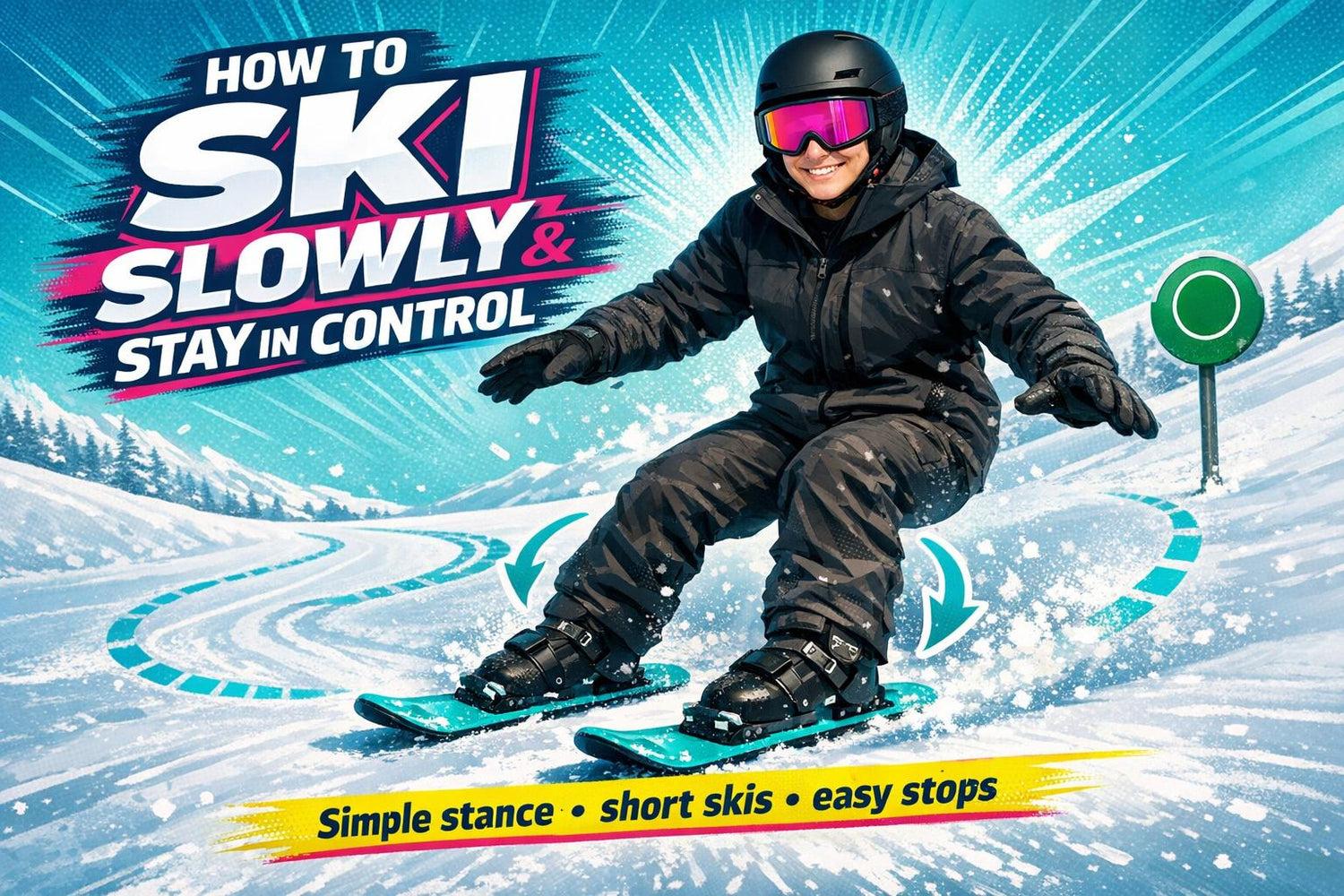
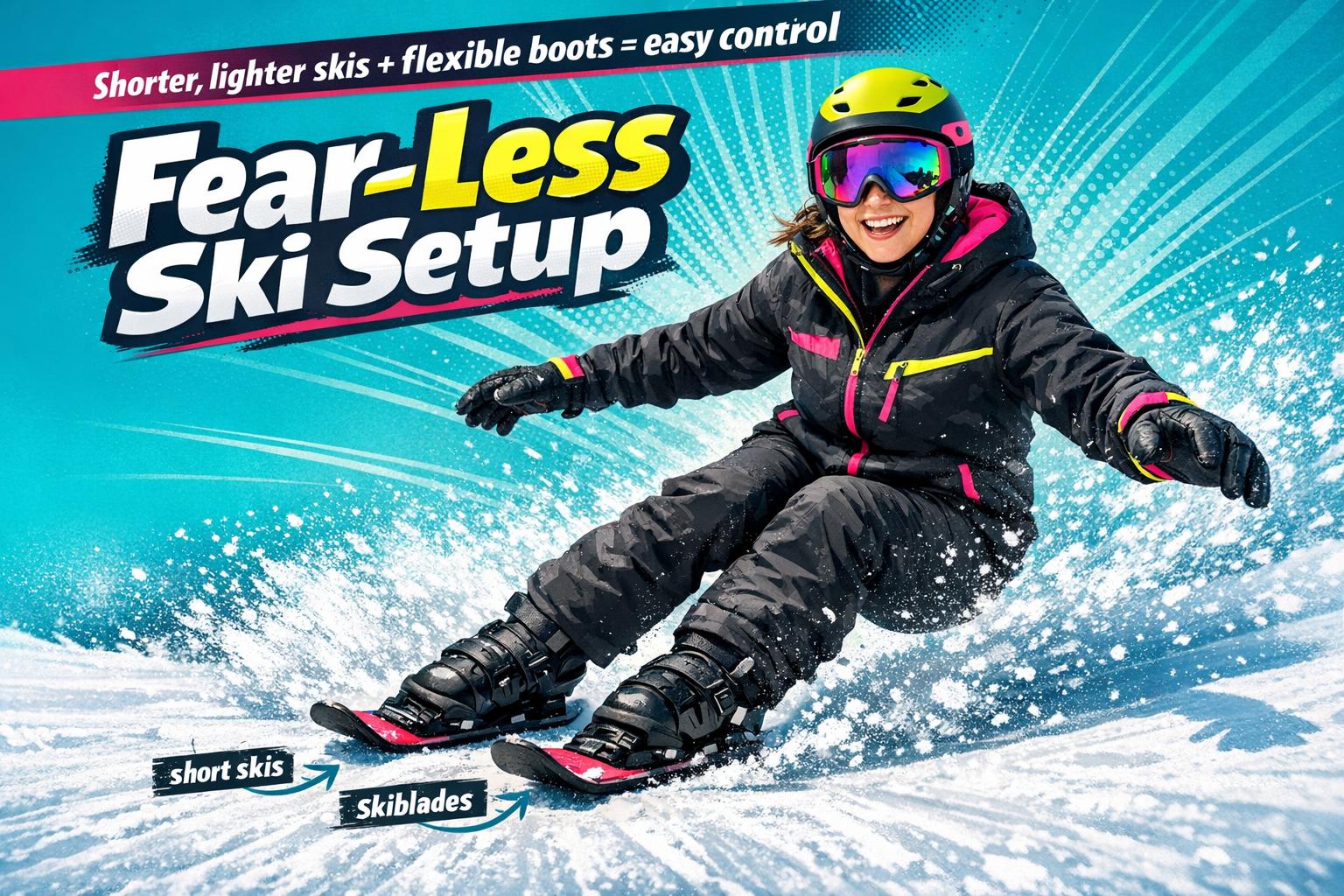
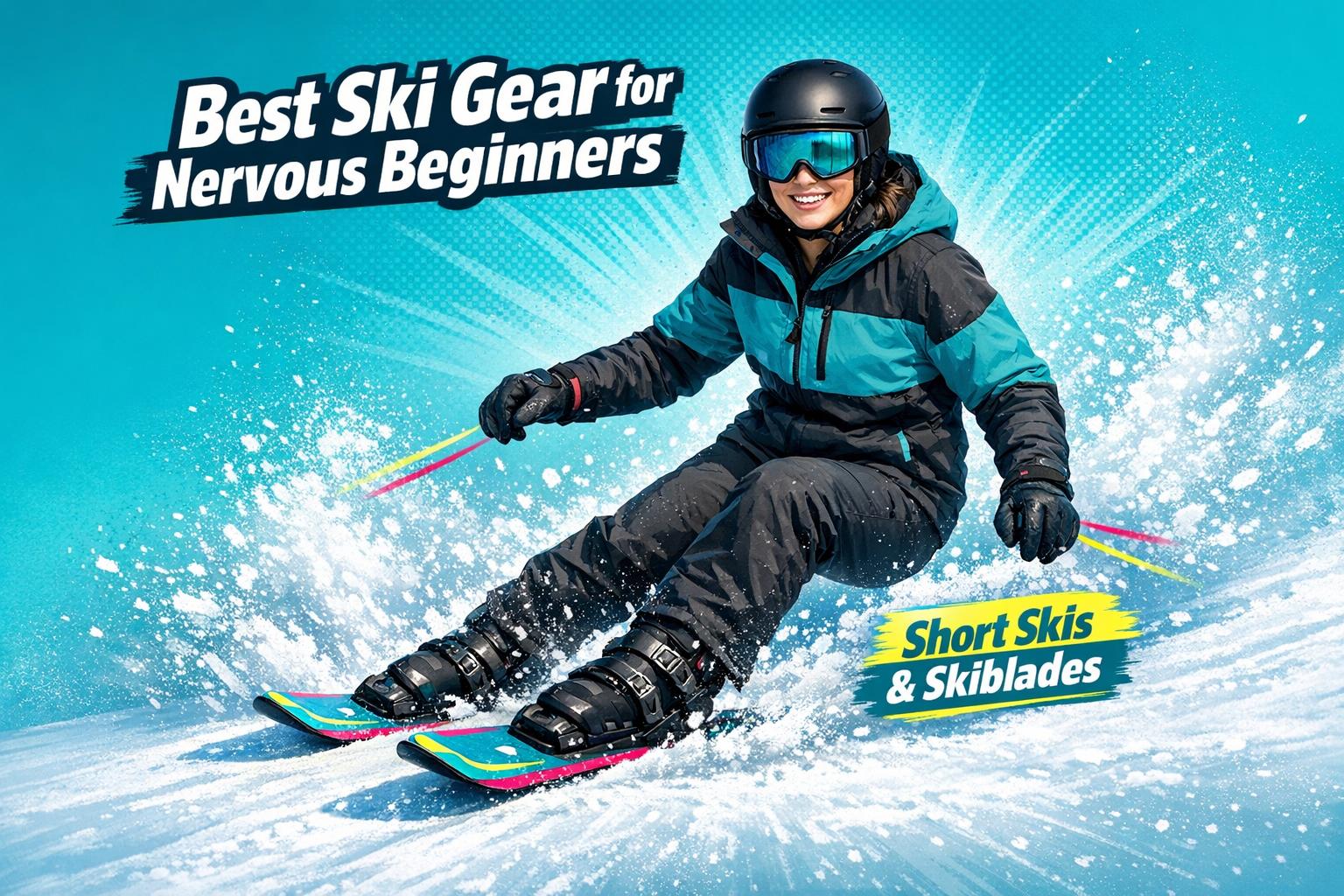
Ever feel like skiing downhill is more about surviving than enjoying the ride? Here's the deal: skiing slowly and staying in control is the secret to having fun and staying safe, especially if you're a beginner. The key? Mastering simple techniques like snowplow stops, smooth turns, and keeping a balanced stance. Plus, using shorter skis like Snowfeet Skiblades (65 cm) or Skiskates (44 cm) can make learning way easier. These compact skis are easier to steer, stop, and control compared to long skis.
Quick Takeaways:
- Control: Use snowplow stops and turns to manage speed and avoid accidents.
- Balance: Stay in an athletic stance - knees bent, weight centered, hands forward.
- Gear: Short skis (like Snowfeet Skiblades) are beginner-friendly and help you feel more in charge.
- Practice: Start on gentle, green slopes and build confidence with simple drills.
Ready to feel confident on the slopes? Let’s break it all down step by step.
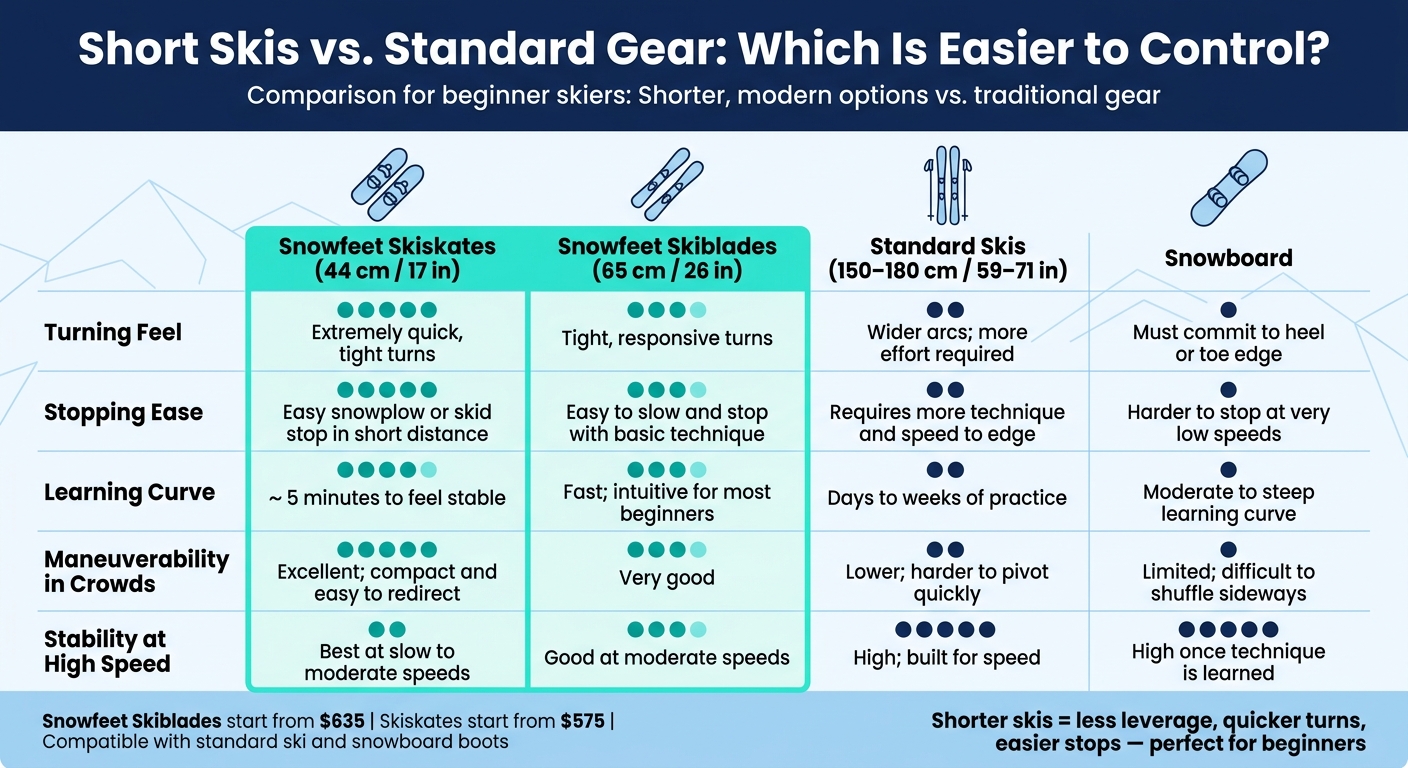
Short Skis vs. Standard Gear: Beginner Ski Control Comparison
The Basics of Slow, Controlled Skiing
What Controlled Skiing Actually Means
Controlled skiing isn’t just about taking it slow - it’s about being in command of your skis. On a beginner (green) slope, this means starting your movement when you decide, slowing down anytime you feel the need, stopping exactly where you want, and being able to turn both ways without feeling overwhelmed.
If you point your skis straight downhill, even on a green run, you’ll pick up speed fast. Instead, try angling across the slope right from the start, using a slight snowplow or small turns to keep things manageable. These basics are key, and they’re also why Snowfeet* products, with their compact design, offer such an immediate edge.
Why Short Skis Give You More Control
Here’s the thing: shorter skis - like Snowfeet* Skiblades and Skiskates - are way easier to handle than traditional long skis. Standard skis (usually 150–180+ cm) are harder to control because their length acts like a lever. Even small mistakes can create big twisting forces, making it harder to recover.
Short skis change the game. Snowfeet* Skiblades (65 cm / 26 in) are less than half the length of typical skis, while Snowfeet* Skiskates (44 cm / 17 in) are even more compact. This smaller size means less leverage on your body, quicker reactions, and tighter, easier turns with less effort. Take it from Brad Tolin, a verified user:
"These ski blades are a blast to use. Super easy to control, quick to turn, and way more forgiving than traditional skis."
With short skis, you can make tight turns effortlessly. This is a big plus for beginners because it keeps your speed in check. Instead of making long, sweeping turns that let you pick up momentum, frequent small turns help you stay in control from top to bottom.
Short Skis vs. Standard Gear: A Side-by-Side Look
Here’s a quick comparison to show why Snowfeet* products are perfect for maintaining control, especially for beginners:
| Feature | Snowfeet Skiskates (44 cm / 17 in) | Snowfeet Skiblades (65 cm / 26 in) | Standard Skis (150–180 cm / 59–71 in) | Snowboard |
|---|---|---|---|---|
| Turning feel | Extremely quick, tight turns | Tight, responsive turns | Wider arcs; require more effort | Requires committing to heel or toe edge |
| Stopping ease | Easy to snowplow or skid to a stop in a short distance | Easy to slow and stop with basic technique | Requires more technique and speed to edge effectively | Harder to stop at very low speeds; edge commitment needed |
| Learning curve | ~5 minutes to feel stable | Fast; intuitive for most beginners | Days to weeks of practice | Moderate to steep; both feet locked together |
| Maneuverability in crowds | Excellent; compact and easy to redirect | Very good | Lower; harder to pivot quickly | Limited; difficult to shuffle or step sideways |
| Stability at high speed | Best at slow to moderate speeds | Good at moderate speeds | High; built for speed | High; stable at speed once technique is learned |
Thanks to their compact size and straightforward design, Snowfeet* products make learning to ski less intimidating. They help beginners feel confident and in control right from the start.
Body Position and Balance for Controlled Skiing
The Right Skiing Stance
Balance starts with your stance, even before you hit the slopes. A solid athletic stance is key. Stand with your feet hip-width apart, knees and ankles slightly bent, and your hips centered over your feet. Your upper body should lean slightly forward from the ankles - not hunched over at the waist - similar to how you’d stand in most sports-ready positions.
Keep your hands forward at about waist height, with your elbows bent. This positioning naturally keeps your chest facing downhill and minimizes unnecessary upper-body rotation, which could throw off your balance.
Watch out for two common mistakes: leaning back (shifting too much weight onto your heels) and straightening your legs. Bent knees act as natural shock absorbers, giving you better control. Straight legs, on the other hand, make it harder to steer, slow down, or stop effectively. A proper stance is especially important for getting the most out of Snowfeet* gear, which thrives on quick, precise movements.
How Snowfeet* Products Help You Stay Balanced
Snowfeet* gear, like their Skiblades (26 in / 65 cm) and Skiskates (17 in / 44 cm), is lightweight and compact, making balance adjustments feel intuitive. Unlike traditional skis, these shorter, more agile designs respond instantly to even small shifts in your knees or hips.
When using Snowfeet*, it's best to keep your weight centered over the middle to back of your feet. A staggered stance - where one foot is slightly ahead of the other - can also boost stability, giving you more control as you navigate the slopes.
Balance Drills to Do on Flat Ground
Once you’ve nailed the basics of your stance, practicing balance drills on flat terrain can help fine-tune your control. These drills are simple and low-pressure, but they make a big difference:
- Forward-Backward Pressure Drill: Shift your weight forward and backward, finding that sweet spot where you feel balanced.
- Side-to-Side Weight Shift: Slowly move your hips over one foot, then the other, keeping your shoulders level. As you improve, try lifting the lighter foot off the ground briefly.
- One-Foot Balance: Stand on one ski for 3–5 seconds, then switch to the other. If needed, use poles or a friend for support.
- Short Glides: Push off gently and glide a few feet, focusing on keeping your hands forward and your knees soft. The goal is to maintain a centered stance, not cover long distances.
Because Snowfeet* gear is so compact, it allows for quick, precise adjustments during these drills, helping you spot and fix stance errors before they become habits. This responsiveness makes practicing not just effective but also a lot more manageable.
How to Control Your Speed and Stop Safely
The Snowplow: A Beginner's Best Stopping Tool
The snowplow is a go-to technique for beginners learning to control speed and stop. To do it, form a V shape by bringing your ski tips together and pushing your heels outward. This position creates friction against the snow, slowing you down. To come to a full stop, widen the wedge and press your knees and ankles inward, letting the inside edges of your skis dig deeper into the snow.
Keep your knees bent, gently press your shins into the tongues of your boots, and hold your hands forward. If you're using Snowfeet*, the shorter design makes forming and maintaining a wedge much simpler compared to full-length skis, which need more leverage to control.
According to the National Ski Areas Association (NSAA), the first point of the U.S. Skier's Responsibility Code is: "Always stay in control. You must be able to stop or avoid people or objects." Learning the snowplow is a key part of achieving that control right from Day 1.
Once you've got the snowplow down, you can start incorporating controlled turns to manage your speed on different slopes.
Using Turns to Keep Your Speed in Check
Turns are another great way to control how fast you're going. When you finish a turn angled across the slope, it naturally slows you down. The more time you spend traveling across the hill, the less speed you build up.
Skidded turns are especially useful. They let your skis slide slightly sideways, creating friction that helps reduce your speed without needing to stop completely. And don’t worry - skidding doesn’t mean you’re out of control. When done deliberately, it’s an effective way to stay at a comfortable pace on beginner and intermediate runs.
Snowfeet* gear makes this even easier. Their shorter length allows for quick pivoting with minimal effort. A small twist of your feet and legs is all it takes to steer across the slope, making it easier to link skidded turns. These turns not only help regulate your speed but also make it easier to stop mid-run when needed.
How to Stop Mid-Run with Confidence
When you feel your speed increasing, start slowing down right away. Begin turning across the slope and either widen your wedge or add more skid to reduce your momentum.
For a more controlled stop, combine a turn with a strong snowplow finish. Angle yourself sideways across the hill, dig in your edges, and hold that position until you come to a stop. This technique works well on beginner slopes and doesn’t require advanced skills.
Once you’ve mastered basic turns and skidding, you can try learning the hockey stop. This involves pivoting both skis sharply across the slope at the same time, engaging the edges, and sliding sideways to a halt. It’s an advanced move that requires good edge control, but Snowfeet* gear makes it more approachable. Their compact design and reduced swing weight make sharp rotations easier to practice. Still, focus on perfecting the snowplow and skidded turns first before moving on to this more technical stop.
| Stopping Method | Skill Level | How Snowfeet* Helps |
|---|---|---|
| Snowplow / Wedge | Beginner | Shorter skis make it easier to form and hold a wedge symmetrically |
| Skidded Turn Stop | Beginner–Intermediate | Quick pivoting allows for controlled sideways skids at lower speeds |
| Hockey Stop | Intermediate | Compact design and reduced swing weight simplify sharp rotations |
Up next, we’ll dive into practical drills and additional tips to combine these stopping techniques with overall slope control.
Picking the Right Slope and Snowfeet* Gear
How to Choose a Beginner-Friendly Slope
Once you've got the basics of control down, picking the right slope is your next step. In the U.S., beginner-friendly slopes are marked with a green circle on trail maps. These runs typically have a gradient of 6–25% (around 3–14°), which is gentle enough to let you glide without gaining too much speed.
Look for wide, open, and well-groomed runs. A broad slope gives you plenty of space to move side to side, helping you manage your speed better. Snowfeet* gear shines on these kinds of slopes because its compact design is perfect for quick turns and low-speed control. Avoid narrow trails, sudden steep sections, or areas with heavy traffic until you’re confident in your stopping and turning skills. Want a quieter practice session? Hit the slopes early in the morning or during the week when they’re less crowded.
A great tip: start at the bottom section of a green run before tackling the entire slope from the top. This lets you get a feel for the terrain and practice essential moves like snowplow stops or skidded turns without committing to a full run.
Once you’ve chosen the right slope, pairing it with the proper Snowfeet* gear will take your control to the next level.
Why Snowfeet* Products Work Well for Control
Snowfeet* gear is designed to make turning and stopping a breeze, especially on beginner terrain. Its compact size means less leverage, making it easy to pivot and stop quickly. Compare that to traditional skis, which are often 150–180+ cm long and require more effort to maneuver. Snowfeet* Skiblades and Skiskates are much shorter, so they’re far simpler to control at slower speeds.
Because they’re lightweight and compact, Snowfeet* products reduce swing weight, making them highly responsive with minimal effort. This is a huge plus when you’re working on balance and control on gentle slopes.
Both Skiblades and Skiskates come with metal edges for better grip and a parabolic shape that naturally assists in turning. This combination helps you feel more confident as you get used to the movements, without feeling like you’re battling your gear.
Which Snowfeet* Products to Start With
The right Snowfeet* model depends on how you want to move on the slopes. Here’s a quick breakdown to help you decide:
| Feature | Snowfeet* Skiblades 65 cm | Snowfeet* Skiskates 44 cm |
|---|---|---|
| Feel | Mini carving ski, similar to traditional skiing | Skate-like, resembling ice or inline skating |
| Best for | Smooth carved turns and edge control on groomed runs | Quick direction changes in tight spaces at low speeds |
| Ideal terrain | Green and easy groomed runs | Beginner areas and shorter green runs |
| Starting price | From $635 | From $575 |
The Snowfeet* Skiblades 65 cm are a great choice if you’re looking for a stable, ski-like experience. They’re perfect for smooth, controlled carving on groomed green runs. Many users praise them for their ability to handle slower speeds with precision.
On the other hand, the Snowfeet* Skiskates 44 cm are ideal if you prefer a skate-like feel. They’re nimble and great for quick direction changes, making them a fun option for tight spaces. Just remember, their short length means you might need to push or skate a bit on flatter terrain, so stick to slopes with a gentle incline to keep things easy.
Both models work with standard ski boots (US sizes 4.5–14.5) and snowboard boots (US sizes 6–14.5), so you won’t need to buy special footwear to get started.
sbb-itb-17ade95
Practice Drills to Build Confidence on the Slopes
Drills for Balance and Stopping
Before heading downhill on your Snowfeet* Skiblades or Skiskates, spend a little time on flat ground to get the basics down. Start with an athletic stance: feet hip-width apart, knees bent, shins pressing lightly against your boots, and hands positioned forward. This stance is your foundation for control. Practice shifting your weight gently forward onto your toes, then backward onto your heels, always returning to center. Keep the movements subtle and controlled.
Once you’re comfortable, find a gentle slope with a safe, flat area to stop. Glide forward 15–30 feet, then push your heels outward into a wedge shape - tips closer together, tails farther apart - and hold that position until you come to a stop. This is called a straight-line glide into a snowplow stop, and it’s the most essential drill for beginners. Repeat it 5–10 times. The goal is to feel in control, not to gain speed. That sense of control is your confidence-builder. Snowfeet* gear makes forming a wedge easier compared to traditional skis.
When stopping feels natural, you can move on to turning drills to fine-tune your control.
Drills for Turns and Speed Control
Once you’ve nailed balance and stopping, it’s time to work on steering and managing your speed. Start with garland drills. Instead of heading straight downhill, make a series of half-turns that zigzag across the slope. Begin in a snowplow position, facing slightly across the hill. Gently shift your weight onto your downhill ski, steer your tips toward the fall line (the natural slope direction), and then guide them back across. You’re not committing to going straight down, so your speed stays in check, letting you focus on steering.
Next up are linked wedge turns. Shift your weight to your right ski to turn left, then to your left ski to turn right, creating a slow "S" shape as you descend. At the end of each turn, steer fully across or even slightly uphill before starting the next one. This technique doesn’t just change your direction - it also helps control your speed. Snowfeet* gear makes initiating these turns feel smooth and effortless thanks to its compact design. Practicing these turns will reinforce your control and help you feel more at ease on the slopes.
How to Track Your Progress
Keeping track of your progress can boost your motivation and highlight your improvement. Use these milestones as benchmarks:
- Balance: Hold your athletic stance for 30 seconds without wobbling.
- Stopping: Perform 5 consecutive snowplow stops without leaning back.
- Turning: Complete 10 linked wedge turns on a green slope while staying in control.
- Full run: Successfully complete an entire green run on Snowfeet* gear without losing control.
After each session, rate your confidence on a scale of 1 to 10 and jot down one thing you improved on. Progress may feel slow at times, but seeing it written down can be a game-changer - it keeps you motivated and eager to return for more practice.
Are Short Skis Better for Beginners?
Conclusion: Slow, Controlled Skiing Starts with the Right Gear
Skiing at a slower pace while staying in control isn’t just about playing it safe - it’s a skill that takes practice. Everything we’ve covered in this guide works together: maintaining a centered athletic stance, making deliberate turns across the fall line, and using a dependable snowplow stop. Practicing these techniques on gentle slopes builds the foundation for confident, safe skiing.
The gear you use plays a huge role, especially for beginners. Traditional skis, usually ranging from 150–170 cm, can feel sluggish and hard to steer at slower speeds - the kind of speeds beginners need to stay in control. That’s where Snowfeet* Skiblades (65 cm) and Snowfeet* Skiskates (44 cm) shine. Their shorter, lighter design makes them far more responsive to subtle shifts in your body, making turns and stops feel natural and intuitive. This responsiveness helps take away the hesitation many beginners feel when learning.
The difference between struggling to find your rhythm and gliding with confidence often comes down to how well your equipment supports you. Shorter skis make it easier to focus on mastering technique instead of wrestling with gear designed for high speeds. Together, the right technique and the right gear help you ease into skiing with confidence.
Choosing the right slope completes the puzzle. Even the best gear and technique work best on wide, gentle green runs where you have room to practice without feeling rushed. Start there, build your skills, and move on to steeper terrain only when you’re fully in control.
Ready to hit the slopes? Snowfeet* Skiblades and Snowfeet* Skiskates are a great place to start. They work with regular winter or snowboard boots, so you can skip the hassle and focus on enjoying your time on the mountain.
FAQs
Are Snowfeet* Skiblades or Skiskates easier for total beginners?
Snowfeet* Skiskates are a great choice for beginners. Their short length - just 44 cm - makes them super easy to control, especially at slower speeds. This makes turning and stopping much simpler. If you're considering Snowfeet* Skiblades, the 65 cm model is also beginner-friendly. They’re lightweight and responsive, which helps new riders get the hang of things quickly. Compared to traditional long skis, both options are way easier to handle, thanks to their compact and straightforward design.
How do I slow down on steeper sections without panicking?
To handle steeper slopes without feeling overwhelmed, lean into the nimbleness of Snowfeet gear. Unlike traditional skis, these are easier to manage and respond quickly to your movements. Try techniques like the hockey stop (turn your blades 90 degrees to skid sideways and slow down), the sideslip for controlled descents, or make wide, sweeping turns to naturally ease your speed. Stay steady by keeping your knees bent, your weight centered, and your shins lightly pressing against your boots.
Do Snowfeet* work at U.S. ski resorts with regular boots?
Yes, most ski resorts in the U.S. permit Snowfeet* because they’re equipped with the same metal edges as traditional skis. Many versions are compatible with regular winter boots, making them lightweight and easy to use. For those looking for more control, professional-grade options like the 44 cm Skiskates are designed to pair with ski or snowboard boots, giving you better performance on groomed slopes. If anyone questions their use, you can point out that Snowfeet* feature standard metal ski edges, just like regular skis.











Zanechať komentár
Táto lokalita je chránená testom reCAPTCHA a vzťahujú sa na ňu pravidlá ochrany súkromia a podmienky poskytovania služby hCaptcha.