







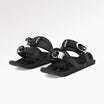












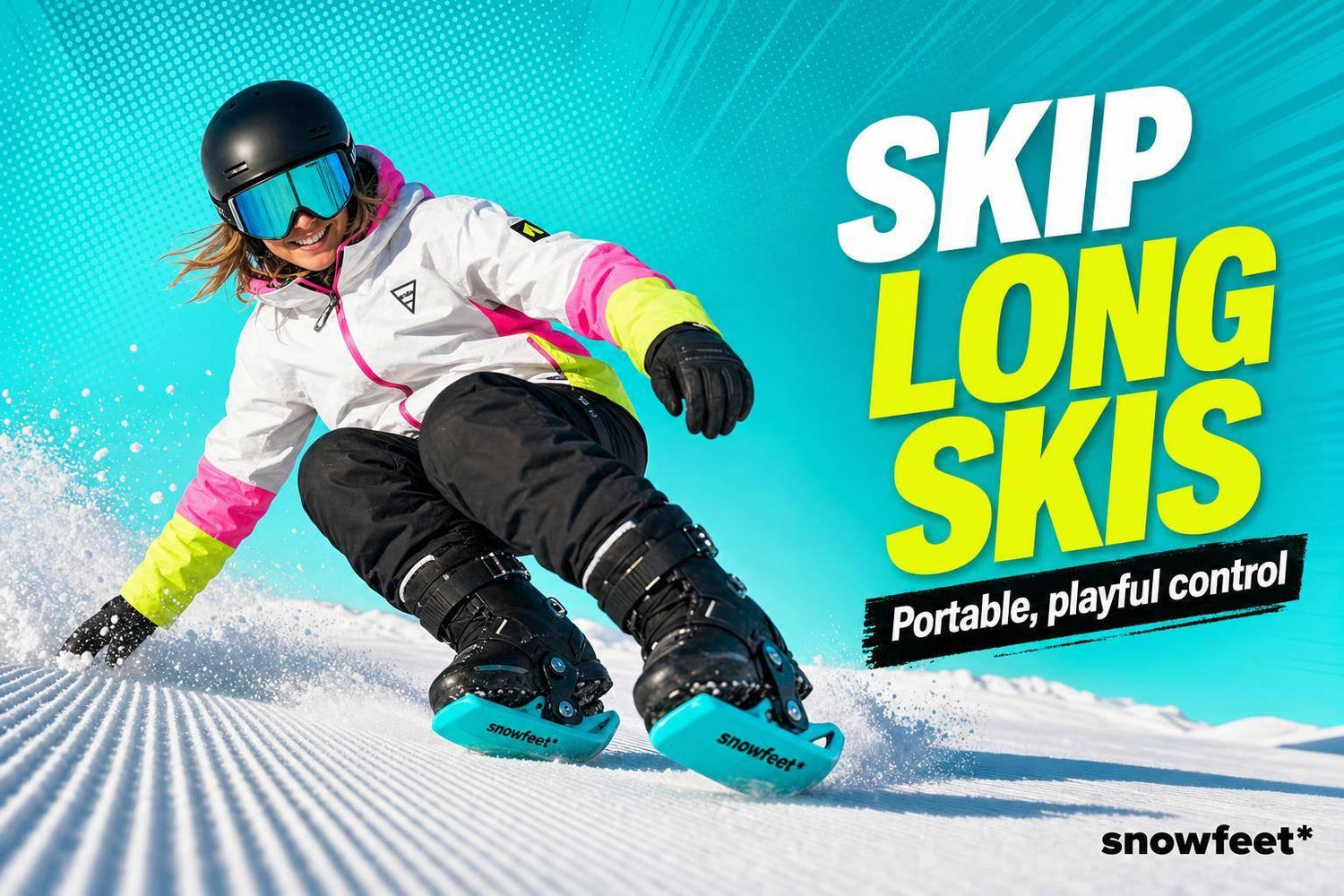
If you don’t like long skis, I’d start with short skis or skiblades. For most casual riders, the best picks are 99 cm skiblades for balance, 65 cm skiblades for easy turns, and 44–50 cm ski skates if you want the smallest setup.
Here’s the short version:
- Best all-around pick: Snowfeet* Skiblades 99 cm
- Best for beginners: Snowfeet* Skiblades 99 cm
- Best for travel: Snowfeet* Mini Ski Skates 38 cm
- Best for snowboarders: Snowfeet* Skiskates 44 cm or PRO 50 cm
- Best for more downhill control: Snowfeet* Short Skis 120 cm
- Best old-school used-market option: Classic snowblades
- Most niche picks: ODR and Figl/Firn gliders
Why? Because long skis still win for high speed, deep powder, and steep terrain. But if you mostly ski groomers, park, or just want gear that’s less annoying to carry, short skis make a lot more sense. And yes, some of these fit in a backpack. That alone gets my attention :)
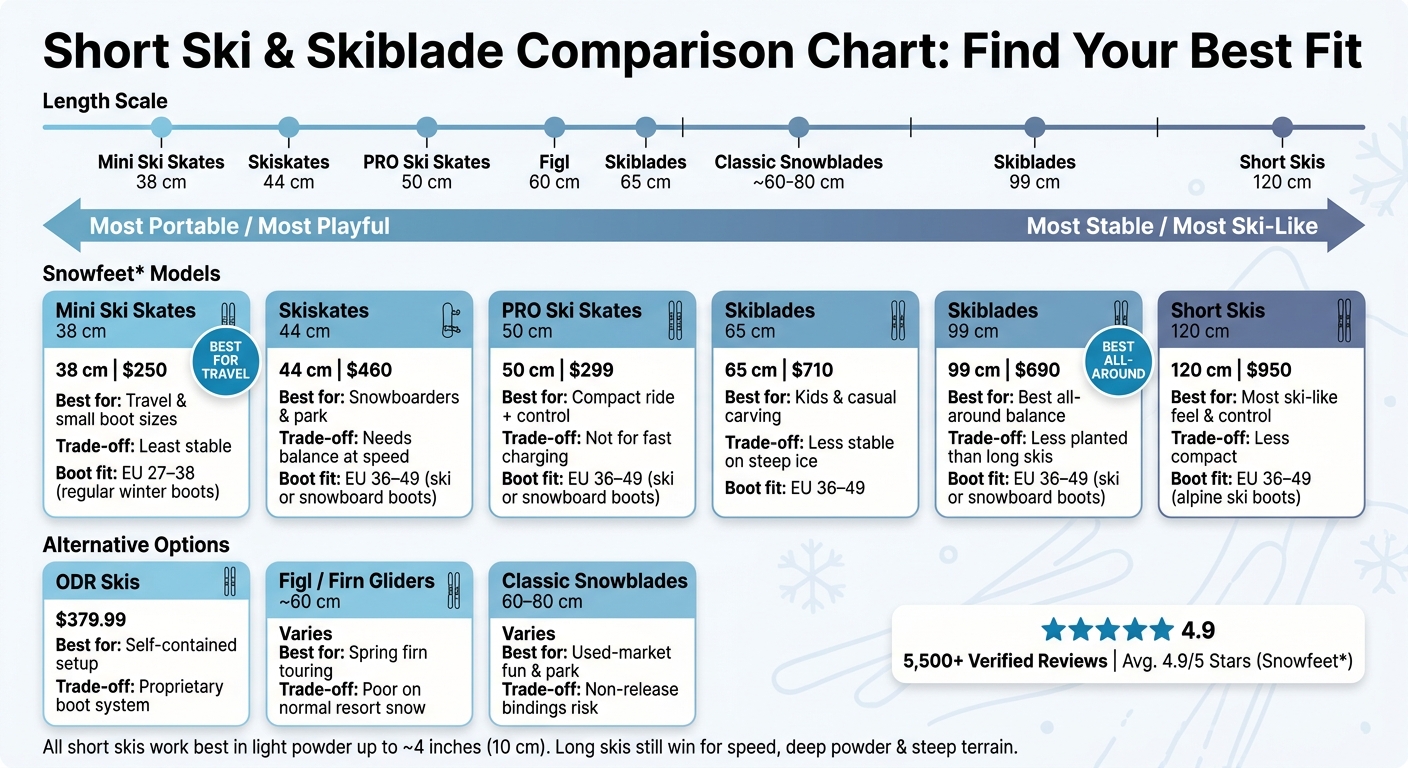
Short Ski & Skiblade Comparison Chart: Find Your Best Fit
Snowboarder tries Snowfeet* | Which Snowfeet* Short Ski is the Best? | Snowblades 44, 65, 99 Review
Quick Comparison
| Model | Length | Best For | Main Trade-Off | Starts At |
|---|---|---|---|---|
| Snowfeet* Mini Ski Skates | 38 cm | Travel, small boot sizes, playful laps | Least stable | $250 |
| Snowfeet* PRO Ski Skates | 50 cm | Compact ride with a bit more control | Not built for fast charging | $299 |
| Snowfeet* Skiskates | 44 cm | Snowboarders, park, tight turns | Takes more balance at speed | $460 |
| Snowfeet* Skiblades | 65 cm | Kids, casual riders, easy carving | Less calm on steep ice | $710 |
| Snowfeet* Skiblades | 99 cm | Best mix of control and fun | Still less planted than long skis | $690 |
| Snowfeet* Short Skis | 120 cm | Most ski-like feel | Less compact | $950 |
| ODR Skis | Built-in boot setup | Self-contained short-ski ride | Proprietary system | $379.99 |
| Figl / Firn Gliders | ~60 cm | Spring firn touring use | Poor fit for normal resort skiing | Varies |
| Classic Snowblades / Bigfoot | 60–80 cm | Used-market fun, park, groomers | Old non-release bindings can be a risk | Varies |
If I had to sum it up in one line, it’s this: the shorter you go, the more playful and portable the gear gets - but you give up calm, planted downhill feel. That’s the whole game here.
What stood out to me from the article:
- 38–50 cm models are for people who want the smallest, lightest setup
- 65–99 cm is the sweet spot for many resort riders
- 120 cm is the closest thing to a normal ski without going full-length
- Snowfeet* claims 5,500+ verified reviews with an average 4.9/5 stars
- Most short models work best in light powder up to about 4 inches (10 cm), not deep snow
So if your goal is simple fun, easy transport, and less gear drama in the parking lot, short skis are a smart move. If your goal is bombing steep bowls at high speed, uh, stick with long skis.
For a quick visual on short-ski riding styles, these videos help:
- Snowblades / short skis overview on YouTube
- Skiskates riding videos on YouTube
- Short skis for beginners on YouTube
I’d frame the whole article like this: pick based on how you ride, not on what looks most like a normal ski. That’s where people get it right.
1. Snowfeet* Mini Ski Skates 38 cm
The Snowfeet* Mini Ski Skates are the smallest option in the Snowfeet* lineup at 38 cm (15 inches). They’re built for agility and easy travel. On snow, they feel more like skates than skis. So if you want the most playful, stripped-down setup, this is the one.
Boot Compatibility
The big draw here is simple: you can use regular winter boots or waterproof shoes. No ski boots. That alone makes the Mini a lot less of a hassle for many riders.
It fits EU 27–38, which means it’s best for:
- Kids
- Teens
- Adults with smaller shoe sizes
If your feet are bigger than that, you’ll want to look at the regular Snowfeet* models or move up to longer Skiskates or Skiblades.
Maneuverability vs. Stability
At 38 cm, the Mini gives you the most freedom to move. You can spin, jump, and control each foot on its own in a way longer skis just can’t match.
But there’s a catch. Short length means less front-to-back support. Longer skis help hold your stance. The Mini doesn’t. You have to balance more actively, kind of like ice skating or rollerblading. The good news? Skaters often get the hang of it fast, sometimes within minutes on snow. Even so, many first-time riders still find it easier to learn than full-size skis.
Best Terrain
The Mini works best on groomed slopes, parks, and gentle trails. It can deal with light powder up to about 4 inches (10 cm), but it’s not built for deep snow or high-speed runs.
Skip rough terrain like:
- Steep ungroomed sections
- Bumps
- Holes
That kind of snow can get sketchy fast on something this short.
Portability
This is where the Mini shines. It fits in a backpack, which makes it far easier to carry and travel with than regular skis. For day trips, casual laps, or packing light, that’s a big win.
If you want a bit more stability and a bigger fit range, the 50 cm PRO is the next move.
Mini KIDS starts at $250.
2. Snowfeet* PRO Ski Skates 50 cm
If the Mini feels a bit twitchy, the PRO gives you more control without losing that short-ski vibe. At 50 cm (about 20 inches), it feels steadier underfoot but still compact and skate-like.
Boot Compatibility
The PRO fits ski boots (EU 36–49). Add snowboard bindings, and it can also work with snowboard boots or sturdy winter hiking boots.
Maneuverability vs. Stability
The PRO lands right between the 38 cm Mini and longer skiblades. You get more stability, but it still turns fast and feels nimble. The fiberglass flex core keeps things light and forgiving, which is nice when you make those small “whoops” mistakes on the slope. The full metal steel edges give you solid stopping power and better edge hold.
That said, there’s a limit. At higher speeds and on steep ice, it won’t feel as planted as longer skis. This model is built for control at moderate speeds, not hard-charging downhill laps.
Best Terrain
The PRO works best on groomed resort runs and snow parks. It can handle light powder up to about 4 inches (10 cm), but once the snow gets deeper, longer skiblades make more sense.
Portability
Like the Mini, the PRO fits in a backpack. That’s a big plus for travel and storage. It’s easier to carry, stash, and transport, which is handy if you’re flying, driving into town, or just don’t want bulky gear taking over your closet.
The PRO starts at $299. It’s a smart next step for riders who want more stability without making the jump to long skis.
3. Snowfeet* Skiskates 44 cm
If the 38 cm Mini feels a bit twitchy, the 44 cm Skiskates give you more control without losing that skate-like feel. They land right between the Mini and the 50 cm PRO. Think of them as the middle ground: still playful, still quick, but a touch calmer under your feet.
Boot Compatibility
The Skiskates come in two binding versions: one for ski boots and one for snowboard boots. The ski-boot version fits sizes 4.5–14.5 US (EU 36–49), and the snowboard-boot version fits 6–14.5 US (EU 38–49).
Both versions use:
- Tool-free adjustable bindings
- Safety leashes
- Anti-slip surfaces
That’s a nice setup if you already own snowboard boots and don’t want to mess with extra gear.
Maneuverability vs. Stability
This is where the 44 cm Skiskates stand out. They turn fast and hold an edge well on groomed snow. Compared with the 50 cm PRO, they feel faster and looser, but they don’t forgive mistakes as much once your speed climbs.
The big trade-off is front-to-back balance. At higher speeds, these ask more from you than anything else in the Snowfeet* lineup. You have to stay active and centered. If you’re coming from long skis and expect them to cruise on autopilot, yeah, there’s a short learning curve.
Best Terrain
Groomed resort runs, snow parks, and packed groomed slopes are their sweet spot. They can handle light powder up to about 4 inches (10 cm), but deeper snow will slow you down and make control harder.
Best fit for:
- Playful laps on groomed runs
- Park riding
- Fast, tight turns on packed snow
Portability
At 44 cm, they still fit in a standard backpack, which is pretty wild when you think about it. You get more control than the Mini without giving up the grab-and-go appeal.
Price starts at $460. This model is a strong match for riders who want a snowboard-like learning curve, easy transport, and quick turns on groomed snow. It works well for beginners, snowboarders, and anyone who wants max portability with a fun, quick-turn feel.
4. Snowfeet* Skiblades 65 cm
The 65 cm Skiblades sit right in the sweet spot of the lineup. They give you ski-like carving without the size and heft of full-length skis. This is the first Snowfeet* model that starts to feel like an actual ski, but it still stays small and easy to handle. If the 44 cm and 50 cm models feel a bit too loose, and full skis feel like too much, this is the cleanest move up.
Boot Compatibility
These come with two binding options:
- The ski-boot version fits US 4.5–14.5 (EU 36–49)
- The snowboard-boot version fits US 6–14.5 (EU 38–49)
That range gives a lot of riders room to work with, which is nice if you don’t want to fuss over fit.
Maneuverability vs. Stability
At 65 cm, these land between the 44 cm Skiskates and the 99 cm Skiblades. They feel more planted than the shorter model, but still turn with less effort than the longer one. The 4-meter turn radius helps with quick direction changes, though without the jumpy, twitchy feel that can show up on the shortest options.
This is where the ride starts to shift. You still get that short-ski fun, but now there’s more of a carved-ski feel in the mix. That makes them easier to trust when you pick up a bit of speed. The learning curve stays short too, which is a big plus for newer riders or snowboarders testing the waters.
That said, there’s a limit. On steep ice or rough terrain, stability drops off fast.
Best Terrain
These work best on groomers, beginner runs, terrain parks, and moderate moguls. They’re a good fit for:
- Beginners
- Weekend riders
- Snowboarders trying skis
Deep powder, steep ice, and rough backcountry are not their thing. That’s where their short length starts to work against them.
Portability
At 65 cm and 5.9 lb per pair, they’re still easy to carry, stash in a car, or tuck away at home. That’s part of the appeal here. You get more control than the smaller models, but you don’t have to deal with the hassle of full skis.
The $710 sale price ($750 regular) makes them a solid pick for casual riders who want a fun, low-commitment setup. If you want more stability and more speed after that, the 99 cm Skiblades are the next move.
5. Snowfeet* Skiblades 99 cm
If the 65 cm Skiblades start to feel a bit twitchy once you pick up speed, the 99 cm version is the clear next move. This is the most ski-like option in the Snowfeet* lineup. You get real carving feel without jumping straight to full-length skis.
Boot Compatibility
The 99 cm Skiblades come in three binding setups: standard ski boot bindings, snowboard boot bindings, and releasable pro ski boot bindings that work much like standard alpine setups. That snowboard-boot option is a nice touch. It keeps things simple if you already ride in snowboard boots.
Maneuverability vs. Stability
At 99 cm, with a 6-meter sidecut radius, these Skiblades are built for smooth carving and calmer turns than the 65 cm model. You still get quick response, but with more control once the pace goes up.
Here’s the trade-off in plain English: they’re more stable than the 65 cm version, but full-length skis still do better at very high speeds. For most casual riders, though, this model hits a sweet spot. It feels like the clean bridge between playful short skis and standard skiing.
Best Terrain
These do a better job on mixed resort terrain than the shorter models. Groomed runs, moguls, and light powder are all on the table. That extra length helps a lot. You get more stability for groomers, moguls, and light powder, without dealing with the bulk of full skis.
Portability
At 99 cm, they’re still easy to travel with compared with full skis. The 99 cm Skiblades start at $690.
If you want more downhill stability, the 120 cm Short Skis are the next step.
sbb-itb-17ade95
6. Snowfeet* Short Skis 120 cm
The 120 cm Short Skis are the most ski-like option in the Snowfeet* lineup. They feel steadier at speed, but they’re still much easier to handle than full-length skis. If the 99 cm version seems a bit too short, this is the next step up.
Boot Compatibility
These skis use standard alpine bindings and are made for alpine ski boots. They fit boots from US 4.5 to 14.5 (EU 36–49).
Maneuverability vs. Stability
At 120 cm, these skis feel more planted than the 99 cm Skiblades. You get better grip on hardpack and less chatter on ice. That matters when the slope gets slick and your legs are already working overtime. The wood core adds more damping too, which helps at higher speeds.
If you want more confidence on the downhill without making the jump to full-length skis, this is the best middle ground in the lineup.
Best Terrain
They work best for all-mountain resort use. There’s enough length here to give you more confidence on:
- Groomers
- Moguls
- Light powder
The added length gives you more float than the shorter models. That said, they’re not a stand-in for wide freeride skis in deep backcountry snow.
Portability
At 120 cm, they’re still easier to pack, carry, and deal with in lift lines than full-length skis. They won’t fit in a backpack like the smaller Snowfeet* models, but they hit a nice balance between on-snow performance and easy transport. The Snowfeet* Short Skis 120 cm are priced at $950.
Next come older short-ski styles: ODR skis, Figl/Firn gliders, and classic snowblades.
7. ODR Skis

If you want an even more self-contained setup than Snowfeet*, ODR Skis take that idea a step further. They combine the boot and ski into one piece, so you get a skate-like ride with no bindings at all.
Boot Compatibility
With ODR Skis, there’s no boot decision to make. The boot comes built in. That makes things simple, sure, but there’s a catch: unlike Snowfeet*, you can’t use boots you already own, and you can’t swap the blade into another setup. You’re in their proprietary system from day one.
Maneuverability vs. Stability
On groomed runs, ODR Skis feel quick and snappy. They’re good for short slalom turns, rollers, small jumps, and bumps. That said, there’s a clear trade-off. Once speed picks up, or the snow gets choppy, they feel less stable than Snowfeet* 99 cm or 120 cm models. Those longer Snowfeet* options give you a better mix of stability and all-around use.
Best Terrain
ODR Skis do best on groomed blue and black runs, mainly on hardpack. They’re also handy on crowded slopes since you can stop fast and change direction without much fuss.
They’re not a good match for:
- Deep powder
- Off-trail terrain
- Long, fast descents
Portability
ODR Skis are small and easy to travel with, which is one of their big selling points. The travel bag costs about $99.99. The skis themselves are currently listed at around $379.99, down from $549.99.
That compact size is the main draw. But for most riders, Snowfeet* still makes more sense in day-to-day use because it works with gear you may already have. So, ODR keeps things simple. Snowfeet* gives you more freedom if you want one setup that travels well, fits different boot types, and feels more useful across more parts of the mountain.
8. Figl / Firn Gliders
After ODR's all-in-one setup, Figl are even more niche. These Firngleiter are about 60 cm long and built for steep spring firn, not day-to-day resort laps. That makes them useful here as a short-ski comparison point. But for casual riders, they don't do nearly as much as Snowfeet*. Figl have a simple shape and simple bindings, so they work more like a tool for a very specific descent than a go-anywhere ski option. Snowfeet* gives you that same compact feel, with a lot more use on groomers, in parks, and across mixed resort snow.
Boot Compatibility
Figl use either simple strap bindings over hiking or mountain boots, or plate bindings for ski or touring boots. A lot of models are non-release, which means they don't have modern alpine safety release.
Maneuverability vs. Stability
On soft spring snow, Figl turn fast and skid with ease. Speed control mostly comes from shifting your weight and leaning a bit back to brake. Simple enough. The catch? They have limited edge grip and less stability on hardpack or ice.
Best Terrain
Figl are best on soft spring firn for controlled downhill runs after a tour. That's their lane. On hardpack, ice, groomers, or mixed resort terrain, they're a poor fit.
Portability
At around 60 cm, Figl are easy to strap to a backpack for touring. If you're thinking in resort terms, the older snowblade style is the closer match.
9. Classic Snowblades and Bigfoot-Style Short Skis
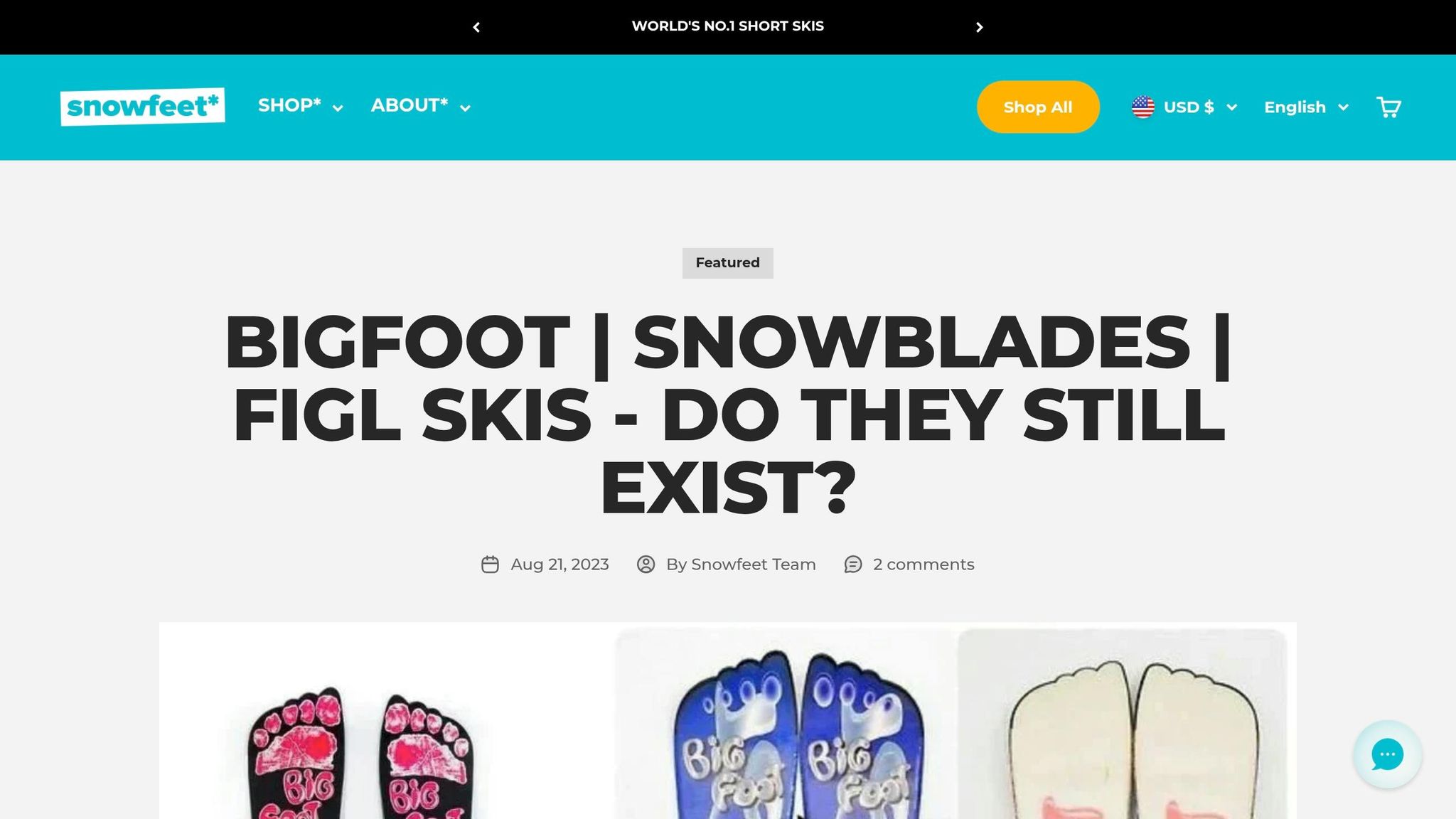
Classic snowblades and Bigfoot-style short skis are the old-school 60–80 cm short-ski option. They usually come with twin tips and a deep sidecut, which helps them turn with less effort than full-length skis.
If you're shopping the used market or just like that throwback feel, these are still around. That said, Snowfeet* still gives most riders a cleaner modern setup. These older models were built for fun, quick carving on easier terrain.
Boot Compatibility
A lot of classic snowblades and Bigfoot-style skis use non-release, adjustable bindings made for standard alpine ski boots. That sounds simple enough, but there’s a catch: non-release bindings can mean a higher injury risk in a crash than proper release bindings.
So, if you're buying used, give the bindings a close look before you ride. No shortcuts here.
Maneuverability vs. Stability
This is where these skis make sense - and where they don’t.
They feel quick and playful at low to moderate speeds. Turning is easy, and that’s a big part of the appeal. But once speed picks up, or the snow gets firm and icy, stability and edge hold start to fade.
Compared with Snowfeet* 99 cm and 120 cm models, they get twitchy sooner on mixed resort snow. Fun? Yes. Planted? Not so much.
Best Terrain
Their sweet spot is pretty clear:
- Groomed green and blue runs
- Terrain parks with small jumps
- Spins and switch skiing
They’re best seen as a groomer-and-park tool, not a ski for backcountry laps or charging fast down steep terrain. They also struggle in deep powder, on steep icy runs, and anywhere off-trail where edge hold matters a lot more.
Portability
At 60–80 cm, they’re much easier to carry than full-length skis. That’s one reason people still like them. But they’re still less compact than Snowfeet* 38 cm and 50 cm models, which can fit in a backpack or suitcase.
That’s the trade-off. You get something shorter than standard skis, but not as travel-friendly or everyday-practical as Snowfeet*. Kind of like bringing a duffel bag when a backpack would do the job :)
Pros and Cons by Riding Style
Different riders want different stuff from a short ski. So after the model-by-model breakdown, this table gives you the fastest way to pair a Snowfeet* setup with how you ride.
Here’s the quick match by rider type.
| Rider Type | Best Snowfeet* Pick | Why It Works | Main Limitation vs. Long Skis |
|---|---|---|---|
| Beginner | Skiblades 99 cm | Stable enough to learn turns and stopping, but much less intimidating than full-length skis | Less edge grip on steep or icy runs |
| Snowboarder transitioning to skis | Skiskates 44 cm or PRO Ski Skates 50 cm | Compact, easy-to-pivot feel that’s close to board movements; quick to pick up | Shorter edges grip less on hardpack and steep slopes |
| Traveler | Mini Ski Skates 38 cm | Fits in a regular backpack or checked bag; no ski bag, no oversized baggage hassles | Not ideal for fast descents or bigger mountain runs |
| Kids and families | Skiblades 65 cm | Short enough for kids to control with ease on green and easy blue runs; the 4 m turn radius keeps turns quick and playful | Less stable at higher speeds on steep blues or blacks |
| Park rider / freestyle | Skiblades 99 cm or Short Skis 120 cm | Shorter than full skis, so spins and grabs feel easier; 120 cm adds more stability for bigger landings | Big jumps still favor longer twin-tips |
The big trade-off with all short options is pretty simple: long skis still do better at speed, float, and steep-terrain confidence.
Which One Should You Get?
After looking at all the options above, the pick comes down to how you ride.
Go with the 44 cm or 50 cm if you want the most play and easy carry. Pick the 65 cm if carving and park laps are your thing. The 99 cm gives you the best middle ground. The 120 cm offers the most stability. And if fitting them in a backpack is your top goal, the 38 cm is the move.
Still, long skis make sense for some riders. They still come out on top for speed, deep powder, and racing.
User reviews line up with that. Snowfeet* has over 5,500 verified reviews with an average rating of 4.9 out of 5 stars. Riders keep calling out the same two perks: freedom of movement and being able to carry them in a backpack.
If long skis feel like too much gear for the kind of day you want, a Snowfeet* model will likely change the way you look at time on the snow.
FAQs
How hard are short skis to learn?
Short skis are a lot easier to learn on than long, standard skis. Most riders start to feel at ease on Snowfeet short skis in 1–2 hours, and plenty of first-timers can slide and make their first turns within 10 minutes.
Why? Their small, light build makes turning feel quick and natural. You don’t have to fight the skis or lock yourself into that hard forward-leaning stance that long skis often demand. For beginners, that usually means less stress, fewer awkward moments, and a lot more fun :)
Which Snowfeet* size is best for me?
The right Snowfeet* length depends more on your skill level, riding style, and terrain than on your size.
- 38 cm or 50 cm: Best for beginners and playful, agile riding
- 65 cm: Great for park tricks, quick turns, and a ski-skate feel
- 99 cm: The best all-around mix of stability and easy control
- 120 cm: Best for steeper runs, higher speeds, and a feel closer to skis
- 44 cm Skiskates: Ideal for skaters who want a highly responsive, skate-like ride
Can I use my regular boots with Snowfeet*?
Yes - one of the biggest perks of Snowfeet* is universal boot compatibility.
Unlike regular skis, most Snowfeet* models work with boots you may already have in your closet. That makes things a lot simpler, and a lot less of a wallet hit.
Here’s how it breaks down:
- The 38 cm and 50 cm models are made for standard winter boots
- Larger models can also be used with snowboard boots or standard ski boots
- If you want more ankle support, the bigger models give you that option
So, depending on the model, you can ride in sturdy waterproof winter boots, snowboard boots, or ski boots. Pretty nice setup if you don’t want to buy a whole extra gear kit just to get out on the snow :)











Zanechať komentár
Táto lokalita je chránená testom reCAPTCHA a vzťahujú sa na ňu pravidlá ochrany súkromia a podmienky poskytovania služby hCaptcha.