



















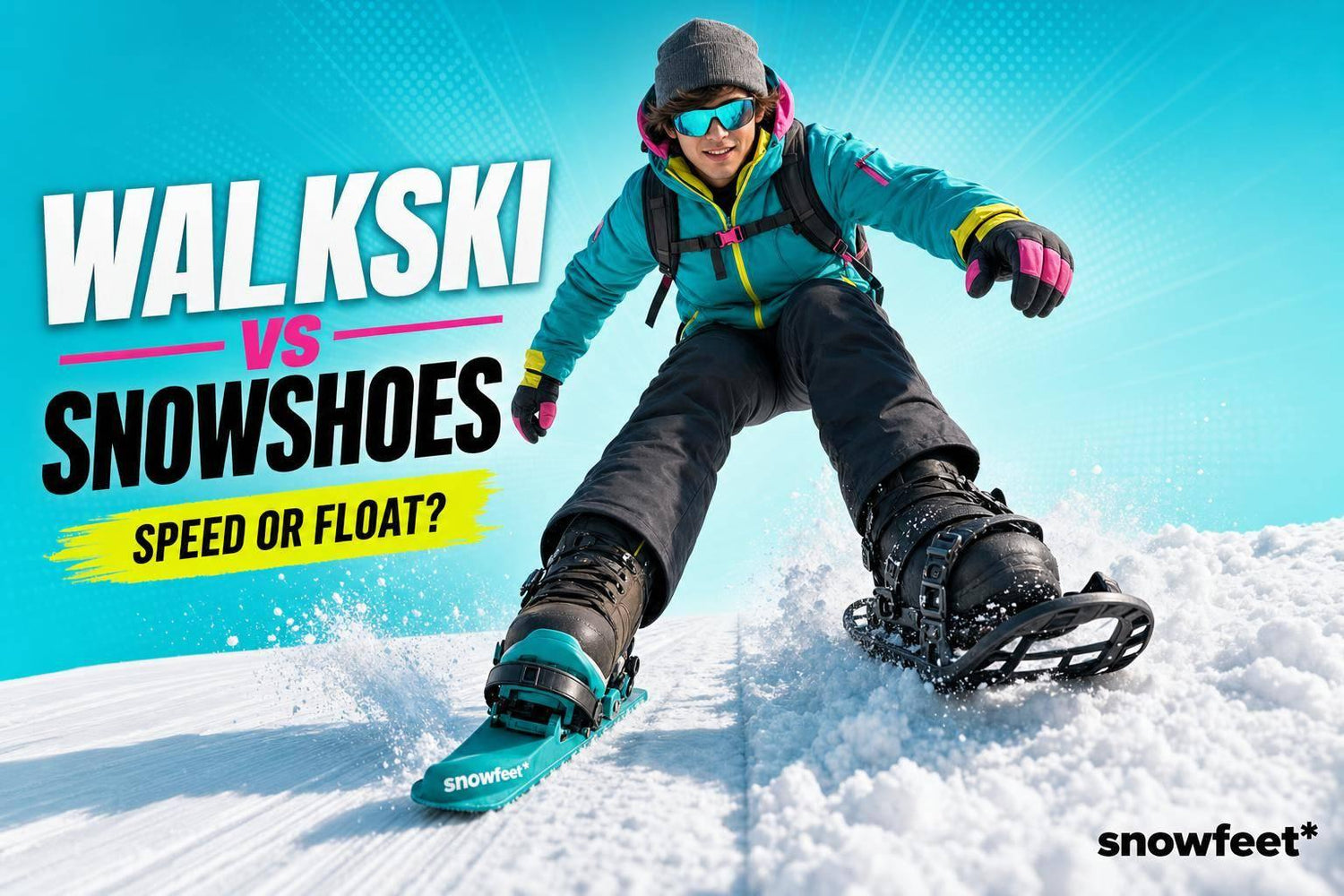
If I want glide, more downhill fun, and better travel on packed snow, I’d pick WALKSKI. If I want the easiest setup for deep snow, tight woods, and steep, awkward climbs, I’d pick snowshoes.
Here’s the short version:
- Choose WALKSKI for packed trails, rolling terrain, forest roads, and open descents
- Choose snowshoes for deep powder, trail-breaking, dense trees, and steep, uneven routes
- Snowshoes are easier on day one
- WALKSKI can move about 1.5x faster on firm snow that supports glide
- Snowshoeing ranges from 5.3 to 10.0 METs depending on trail conditions
- WALKSKI starts at $595 and packs smaller for car trips and flights
So, this isn’t just “skis vs snowshoes.” It’s glide vs walk, speed vs simplicity, and packed snow vs soft snow. If I’m heading out on mellow winter trails and want to cover more ground, WALKSKI makes a lot of sense. If I’m stomping into deep snow or weaving through tight trees, snowshoes still win. Simple as that :)
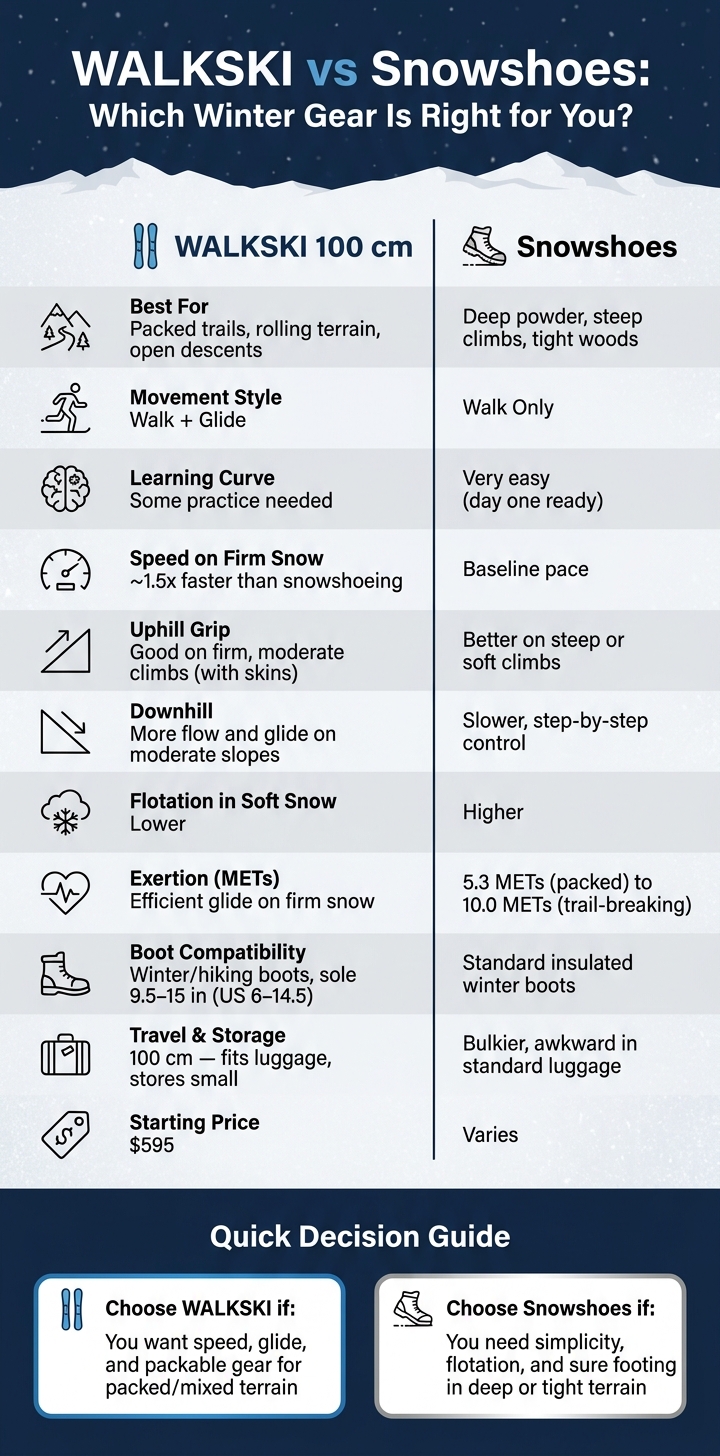
WALKSKI vs Snowshoes: Which Winter Gear Is Right for You?
Snowfeet* WALKSKI Backcountry Touring Skis | 100 CM
Quick Comparison
| Criteria | WALKSKI 100 cm | Snowshoes |
|---|---|---|
| Best use | Packed trails, rolling tours, open descents | Deep snow, steep climbs, tight woods |
| Movement style | Walk + glide | Walk only |
| Learning curve | Some practice needed | Very easy |
| Uphill grip | Good with skins on firm climbs | Better on steep or soft climbs |
| Downhill | More flow and fun on moderate slopes | Slower, more step-by-step control |
| Speed on firm snow | Higher | Lower |
| Flotation in soft snow | Lower | Higher |
| Boot setup | Works with winter or hiking boots | Works with winter boots |
| Travel and storage | Easier to pack at 100 cm | Bulkier |
| Starting price | $595 | Varies |
If I had to boil it down to one line: WALKSKI is the better pick for packed, mixed winter touring, while snowshoes are the safer pick for deep and tricky snow.
Performance Comparison: How Each One Moves
WALKSKI glides. Snowshoes walk. That one split changes effort, control, and speed.
Uphill Travel: Traction, Rhythm, and Effort
Snowshoes have a solid name on climbs, and for good reason. Their traction-first design feels steady on steep or uneven ground. WALKSKI, with skins, does well on moderate packed climbs. The glide helps each stride go farther without asking for more work, and over a long approach, that starts to pay off.
You’ll feel that most on a rolling forest road or a well-traveled winter trail. WALKSKI can keep a smooth rhythm there. But once the climb gets steep, soft, or tight with trees, snowshoes usually feel better underfoot. They give you more grip and a steadier pace. So, yeah, that extra efficiency from WALKSKI matters most when the trail stays firm and the climb stays even.
ACSM data puts packed-trail snowshoeing at 5.3 METs, climbing to 10.0 METs when you’re breaking trail. WALKSKI’s glide doesn’t wipe out that cost, but on firm snow it helps you keep momentum on your side.
Downhill Travel: Control, Speed, and Fun
This is where WALKSKI pulls ahead.
On a moderate, open descent, it acts a lot like a short ski. It moves through transitions with more flow and carries speed in a natural way. Snowshoes, by contrast, get you down with control, not glide.
WALKSKI does best on open, moderate slopes with reasonable snow quality. Snowshoes are still the safer pick on steep, narrow, icy, or obstacle-filled descents, where exact foot placement matters more than staying in motion. That edge shifts with snow depth and trail shape, which leads straight into the next point.
Speed and Maneuverability on Winter Trails
On flat ground, ski-style travel can move about 1.5x as fast as hiking or snowshoeing when the surface supports glide. That’s the kind of edge WALKSKI can get close to on firm, rolling routes.
| Terrain Type | WALKSKI | Snowshoes |
|---|---|---|
| Packed winter trail | Faster glide | - |
| Rolling backcountry route | Better rhythm and speed | - |
| Deep, soft, unpacked snow | - | Better flotation |
| Tight trees or sidehills | - | Easier pivots |
| Open moderate descent | More flow | - |
| Steep or icy descent | - | More control |
On routes with lots of turns and stops, snowshoes have the edge in maneuverability. They make sharp pivots and awkward step placements easier. WALKSKI likes a smoother, more steady line. It works best when you can keep moving instead of stopping every few seconds to reset. Put simply, the movement style only pays off when the terrain lets it.
sbb-itb-17ade95
Best Terrain and Conditions for Each
Terrain and snow quality make this call pretty simple. Some routes beg for glide. Others just ask for steady, sure-footed steps.
| Terrain / Condition | WALKSKI | Snowshoes | Better For… |
|---|---|---|---|
| Packed winter trails | Fast glide on packed snow | Simple, stable, and slower | WALKSKI for fitness and fun; snowshoes for maximum simplicity |
| Rolling terrain | Good on rolling routes with short climbs and descents | Works, but adds no downhill payoff | WALKSKI for hikers who want short ski-like runs on the return |
| Deep powder / unconsolidated snow | Sinks deeper and slows trail-breaking | Better flotation | Snowshoes for trail-breaking |
| Dense forest / narrow trails | Needs more room to move | Easy pivots in tight spaces | Snowshoes for tight, rooty, or obstacle-filled routes |
| Steep climbs / steep descents | Best on open, moderate slopes | Better on sustained steep climbs | Snowshoes for steep ascents; WALKSKI for open, moderate descents |
| Open meadows and glades | Efficient on varied surfaces; great downhill payoff | Reliable, but slower and less rewarding downhill | WALKSKI for day tours to open viewpoints or lake basins |
| Mixed snow: crust, ice, packed sections, and soft patches | Handles varied surfaces well with basic technique | Reliable, but less efficient on firm stretches | WALKSKI for fit, experienced users; snowshoes for cautious hikers |
Where WALKSKI Works Best
On firm, rolling snow, WALKSKI starts to shine. That glide is the whole point. It works best on packed trails, forest service roads, and rolling backcountry routes where the snow has some support underfoot.
Picture a winter approach on a snowmobile-packed road to a backcountry cabin. With WALKSKI, you save energy on the flats, and those little descents turn into short, fun runs instead of plodding downhill step by step. That’s a pretty nice trade.
Open meadows, wide glades, and mellow bowls also suit WALKSKI well. It also handles routes with mixed snow - wind-packed ridges, firm crust, and pockets of softer snow - as long as you’re comfortable changing your stride a bit as the surface shifts.
Where Snowshoes Stay the Safer, Simpler Pick
When snow gets soft or the trail gets tight, snowshoes pull back ahead. In more than a few inches of fresh, unconsolidated snow, they stay higher and move with less fuss. If you’re breaking trail, that extra flotation matters. A lot.
Dense woods and narrow hiking trails also lean snowshoe. On classic New England wooded ridge routes or tight gullies where trees crowd both sides of the trail, precise foot placement matters more than glide. Snowshoes make those small moves easier and give you fewer chances to get tangled up.
If your route is narrow, wooded, or steep, snowshoes are the safer call.
Once you know where each tool works best, the next question is how easy each one is to learn and carry.
Learning Curve, Boot Compatibility, and Packability
How Easy Each One Is to Learn
After terrain, the next big split is simple: which one feels more natural on day one?
Snowshoes are the easy pick here. You strap them on and walk. That’s it.
WALKSKI takes a bit more time to get used to because it moves more like a short ski. There’s a learning curve, no doubt. But that trade-off gets you more glide and more speed. On an actual trail, you’ll feel that pretty fast. Snowshoes let you focus on steady footing, while WALKSKI pays off when you settle into a smooth gliding stride and keep moving.
If you want more speed and glide, that extra practice tends to pay for itself.
Boot Compatibility and Setup
WALKSKI works with insulated winter boots, hiking boots, and snowboard boots, with sole lengths of about 9.5 to 15 inches (U.S. sizes 6 to 14.5). The key detail: measure your boot sole length, not your shoe size.
Snowshoes also work with standard insulated winter boots, so neither option calls for ski boots. That keeps setup pretty simple on both sides.
Once boot fit is sorted, the next thing people care about is plain old logistics: how easy is this stuff to pack, store, and travel with?
Portability, Storage, and Travel
| Factor | WALKSKI 100 cm | Snowshoes |
|---|---|---|
| Airline travel | Fits luggage easier | Awkward in standard luggage |
| Home storage | Stores smaller | Wider and takes up more room |
| Backpack carry | Not designed to carry mid-hike | Easy to strap to a daypack |
For road trips and flights, WALKSKI’s 100 cm length is easier to pack. At home, it also takes up less space. Snowshoes still have the edge if you want to strap them to your pack during a hike.
So now it comes down to the last piece: which one lines up with the way you like to hike?
Which One Should You Choose?
It comes down to one simple tradeoff: snowshoes give you easy walking and more flotation, while WALKSKI gives you more speed, more glide, and a setup that's easier to pack.
Best Pick for Beginners, Families, and Casual Hikers
For flat neighborhood trails and short walks in the park, snowshoes are still the simplest pick. They feel stable, familiar, and easy for first-timers.
That said, WALKSKI makes more sense for active beginners who want to move faster, glide a bit, and carry something less bulky. If you travel a lot or want winter gear that packs down well, WALKSKI stands out as the better long-term choice at $595.
Best Pick for Fitness-Focused Hikers and Mixed-Terrain Users
For longer packed routes or rolling terrain, WALKSKI is the better all-around tool.
Snowshoes still have their place. They work better in very deep, loose powder, tight brush, and routes with lots of obstacles where glide doesn't help much.
Here’s the quick rule: pick the tool based on your snow depth and how much glide you want. Simple, right?
| Choose snowshoes if… | Choose WALKSKI if… |
|---|---|
| You mostly walk flat, local trails | You want speed and glide on packed routes |
| Your group needs the simplest walking option | You're an active beginner ready for more than walking |
| Deep powder is your main terrain | You hike rolling or mixed terrain with real descents |
| You want minimal technique | You travel and want compact, packable winter gear |
For most casual winter adventurers, WALKSKI is the better pick. Snowshoes still win when the snow gets deepest and you just want the simplest way to walk.
FAQs
Can WALKSKI handle icy trails?
Yes - WALKSKI has metal edges for better grip and control on firm, icy, or packed surfaces.
In icy or steep backcountry conditions, nylon ski skins can help with traction and cut down on slipping. Trim the skins so the metal edges stay exposed. That helps you keep a secure hold and better maneuverability.
Are snowshoes better for beginners?
Traditional snowshoes often get framed as the go-to pick for beginners. That sounds fine on paper, but Snowfeet products can be the easier and more fun way to start.
Why? They’re simpler to get used to, so the learning curve feels less steep. They’re also compact and lightweight, which helps with movement and can leave your legs less tired by the end of the day. And instead of dealing with extra gear, you can use them with your own winter boots.
So for beginners, Snowfeet products can feel more accessible, easier to handle, and a lot more enjoyable on snow.
How much snow is too deep for WALKSKI?
WALKSKI Backcountry Touring Skis do a better job in soft, ungroomed snow than narrow cross-country skis. But because they’re compact, they work best in moderate backcountry terrain.
Once powder gets deeper than 4 inches, you’ll need steady front-to-back balance to stay in control. In deep, bottomless powder, short skis just won’t float like big, deep-powder alpine skis. That’s just the tradeoff.
Still, for most mixed backcountry conditions, WALKSKI is the more efficient and more fun pick.











Оставить комментарий
Этот веб-сайт защищается hCaptcha. Применяются Политика конфиденциальности и Условия использования hCaptcha.