



















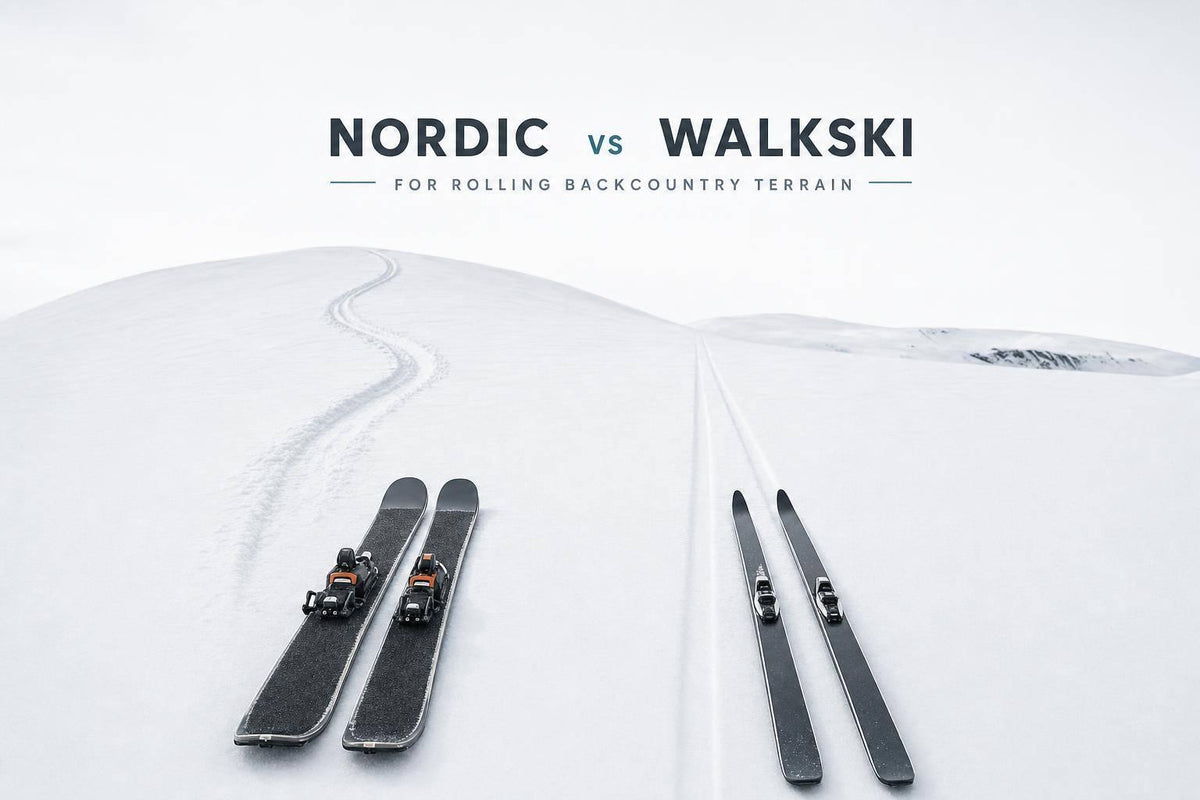
If I mostly ski flat, packed routes, I’d pick the NORDIC 90 cm. If my route has more climbs, mixed snow, and short descents, I’d go with the WALKSKI 100 cm. That’s the short answer.
Here’s the simple split:
-
NORDIC 90 cm - $450
- Better for glide on packed snow
- Lighter and easier to carry
- Best for meadows, forest roads, and easy fitness laps
-
WALKSKI 100 cm - $595
- Better for climbs and mixed snow
- Uses climbing skins and heel risers
- Better for hut approaches and routes with more downhill control
For most casual riders on rolling backcountry terrain, I’d lean WALKSKI. You pay $145 more, but you get more help on climbs, more boot options, and a calmer feel on rough snow. If your days are mostly flat and smooth, NORDIC still makes more sense.
Snowfeet WALKSKI | Backcountry Skiing in Georgia
Quick Comparison
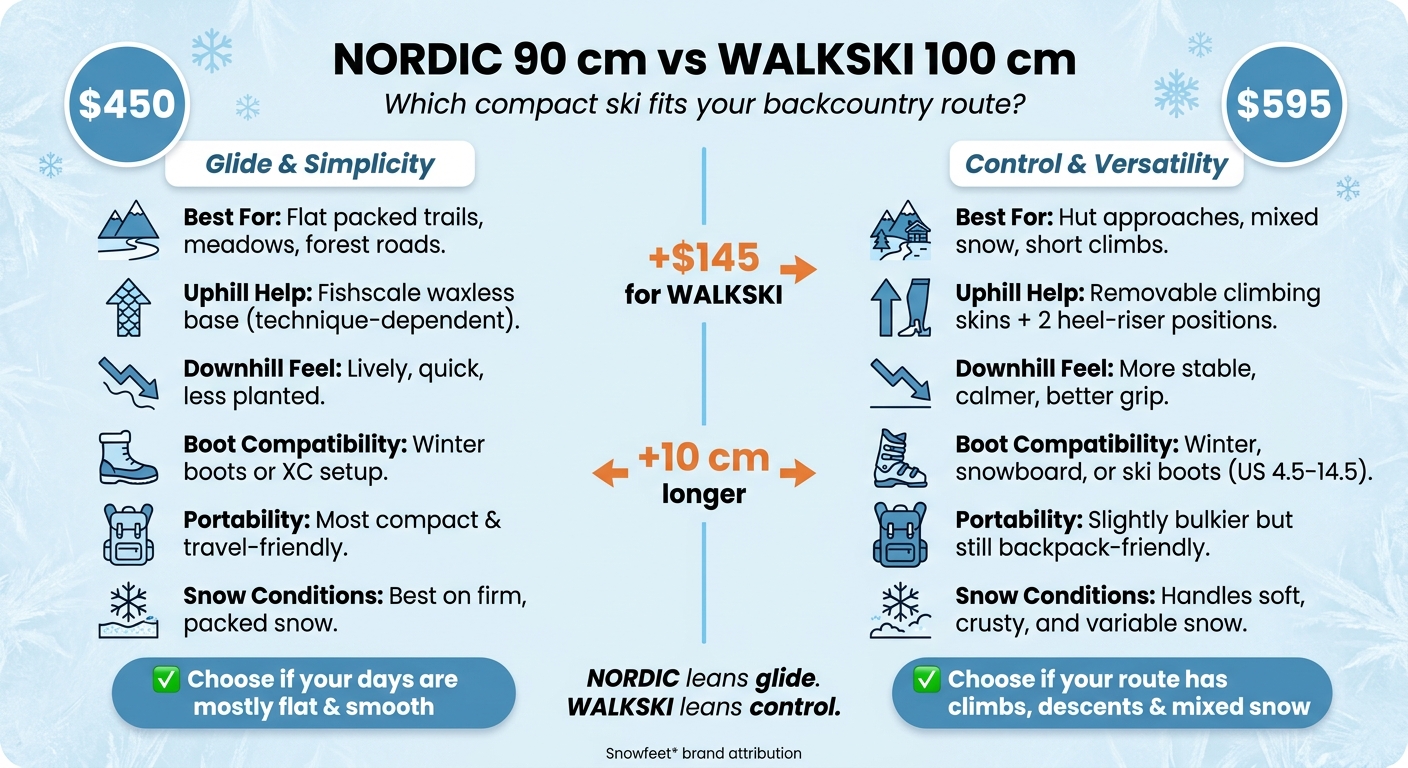
NORDIC 90 cm vs WALKSKI 100 cm: Side-by-Side Comparison
| Model | Price | Best For | Uphill Help | Downhill Feel | Boots |
|---|---|---|---|---|---|
| NORDIC 90 cm | $450 | Flat packed trails, meadows | Fishscale base | Lively, less planted | Winter boots or XC setup |
| WALKSKI 100 cm | $595 | Hut approaches, mixed snow, short climbs | Skins + 2 heel risers | More stable, more grip | Winter, snowboard, or ski boots |
A 10 cm length gap doesn’t sound like much. But on snow, it changes the feel a lot. NORDIC leans glide. WALKSKI leans control. That’s the call I’d make before buying.
NORDIC 90 cm vs WALKSKI 100 cm: design, feel, and intended use
Both Snowfeet* models are compact, easy to carry, and fast to learn. On rolling terrain, that matters more than top speed. Longer skis still do better on long, open flats, but that’s not the main job here. The core split is pretty simple: NORDIC leans toward easy glide, while WALKSKI leans toward uphill control.
Snowfeet* NORDIC 90 cm: a lighter cross-country feel
The NORDIC is 90 cm long and uses a waxless fishscale base for easy kick-and-glide, with optional glide wax if you want more speed. It comes in a simple winter-shoe setup or a ski-boot version. On packed forest roads and open meadows, its lighter feel and shorter length make it easy to stride, turn, and keep moving without burning out your legs. It’s the more cross-country-like pick, especially when the snow is firm and the terrain rolls instead of dropping away.
WALKSKI goes the other way a bit. You get more touring support, more traction, and more range across mixed conditions.
Snowfeet* WALKSKI 100 cm: a compact touring ski
The WALKSKI adds more surface area for softer, mixed snow. Instead of fishscales, it uses removable climbing skins for uphill grip, and the 4-mode binding offers Walk, Ski, and two Climb modes with heel risers. That setup makes it easier to match the ski to the route. For hut approaches, mixed snow, and uneven routes, WALKSKI is the more versatile choice.
Next, the gap shows up more clearly in glide, climbing, and downhill control.
sbb-itb-17ade95
Head-to-Head: How Each Model Performs on Rolling Terrain
Glide and uphill travel
On firm, packed snow - like a groomed forest road or meadow trail - NORDIC 90 cm is the smoother, more efficient glider. It has a lighter swing weight and a flex that leans more toward cross-country travel, so it’s easier to keep a steady rhythm on flat, glide-first sections.
That edge starts to fade once the snow gets softer or the route points uphill.
On soft, crusty, or uneven snow, WALKSKI 100 cm does a better job of floating and keeping you from punching down into the surface. And when the climb starts, WALKSKI has tools that NORDIC just doesn’t: removable climbing skins and two heel-riser positions for extra grip on the way up. On short, punchy climbs during a hut approach, that gap matters a lot.
Downhill control, turning, and stability
Downhill is where this choice becomes less about speed and more about control.
NORDIC 90 cm feels quick and lively on mellow descents. It’s easy to flick into a step turn in open terrain, which makes it fun when the slope stays friendly. But once the trail gets tight, the snow turns choppy, or speed starts to build, it asks more from the rider. Braking takes more skill, and the shorter platform can feel less planted on rough or rutted snow.
WALKSKI 100 cm feels calmer in those same spots. Its locked-heel ski mode and slightly longer running surface give you more grip when you need to scrub speed between trees or hold your line across uneven snow. That steadier feel is a big plus for newer riders, and for anyone hauling a daypack over bumpy terrain.
Portability and boot compatibility
Off the snow, the main differences come down to packing and boot fit.
NORDIC 90 cm is the easier travel companion. It’s lighter, shorter, and simpler to pack. Both models fit in a car trunk and can strap to a backpack without the pain of dealing with full-length skis, but NORDIC has the edge if compact size is high on your list.
Boot fit is where WALKSKI 100 cm pulls ahead. It works with winter boots, snowboard boots, and ski boots across a broad size range: US 4.5–14.5 for ski boots and US 6–14.5 for winter and snowboard boots. NORDIC 90 cm works well with winter boots, but if you switch boot setups from trip to trip, WALKSKI gives you more room to mix things up without needing a separate setup.
These trade-offs are easiest to see side by side.
| Factor | NORDIC 90 cm | WALKSKI 100 cm |
|---|---|---|
| Glide on packed snow | ✅ Smoother, more efficient | Good, slightly slower |
| Glide on soft/variable snow | Less stable | ✅ Better float and control |
| Uphill grip | Basic, technique-dependent | ✅ Skins + dual heel risers |
| Downhill stability | Lighter, less planted | ✅ More grip, calmer |
| Portability | ✅ Most compact, travel-friendly | Slightly bulkier |
| Boot compatibility | Best with winter boots | ✅ Winter, snowboard, and ski boots |
Who Should Buy Each Model: Use Cases and Rider Types
With glide, climbing, and downhill control covered, the choice now comes down to where you ski most often.
Choose NORDIC 90 cm for forest trails, meadows, and easy fitness touring
NORDIC 90 cm is a good match for packed forest roads, open meadow loops, and gently rolling terrain. It also suits beginners who want the easiest learning curve on packed, low-angle snow. If your outings are more about smooth movement than route-finding or handling rough patches, this model keeps things simple.
Another plus: NORDIC works well with regular winter boots. That makes it an easy pick for casual fitness touring, quick outings, and low-stress days outside.
That setup works well for easy touring. Once routes get more varied, WALKSKI starts to make more sense.
Choose WALKSKI 100 cm for hut approaches, mixed snow, and more varied terrain
WALKSKI is the better fit when your route changes a lot. If you're heading to a hut, crossing packed and uneven snow, or following a route with flats, climbs, and short descents, it handles the mix with more control.
It also suits beginners who want more stability when the route includes actual descents or mixed snow. That’s the key point. On simple terrain, both can work. But when conditions get less predictable, WALKSKI gives you a bit more margin for error.
Its broader boot compatibility also makes it the easier all-in-one choice.
That leaves the last question: which one should most casual backcountry riders actually buy?
Conclusion: Which Snowfeet* Model Should Most Casual Backcountry Riders Buy
After looking at glide, uphill travel, downhill control, and boot fit, the answer is pretty simple: it comes down to glide vs. control.
If you spend most of your time on flat, packed terrain, NORDIC 90 cm (~35 in.) is the better pick. It’s lighter, simpler, and costs less. It also has more of that cross-country feel, made for easy movement and a steady rhythm.
If your outings look more like a hut approach with uneven snow, a short climb, and a mellow descent, WALKSKI 100 cm (~39 in.) makes more sense. It’s the more flexible option. Its four binding modes and included climbing skins help it deal with flat trails, short climbs, and gentle descents with more control. Snowfeet* keeps the whole setup compact, easy to learn, and way less of a hassle to carry than full-length touring skis.
So, for rolling backcountry terrain, WALKSKI is the safer all-around choice. If glide is your top priority, NORDIC is the better fit.
FAQs
Which model is easier for beginners?
Both are great for beginners and feel a lot less scary than long, old-school skis. Because they’re short and light, they’re easier to turn, steer, and handle. That means less wrestling with your gear and more time just getting the hang of it :)
Choose NORDIC 90 cm if you’ll be on groomed, flat, or rolling skate-style trails. Go with WALKSKI 100 cm if you want easy backcountry touring, most of all if you’d like to use your current winter boots or snowboard boots.
Do I need climbing skins for rolling terrain?
It depends on the model and the terrain.
With Snowfeet WALKSKI 100 cm, climbing skins matter on rolling backcountry terrain. They add traction on climbs and on slick patches, which makes a big difference when the snow gets a little tricky. The removable skins also make transitions between flats, climbs, and descents easier. Nice and simple.
The Snowfeet NORDIC 90 cm does not use skins. It works best on groomed or packed snow. But if you're heading into steeper terrain or mixed rolling terrain, the WALKSKI is the better pick.
Can I use my regular winter boots with both?
Yes - both models work with regular winter boots.
WALKSKI 100 cm fits winter boots, snowboard boots, and ski boots in US sizes 6–14.5. NORDIC 90 cm with the standard binding fits regular winter shoes and snowboard boots in US sizes 6–13.
For better control, Snowfeet recommends boots with firm ankle support. One heads-up: the NORDIC Pro XC version is the exception. It requires NNN cross-country ski boots.











Оставить комментарий
Этот веб-сайт защищается hCaptcha. Применяются Политика конфиденциальности и Условия использования hCaptcha.