



















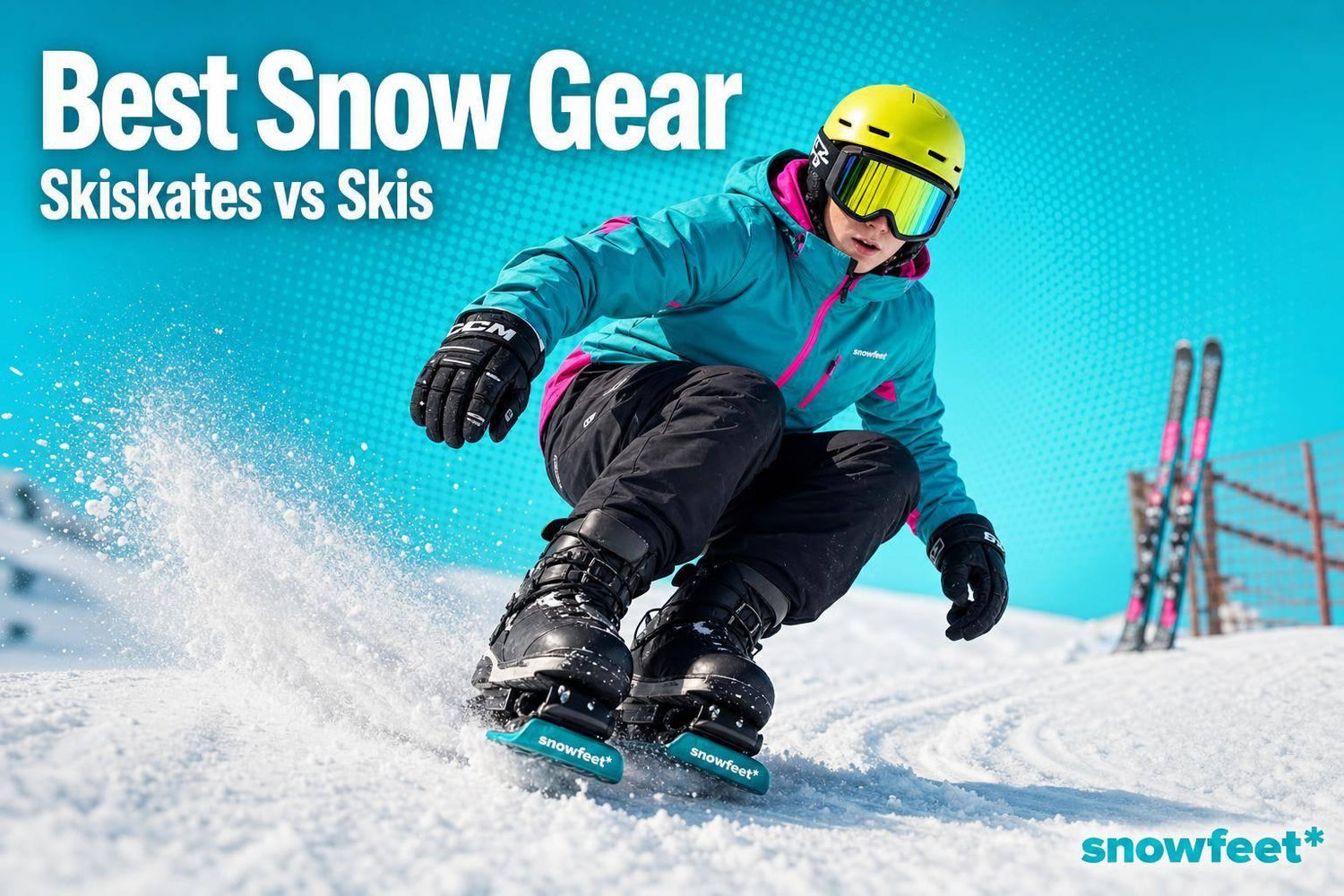
If I want the closest thing to hockey on snow, I’d pick the shortest setup I can control well. In this lineup, that means 44 cm and 50 cm models for the most skate-like feel, 65 cm for a calmer middle ground, and 99 cm or longer only if I care more about downhill calm than hockey-style movement.
Here’s the short version:
- 44 cm Skiskates: closest to ice skates for stops, pivots, and tight turns
- 50 cm PRO: easier for most players, with a bit more balance
- 65 cm Skiblades: best middle option if I want more control on resort runs
- 99 cm Skiblades: more ski-like, better when speed starts to build
- 90–100 cm snowblades: smoother on groomers, less like hockey
- 150+ cm skis: best for downhill skiing, worst match for skate-style drills
For hockey players, the main tradeoff is simple: shorter gear feels more like skating, longer gear feels more like skiing. USA Hockey’s off-ice guidance also puts focus on balance, agility, coordination, and multi-direction movement, so this kind of snow setup can make sense when rink time drops off.
Hockey Player Tries Snowfeet* Skiskates | See What He Thinks | Skiboards | Short Ski | Mini Ski
Quick Comparison
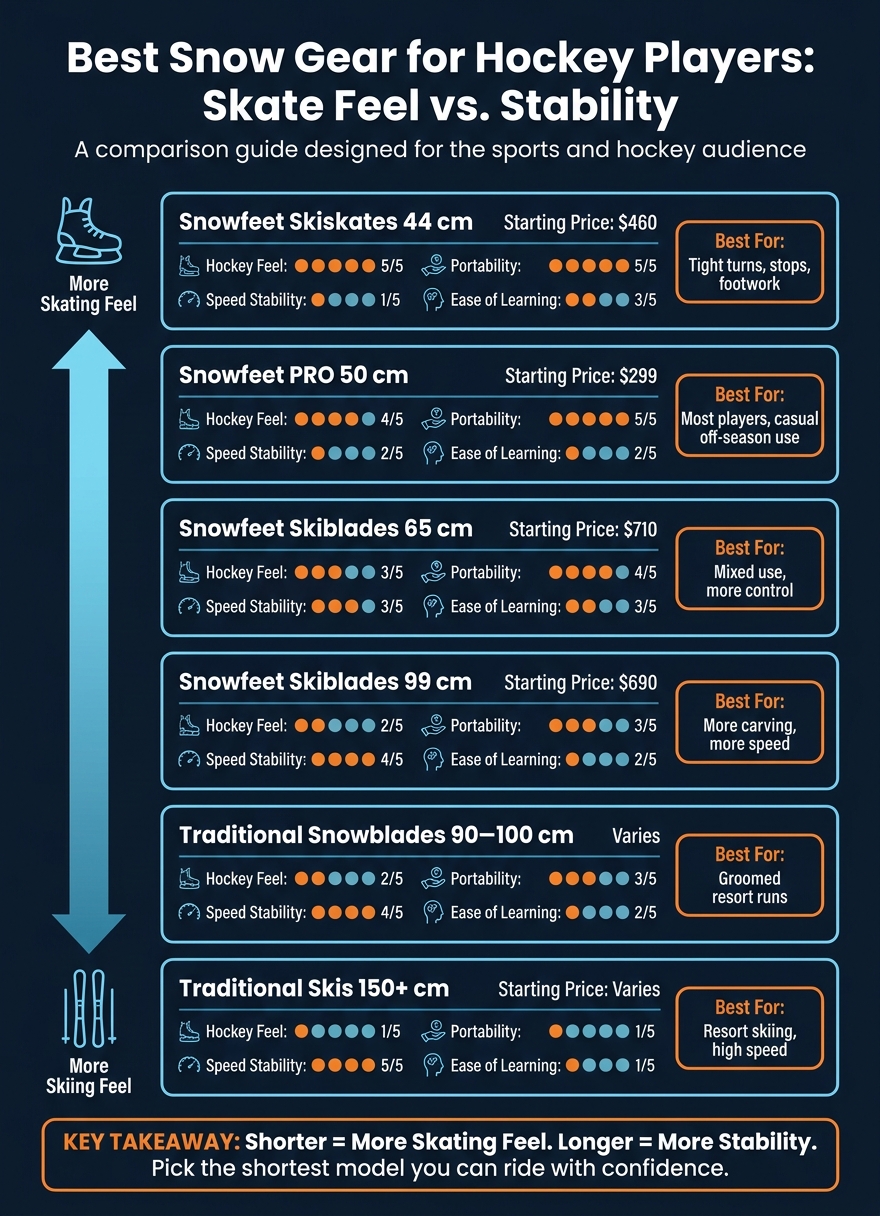
Best Snow Gear for Hockey Players: Skate Feel vs. Stability Comparison
| Gear | Best For | Hockey Feel | Speed Stability | Easy to Carry | Starting Price |
|---|---|---|---|---|---|
| Snowfeet Skiskates 44 cm | Tight turns, stops, footwork | High | Low | High | $460 |
| Snowfeet PRO 50 cm | Most players, casual off-season use | High | Low-Mid | High | $299 |
| Snowfeet Skiblades 65 cm | Mixed use, more control | Mid | Mid | Mid | $710 |
| Snowfeet Skiblades 99 cm | More carving, more speed | Low-Mid | High | Mid | $690 |
| 90–100 cm snowblades | Groomed runs | Low | High | Mid | Varies |
| 150+ cm skis | Resort skiing, speed | Very low | High | Low | Varies |
My quick take: if you play hockey and want snow gear for edge work, balance, and fast direction changes, start short. If you want more glide and less twitch, go longer. Simple as that. :)
1. Snowfeet* Skiskates 44 cm
At 17.3 inches long, Snowfeet* Skiskates are the shortest pick in this lineup. That short length puts you right over the platform, so your stance matters a lot. If you stay centered and use clean weight shifts, ankle flex, and edge control, they feel sharp and fun.
Skating Feel
These feel a lot closer to skating than skiing. You can ride forward, backward, and snap through tight spins. Stopping also feels close to a hockey stop. That’s a big reason hockey players often get the hang of them fast - the learning curve is usually easier for skaters than for non-skaters.
Longer skis still feel calmer at speed. But for pure maneuverability, these little things are a blast.
That snappy ride comes down to the shape and edge setup.
Edge Response
The Skiskates use a parabolic shape, steel edges, a wood core, and a fast base. On snow, that means very fast turn initiation and quick edge-to-edge response. If you like fast cuts and crossover-style moves, they translate well.
Stability at Speed
The 44 cm model is less stable at speed than longer skiblades or skis. So, it makes more sense for short, fun laps on groomed terrain - beginner slopes, mellow resort runs, and local hills. It’s not the pick for steep or hard-charging downhill.
Portability
This is one of the big selling points. At 44 cm, they fit in a backpack or car trunk, which makes them easy to toss in and bring to the hill after practice.
They work with:
- Ski boots in US sizes 4.5–14.5
- Snowboard boots in US sizes 6–14.5
Ski boots give you sharper edge control. Snowboard boots feel more relaxed and casual.
The Skiskates start at $460 on the official Snowfeet* store.
If you want a little more stability and still want to keep most of that skate-like feel, the 50 cm PRO model is the next move.
2. Snowfeet PRO Ski Skates 50 cm
If the 44 cm model feels a bit twitchy, the 50 cm PRO gives you a nicer middle lane. That extra length adds more balance and a calmer ride when you pick up speed. So you still get the short-ski feel, just with less of the “whoa, okay” factor.
It sits right between the ultra-compact 44 cm and the longer skiblades.
Skating Feel
The PRO works best when you stay low, move edge to edge fast, and react on the fly. It has a narrower base and a higher stance than the shorter models, so turns start fast and feel natural.
That’s a big part of the appeal. You lean, it goes. No long setup. No lazy response.
Edge Response
The PRO uses full metal ski edges, which helps it hold well on groomed snow. Its higher stance also makes edge changes feel direct and snappy.
For hockey players, that’s the hook. If you’re used to instant edge changes on ice, this setup feels much closer to home than a longer ski.
Stability at Speed
It feels steadier than the 44 cm at moderate speeds, but it still fits controlled laps more than fast carving. That extra steadiness also helps after sharp direction changes. You can recover faster, and it’s a bit more forgiving than the 44 cm.
Still, this doesn’t drift into full ski-style carving. It stays in that short, quick, playful lane. Players with a strong athletic stance will likely feel at ease on it. If you want more downhill stability, the 65 cm or 99 cm options make more sense.
Portability
At 50 cm, the PRO is still compact enough to travel with ease. It fits waterproof winter boots or snowboard boots in US sizes 6–13. Large snowboard boots may need strap adjustment.
The PRO starts at $299 on the official Snowfeet* store, which makes it the best budget-friendly entry point in the lineup.
If you want more stability but don’t want to give up the short-ski feel, the 65 cm Skiblades are the next move.
3. Snowfeet* Skiblades 65 cm
The 65 cm Skiblades are where the Snowfeet* lineup moves into a nice middle ground. They’re a smart step up for players who want more stability but still want that quick, skate-like feel. If the shorter Skiskates felt a bit twitchy, this is where things start to feel calmer and more dialed in - without losing the fast response hockey players like.
Skating Feel
Snowfeet* calls the 65 cm model a "Skis & Skates Combo," and that fits. You get enough length to carve more like a ski, but they’re still short enough for lateral push, fast turns, and that familiar hockey-stop feel. In plain English: they still feel like skates, just with a bit more under you. Compared with the 44 cm and 50 cm models, the ride feels more planted.
Edge Response
The 65 cm model has a 9.5 cm waist and a 4-meter turning radius. That tight radius helps turns start fast and finish clean. The full metal steel edges grip well on groomed snow, and stopping feels natural if you already know hockey-stop mechanics. It’s easier to control than the 44 cm or 50 cm versions.
Stability at Speed
This is the sweet spot in the Snowfeet* line for agility and stability. It handles groomers, moguls, and narrow trails well. So if you want something that still feels playful but doesn’t get nervous once you pick up speed, this size makes a lot of sense. For players who want longer turns and more downhill stability, the 99 cm model is the next move.
Portability
The 65 cm Skiblades stay easy to travel with. They weigh about 3.8 lbs per pair with ski bindings and about 5.9 lbs with snowboard bindings. Boot fit covers ski boots in EU sizes 36–49 and snowboard boots in EU sizes 38–49. Pricing starts at $710, marked down from $750, on the Snowfeet* store.
If you want more downhill calm and more speed, move up to the 99 cm Skiblades.
4. Snowfeet* Skiblades 99 cm
The 99 cm Skiblades are the first Snowfeet option that starts to feel more like a short ski than a skate. You still get that quick, playful ride, but with more calm once you start moving faster. Compared with the 65 cm Skiblades, the 99 cm gives you more speed stability and a more ski-like carve without getting anywhere close to the length of a standard ski.
So, this is where things start to shift a bit. The big gain here is more confidence at speed and cleaner carving, while keeping the snappy feel that makes short skis fun.
Skating Feel
At 99 cm, your stance feels more like skiing than skating. Still, the high twin tips make it easy to ride forward or backward and stay centered during fast transitions. That matters if you like to change direction on the fly instead of feeling locked in.
Stiff ski boots also help here. They give you more direct control through the turn, which helps when you're pushing through crossovers or making hard cuts. For hockey players, that's a nice match. The 99 cm works well for riders who want that crossover-style control on snow.
Edge Response
The 99 cm model uses a deep parabolic sidecut with a tip/waist/tail of 11.5 / 8.5 / 11 cm and a 6-meter turning radius. In plain English, that shape helps the ski tip onto edge fast and hold a clean arc through the turn.
It also has full metal steel edges, so it grips well when you commit to a carve. For hockey players, that can make it a solid off-season stand-in for edge control, recovery, and fast direction changes. Kind of like taking your skate habits and giving them a snowy playground.
Stability at Speed
That tight sidecut helps the 99 cm stay composed as speed builds. It’s the most stable Snowfeet option so far, which is a big step up if the shorter models feel a bit too loose once the pace climbs.
That said, there’s still a tradeoff. It won’t match the planted feel of full-length skis at high speed. For resort carving and off-season edge work, though, the 99 cm lands in a sweet spot. If your goal is straight-line speed, long skis still have the edge.
Portability
At about 5.5 lb per pair, the 99 cm Skiblades stay light for their size. They also work with ski or snowboard bindings, which makes setup pretty simple if you already have gear.
Pricing starts at about $690.
sbb-itb-17ade95
5. Traditional Snowblades (90–100 cm)
Traditional 90–100 cm snowblades sit in that middle zone between Snowfeet* 99 cm and full skis. They feel calmer and more like skis than Snowfeet, but they’re still shorter and less of a handful than 150+ cm skis. Put simply: compared with Snowfeet* 99 cm, you give up some agility for a smoother, more ski-like ride.
For hockey players, that tradeoff matters.
These blades carve well on groomed runs, and the longer edge contact helps the ski feel smoother through turns. But they’re less reactive than Snowfeet* when you need tight turns, fast stops, or quick direction changes. You get more calm, but less snap. And for hockey stops, shuffles, and tight recovery steps, they still trail the shorter Snowfeet options.
At higher speeds, 90–100 cm snowblades feel more settled than the short Snowfeet models. That said, they still don’t match the high-speed confidence of full skis. If your main goal is speed and a calmer downhill feel, full-length skis are the next move.
There’s a travel angle too, and yeah, it matters more than people think. At 90–100 cm, you can skip the roof rack and lay them across a back seat. Nice. But they still won’t slide into a standard gear bag like shorter Skiskates will. So for fast local-hill sessions, the shorter Snowfeet options are still easier to toss in the car and go.
For hockey players, 90–100 cm snowblades fit better for carving and casual resort laps than for true skating-style training.
6. Traditional Skis (150+ cm)
Once you get past 100 cm, the tradeoff changes fast. You gain more ski performance and lose more of that hockey-like feel. Full-length skis are best for speed and powder, but they’re the weakest match for hockey-style off-season training.
Skating Feel
Full-length skis put you in a ski stance, not a hockey stride. That means they do less for the balance and edge control hockey players usually want to keep sharp.
Edge Response
These skis carve well, no doubt. But in tight turns and quick stops, they feel slower and less snappy than short ski-skates or skiblades. If you want fast, twitchy movement, this is where the gap shows up.
Stability at Speed
This is the big win for full-length skis. They’re the most stable pick at higher speeds, which makes them the right call if your off-season goal is fast resort laps or powder days. But for hockey-like agility, there’s a tradeoff: that calm speed feel comes at the cost of the quick, reactive movement players rely on.
Portability
Full-length skis usually need a roof rack or a full trunk, so they’re much less grab-and-go than 44–99 cm gear. That matters most when hockey movement is the main goal. You can see the difference pretty fast when you compare movement, balance, and edge control side by side.
How Each Option Holds Up for Hockey-Specific Movement
Put all six options next to each other and the pattern jumps out fast: the shorter the gear, the more it feels like hockey.
The 44 cm Skiskates come closest to skating on ice, just on snow. You get lateral balance, fast edge changes, and that stop-and-go rhythm hockey players know by feel. As Snowfeet's own FAQ says, "Stopping with Snowfeet... is similar to a hockey stop." That’s the big split between skate-like gear and short skis.
The Snowfeet PRO 50 cm is the easier starting point for most hockey players. That extra 6 cm gives you a bit more room for error. Turns feel steadier. Stops feel less twitchy. But you still keep the nimble feel that makes skiskating worth using in the off-season.
Then you move into gear that feels less like skating and more like short skiing.
The 65 cm Skiblades still turn fast, but they lose some of that side-to-side pop. The 99 cm Skiblades go even farther down the skiing path. They trade fast reaction for more stability and smoother carving. Traditional snowblades live in that same carve-first zone.
Here’s the clean side-by-side view:
| Gear Option | Skating Feel | Edge Response | Stability at Speed | Portability |
|---|---|---|---|---|
| Skiskates 44 cm | Elite | Instant/Agile | Low | Fits in a backpack |
| Snowfeet PRO 50 cm | High | High/Agile | Medium-Low | Fits in a backpack |
| Skiblades 65 cm | Medium | Moderate | Medium | Easy to carry |
| Skiblades 99 cm | Low | Precise/Carving | High | Manageable |
| Traditional Snowblades (90–100 cm) | Low | Forgiving | High | Manageable |
| Traditional Skis (150+ cm) | Minimal | Slow for skating | Excellent | Needs a roof rack |
Terrain changes the picture a bit too. Some gear feels great on groomers, then kind of awkward on a small hill behind the house.
| Gear Option | Groomers | Small Parks | Neighborhood Slopes |
|---|---|---|---|
| Skiskates 44 cm | ✅ Strong | ✅ Strong | ✅ Strong |
| Snowfeet PRO 50 cm | ✅ Strong | ✅ Strong | ✅ Best fit |
| Skiblades 65 cm | ✅ Good | ✅ Good | ✅ Good |
| Skiblades 99 cm | ✅ Best fit | ⚠️ Workable | ⚠️ Less ideal |
| Traditional Snowblades | ✅ Good | ⚠️ Workable | ⚠️ Less ideal |
| Traditional Skis (150+ cm) | ✅ Good at speed | ❌ Poor fit | ❌ Poor fit |
So, if your goal is hockey-style edge control, quick feet, and movement that feels close to skating, the shorter Snowfeet options do the heavy lifting. The longer choices help with a different job.
Next, let’s sort those trade-offs into pros, cons, and the best match for each type of hockey player.
Pros, Cons, and Gear Setups by Player Type
The best setup depends on who's riding. Some players need more stability. Others want tighter control and a feel that’s closer to skating. So after looking at length, the next move is simple: match the gear to the player.
Youth players (ages 8–14) usually do best with the Snowfeet PRO 50 cm or the Skiblades 65 cm. Both give you an easy setup and a more forgiving ride, which helps with balance, confidence, and those first safe turns on snow. For protection, pair either one with a helmet, goggles, and wrist guards. If an older kid wants more speed without making things harder, the PRO 50 cm is still the easiest pick.
Adult rec league players get the best bang for the buck from the Snowfeet PRO 50 cm. It works with waterproof winter boots or snowboard boots, handles most terrain well, and keeps the learning curve nice and low. That makes it a smart way to stay sharp between ice sessions. The built-in heel brake is a nice bonus too. Add a helmet, goggles, and padded shorts. If you want the most edge response, go with the 44 cm model.
Competitive athletes - high-level juniors, college players, and semi-pros - are usually best matched with the Skiskates 44 cm and performance ski boots. This setup is built for hockey stops, backward skating, and fast direction changes. At this level, protection matters even more, so use a helmet, goggles, and hip and tailbone protection.
Use the breakdown below to match gear, boots, and protection to each player level.
| Player Type | Best Gear | Boot Pairing | Key Pros | Key Cons | Must-Have Protection |
|---|---|---|---|---|---|
| Youth (8–14) | PRO 50 cm or Skiblades 65 cm | Snowboard or winter boots | Forgiving, easy to learn | Less skate-like than 44 cm | Helmet, goggles, wrist guards |
| Adult Rec | Snowfeet PRO 50 cm | Winter or snowboard boots | Simple setup, fits varied terrain | Slightly less agile than 44 cm | Helmet, goggles, padded shorts |
| Competitive | Skiskates 44 cm | Performance ski boots | Max edge response, hockey-stop capable | Less stable at speed | Helmet, goggles, hip/tailbone protection |
One last gear note: use ski boots if you want the most control, snowboard boots if comfort matters more, and skip soft winter boots with the 44 cm model.
Conclusion
After lining up the options side by side, it comes down to one simple tradeoff: hockey-style agility or downhill stability.
For hockey players, the main question is pretty simple: how much skating feel do you want on snow, and how much stability do you want once your speed picks up?
- Skiskates 44 cm - Best if you want the closest hockey-to-snow feel: fast pivots, sharp stops, and quick footwork.
- Snowfeet PRO 50 cm - Best middle ground between agility and control.
- Skiblades 65 cm - Best all-around choice for mixed skill levels and resort riding.
- Skiblades 99 cm - Best if you want more speed and stability without jumping to full-length skis.
So, the call is simple: pick the shortest model you can handle well for your skill level and the terrain you ride.
Competitive players will often get the most hockey-specific training from the 44 cm or 50 cm models. Most recreational riders are better off starting with 65 cm. Go with 99 cm only if speed and stability matter more to you than that skate-like feel.
Traditional skis still come out ahead for big-mountain speed and long, sweeping turns. But Snowfeet* lines up better with hockey training because it keeps the balance, agility, and fast edge changes hockey players rely on most. For most hockey players, the best off-season pick is the shortest Snowfeet* model they can ride with confidence.
FAQs
Which length should I start with?
For your first day on snow, start with the 65 cm Snowfeet Skiblades. They’re the easiest option to learn on, but they still feel quick and fun.
If you come from hockey, the move may feel pretty natural. Still, the 65 cm length gives you more balance and stability, which makes those first runs a lot easier than on shorter models. Later on, you can look at 99 cm if you want more stability at higher speeds or on mixed terrain.
Do I need ski boots or snowboard boots?
Not always. It comes down to your goal and which Snowfeet model you pick.
Some Snowfeet products work with snowboard boots, ski boots, or even regular winter shoes, depending on the binding.
For hockey players, snowboard boots often feel more natural and more comfortable. They give you a feel that’s closer to what you already know. Ski boots, on the other hand, give you more stability and a stiffer ride.
Some models also work well for casual sessions with supportive winter boots. Just make sure to check your model’s binding compatibility before you head out.
Are Skiskates safe for beginners?
Yes. Skiskates can be a good pick for beginners, especially if you’ve done ice skating, inline skating, or hockey before. Their short, light build often makes them easier to learn than standard skis. That said, they do ask for solid balance right away.
A lot of people get the basics down in a day. Some even start feeling comfortable within a few minutes. If you want the most stable, forgiving starting point, 65 cm Skiblades are usually the best bet. If you want something more playful with a skate-like feel, 44 cm Skiskates are a fun option.











Оставить комментарий
Этот веб-сайт защищается hCaptcha. Применяются Политика конфиденциальности и Условия использования hCaptcha.