




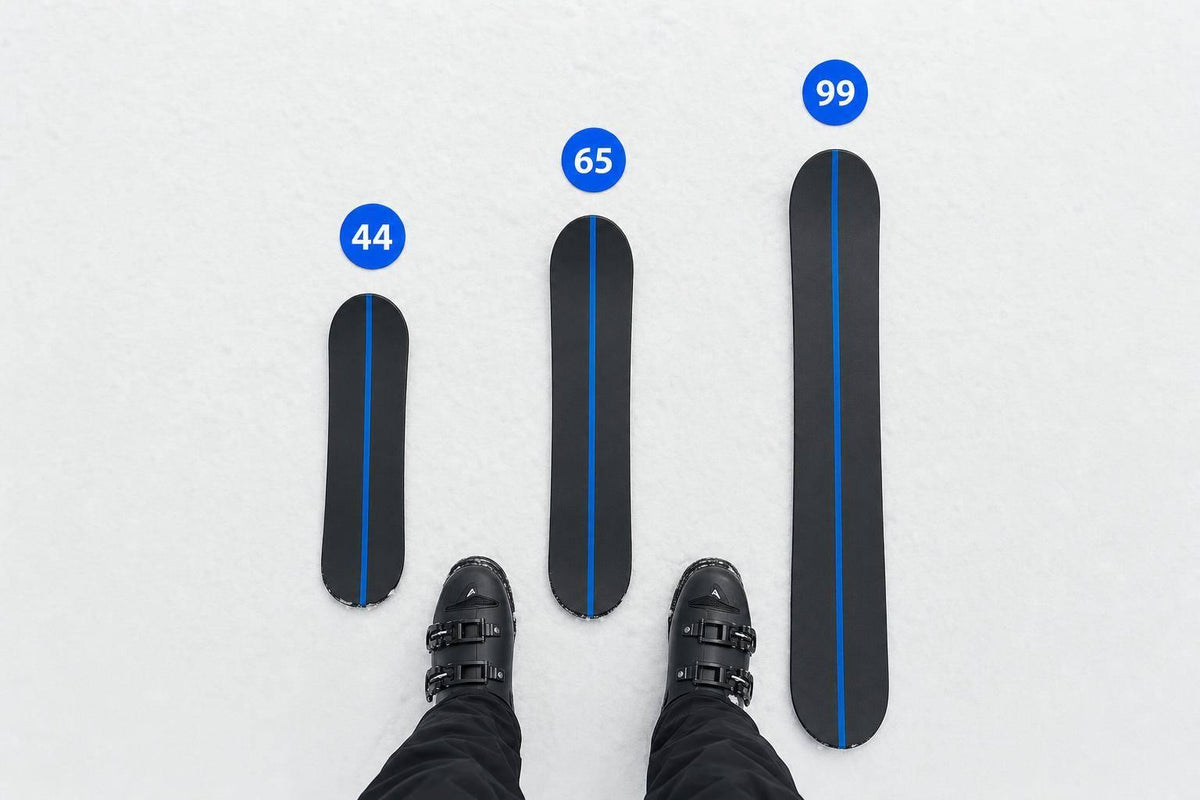
If I want the short answer, it’s this: 44 cm is best for the most playful spins, 65 cm is the best pick for most new riders, and 99 cm gives me the most support without going to full-length skis.
Long skis can feel like a lot when I’m learning tricks. Short skiboards make it easier to turn at low speed, try 180s, ride switch, and lap the park without needing a ton of room. The trade-off is simple: the shorter I go, the less stable things feel at speed or in deep snow.
Here’s the whole article in one quick hit:
- 44 cm Skiskates: smallest, lightest, and easiest for tight moves
- 65 cm Skiblades: best middle option for learning tricks
- 99 cm Skiblades: most stable of the three
- Best use: groomers, park laps, packed snow
- Not ideal for: deep powder, steep icy lines, or going fast
- Powder note: once snow gets to about 12 inches+, longer skis still do a better job
Snowboarder tries Snowfeet* | Which Snowfeet* Short Ski is the Best? | Snowblades 44, 65, 99 Review
Quick Comparison
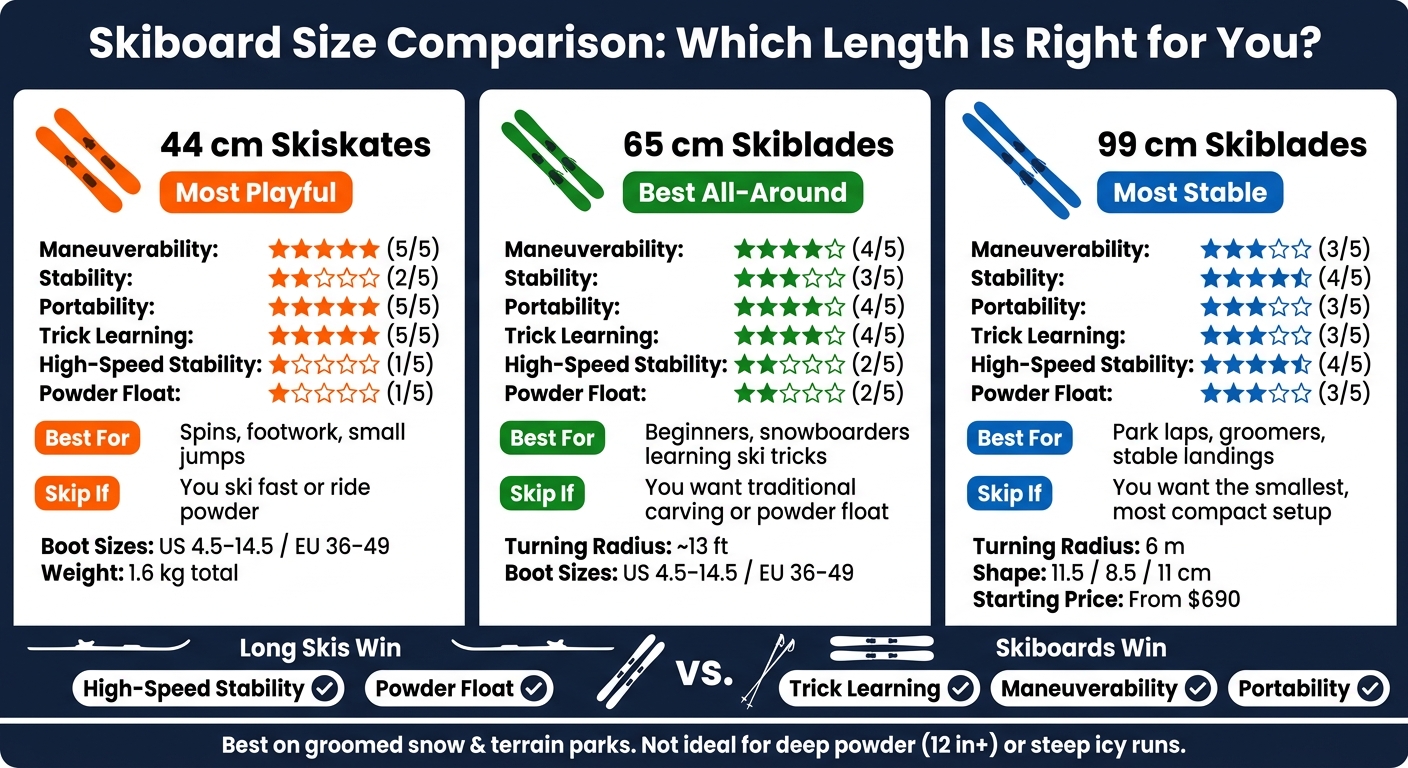
Skiboard Size Comparison: 44cm vs 65cm vs 99cm for Tricks
| Model | Best For | Feel | Main Trade-Off |
|---|---|---|---|
| Skiskates 44 cm | Spins, footwork, small jumps | Most playful | Least stable |
| Skiblades 65 cm | New trick riders, snowboarders moving to skis | Best balance | Not as planted as 99 cm |
| Skiblades 99 cm | Park laps, groomers, more support on landings | Most ski-like | Less nimble than shorter options |
So, if I’m buying one pair for casual trick riding, I’d point most people to the 65 cm. If I want the smallest setup and skate-like feel, I’d go 44 cm. If I want more support under me, I’d go 99 cm.
For a quick look at short skis in action, these YouTube searches can help:
1. Snowfeet* Skiskates 44 cm
At 44 cm (17.3 in), Skiskates are the shortest option here. That short platform cuts swing weight, so pivots and spins feel much easier than they do on full-length skis.
Trick Agility
Skiskates are quick. Edge changes happen fast, and that helps a lot with basic moves on flat ground or mellow slopes. If you're new and want to work on 180s, hockey stops, or skating-style footwork, this is a solid place to start.
That said, short gear has a bit of a spicy side :) Every small weight shift shows up right away. Keep your knees bent and your movements tight. And when you come off a jump, that fast response means you need better body control.
Landing Stability
Landings take more precision than they do on longer skiboards. You get less room to fix mistakes because the platform is so short. So, start small in the park. At this length, staying centered on touchdown matters a lot.
Terrain Range
These work best on packed snow and groomed park features. They do best on hard snow. Deep powder, icy steeps, and high-speed runs aren’t where they shine.
Next comes fit and portability, which matter if you want a trick tool you can toss in a bag and bring anywhere.
Boot Compatibility
Snowfeet* offers two binding versions:
- The ski-boot version fits US sizes 4.5–14.5 (EU 36–49)
- The snowboard-boot version fits US sizes 6–14.5 (EU 38–49)
Snowboard boots feel softer. Ski boots give you a stiffer, more precise connection. So, go with the version that matches the boots you already own.
The pair weighs 1.6 kg total and fits in a backpack. That makes them easy to bring to a park session without a bunch of extra gear.
If you want a bit more stability but still want easy spins and quick turn-in, the 65 cm Skiblades are the next step.
2. Snowfeet* Skiblades 65 cm
At 26 inches (65 cm), these Skiblades hit a nice middle ground. They’re more stable than the 44 cm Skiskates, but they still feel quick and easy to handle. That’s why they make a smart pick for riders who want tricks to feel easier without going super short.
Trick Agility
The 65 cm length comes with about a 13-foot turning radius, so quick pivots, sharp turns, and spins feel natural. You get more control than the twitchier 44 cm model, but you’re not dealing with nearly as much ski as the 99 cm version.
A good way to learn on them:
- Start with flat-ground balance
- Move to low-speed turns
- Add small hops
- Then work up to bigger features
That step-by-step path makes a lot of sense. No need to go full send on day one :)
Landing Stability
The wider base gives you more support on small jumps and when practicing on small features than narrow skis. That said, they still don’t replace full-length freestyle skis on large jumps. Keep your landings centered over both blades, and stay in control of your speed on the way in.
Terrain Range
These work best on groomers, parks, moguls, and packed snow. They’re not made for deep powder or steep runs at high speed, so they fit riders who want a trick-friendly setup more than a full-length ski feel.
Boot Compatibility
These Skiblades use the same ski-boot and snowboard-boot options as the 44 cm model. Pick the binding style that matches your boots. Before you buy, check the binding type so you don’t get a bad surprise at the hill.
If you want a bit more speed and stability but still want that trick-friendly feel, the 99 cm Skiblades are the next step.
sbb-itb-17ade95
3. Snowfeet* Skiblades 99 cm
At 99 cm (39 in), this is the longest short-ski pick in this group. It still turns fast, but it feels more planted than the 44 cm and 65 cm models.
Trick Agility
The 99 cm model has a 6-meter turning radius, which is tight next to many standard all-mountain skis. That makes it a good match for controlled spins, small jumps, and basic park laps. It doesn’t feel as skate-like as the shorter versions, and that’s kind of the point. You give up a bit of snap, but you get more control back.
At this length, the 99 cm sits in a sweet spot before you start trading more agility for added support.
Landing Stability
The 11.5/8.5/11 cm shape gives you more support than the shorter models, though this size still makes the most sense for small jumps and controlled park riding.
Terrain Range
Snowfeet* places the standard 99 cm in the lane for groomers, park laps, and light mixed conditions. If you want more float, the separate 99 cm Powder version uses a wider 15/12/15 cm shape.
So, this one lands right between playful short boards and more planted short skis. That balance shows up pretty clearly in the specs.
Boot Compatibility
The 99 cm Skiblades are sold with simple ski-boot bindings, pro ski-boot bindings, or snowboard-boot bindings. One small heads-up: snowboard-boot sizing starts at US 6, so if your feet run smaller, check the fit before you buy.
| Spec | Snowfeet* Skiblades 99 cm |
|---|---|
| Length | 99 cm / 39 in |
| Tip / waist / tail width | 11.5 / 8.5 / 11 cm |
| Turning radius | 6 m |
| Ski-boot binding range | US 4.5–14.5 / EU 36–49 |
| Snowboard-boot binding range | US 6–14.5 / EU 38–49 |
| Starting price | From $690 |
That middle-ground feel is exactly what the pros and cons section breaks down next.
Pros, Cons, and Trade-Offs
After the model-by-model reviews, the choice boils down to one simple trade-off: more agility or more stability.
Shorter skiboards give you faster turns, easier tricks, and easier carrying. The catch? You give up some stability. So if you like a loose, playful ride, go shorter. If you want more control at speed, go longer.
Use the tables below to line up ski length with how you ride.
| Model | Main Advantages | Main Limitations | Best Terrain | Skip If |
|---|---|---|---|---|
| Skiskates 44 cm | Maximum maneuverability | Lowest stability and float | Groomed runs, small park features | You ski fast, ride powder, or need stability on steep terrain |
| Skiblades 65 cm | Best balance of agility and control | Less stable than 99 cm | Groomers, moguls, terrain parks | You want traditional carving or strong powder float |
| Skiblades 99 cm | Best stability and resort versatility | Less portable than shorter models | Groomed runs, park laps, mixed terrain | You want the smallest turning radius or maximum compactness |
The first table lays out the trade-off for each model. The second shows how they stack up next to long skis.
Put simply: 44 cm is the most maneuverable, 99 cm is the most stable, and long skis are the least trick-friendly.
| Criteria | 44 cm Skiskates | 65 cm Skiblades | 99 cm Skiblades | Long Skis |
|---|---|---|---|---|
| Maneuverability | Most | Very high | High | Least in tight spaces |
| Portability | Most | Very high | High | Least |
| High-Speed Stability | Least | Low to moderate | Moderate to high | Most |
| Flotation | Least | Low | Moderate | Most |
| Ease for Learning Tricks | Most for basic spins and small tricks | Very high | High | Least for beginners and compact tricks |
Long skis still win if you care most about speed and powder float. But for a lot of casual riders, Snowfeet* offers the easiest path to spins, small jumps, and park laps.
With the trade-offs clear, the next step is choosing the right length.
Which Skiboard Should You Pick?
After all the trade-offs, here’s the short version.
Short answer: 44 cm for max agility, 65 cm for the best all-around trick learning, 99 cm for the most stability.
Go with the Snowfeet* Skiskates 44 cm if you want playful, low-speed spins and super tight pivots. They’re a blast for quick moves, but there’s less support when you land.
Pick the Snowfeet* Skiblades 65 cm if you’re a beginner or a snowboarder moving into ski-based tricks. This is the best all-around choice: short enough to spin, long enough to land without feeling sketchy.
Choose the Snowfeet* Skiblades 99 cm if you care more about stable landings and easy resort laps than having the most compact setup.
For most casual riders, Snowfeet* makes tricks easier, faster to learn, and way less intimidating than long skis. Long skis still win when you want more speed or better powder performance.
FAQs
Are skiboards easier than skis for beginners?
Yes. Skiboards are often easier for beginners than long skis.
Their shorter length makes them easier to turn, simpler to control, and a lot less intimidating when you're just starting out.
There’s also less gear to wrestle with. That means beginners often have an easier time avoiding crossed tips and dealing with bulky equipment.
Snowfeet*, especially the 65 cm Skiblades, give you a stable but playful ride. That can help new riders build skills faster and feel more sure of themselves on the snow.
Can I use skiboards with snowboard boots?
Yes - Snowfeet skiboards work with snowboard boots, so you can skip stiff alpine ski boots.
Here’s how it breaks down:
- 44 cm Skiskates
- 50 cm PRO
- 65 cm Skiblades
These models come with tool-free strap bindings, which work directly with snowboard boots.
The 99 cm and 120 cm models can also work with snowboard boots if you pick the snowboard-boot binding option.
How much powder can skiboards handle?
Skiboards are best on groomed runs and in terrain parks. That’s where they feel the most natural.
In light powder, standard models can do okay up to about 4 inches (10 cm). Past that, they start to sink, and things can get a bit sketchy.
If the snow is soft, chopped up, or uneven, the Snowfeet POWDER 99 cm* is a better pick. Its wider shape gives you more float and support than standard skiblades.
For deep powder days, though, long skis or a snowboard are still the better tool for the job.












Оставить комментарий
Этот веб-сайт защищается hCaptcha. Применяются Политика конфиденциальности и Условия использования hCaptcha.