



















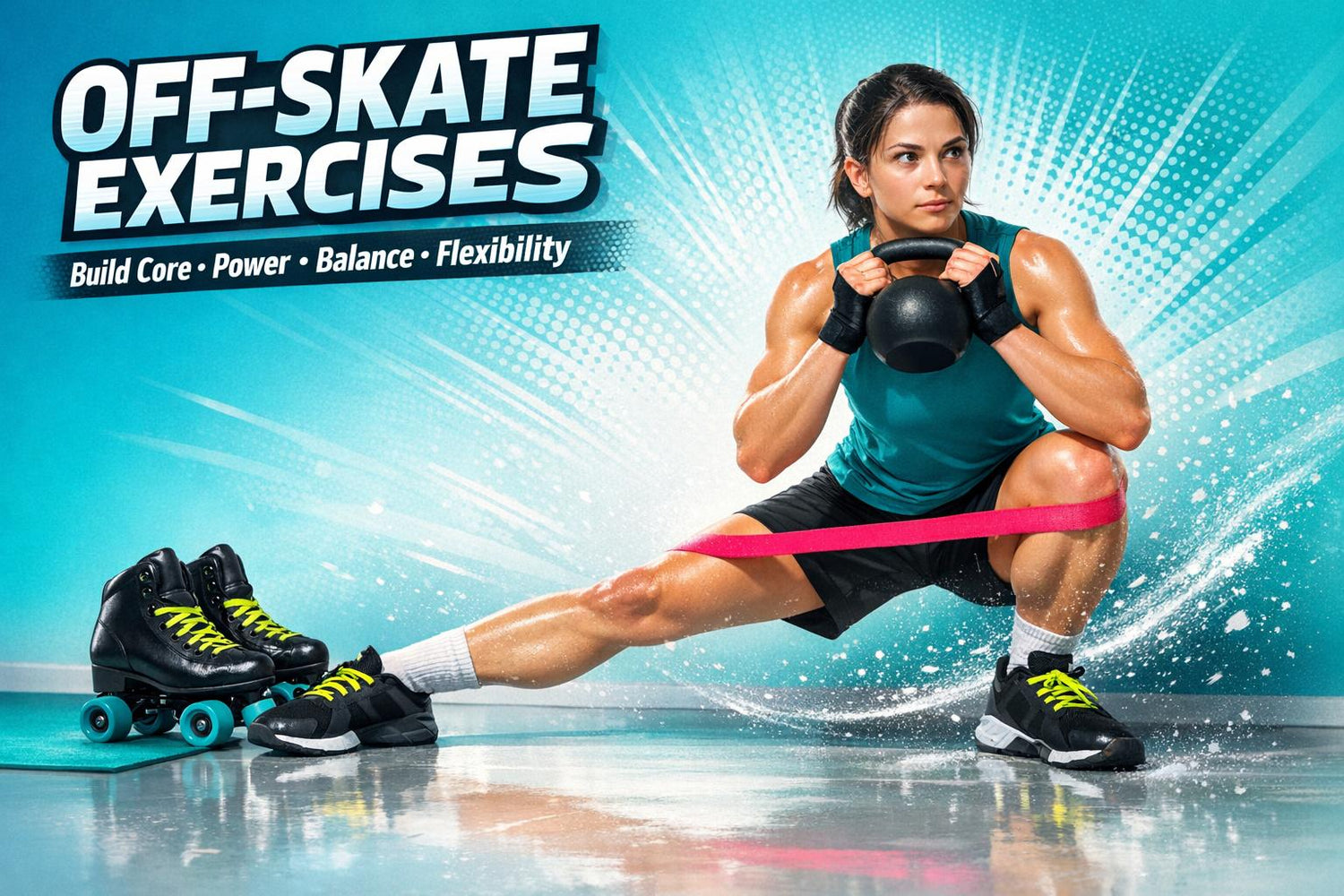
Want to skate better? Start training off your skates. Off-skate exercises build strength, balance, and flexibility - key skills for smoother, faster, and more controlled skating. Think of it as the secret sauce to becoming a stronger skater. Whether you're new or experienced, these exercises can help you level up.
Key Points:
- Core Work: Planks, bird dogs, and dead bugs improve balance and control.
- Leg Strength: Wall sits, lunges, and glute bridges boost power and endurance.
- Balance Drills: One-leg stands and wobble board exercises refine stability.
- Flexibility: Stretching and mobility work reduce injury risk and improve stride.
Pro Tip: Combine these with your skating sessions for maximum results. Consistency matters - start with 2-4 strength sessions and 4 flexibility routines per week. Ready to roll? Let’s dive in!
Off Skates Balance & Agility Workout | Roller Skater Follow-Along Training
Core and Stability Exercises for Skating Control
Having a strong core is like having a solid foundation - it keeps you steady during crossovers, edge holds, and one-foot glides. Even if your footwork is on point, a weak core can throw you off balance, especially on uneven surfaces.
Core Exercises to Build Balance and Control
To strengthen your core for skating, focus on exercises like planks, dead bugs, and bird dogs. These target the deep stabilizing muscles that are key to staying balanced and controlled on the ice.
- Planks: Start by holding a plank for 20–30 seconds, gradually increasing to 60 seconds. This move trains your entire midsection to stay firm, which is crucial when absorbing impact or maintaining a low skating stance.
- Dead Bugs: These help your core stay stable while your arms and legs move independently, mimicking the coordination needed for complex skating footwork.
- Bird Dogs: From a hands-and-knees position, extend one arm and the opposite leg. This exercise builds rotational control, improving your edge work and overall balance.
A strong core doesn’t just help with balance - it also boosts rotation speed, jump power, and stability on one foot.
Once your core is strong, it’s time to focus on hip stability to refine your skating posture.
Hip Stability Exercises for Better Posture
Keeping your hips stable ensures smoother maneuvers and a cleaner posture on the ice. Stable hips are the secret to efficient strides and proper alignment. Two simple but powerful exercises to enhance hip stability are clamshells and glute bridges.
- Clamshells: Lie on your side with your knees bent. Keeping your feet together, rotate your top knee upward like a clamshell opening. This move strengthens the hip abductors, which help stabilize your pelvis during one-foot balances.
- Glute Bridges: Lie on your back with your knees bent and feet flat on the ground. Lift your hips toward the ceiling. This exercise activates your glutes and hamstrings, which are essential for powerful push-offs and maintaining an upright skating posture.
As skating coach Liz Miller explains:
"Good balance means coordination and agility when it really counts, and the ability to sustain the long glides of technically proficient stroking."
Lower Body Strength Drills for Power and Endurance
Lower body strength is the engine behind every strong skating stride. Whether you're gliding on roller skates or carving with Snowfeet* skiskates, these muscles are what drive your performance. Building strength and endurance off the rink translates to better, more explosive strides on wheels - or snow.
Leg-Strengthening Exercises for Skaters
If you're looking to build skating-specific leg strength, focus on wall sits with heel lifts, side lunges, and front-to-back lunges. These exercises target the key muscle groups skaters rely on.
- Wall sits with heel lifts: Hold a wall sit for 30–60 seconds per set, alternating heel lifts. This improves both endurance and stability, which are essential for sustained skating.
-
Side lunges: These strengthen the muscles responsible for side-directed pushes. Inline skating instructor Liz Miller highlights their importance:
"Side lunges directly work the muscles in the side-directed push that defines the best inline stroke technique."
- Front-to-back lunges: Keep moving without pausing, maintain an upright torso, and ensure your front knee stays behind your ankle. This exercise builds endurance for the scissors stance, a key position in intermediate and advanced skating.
Plyometric Drills for Explosive Movement
Once you've built a solid strength base, it's time to add some plyometric drills. These exercises focus on explosive power by loading your muscles on the way down and then releasing that energy quickly during the push-off. This kind of training is perfect for skating, whether you're looking to boost speed, improve edge control, or tackle obstacles.
Trainer Dan Kibler explains it best:
"Power is the measure of not just strength but the ability to apply strength quickly. Muscular power gets you off the starting line quickly, accelerate up the hill, or bound over an unexpected obstacle."
Here are some plyometric drills that skaters can use to build explosive power:
| Exercise | Key Muscles | Skating Benefit |
|---|---|---|
| Plyometric Lunges | Quads, Hamstrings, Glutes | Builds explosive power for sprints and transitions |
| Lateral High Hops | Glutes, Adductors | Enhances power for jumping obstacles |
| Zig-Zag Hops | Full lower body | Improves lateral agility and quick transitions |
| Box Jumps | Quads, Calves, Core | Develops control for landings and impact absorption |
To safely incorporate plyometrics, limit sessions to twice a week with at least 48 hours of rest between. Perform 2–4 sets per exercise, resting 1–2 minutes between sets. Always land with bent knees to absorb impact - this not only protects your joints but also translates to smoother, safer landings on skates.
Balance and Agility Training for Better Maneuverability
Balance and quick footwork are what set skilled skaters apart. Once you've built up lower body strength, it's time to focus on shifting your weight, changing direction, and staying stable without overthinking it. These skills don't just help with roller skating - they're also key for snow-based activities using Snowfeet* equipment, where edge control and quick transitions make all the difference.
Balance Drills for Skaters
A great starting point is the single-leg stand. Stand on one foot for 60 seconds, keeping your head up and core tight. Once you’ve nailed that, make it harder by standing on a plush carpet, then on a pillow, and eventually on a wobble board. Each surface adds a new level of challenge for your stabilizer muscles and inner ear, helping you glide more smoothly on skates.
Pay extra attention to training your non-dominant leg to address any imbalances. You can also work yoga poses like Tree Pose, Dancer’s Pose, and Warrior 3 into your routine. These poses are fantastic for improving hip flexibility and stability - both of which are important for technical skating moves.
"Constantly work on improving your balance, because the coordination you gain is crucial to inline skating." - Liz Miller, Author and Instructor
| Exercise | Level | Primary Benefit |
|---|---|---|
| One-Foot Stand | Beginner | Builds basic stability for gliding |
| Tree Pose | Beginner | Improves hip flexibility and posture |
| Warrior 3 Pose | Intermediate | Strengthens core and horizontal balance |
| Wobble Board Stand | Advanced | Develops ankle strength and coordination |
Once your balance is solid, you can move on to agility drills to fine-tune your footwork.
Agility and Footwork Drills
Agility ladders are a great way to train off-skate footwork. Try lateral shuffles, in-out steps, and single-leg hops to improve foot speed and reflexive balance. This kind of training ensures you can react quickly to unexpected bumps or dodge someone mid-rink. Practice these drills without skates first to perfect your foot placement.
Pair ladder drills with dynamic skater jumps to mimic real skating strides. Push off one foot, land softly on the other, and pause briefly before jumping again. This movement not only mirrors a skating stride but also teaches your body how to absorb impact - a must for staying in control, whether you're on wheels or using Snowfeet* equipment.
To take it up a notch, try cone drills. Set markers about 3 feet apart and combine them with skater jumps to sharpen your lateral agility and smooth out your transitions.
With consistent practice, these balance and agility drills will give you the edge you need for top-notch skating performance.
sbb-itb-17ade95
Flexibility and Mobility for Safer, Smoother Skating
Building on strength and balance, flexibility and mobility are key to improving your skating stride, reducing injuries, and gaining better control on the ice or snow.
Even if your legs are strong and your footwork is sharp, stiff joints and tight hips can hold you back. Without flexibility, your stride becomes shorter, and the risk of injury increases. A targeted flexibility routine can quickly make a difference. Skaters using Snowfeet* often report better edge control and comfort, thanks to improved hip mobility. Unlike traditional ski or snowboard gear, Snowfeet* align well with off-skate training benefits.
"Flexible joints give you increased stroke length, while a regular stretching routine can help prevent joint injuries and reduce muscle soreness." - Liz Miller, Fitness Author and Skating Instructor
Dynamic Warm-Up Movements
Warming up before skating is non-negotiable. Cold muscles are more prone to tears and can’t handle the sudden side-to-side movements that skating demands. A proper warm-up takes just 10 minutes and can prevent a lot of problems.
Here’s a quick routine you can follow:
- Leg Swings: Hold onto something for balance. Swing each leg forward and backward 10–12 times, then side-to-side. This loosens up your hip flexors and hamstrings.
- Hip Circles: Stand with your feet shoulder-width apart, hands on your hips. Rotate your hips in a circular motion for 30 seconds in each direction.
- Trunk Rotations: Extend your arms at shoulder height and twist your torso side to side to warm up your spine.
Liz Miller also suggests Yoga Sun Salutations as an excellent full-body warm-up. This sequence includes forward folds, lunges, and backbends, all of which prepare your body for skating.
After these dynamic movements, move into focused stretching to fully prepare your body for the session ahead.
Stretching and Mobility Routines
Once you’ve warmed up - or immediately after skating - stretching is essential to improve mobility in your hips, hamstrings, and ankles. Stretching not only prevents injuries but also enhances your stride. For the best results, aim to stretch at least four times a week.
Here’s where to focus:
- Hips: Tight hips limit your stride length and posture. Try a low lunge with a hip flexor hold for 30 seconds on each side.
- Hamstrings: A seated hamstring stretch can improve your push-off power.
- Ankles: Perform ankle circles paired with dorsiflexion holds to increase mobility and edge angles, especially useful for Snowfeet* users.
For even better results, try Active Isolated (AI) stretching. Hold each stretch for about 2 seconds, then release and repeat 8–10 times. This method gently increases your range of motion without triggering the muscle’s natural tightening reflex.
Adding Pilates mat exercises to your weekly routine can also help stabilize your spine, pelvis, and hips - essential for smooth glides and tight turns.
Sample Off-Skate Training Routines
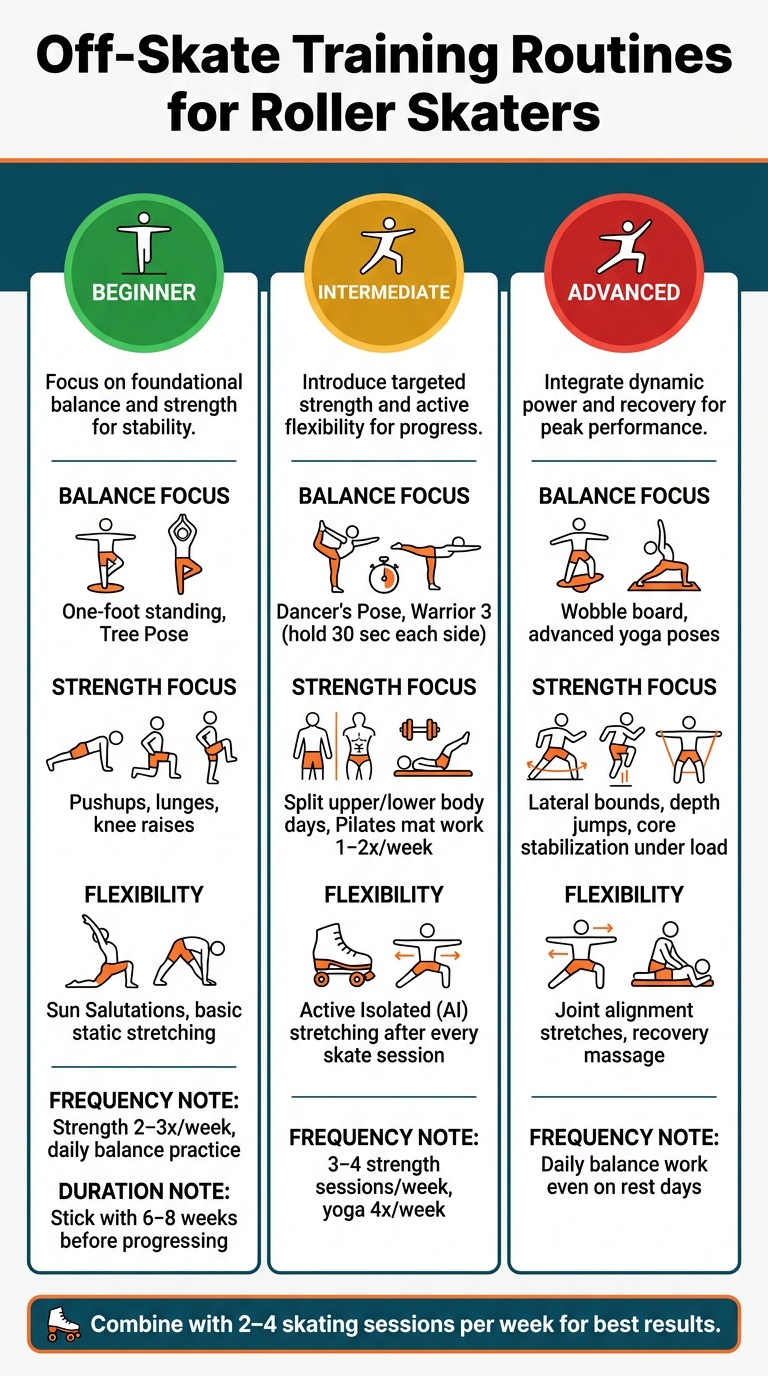
Off-Skate Training Routines: Beginner vs Intermediate vs Advanced
Let’s put those off-skate drills into action with weekly routines! These plans combine core strength, balance, leg power, flexibility, and mental focus - everything we’ve touched on so far. Pick the routine that matches where you’re at right now.
"Supplement your skating with off-skate workouts to become more balanced in every sense of the word." - Liz Miller, Author and Skating Instructor
Beginner Routine
Start with the basics: balance and strength. Practice standing on one leg every day - try doing it while brushing your teeth or cooking. Once that feels steady, step it up by standing on a pillow to add some wobble.
Strength training should happen 2–3 times a week. Focus on simple moves like pushups, lunges, knee raises, and side crunches. Pair this with daily single-leg balance practice. For flexibility, warm up with Yoga Sun Salutations and cool down with basic static stretches. Stick with this routine for at least 6–8 weeks to build a solid base before moving on.
Intermediate Routine
Ready for more? Challenge your balance with single-leg exercises and tougher yoga poses. Start each session in Mountain Pose (stand with feet hip-width apart, evenly distributing your weight). Then move into Dancer’s Pose or Warrior 3, holding each side for at least 30 seconds.
Alternate between upper and lower body strength workouts to allow for recovery, and add Pilates mat work once or twice a week to improve hip and spine control. Your weekly schedule could include 3–4 strength sessions, yoga 4 times a week (which can double as balance and flexibility training), and Active Isolated (AI) stretching after every skate session.
Advanced Routine
If you’ve nailed the intermediate drills, it’s time to ramp things up. Add unstable surfaces like wobble boards or plush carpets to test your balance further. Power-focused lower body exercises - like lateral bounds and depth jumps - should take center stage, alongside core stabilization drills that challenge your body under load. These explosive moves are especially helpful for Snowfeet* users looking to enhance their power and balance.
| Routine Level | Balance Focus | Strength Focus | Flexibility |
|---|---|---|---|
| Beginner | One-foot standing, Tree Pose | Pushups, lunges, knee raises | Sun Salutations, basic stretching |
| Intermediate | Dancer's Pose, Warrior 3 | Split upper/lower body days, Pilates | AI stretching after sessions |
| Advanced | Wobble board, advanced yoga | Lower body power, skeletal stabilization | Joint alignment, recovery massage |
Recovery becomes just as important as training at this stage. Incorporate massage and targeted joint-alignment stretches to reduce soreness and speed up recovery. And don’t skip daily balance work - even on rest days.
Conclusion
Off-skate training is what separates skaters stuck in a rut from those reaching their peak performance. It's the extra step that builds a foundation you simply can't get from skating alone.
Think about it: stronger legs mean more power and endurance, a solid core keeps you steady through every turn, and improved flexibility helps protect your joints and speeds up recovery. Even quick, consistent workouts can lead to noticeable progress over time.
This kind of training isn't just for skating - it also works wonders for Snowfeet* short skis. With strong hips, better balance, and leg strength, you'll find adapting to Snowfeet* much easier than traditional long skis. While long skis often come with a steep learning curve, Snowfeet* reward the agility and core control you've been working on. By combining these off-skate exercises with your skating practice, you're setting yourself up for long-term success.
The secret? Stick with it. Consistency makes all the difference.
FAQs
How long until off-skate training improves my skating?
With just 5–10 minutes of off-skate training each day, you can see progress in your skating skills in just a few weeks. Simple exercises like single-leg stands, weight transfers, and mobility stretches work wonders for improving core stability, balance, and coordination. Sticking with these drills consistently strengthens important muscles and sharpens your control, making a noticeable difference in your skating over time.
What off-skate exercises help the most with crossovers and turns?
To get better at crossovers and turns, focus on exercises that build control, balance, and agility. Start with crossover steps to work on shifting your weight and changing directions smoothly. Incorporate one-leg balance drills and heel-toe manual exercises to boost your stability and strengthen your core. For added precision and agility, try slalom drills or weaving around cones. These moves will help you nail those clean crossovers and sharp turns.
What should I do if these exercises make my knees or ankles hurt?
If you feel pain in your knees or ankles while doing these exercises, stop right away and talk to a healthcare professional. It’s important to avoid worsening any potential injury. Make sure you’re using the correct technique and sticking to an intensity level that works for you. Supportive footwear or safety gear can also make a big difference. You might even consider modifying the exercises to ease the strain on your joints. Pay attention to how your body feels and don’t hesitate to get expert advice - it’s the best way to keep improving your skating safely.











Оставить комментарий
Этот веб-сайт защищается hCaptcha. Применяются Политика конфиденциальности и Условия использования hCaptcha.