



















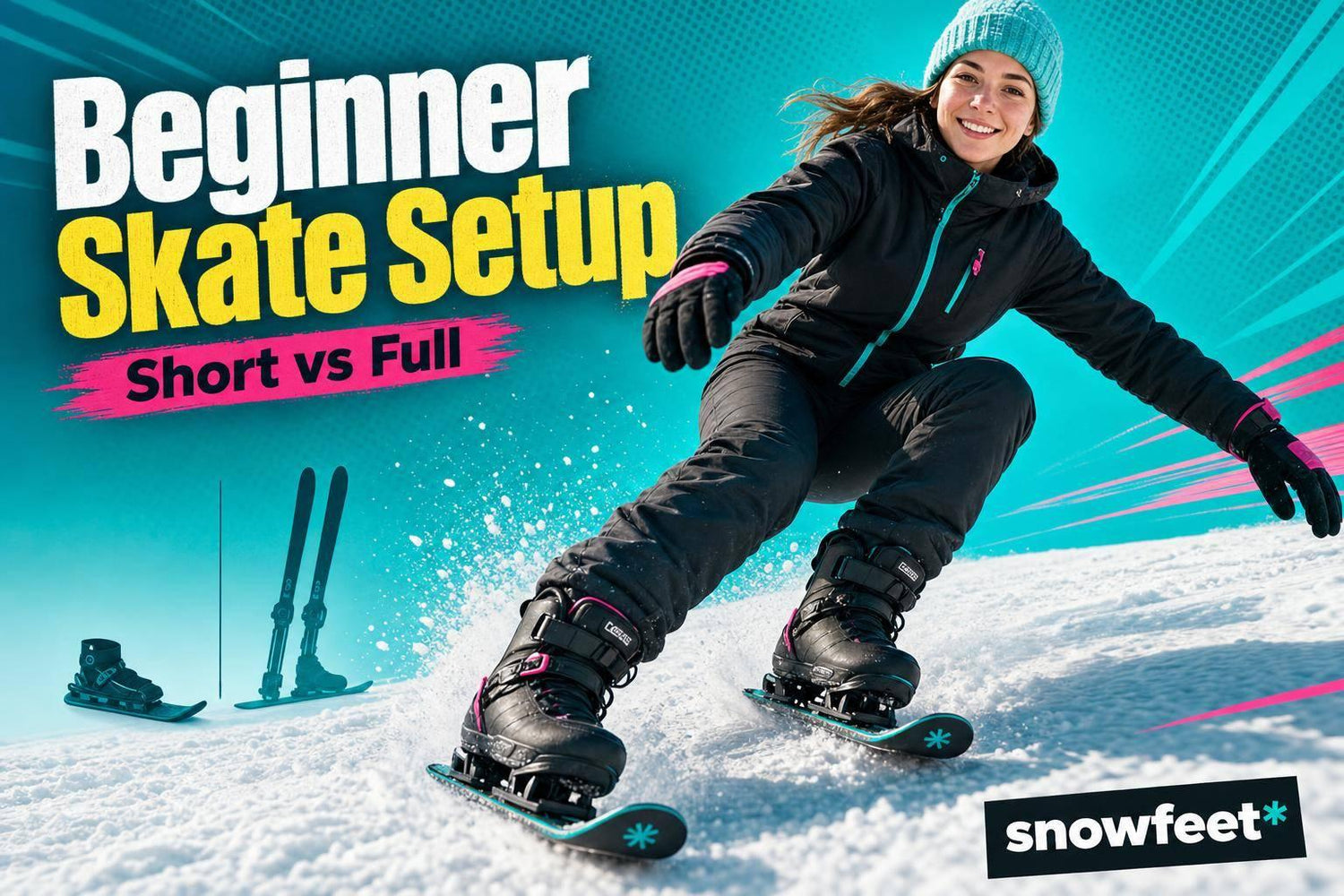
If I were helping a first-time skate-style skier today, Jul 26, 2026, I’d keep it simple: go short, keep costs down, and make balance easier from day one. Most skate skis run about 177–207 cm (70–81 in.), while the short options in this guide sit at 90–100 cm (35–39 in.). That’s a huge gap, and for many beginners, it means less awkward gear, less stress, and more time gliding instead of wrestling the skis.
Here’s the short version:
- Best first pick: Snowfeet* NORDIC 90 cm
- Best for mixed terrain: Snowfeet* WALKSKI 100 cm
- Best for speed and groomed-track focus: full-length skate ski package
- Best for casual sliding on small hills: short skis or snowblades, but not for learning proper skate form
What stood out to me most:
- Short skis are easier to carry, store, and steer
- Using regular winter shoes can cut your day-one cost
- Metal edges help with stopping and control
- Full-length skate skis still win for glide and speed once your form gets better
A standard full setup can get pricey fast, especially once boots are added. By contrast, the short Snowfeet* options land around $490–$499, and some versions let you skip buying special boots at the start. That alone can save a chunk of money.
This Nordic Ski Can Be Attached to Any Winter Shoes | Snowfeet Cross-country Skate Skis | 90 cm
Quick Comparison
| Setup | Best For | Main Upside | Main Tradeoff | Price |
|---|---|---|---|---|
| Snowfeet* NORDIC 90 cm | First-time skiers on groomed or packed snow | Easy to learn on, small, works with winter shoes | Less calm at high speed | $490 |
| Snowfeet* WALKSKI 100 cm | Beginners who want trails plus light backcountry | Works across more snow conditions | Not as fast on groomed trails | $499 |
| Full-length skate ski package | Groomed-trail fitness, club skiing, speed | Best glide and power | Harder learning curve, more gear | Varies |
| Short skis / snowblades | Casual fun on mellow slopes | Easy turns and stops | Don’t teach skate form well | Varies |
So, if you want the easiest on-ramp, I’d start short and simple. If you already know you want speed on groomed trails, then the full-length setup still has its place. The rest comes down to where you’ll ski, what boots you already own, and how much hassle you want on your first few outings. :)
1. Snowfeet* NORDIC Cross-country 90 cm
At 90 cm (35 inches), these skis are very short for Nordic skiing - among the shortest Nordic skis you can get. That short size makes them much easier to handle than standard skate skis. And for a beginner, that matters a lot when you're trying to learn balance and the side-to-side push without feeling like the skis are running the show.
Stability
Short skis are easier to lift, turn, and recover on. That can take some of the stress out of your first few sessions. Metal edges also help with control and stopping on packed snow, which is a nice bonus when things get a little wobbly.
Control
The waxless grip base gives you traction without kick wax, so you can ski right out of the box. If you want more speed later, you can add glide wax. The short length also helps with maneuvering while you're still getting used to skate-style movement.
Boot Comfort
The base binding model fits any standard winter shoe in sizes 6–13 US / 38–47 EU, so you can start with normal winter shoes and skip special boots at first. That's a big plus if you don't want to spend a pile of cash on day one.
If you decide to move into dedicated cross-country gear later, the Pro XC version uses Rottefella NNN bindings. Users also report a fast learning curve and say these are easier to handle than longer XC skis.
Portability
At 90 cm, they're easy to carry and easy to pack. Toss them in the car, head to a local trail, and you're set. For day trips, that's pretty hard to beat.
Value
At $490, the price is far below a standard ski touring setup, which can cost about $2,200. And since you can use normal shoes, your starting cost stays lower too.
For beginners who want a slightly longer, more touring-focused option, the 100 cm WALKSKI comes next.
2. Snowfeet* WALKSKI Backcountry Touring 100 cm
At 100 cm (39 inches), the WALKSKI is a bit longer than the NORDIC 90 cm, but it still feels short and easy to manage. That extra length opens up more terrain for beginners who want one setup for both trails and light backcountry use. Think packed trails, light powder, and uphill climbs. For a first-time skier, that means more room to roam without feeling like the skis are running the show.
Stability
The WALKSKI stays short and manageable underfoot, which helps keep balance, glide, and side-to-side control within reach while you're still learning. Longer skis still do better at higher-speed stability and long, steady glide, but the WALKSKI feels less intimidating when you're new to the sport.
Control
The WALKSKI comes with climbing skins for uphill traction, and its 4-position free-heel binding helps on both climbs and descents. So, if you're heading over mixed terrain, you get a simple setup that can handle a bit of everything without jumping straight into a more specialized kit.
Boot Comfort
Its free-heel binding works with winter boots, hiking boots, or snowboard boots, so beginners can skip dedicated XC boots. That's a big deal. It cuts out one of the main entry barriers for people who aren't ready to spend more money on special footwear before they know they'll stick with skiing.
Portability
At 100 cm, it's easy to strap to a pack or toss in the car. No drama, no awkward roof-rack puzzle. That makes it handy for short trips or remote trail starts.
Value
At $499, the WALKSKI sits well below the cost of a full touring setup and also avoids the added cost of special boots. For beginners, that makes it a strong step-up pick before moving on to full skate gear.
If you want a more standard skate-ski path, the next option is a standard entry-level package.
3. Entry-Level Skate Ski Package (skate skis + skate boots + NNN/Prolink bindings)
A standard skate ski package comes with full-length skis, NNN or Prolink bindings, and skate-specific boots. It’s the usual path into skate skiing, but for a first-timer, it can feel like jumping into the deep end. You can learn on it, of course. But it asks more from your balance, timing, and side-to-side push right out of the gate.
Stability
Traditional skate skis are usually 170–190 cm long. Once your technique starts to click, that length can feel smooth and steady. In the first few sessions, though, longer skis are often tougher to handle.
Control
These skis are made for groomed trails and usually don’t have metal edges. So, stopping and turning take more practice. Snowfeet* NORDIC 90 cm gives beginners more grip and easier braking, which can make those early outings feel less sketchy.
Boot Comfort
NNN and Prolink bindings need dedicated skate boots. That means a higher first-time cost and one more piece of gear to figure out. If you’re new, that’s not nothing.
Portability
Full-length skate skis are more awkward to pack, store, and carry than 90–100 cm short skis. If you’ve ever tried fitting long skis into a small car, you know the drill.
Value
For many beginners, the big drawback is the total upfront cost: full-length skis, plus stiff, specialized boots and bindings. Snowfeet* NORDIC lowers that entry cost by working with regular winter shoes at $490.
Next, compare the short skis and snowblades that sit between classic skate gear and the easiest beginner setups.
sbb-itb-17ade95
4. Other Short Skis and Snowblades (Bigfoot, Figl, Salomon snowblades, ODR snow skates)
If you want something shorter and more playful than a full skate package, this group sits right in that middle zone. Bigfoot, Figl, Salomon Snowblades, and ODR-style snow skates are short recreational skis. They are not true skate-ski tools.
What are they built for? Fun, easy sliding. Quick turns. Easy stops. That’s the appeal.
They’re often easier for casual use than Nordic gear, but they don’t teach skate technique as cleanly as Nordic-style short skis. So if your goal is to mess around on a small hill, they can be a blast. If your goal is to learn a proper skate stride on groomed trails, they start to work against you.
Stability
On mellow slopes, these skis usually feel stable underfoot. They also help cut down on tip-crossing, which is nice when you’re new and your legs still feel a bit all over the place.
On flat or rolling cross-country terrain, though, the story changes. Their sidecut is made to start turns fast, not to track straight. That makes them fun for casual sliding, but less precise for learning a real skate stride.
Control
These skis turn and stop with little effort on small hills. That part feels friendly right away.
But on groomed Nordic trails, their shape gets in the way of smooth glide. They don’t track as cleanly during a skate stride, and the side-to-side push feels less natural. In plain English: they want to turn when you’re trying to glide.
Boot Comfort
Boot setup depends on the product, and this part matters more than people think.
- Many classic snowblades need alpine ski boots, which are stiff and heavy
- ODR-style snow skates can work with boots you already own, like snowboard boots or insulated winter boots
- Softer boots feel better for casual use, but they give up edge control on steeper terrain
So, yes, some setups save money up front. But comfort and control can pull in opposite directions here.
Portability
Most of these short skis fit in a car trunk or gear bag with no drama. That’s a big plus.
If the setup needs alpine boots, though, that easy portability takes a hit. The skis stay small, but the boots still feel like you packed bricks.
Value
Prices vary a lot by brand and by whether bindings come with the ski. But for first-time skate-style skiers, price isn’t the only thing to watch.
The bigger question is: how fast does the gear help you learn balance and glide?
These skis tend to teach a turning-first sliding style, not true skate technique. On groomed Nordic trails, that can slow your progress. For beginners who want skate-style learning on groomed trails, Snowfeet* NORDIC 90 cm is the more direct fit: short, made for cross-country movement, and usable with regular winter shoes.
That’s the main difference. These short skis are fun little toys for turning and sliding, while the two Snowfeet* setups are built more directly for beginner cross-country use.
Side-by-Side Comparison: Stability, Control, Boot Comfort, Portability, and Value
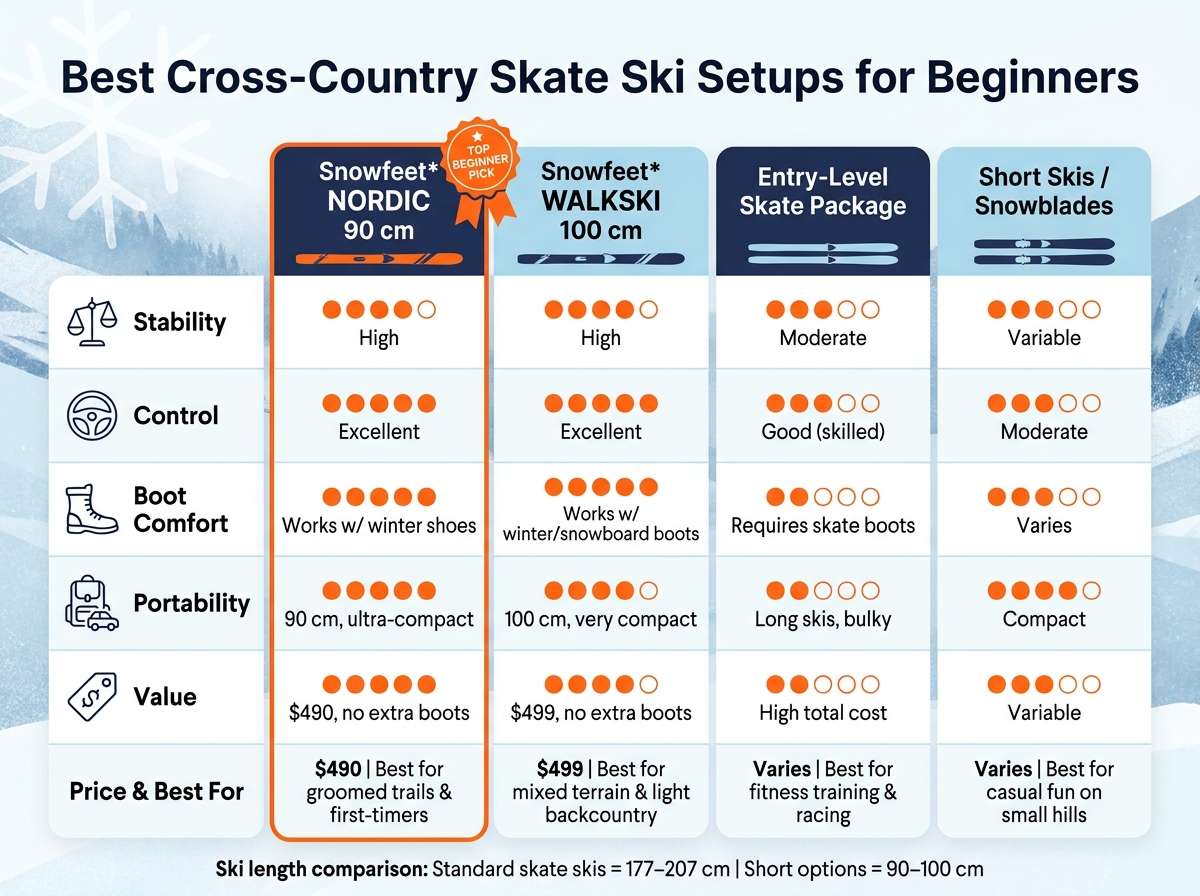
Best Cross-Country Skate Ski Setups for Beginners: Side-by-Side Comparison
After looking at each setup on its own, this is the fast read.
For beginners, the pattern is pretty clear: shorter setups are easier to balance, steer, and carry. That’s why the 90–100 cm options stand out for first-time skiers. If you want to learn fast without buying a pile of gear, Snowfeet has the edge.
Here’s how the four setups compare across the five things that matter most on day one:
| Criterion | Snowfeet* NORDIC 90 cm | Snowfeet* WALKSKI 100 cm | Entry-Level Skate Package | Short Skis / Snowblades |
|---|---|---|---|---|
| Stability | High - easy to stay centered | High - a bit more planted for casual touring | Moderate - fast and efficient, but harder to learn | Variable - compact, depends on the binding and boot setup |
| Control | Excellent - metal edges help with stopping and steering | Excellent - responsive and versatile | Good once skilled - better edging as technique improves | Moderate to high - maneuverable, but not always purpose-built for skate-style learning |
| Boot Comfort | High - works with familiar winter shoes | High - works with winter shoes or snowboard boots | Low - requires dedicated skate boots | Varies - depends on the binding and boot setup |
| Portability | Excellent - 90 cm is easy to carry and store | Excellent - 100 cm is still very compact | Poor - long skis are harder to transport and store | Good - compact, but setup details vary |
| Value | High - no separate boot purchase if you already own compatible shoes | High - lower total entry cost if you reuse familiar boots | Moderate to low - skis, bindings, and boots add up | Variable - fun and portable, but not always the best value for skate learning |
The table tells most of the story. The big split comes down to how much skill, gear, and cost each setup asks from you right away.
Boot fit is the main cost divider. Snowfeet works with footwear many people already own, while a standard skate package needs dedicated boots. That alone can change the whole math.
The short length helps in other ways too. It’s easier to toss in the car, easier to store in a small apartment, and a lot less awkward to carry to the snow. For a beginner, that matters more than people think. If gear is a hassle, it tends to sit in a closet.
Dedicated skate boots do help with power transfer. No doubt there. But most first-time skiers will have an easier start with the comfort, simple setup, and easy handling of short Snowfeet options. For most beginners, the best pick is the one that cuts the hassle and gets them out skiing more often.
Pros, Cons, and Best Picks for Common Beginner Situations
Each setup works best for a different kind of beginner. Some are better for mellow trail laps. Some make more sense for light touring. And some are built for people who want speed and fitness work. So let’s keep it simple and honest.
| Setup | Pros | Cons |
|---|---|---|
| Snowfeet* NORDIC 90 cm | Ultra-portable; works with regular winter shoes; metal edges for control; waxless fishscale base | Less stable at higher speeds; not built for racing |
| Snowfeet* WALKSKI 100 cm | Includes climbing skins; free-heel binding; works with snowboard boots; handles ungroomed terrain | Slower on groomed tracks than dedicated XC skis |
| Entry-Level Skate Package | Best glide and speed; ideal for fitness training and club skiing | Requires specific NNN/Prolink boots; bulky to transport; steeper learning curve |
| Short Skis / Snowblades | Maneuverable and fun; compact; easier to carry | Not optimized for XC tracks |
For groomed local trails and short learning sessions, Snowfeet* NORDIC is the easiest place to start. It keeps things low-stress. You can get out there, move around, and learn the basics without hauling a bunch of gear.
Snowfeet* WALKSKI makes more sense for light backcountry terrain than groomed-track use. If your idea of fun is leaving the tidy trail and poking around in softer, less set-up snow, that’s the better fit.
Traditional long skate skis still have their lane. They’re best for fitness training, club skiing, and racing. If you want glide, speed, and that full cross-country feel, that setup still wins.
So, the pick comes down to where you’ll ski most often. That’s the whole game.
| Situation | Primary Pick | Secondary Pick |
|---|---|---|
| Groomed local trails | Snowfeet* NORDIC 90 cm | Entry-Level Skate Package |
| Short after-work outings | Snowfeet* NORDIC 90 cm | Snowfeet* Skiblades 99 cm |
| Travel-friendly gear | Snowfeet* NORDIC 90 cm | Snowfeet* WALKSKI 100 cm |
| Reusing familiar boots | Snowfeet* NORDIC (Winter Shoe version) | Snowfeet* WALKSKI 100 cm |
| Light backcountry touring | Snowfeet* WALKSKI 100 cm | Snowfeet* NORDIC 90 cm |
| Fitness training / racing | Traditional Skate Ski Package | - |
Conclusion
For first-time skate-style skiers, the Snowfeet* NORDIC 90 cm is the easiest way in. It keeps the learning curve low while you work on balance and that side-to-side push. For stability, comfort, portability, and value, it stands out as the top beginner pick. At $490, it works with regular winter shoes and is easy to carry and store.
If you plan to ski beyond groomed local trails, the next step is the WALKSKI 100 cm. If you split your time between packed trails and light backcountry, the Snowfeet* WALKSKI Backcountry Touring 100 cm gives you the best beginner mix of control and flexibility. Its climbing skins and universal bindings make it the top Snowfeet choice for varied terrain.
A traditional skate package makes sense for skiers who already know they want groomed-trail speed and are fine trading simplicity for performance. You get that classic speed and glide, but you’ll also need more gear and a bit more patience on day one.
Here’s the fastest way to choose:
| Your Priority | Best Pick |
|---|---|
| Lowest upfront cost + easiest learning curve | Snowfeet* NORDIC 90 cm |
| Mixed terrain + extra flexibility | Snowfeet* WALKSKI 100 cm |
| Race-style technique on groomed trails | Traditional Skate Ski Package |
Pick the gear that feels natural from your first stride. Then build from there.
FAQs
Can I really learn skate skiing on short skis?
Yes - you can learn skate skiing on short skis like the Snowfeet* NORDIC 90 cm.
Their short length, about 35 inches / 90 cm, makes them easier to control at low speeds. That means turns feel simpler, and shifting your weight from side to side is often less of a hassle.
They also feel less intimidating than full-length skate skis. For a lot of beginners, that can make a big difference on day one. Many people can pick up the basic movement in a single day.
The downside? You give up some glide and top-end speed, especially on long, flat sections.
Do I need special boots to start?
No. One of the biggest pluses of Snowfeet NORDIC skis is how flexible they are: with the right binding setup, you can use the waterproof winter boots or snowboard boots you already own.
That means you can skip the extra cost of buying separate cross-country ski boots. If you're just getting started, go with winter boots that have firm ankle support for better balance and control.
When should I switch to full-length skate skis?
Switching to full-length skate skis starts to make sense when you go from casual laps to serious fitness training, more speed, or longer sessions on groomed tracks.
Snowfeet NORDIC 90 cm is easier for beginners. It gives you better control, it’s easy to carry, and the learning curve feels much less steep. If you start caring more about speed and distance than convenience and agility, full-length skis are the next move.











Оставить комментарий
Этот веб-сайт защищается hCaptcha. Применяются Политика конфиденциальности и Условия использования hCaptcha.